
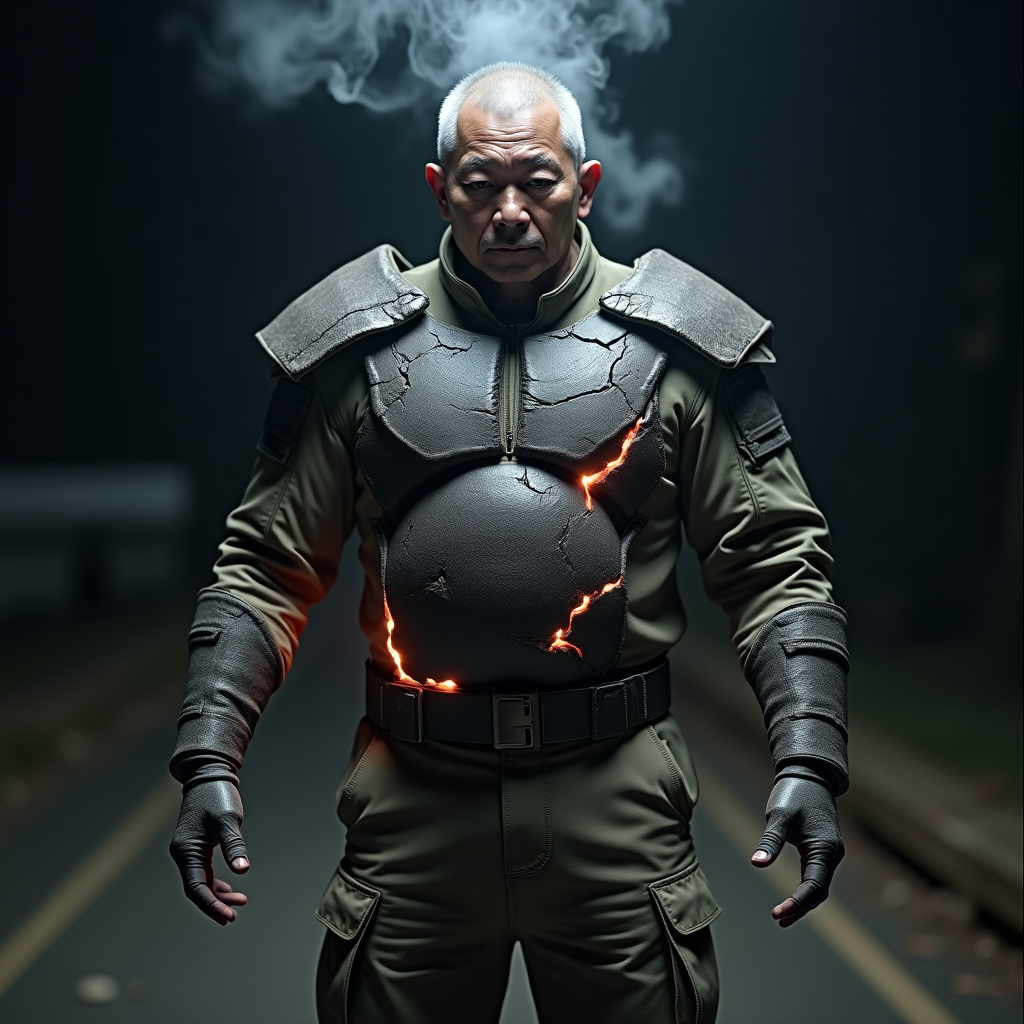


Ashgate of Nixon Road
Part One: The Inheritance Nobody Claimed
The Nixon Nitration Works explosion of 1924 killed forty-one men and left the soil of Nixon Road saturated with compounds that no official remediation ever fully resolved. The county sealed the records in 1961. The brownfield sat for decades, accruing chain-link and silence, while the rest of Edison Township grew up around it — the mall, the sari shops, the office parks, the quiet suburban streets named after things people had already forgotten.
Dara Ashgate never forgot.
She grew up hearing the story at her grandmother’s kitchen table in the Menlo Park section of Edison, three blocks from the commerce park that now squats on the bones of what her great-grandfather Ezekiel helped build and nearly died inside. Ezekiel Ashgate had been a groundskeeper at the Nitration Works — one of the few Black workers on the site, hired for outside maintenance, not permitted inside the processing buildings. Which is the only reason he survived the blast. He was forty meters away when the primary detonation went off, near a fertilizer loading dock, and the pressure wave that hit him was not the fire but the shockwave: a wall of compressed air and chemical particulate that knocked him flat and left him bleeding from the ears and unable to speak clearly for six weeks.
He recovered. Mostly.
What the official reports never catalogued — because nobody was measuring what happened to Ezekiel Ashgate, only to the buildings — was the slow change in his cellular density in the years following. The way his skin gradually took on a faint grey cast, like soot worked deep into the grain of wood. The way he never got cold, not once, in the remaining forty years of his life. The way his hands, when he pressed them flat against the ground, could feel the pressure in buried pipes the way other men felt a handshake. He called it a sensitivity. He never called it a gift.
He passed it to his daughter. She passed it to hers.
Dara Ashgate, thirty-eight years old, a Columbia-trained environmental consultant with a razor-sharp CV and a controlled bearing that she has cultivated since childhood like a second skin, has known since adolescence that the inheritance is in her. She spent her twenties pretending it wasn’t. She spent her early thirties learning exactly what it was — studying chemistry, industrial toxicology, soil science, the specific composition of post-blast chemical residue in legacy brownfield sites — not to understand herself but to understand what was done to her family. What was done to the soil. What was being done, still, every year, by developers and county administrators who had no interest in what sat beneath the ground they were selling.
She founded Vantablack Infrastructure Solutions at thirty-four. The name was a private joke. True vantablack absorbs all light. So does a ledger full of liabilities that nobody wants to read.
By the spring of 2026, Vantablack holds options on eleven degraded industrial parcels across Central Jersey. Six of them are in Edison, clustered along Oak Tree Road’s commercial corridor and the aging commerce park on Nixon Road itself. Dara has been acquiring them quietly, at distressed prices, with plans she has filed with no county office and shared with no partner. The plans are not for luxury condominiums or mixed-use retail. They are for a drainage remediation network, funded privately, that would restructure Edison’s six worst flood chokepoints and restore subsurface permeability across the entire commercial corridor.
She has read every report Yoon-Sik Chae filed with the Middlesex County Office of Water Resource Management. She has read all fifteen years of them. She agrees with every conclusion.
She simply does not believe the county will ever act on them.
Part Two: The Chemistry of Acceleration
The plan was never elegant. Dara is honest with herself about that.
She needed the parcels at distressed prices. For them to be distressed, they needed to flood — specifically, they needed to flood worse than their neighbors. The compound she developed over eighteen months of private laboratory work is a slow-acting clay hardener: introduced into the soil at three of Edison’s six major drainage chokepoints, it reduces soil permeability, ensures that the next significant storm event backs water up precisely into the commercial properties she is targeting, and does so without leaving a chemical signature that any standard county environmental screen would flag.
She does not think of it as poisoning the ground. She has thought about it carefully, and she does not reach that word. The compound degrades within eighteen months with no lasting effect. The flooding it induces is calibrated — nuisance-level for the commercial properties, not catastrophic for the residential streets. She has run the models forty times. She knows where the water goes.
She is not doing this for profit. She needs the money the distressed-price acquisitions save her to fund the actual remediation. She has gone over the numbers until her eyes blur. There is no version of this project that works if she pays full market price for six contaminated commercial parcels on a corridor that the county has systematically undervalued and over-ignored for thirty years.
She tells herself this on the April night she introduces the first batch of compound into the soil junction beneath the Middlesex Avenue culvert, moving in the dark with the quiet confidence of someone who has done this twice before. She tells herself this while her fingers read the pressure of buried pipe joints the way Ezekiel always could — better now, because she has trained the sensitivity where he only endured it.
What she does not tell herself, on this particular night, is what she knows but has learned not to examine: that the transformation accelerating in her body is not going to stop at useful. That the grey cast in her skin has deepened to something architectural. That the pressure she can compress and direct through her palms has grown, in the past year, from a sensitivity into a force. That the chemical compounds she synthesizes are becoming more precise and more potent with every passing month, as if the inheritance is not merely genetic but cumulative — as if the blast residue in her family’s cellular line has been waiting, across a century and four generations, for someone who finally understood what it was for.
The April storm arrives three days later, and it is not a nuisance flood.
It is the worst event in Edison’s recorded history.
Dara watches it from the Nixon Road commerce park, standing in the rain with her tablet showing the gauge readings, and she feels — for the first time since she started this — the specific weight of having made a calculation that was wrong.
Part Three: The Ashen Reckoning
The transformation completes itself on the night Raritan Tideborn finds her.
It has been building for weeks. Since the April flood. Since she stood in the rain at Nixon Road and felt the water moving in ways her models had not predicted — felt something moving with it, something older than the concrete, older than the commerce park, older than the 1924 explosion and the ground it poisoned. The ghost ecology of the Raritan estuary waking up beneath a century of asphalt. She recognized it the way you recognize a language you were never taught but have always heard.
It recognized her differently.
What the estuary felt in the soil of Nixon Road was not the slow tidal patience it found in Yoon-Sik Chae. It was the compressed, scorched record of the explosion itself — a century of industrial violence locked into the cellular inheritance of a woman who had spent her adult life trying to undo it. The ghost ecology does not choose sides. It reads what is there.
What is there, in Dara Ashgate, is a fault.
The transformation is rapid and total. Over three days in late April, the grey cast in her skin hardens from pigment into material — compressed ash and industrial slag reforming her body’s surface into packed soot-dark chitin, dense and heat-resistant, each plate fitting against its neighbor with the precision of a pressure vessel’s seam. Her eyes lose their warmth and take on the flat amber of cooling furnace glass. The chemistry she has always been able to synthesize — the compounds she developed in her laboratory, the plant-derived toxins she identified in her fieldwork — migrates from deliberate craft into involuntary production: alkaloids and sedatives and contact toxins blooming between her knuckles without effort, caught from the botanicals of the world around her, sharpened into something her conscious mind only partially controls.
And the light goes.
It goes first at Nixon Road, in a twenty-meter radius around where she stands. Then it goes further. Streetlamps on New Oak Tree Road blink out one after another as she walks, as if something is pulling the photons out of the air itself. Neon signs in the windows of the spice shops die. The glow of Menlo Park Mall collapses into a spreading disc of perfect black. In the darkness, her other senses open fully — she feels the fault lines running beneath Edison’s commercial corridor with absolute clarity, the stress fractures in the bedrock where decades of development have strained the Raritan Valley’s geology past its tolerance. She reads them like a map written specifically for her.
She understands, in this moment, that the inheritance has finished arriving.
She is not Dara Ashgate the environmental consultant anymore. She is the condensed record of what Nixon Road did to one family across a hundred years, walking upright through the town that never answered for it.
She calls herself Ashgate of Nixon Road.
It is not a name she chose for power. It is a name that is simply true.
Part Four: What Raritan Tideborn Doesn’t Understand
Yoon-Sik Chae finds her on a Tuesday morning in late April, standing at the edge of the Nixon Road commerce park where she has spent the night reading the fracture lines in the bedrock below through the soles of her feet.
She knew he was coming. She felt the salinity shift in the groundwater two hundred meters out — the tidal memory of the estuary moving through the drainage channels with something that was not rain. She has read his reports, all thirty-one pages of the new one he filed before dawn, preserved on the hood of the county vehicle. She found a copy through channels she will not explain.
He is every drainage report he ever filed, made physical — his field jacket restructured into layered basalt and salt-bleached driftwood, steam rising from the joints, silver salinity lines tracing across his chest like the ghost channels of the Raritan made visible. He is sixty-three and precise and furious in the way of someone who has been right for fifteen years and knows it.
She does not move when he crosses the lot.
“I found the hardener compound in the soil,” he says. His voice is quiet. His conclusions are not. “Three of the six chokepoints. I’ve preserved evidence. The county will have it by morning.”
“Good,” Dara says.
He stops.
“The compound degrades in eighteen months,” she continues. “I have the chemical profile if anyone needs it. I also have the full remediation plan for all six sites — subsurface drainage restructuring, restored permeability across the corridor, privately funded. I needed the parcels at distressed prices to make the numbers work. The flooding was the instrument. I know what that sounds like.”
“It sounds like you flooded Linwood Avenue,” Yoon-Sik says.
“The residential exposure was within my models,” she says. “The April storm was not in my models.”
“No,” he says. “It wasn’t.”
The silence between them is not comfortable. She does not try to make it comfortable. She knows the difference between an explanation and an absolution, and she is not asking for absolution.
What she is asking for — though she will not frame it as asking — is for someone with thirty years of hydrological field experience and a transformed relationship with the Raritan estuary’s ghost channels to understand the architecture of what she built before dismantling it. Because Yoon-Sik Chae, for all that the estuary chose him as its instrument, is still operating within county structures. Filing reports. Trusting institutions that have failed these streets for thirty years.
Dara Ashgate watched her grandmother spend forty years waiting for the county to remediate Nixon Road.
She is not filing any more reports.
Part Five: The Fault That Runs Both Ways
The confrontation at Nixon Road is not a battle. It is a argument conducted in geological and chemical terms, and neither of them wins it cleanly.
Yoon-Sik moves first — not to strike but to open, flash-vaporizing the chemical hardener from two of the three compromised soil junctions in precise forge-temperature bursts, restoring permeability, undoing the months of careful placement with a precision that is, Dara admits internally, impressive. The ghost drainage channels beneath Edison’s commercial corridor shift and breathe.
Her land acquisition timeline collapses with it.
She does not try to stop him. She could — the pressure she can direct through her palms is structural and devastating, and she has already tested it against loading-bay walls, against reinforced concrete, against storm drain junctions. She does not use it on a sixty-three-year-old Korean American hydrological engineer who has been right about Edison’s drainage infrastructure since before she had her graduate degree.
What she does instead is walk Oak Tree Road.
She walks it from the Nixon Road junction all the way to the Menlo Park Mall parking deck, in the grey pre-dawn, moving through the spice market corridors as they open for the morning. Cardamom and turmeric catch on her skin and become something new between her knuckles — a sedative compound, invisible, drifting through the air behind her. The lights die in her wake: streetlamps, neon, the parking deck’s fluorescent wash, the glow of storefronts. Every photon in a spreading radius simply stops. The drainage channels beneath the pavement sing with stress fracture information that she reads like Braille, her fingertips registering the precise location of every cracked pipe joint and compacted clay seam beneath thirty years of commercial overlay.
She is making a record. A complete survey. More precise than anything the county has ever produced.
She leaves it on Yoon-Sik’s car in the form of a hand-drawn subsurface map — every fault, every fracture, every drainage failure from Middlesex Avenue to Parsonage Road — rendered in the dark on drafting paper with a precision that should not be possible without instrumentation.
Beneath it, one line: The parcels are still available. The remediation plan still works. The county still won’t fund it.
Yoon-Sik Chae stands in the Nixon Road lot as the sun comes up, the county evidence preserved, the drainage system partially restored, the map in his hands. The Middlesex County Emergency Management Authority is twenty minutes out. He has thirty-one pages of report on the hood of his vehicle.
He looks at the map for a long time.
He does not add it to the report he filed.
He does not throw it away either.
Dara Ashgate is already gone — back into the commercial grid of Edison Township, moving through the dark she carries with her, reading the fractures in the bedrock with her fingertips, synthesizing compounds from the spice-air of Little India, feeling the stress of every buried fault line beneath the Raritan Valley’s overdeveloped surface. She is wrong about the method. She has always known she is wrong about the method.
She has never found a right one that worked.
The Nixon Nitration Works exploded in 1924 and nobody answered for it. The soil was poisoned and the records were sealed and a groundskeeper named Ezekiel Ashgate walked home with his ears bleeding and a sensitivity in his hands that his family has carried for a hundred years. Edison Township renamed itself after a genius who lit up the world. The drainage channels still fail. The reports still go unread.
Ashgate of Nixon Road walks the fault lines of this town in perfect darkness, and she is not finished.
She is only just beginning to understand what she was made for.