


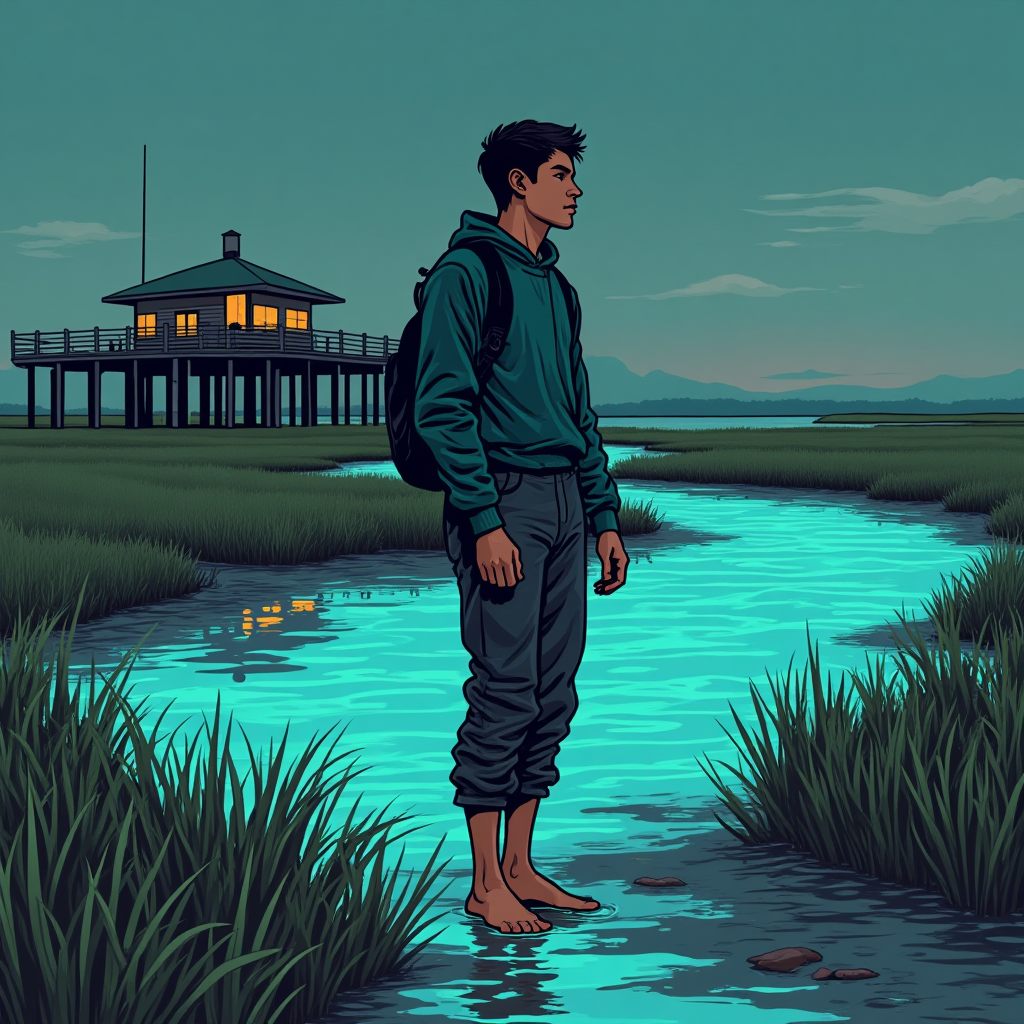
Ashwater
Part One: The Weight of Water Memory
The Toms River has never forgotten anything.
That is what Nolan Swiftwater understands before he understands anything else — before the power, before the bioluminescence, before the cold channel of the bay opens itself into him like a door blown off its hinges. He knows it academically first: in the research notes he carries in a battered field notebook, in the citations from his thesis on pre-colonial hydrology, in the grant paperwork from the Matawan Institute for Indigenous Environmental Studies that brought him to Ocean County in the first place. He knows that this river was called Tomʼs River by colonists and something older, something without a European spelling, by the Lenape who built their fish weirs in its shallows for centuries before the Dutch arrived with their compasses and their deeds.
Nolan is twenty-two years old. He is Lenape by descent — his family among the thousands scattered from this exact watershed over three centuries of displacement, converted from a people of a specific place into a people of everywhere and nowhere. He grew up in western Pennsylvania, which was also not his people’s land. He went to Rutgers on a scholarship and wrote a thesis that his advisor called incendiary and his committee called technically rigorous, which meant they couldn’t fail it and couldn’t quite approve of it. The thesis argued that the entire drainage architecture of the Toms River estuary was a colonial document — that every levee, every filled marsh, every culverted creek was a material inscription of dispossession as legible as any treaty.
He came to Toms River to prove it. He is standing at the edge of the deep channel beneath the Route 549 bridge on a Tuesday night in April with his boots off and his bare feet in the current, taking sediment readings with borrowed equipment, when the river decides that knowing is no longer enough.
Part Two: Called From Depth
The channel beneath the Route 549 bridge is not a place people linger. The bridge hums with the weight of Route 9 traffic above; the water beneath it is dark and fast-moving, cold even in April, smelling of salt and the faint petrochemical residue that no amount of environmental enforcement has ever fully cleared from this corridor. Nolan has been here four nights in a row. He knows the smell. He has documented it in three separate sample bottles that are now sitting in a cooler in the back of his used Subaru.
He is crouching at the water’s edge, the current tugging at his ankles, when the pull begins.
Not a current. Not drag. Something purposive — a draw that comes from below the water, from the deep channel where the river meets the tidal influence of the bay, where the salinity gradient shifts and the sediment layer thickens to decades of accumulated record. He feels it in his sternum first, then in the soles of his feet, then everywhere at once: a cold, vast, total invitation.
He does not pull back. This is important. This is the thing about Nolan Swiftwater that will define everything that follows: when the river calls, he answers. He goes forward. He goes down.
The water closes over him and he does not drown. He is held.
What fills him is not power, not at first. It is memory — the river’s, not his own. He sees the fish weirs woven from river cane, the seasonal encampments along the high ground above the flood plain, the intricate network of channels and marshes that made this estuary one of the most biologically productive systems on the eastern seaboard. He sees it all removed, layer by layer: the Dutch drainage cuts, the English land grants, the industrial century, the suburban build-out, the post-Sandy levee reinforcement that locked the shoreline into its current form like a sentence with a period at the end.
He surfaces twelve minutes later. The water follows him — not all of it, but a column, a sleeve of river that rises with his arm and holds its shape for a long, impossible moment before he lets it fall.
He stands in the current, shaking, and understands that he has been given something he did not ask for and cannot refuse.
Part Three: Ashwater
He names himself carefully, the way he names everything: with attention to what the words actually mean. Ash for the color of the river in winter, for the industrial residue that colors the sediment cores, for the grey of a world burned and left behind. Water for what remains. What persists. What remembers.
Ashwater.
He does not make a costume. He wears what he wears: worn field pants, a dark thermal layer, the same waterproof jacket he uses for fieldwork. His power needs no theater. When he calls water from depth, the columns rise in silence — dark and heavy and geometrically precise, not the chaotic surge of a burst main but the deliberate movement of something that knows where it is going. He can feel every body of water within half a mile as a pressure in his chest, a spatial map of weight and movement. He can draw groundwater upward through packed earth, redirect subsurface flow, raise the water table in a localized area with a slow, irresistible patience that resembles nothing so much as an argument you cannot win because it does not raise its voice.
In the first week, he tests the limits quietly. He stands on the bank of the Toms River at dawn and calls up the shape of a fish weir — a ghost-form of water, holding the geometry of something that hasn’t existed here in two hundred years — and watches it hold for four minutes before the current takes it. He finds the old channel beneath Cattus Island, the one that was partially filled in the 1960s to enable marina development, and coaxes it briefly awake: a shimmer of moving water through soil that has not felt it in sixty years.
He is not performing. He is researching. He is documenting, in the most literal possible way, what is still here. What was never truly erased. Only buried.
His plan comes to him not as inspiration but as logic. He has the data — years of it, in notebooks and sample bottles and a thesis that was technically rigorous enough to survive a hostile committee. He has the power now to act on that data. The estuary’s pre-colonial hydrology is not lost; it is suppressed. The keystone infrastructure — the marina reinforcements, the post-Sandy levee upgrades along the waterfront corridor, the drainage channels that protect the low-lying neighborhoods near Barnegat Bay — these are the mechanisms of suppression. Remove them in sequence. Let the water find its old shapes. Let the estuary breathe.
The science is not wrong. He has run it too many times to have any doubt about that.
He has also run the consequence models. He knows about the three residential neighborhoods in the inundation zone. He knows about the families there — people who did not build these levees, who were not present at the original dispossession, who simply live in houses twelve feet above a reclaimed flood plain and have never thought much about what was reclaimed from whom.
He sits with this knowledge for three days. He walks the waterfront along Water Street, past the restaurants and the marina and the small park where families bring children to watch the boats. He sits on the retaining wall and watches a pair of herons work the shallows. He counts the houses in the inundation zone on his map. He reads his own thesis again, the part where he writes: The restoration of a dispossessed landscape cannot wait for the convenience of those who benefit from its dispossession.
He wrote that before he had the power to act on it. It seemed like theory then. It seems like a plan now.
He begins.
Part Four: The Shape of What Was Taken
He works at night, starting small, starting deep. He opens the old filled channel beneath the Cattus Island marina with a patience that no machine could replicate — drawing water through compacted sediment grain by grain, restoring permeability, letting the aquifer find its own level. He adjusts current patterns near the river mouth, redirecting flow toward the pre-colonial channel geometry he has mapped from archival surveys and sediment cores. He is building toward something. He is, in his own understanding, unmuting a landscape that has been silenced for three centuries.
He feels her before he sees her.
A pressure in the water — another will, another presence operating in the same frequency. Someone else in the river, exerting control with a fluency that stops him cold because it is genuinely skilled, genuinely felt, not brute force but comprehension. He follows the signature along the current one night and finds its source: a girl, maybe sixteen, standing at the edge of a tidal creek in Cattus Island Park with her hand in the water and her eyes closed and the surface around her fingers organizing itself into patterns that he recognizes as chemical gradient maps.
She is reading the river the way he reads it. She has been given the same gift from the same source. He watches her for a long time from the far bank before she opens her eyes and looks directly at him across the dark water.
He does not speak. He walks away. He has a plan and she is not part of it.
But she finds him again, three nights later, under the Route 37 bridge. She has been following the current anomalies — of course she has; she is a scientist, she notices geometry — and she stands on the bank and asks him what he is doing. He tells her. Not everything, but enough. He tells her about the filled channels, the suppressed estuary, the three-century record of dispossession encoded in the hydrology of this township.
She listens in a way that most people don’t: completely, without preparing her response while he is still talking. Then she asks about the inundation zone.
He tells her he has considered it.
She asks if considered means he has decided it is acceptable.
He doesn’t answer. She already knows.
Part Five: The Mouth of the River
The confrontation at Cattus Island is not what he planned for, but he recognizes it when it arrives. She is standing at the edge of the tidal creek where the park thins to marsh grass and packed mud, the water around her shimmering faintly, her hands at her sides. The sky is old iron. The park is empty. The herons are in the shallows and do not move, which he takes as either indifference or judgment.
He crosses the water to reach her. The surface tension holds him. The bioluminescence rises around his feet.
She knows his plan. She has modeled it — he can see that in the way she speaks, precise and without panic, citing the drainage coefficients and the inundation timelines as if she has run them on software. She has. She is infuriating in the way that people who are genuinely right about the details are always infuriating when they are also wrong about what the details mean.
He throws everything he has. The bay rises in columns sixty feet above them, dark water catching the faint light from the Route 37 bridge, holding its shape with the stillness of something that has been waiting underground for a long time. She splits the columns without screaming, without theatrics — just redirects, patient and precise, curtains of water falling back into the creek while she holds the drainage channel closed with her knees in the mud and her jaw set and the water trembling between them like a held breath.
She is stronger than he expected. Not stronger in power — he does not know whose power is greater and does not want to find out — but stronger in position. She is rooted here in a way that he, for all that this watershed is his ancestral territory, is not. She grew up on Fischer Boulevard. She has core samples in her bedroom labeled by year. She knows this specific creek, this specific patch of packed mud, in her bones.
He pushes harder. She holds.
And then she opens the river between them.
It is not an attack. It is what she said — memory, the whole record, running through the water from her hand to the ground beneath his feet. He does not choose to receive it. He simply does. The Lenape fish weirs. The Dutch drainage. The industrial century. The Hurricane Sandy flood lines. The families who rebuilt. The Little League team that won the World Series and came home. The mundane, irreducible fact of people living their lives in a landscape that was, in its foundations, a document of harm that they did not write and did not sign and did not entirely understand.
He sits down in the creek because his legs stop working. The columns fall.
He has told himself, for three days and again tonight, that knowing about the families in the inundation zone does not change the logic of what must be done. Sitting in the cold water with the river’s full memory running through him, he understands that he was using logic as a way to not feel the specific weight of specific people drowning in the consequence of his righteousness.
The river does not approve. He feels that clearly. The river wants to breathe. It does not want to kill anyone to do it.
“This isn’t over,” he tells her. He means it. The estuary is still a colonial document. The filled channels are still filled. The dispossession is still encoded in every levee and culverted creek and drained marsh in this township. None of that has changed.
“I know,” Cassidy Marlowe says. “But you know I’m right about who would drown.”
He has no answer for that. He walks back across the bay, the bioluminescence trailing behind him like a word he doesn’t know how to finish, and the marsh settles into the sound of moving water, and the herons finally lift from the shallows and are gone.
He drives back along Route 37 with the windows down and the river smell coming through, and he opens his field notebook to a blank page and begins, again, from the beginning. The plan is wrong. The cause is not. There is a way to restore what was taken without drowning people who don’t know they’re living on a wound.
He is going to find it. And if Cassidy Marlowe gets in his way again, he is going to have to decide something he is not yet ready to decide.
The notebook stays open on the passenger seat. The page stays blank. The river runs south toward the bay, carrying everything it remembers, and the night air smells of salt and cherry blossoms letting go.