

Bloomkeeper: An Irvington Origin
Part One: The Woman Who Counted the Dead
Celestine Okafor has spent thirty-one years cataloguing grief.
As the head archivist of Clinton Cemetery on Chancellor Avenue, she knows every stone, every sunken plot, every name worn smooth by New Jersey winters. She walks the grounds each morning before the gates open, her boots dark with dew, her breath fogging in the April air. The cemetery is the oldest in Irvington — graves dating back to the Revolutionary era, soldiers and merchants and ordinary people swallowed by time — and Celestine tends it with the devotion of a woman who believes the dead deserve more than silence.
She is fifty-eight years old, broad-shouldered and deliberate, with natural grey locs pulled back beneath a wide-brimmed field hat. She wears reading glasses on a beaded chain around her neck and keeps a worn leather notebook in her coat pocket, full of pencil sketches — grave rubbings, branch patterns, root structures she finds while walking. She has lived in Irvington her entire life. She raised two children here, buried her mother here, rode the 25 bus to Newark so many times she could navigate the route in her sleep. She is not a woman who expects the extraordinary. She is a woman who has made peace with the ordinary, and found it beautiful enough.
But April has always done something strange to Celestine.
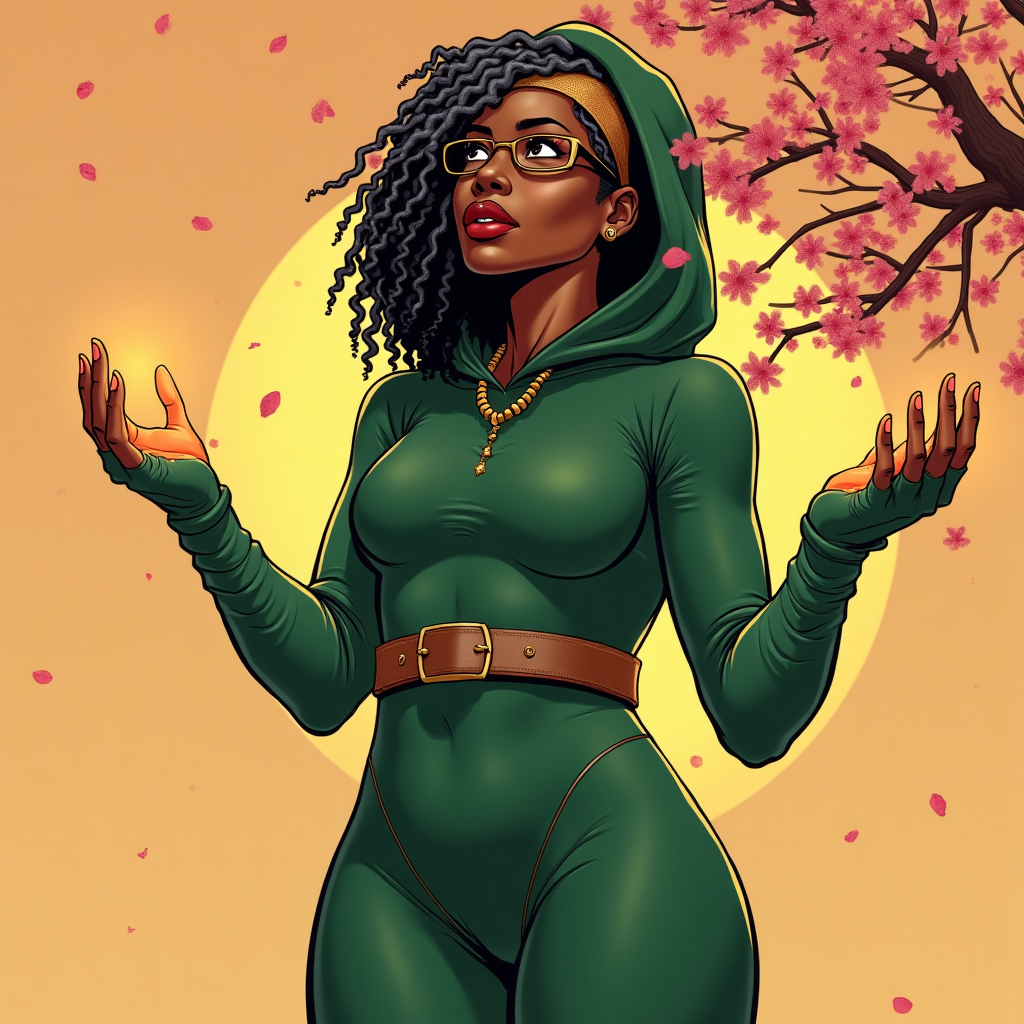
It started when she was a girl, walking with her grandmother through Branch Brook Park in Newark, where the cherry trees bloomed in walls of pale pink that turned the whole world soft. Her grandmother told her that cherry blossoms don’t just bloom — they remember. Each spring the tree returns to the same gesture, the same unfurling, the same reckless burst of color before the petals fall. That’s not dying, her grandmother said. That’s persistence.
Every April since, Celestine has felt something she cannot name — a low hum in her sternum, a warmth in her palms when she touches old bark or old stone. She has always chalked it up to nostalgia. Muscle memory. The grief of a woman who loves things that don’t last.
She is wrong about what it is.
Part Two: The Night the Ground Breathed
The incident happens on the fifteenth of April, just before midnight.
Celestine is working late, as she sometimes does when the archive backlog grows unmanageable — cross-referencing burial records from the 1890s, trying to restore names to markers that have gone blank. The cemetery is closed and dark, lit only by her desk lamp and the amber glow of the Irvington street grid beyond the wrought-iron fence. Through the window she can see the silhouettes of the older oaks, their new leaves barely showing.
Then she hears the machines.
She steps outside and sees them at the western boundary: a backhoe and two flatbed trucks, their running lights low, their operators moving with the quiet urgency of people who know they are not supposed to be there. She recognizes the logo on the trucks — a stylized compass rose — belonging to Vantage Meridian Holdings, a development group that has been quietly buying distressed properties across Irvington and flipping them into high-margin mixed-use buildings that the township’s longtime residents cannot afford. She has read about them in the Irvington Courier. She has attended the township council meetings where their proposals sailed through on split votes.
She did not know they had permits for Clinton Cemetery land.
She calls out. The operators ignore her. The backhoe arm swings toward a section of the cemetery’s oldest edge — pre-Civil War plots, some of the only remaining burial records for Black Irvington families from the 1840s. Celestine runs toward the fence, fury and horror rising in her chest, and she grabs the iron bars with both hands and shouts —
And the ground answers.
The earth beneath the backhoe’s treads buckles and rolls like a slow wave. Roots — thick, ancient, oak and elm and ash — surge upward through the soil, wrapping around the machine’s arm, cracking the frozen clay in long fracture lines that race from Celestine’s hands outward across the ground. The operators scramble from their cabs. The trucks stall. And then the cemetery goes quiet again, except for Celestine’s ragged breathing and the sound of something blooming — impossibly, in the dark, in April — a single cherry tree at the cemetery’s northeastern corner erupting into full blossom, petals falling in the lamplight like pink snow.
Celestine releases the fence. Her palms are glowing — faintly, warm gold, like light filtered through spring leaves. Then the glow fades.
She stands in the dark for a long time. Then she goes back inside and opens her notebook.
She has work to do.
Part Three: The Shape of a New Power
It takes her six weeks to understand what she has become.
The power is rooted in the living and the buried both — in the deep biological memory of the land itself. Celestine can feel the root networks beneath Irvington like a second nervous system, a slow vast architecture of connection running under every sidewalk and vacant lot and schoolyard. She can channel that network to move earth, accelerate growth, read the history of a place through its soil chemistry the way she once read history through handwritten ledgers. Old ground holds old knowledge. Irvington is full of both.
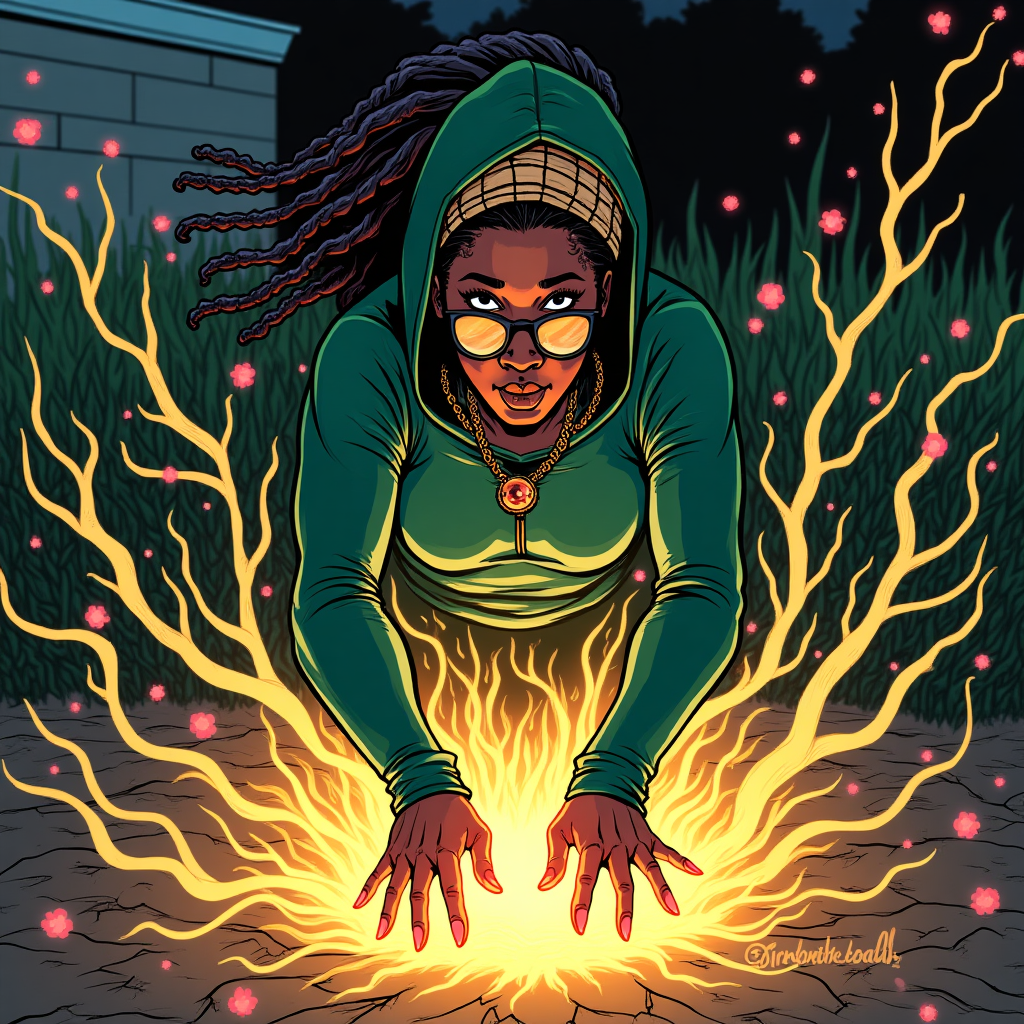
She cannot fly. She cannot move faster than a purposeful walk. But she can cause a century-old oak to grow a full year’s worth of rings in thirty seconds, its branches thickening into barriers. She can read the stress fractures in neglected infrastructure and feel them the way a dentist feels a cracked tooth. She can coax blossoms from bare wood in winter, and when she does, the petals carry a sedative pollen that can gently incapacitate without lasting harm.
She makes her own costume: deep forest green with panels of earth brown, her field hat replaced by a close-fitting hood with a single woven band of cherry blossom branches across the crown. She keeps her reading glasses. She keeps her notebook. She does not pretend to be anyone other than who she is.
She calls herself Bloomkeeper.
She does not announce herself. She does not seek press. She begins doing what she has always done — tending to what others ignore, protecting what others have decided is expendable. She reinforces a crumbling retaining wall near Irvington High School on Augusta Street by accelerating the root systems beneath it. She disrupts a midnight dumping operation near the Day-Elder neighborhood by raising a wall of knotted root and vine from the vacant lot’s soil. She rides the 25 bus to Branch Brook Park on a Thursday morning and stands among the cherry trees for a long time, her palms warm, listening.
The city is alive beneath its concrete. Celestine has always known this. Now she can prove it.
Part Four: The Adversary in the Architecture
Her name is Zara Voss, and she is twenty-three years old, and she is the most dangerous person in Essex County.
The granddaughter of Vantage Meridian Holdings’ founder, Zara has inherited both the company’s portfolio and its philosophy — that land has no memory, that communities are markets, that the only honest measure of a place is what it can yield. But Zara is not simply a corporate inheritor. She is a true believer, and she has power of her own.
Zara is tall and sharp-featured, with close-cropped natural hair and dark eyes that read a room the way a surveyor reads a parcel — in angles and margins. She dresses with deliberate austerity: black structured coats, clean lines, no ornament. She moves through Irvington’s council chambers and bank meetings and zoning hearings like someone who has already seen the outcome. In most cases, she has arranged it.
Her ability is entropic and precise: she can accelerate the decay of organic matter — wood rots, fabric frays, roots blacken and crumble — within a radius she has spent years learning to control. She does not know where it came from. She does not particularly care. She thinks of it as an extension of her philosophy. Everything breaks down eventually. She simply accelerates the inevitable.
She calls herself Nullbloom.
When she first encounters evidence of Bloomkeeper’s interference — the stalled machinery at Clinton Cemetery, the inexplicable root wall in Day-Elder, the retaining wall that should have failed and didn’t — she is not afraid. She is curious, and then she is methodical. She begins attending the same spaces where the interventions occurred. She starts to understand the pattern.
She does not yet know it is the archivist. But she is close.
Part Five: Roots and Ruin
The confrontation comes on a Wednesday evening in mid-April, at the Irvington Bus Terminal on Springfield Avenue.
Vantage Meridian Holdings has filed a new proposal: a high-density luxury transit hub to replace the aging terminal, requiring the demolition of three adjacent buildings, one of which is a community garden that has operated continuously since 1987. Celestine has read the filing. She is here to witness the first phase of the survey, which is scheduled — illegally, without community notice — to begin after dark.
Zara Voss arrives first. She is standing in the garden when Celestine comes through the gate, and for a moment the two women simply look at each other across the rows of early-spring seedlings.
You’re the one doing all this, Zara says. It is not a question.
This garden has been here since before you were born, Celestine says.
Zara tilts her head. And that’s supposed to matter?
She raises her hand and Celestine feels it before she sees it — a cold wrongness moving through the soil, the root network below her feet suddenly flickering and going dark in patches, like lights failing. The seedlings nearest Zara begin to wither. The old wooden fence posts along the garden’s edge go grey and soft with instant rot.
Celestine presses both palms to the earth.
The ground shudders. The garden’s root network flares gold beneath the soil — visible for a moment through the cracked clay, a luminous web of connection — and surges against Nullbloom’s decay like a tide against erosion. Cherry blossoms erupt from the single ornamental tree at the garden’s corner, filling the air with drifting pink, the sedative pollen thickening in the space between them.
Zara staggers, covers her face, pulls back. She is not incapacitated — she is too controlled for that — but she retreats to the terminal’s concrete steps, where the soil cannot reach her.
You can’t stop what’s coming, she says, but her voice is thinner now.
I’ve been reading Irvington’s dead for thirty-one years, Celestine answers, rising slowly to her feet, petals in her locs, her palms still warm. I know how long things can last when someone tends them.
The survey crew arrives to find the garden gate sealed in a dense wall of living root and the project manager’s truck idling in a courtyard full of blossoms, every crew member gently, harmlessly asleep.
Zara Voss is gone. But she will be back. The filing is still active. The proposal is still moving through the township council. The fight is not over — it is never over in a place where the land has memory and the people who love it are still standing.
Bloomkeeper walks home down Springfield Avenue, past the bus terminal, past the cemetery gates, past the amber streetlights that have always known her name. April blooms around her. The roots hold.