


Part One: The Weight of Forty-Five Square Miles
Route 9 has never been a quiet road.
It roars through the spine of Lakewood Township like a commercial artery that forgot how to rest — strip malls bleeding into lumber yards, yeshiva dormitories stacked against new-framed townhouses, water towers looming over parking lots packed tight as Torah commentary. In 2026 Lakewood is not a suburb. It is a city that refuses to call itself one. A hundred and forty-two thousand souls pressed into forty-five square miles of Pine Barrens clay and ambition, and the ground beneath them is groaning.
Seth Morwenn knows the groan personally.
He has felt it in his knees on job sites. He has felt it in the vibration of his transit level when a backhoe bites too close to a main. He is forty-four years old, white-haired at the temples, with the calloused forearms and squint-lined eyes of a man who has spent twenty years reading the earth for a living. A licensed civil engineer for Lakewood Township’s Office of Infrastructure Planning, Seth works the unglamorous math: soil density charts, hydrostatic pressure curves, utility corridor clearances, the Byzantine permit records of a municipality that grew fifty-three percent in one decade and then did it again. He carries a battered field notebook in the chest pocket of his canvas work jacket — the jacket the color of dried clay, patched at the left elbow, smelling of surveying chalk and rain.
He lives on the west side of town, not far from Lake Carasaljo, the old glacial kettle lake that gave the township its water identity before the reservoirs came. In the evenings he walks its shore path under the pitch pines and thinks about pressure. About what the ground is hiding.
He is not, in any conventional sense, a man on the edge of transformation.
But the ground beneath Lakewood is.
Part Two: The Cavity Beneath Cedar Bridge
April in the Pinelands is the month the water moves. Snowmelt and spring rain push through the sandy aquifer like a slow tide through gauze, and in Lakewood — where the population density now rivals Hoboken block-for-block in its densest wards — the aquifer meets a maze of aging infrastructure that was never designed for what the township has become.
Seth is called to Cedar Bridge Avenue on a Thursday morning. A section of road has buckled — not dramatically, just a suspicious crown, a micro-hump that a township inspector noticed while driving the route. Standard protocol: Seth brings the ground-penetrating radar unit, runs the grid, writes a report.
He is running the grid at six-forty in the morning, alone, the pines dripping at the road edge, when the sinkhole opens.
It is not a slow process. The crown becomes a crack. The crack becomes a gap. And then the road surface drops away beneath the GPR cart and Seth goes with it — twelve feet down into a void chamber the size of a small room, where a ruptured water main has been quietly dissolving the basal clay for months, unseen, undetected, unreported. He lands hard on his left side in standing water. The GPR cart crashes beside him. A cascade of road material seals most of the gap above.
In the dark, in the cold water, something changes.
The void is not empty. The ceiling of the cavity is thick with fungal mat — Ganoderma root rot from the cedars above, their mycelial network running through the sand in threads finer than capillaries. The broken water main sprays mineral-rich aquifer water across everything. And beneath Seth, half-submerged, the soil is alive with dormant pine seed — the Pinelands’ slow, patient biology, waiting for disturbance and light and pressure shift to wake it up.
All three arrive at once.
Seth does not lose consciousness. What he loses is the boundary between his nervous system and the network surrounding him. The mycelial threads find him through his soaked jacket like fiber optic cable finding a node. The mineral spray enters his bloodstream through a laceration on his forearm. The seed mass beneath him pulses with the kind of electrochemical signal that has no name in any human physiology textbook.
He screams — and the scream returns to him.
Not as an echo. As a map.
Every surface of the void cavity is rendered in his mind with perfect acoustic precision — the water line’s exact rupture point, the dimensions of the hollow space, the location of every pipe and conduit within thirty meters, mapped in the milliseconds his sound takes to return. He screams again, involuntarily, and this time the map extends further. Through the clay. Through the sand. Northward under Route 9 for two hundred meters, he can feel the corroded wall of a secondary gas lateral three inches from a new foundation bore.
He is in the earth. The earth is in him.
The municipal crew finds him four hours later. He is sitting in the dark, in the water, perfectly calm, drawing a utility corridor map in his field notebook from memory — or from something beyond memory. The map is accurate to the centimeter. They will not know that until the survey drones confirm it six days later.
Part Three: What the Pines Remember
The transformation does not announce itself with a costume or a name. It announces itself with a headache that lasts six days, during which Seth Morwenn can hear the entire aquifer moving beneath the township like a second heartbeat.
By the end of the second week, his senses have restructured entirely.
His echolocation is now precise and involuntary — a constant low-frequency emission, inaudible to others, that maps the subsurface world in real time the way a bat maps a cave: not as sound but as spatial knowledge, uploaded directly into proprioception. Walking down Clifton Avenue, he feels the gas mains, the fiber conduits, the failing sewer junctions of Lakewood’s aging west-side grid as physical presences around his body, as intimate as furniture in a dark room he knows by heart. He sends precise sonic pulses through the earth and reads their returns with a sensitivity that no instrument in the township’s equipment fleet can match.
The spore and seed dispersal came later, stranger, slower. The Pine Barrens are a seed economy — pitch pine, Atlantic white cedar, sundew, sphagnum — all of it waiting for the right signal. Seth finds he can reach into that waiting. A thought directed outward, a kind of muscular relaxation in the hands, and the dormant biology of Lakewood’s remaining green corridors responds. He has been using it carefully — guiding native pollen across the green spaces of the township’s Veteran’s Memorial Park, releasing mycorrhizal spore into degraded soil along the Cedar Bridge greenway, nudging seed dispersal away from invasive-colonized zones toward the native plant corridors the Township’s environmental office has been struggling to restore for a decade. It is slow work. Patient work. Pine Barrens work.
The light spectrum manipulation arrived with no ceremony. One morning, standing at the edge of Lake Carasaljo at dawn, he simply saw everything. Ultraviolet, infrared, wavelengths below and above human range — not as separate channels but as a single augmented vision in which the world is striated with information. The waterway’s chemical load is visible as color-gradients of pollution. The stress fractures in aging building facades on James Street read as thermal contour lines. The buried drums of petroleum distillate that a long-gone Lakewood dry-goods operation left below a vacant lot on Prospect Street in 1987 glow like lanterns. He spends a Tuesday afternoon walking the township’s older industrial corridors alone, seeing the invisible debts the ground is owed.
He has not told his supervisor. He has not told anyone.
He calls himself Carasaljo.
Part Four: The Man Who Bought the Water
His name, in the township’s permit records, is listed as Rodolfo Cantera. He is sixty-three years old, a broad-shouldered man of Cuban and Puerto Rican descent with silver-streaked black hair worn swept back, deep-set brown eyes behind wire-rimmed glasses, and the measured bearing of someone who has been the smartest person in every room he has entered for thirty years and learned not to show it. He runs a private infrastructure investment vehicle called Cantera Subsurface Holdings, which in the past four years has quietly acquired controlling easements on seventeen private utility lateral corridors across Lakewood Township — the secondary pipes and conduits that run beneath privately-held parcels, connecting to the public grid at their ends.
He presents himself as a solution. In a township where infrastructure is strangling under explosive growth, Cantera has positioned his firm as a private-capital bridge: he will maintain, upgrade, and expand the utility laterals he controls, relieving municipal burden and accelerating development approvals. The pitch is persuasive. The Township Council, facing a two-hundred-million-dollar infrastructure deficit, has accepted two of his proposals already.
What the permits do not show — what no surface-level audit would find — is what Seth Morwenn sees with ultraviolet eyes when he walks the corridors above Cantera’s easement holdings.
The laterals are not being upgraded. They are being choked.
Deliberate accumulation of mineral-deposit accelerants — compounds that calcify pipe walls from the inside — is being introduced through maintenance access points. Slow, invisible, chemically plausible as natural scale buildup. At Cantera’s current rate, within eighteen months, the private laterals connecting the township’s densest Orthodox neighborhoods to the main water grid will face simultaneous failure. Not dramatically. Not in a way that makes the news on a single night. Just an escalating cascade of local service interruptions — burst pipes, pressure drops, boil-water advisories — affecting the township’s most populous and politically organized community in the months before a critical zoning vote on the eastern development corridor.
Seth has mapped the whole play acoustically. He knows where every deposit cluster sits. He knows the access schedule Cantera’s maintenance crews follow. He knows that when the cascade begins, Cantera Subsurface Holdings will be positioned as the only entity with the easement rights and technical capacity to perform emergency restoration — at contract rates that will transfer effective control of the township’s secondary water grid permanently to private hands.
Carasaljo surfaces on a Thursday night at the Prospect Street junction — the oldest node in the compromised lateral network — and begins the work of reversing what Cantera’s crews have spent fourteen months building.
This is when Rodolfo Cantera learns that Lakewood has a problem.
He names the problem after the aquifer it came from. He calls it a liability.
Then he calls it something else — a Dredgeholt, a corruption, an obstacle. And like any investor who has spent thirty years acquiring assets, he begins to plan for its removal.
Part Five: Pressure Test
The confrontation comes in the way infrastructure confrontations always do — not in daylight, not with witnesses, but in the middle of the night at a maintenance access shaft on the south side of the Cedar Bridge greenway, where Route 9’s roar is far enough away to hear the pines breathing.
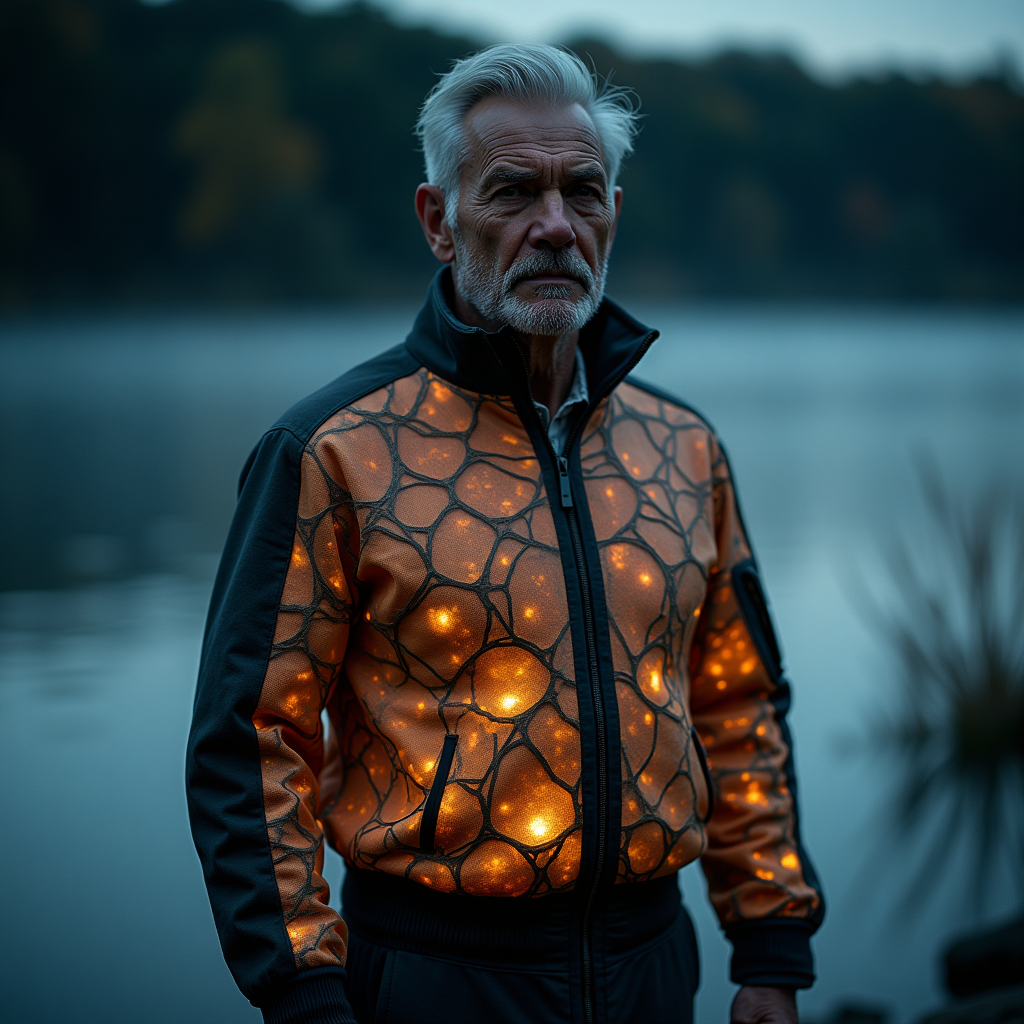
Carasaljo has been working for three hours. The deposits in the northern lateral cluster are seventy percent cleared — a combination of precisely directed sonic pulses that shatter the calcified accumulation and seed-dispersal bursts of native root chemistry that neutralize the mineralizing compounds at their source. The work has transformed Seth’s canvas jacket into something else entirely: Radiolaria & Diatom geometry has grown over every surface of the old field garment, a full-body silicate lattice of translucent overlapping panels — hexagonal, dendritic, spiraling, the complexity of deep-ocean diatom architecture rendered across every inch of cloth and skin. His face shows through the crystalline geometry like a face carved into patterned glass, the structure legible through it, eyes become concentric crystalline rings that throw prismatic shadows across the access shaft walls. A cuff edge and the left shoulder patch of the original jacket are still visible through the lattice’s inner layer.
Rodolfo Cantera arrives with three engineers and a legal injunction.
He is wearing a charcoal site coat and his wire-rimmed glasses. He looks, in every physical sense, like a sixty-three-year-old executive performing a midnight site inspection. But when he steps into the light thrown by Carasaljo’s prismatic vision, Seth sees the chemistry around him — the mineral accelerant residue on his gloves, the pressure readings on the handheld unit he carries, the exact calculated pattern of a man who has been here before, many times, doing precise and patient damage.
“You’re interfering with private infrastructure easements,” Cantera says. His voice is steady. He has clearly rehearsed this conversation. “Whatever you think you’re doing here, it constitutes criminal trespass under State statute thirty-nine dash—”
Carasaljo sends a single sonic pulse through the earth.
The return maps everything within a quarter-mile. It maps Cantera’s engineers. It maps the municipal fire hydrant at the greenway’s north end that has been locked open — Cantera’s backup plan, a sudden pressure surge that would re-deposit the very calcification Carasaljo has spent the night removing. It maps the third thing, the thing Cantera doesn’t know about yet: a new micro-fracture in the gas lateral running fourteen inches below their feet, created by the resonance of Cantera’s own accelerant work, expanding at a rate that will become a rupture in approximately eleven minutes.
Seth speaks in his own voice, which is Seth Morwenn’s voice — a civil engineer’s voice, flat and specific.
“There’s a gas lateral fracture fourteen inches down, running northwest at roughly nine degrees from your left foot. You have eleven minutes before it classifies as a reportable release under NJDEP protocols. I’ve already sent the acoustic survey to the Township’s emergency infrastructure line.”
He pauses. The prismatic light from his eyes throws geometric shadows across Rodolfo Cantera’s face.
“I’d move the engineers back.”
Cantera does not move for a long moment. He is calculating. Seth can see the calculation in the infrared warmth of the man’s face, the elevated temperature of stress-response physiology visible as color against the dark.
Then Cantera steps back. One step. Then two.
“This isn’t finished,” he says.
“No,” Seth agrees. “It isn’t.”
He turns back to the access shaft. The Pine Barrens breathe around them — cedar and pitch pine and the quiet, patient biological intelligence of forty square miles of sandy soil that has been here far longer than the pipes beneath it, far longer than the township above it, far longer than any instrument or accelerant or easement agreement or man in a charcoal site coat.
Carasaljo clears the final deposit cluster at 2:47 in the morning.
By dawn, water pressure in the northern lateral network is nominal. A Township crew arrives at first light to seal the gas fracture. The maintenance access shaft is logged as a routine infrastructure inspection, authorized by a mid-level engineer in the Office of Infrastructure Planning.
Seth Morwenn drives home on Route 9 as the yeshivas begin their morning prayers and the first NJ Transit buses start their runs and the Cedar Bridge greenway catches the first prismatic light of a clear April morning in Lakewood, where the ground holds its secrets, and one man knows them all.