


Cassian Dray
Part One: The City as Raw Material
Camden does not look like a place worth fighting over. That is precisely why Cassian Dray has always loved it.
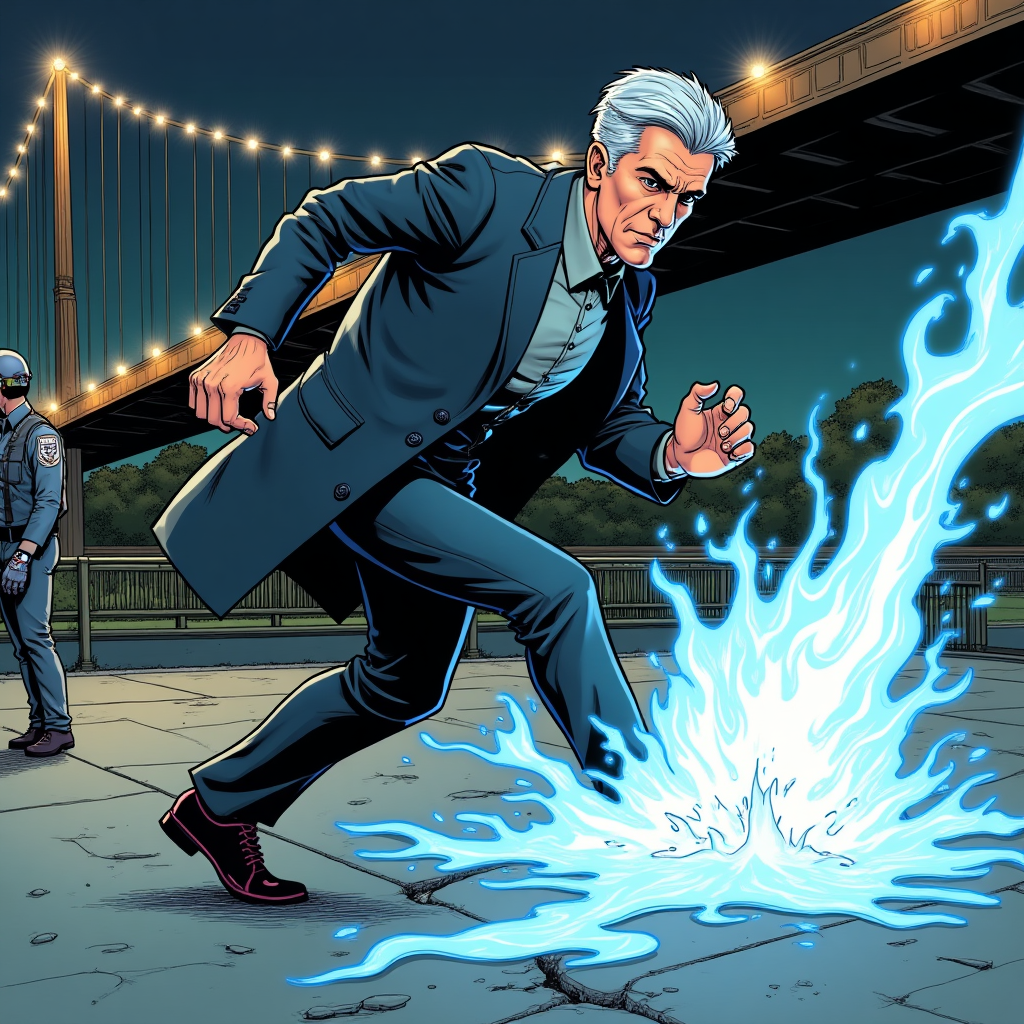
They are sixty-three years old, multiracial, nonbinary, with silver hair cut close at the sides and left long enough on top to move when the river wind comes off the Delaware. Their face is a map of composed attention — deep-set eyes that catalogue everything, a mouth that defaults to the faint half-smile of someone who has already calculated three moves ahead. They dress in charcoal and slate and the occasional burgundy, colors that read as serious at a zoning board meeting and invisible at a fundraiser. They have spent forty years perfecting the art of being underestimated in exactly the right rooms.
Cassian grew up in North Camden, in a narrow row house on Erie Street that smelled like their mother’s sofrito and the chemical exhaust of the old RCA Victor plant three blocks east. Their mother was Puerto Rican, a seamstress. Their father was Black, a draftsman who worked briefly at New York Shipbuilding before The Yard shuttered in 1967, the year Cassian was four years old. They do not remember The Yard operating. They remember their father sitting at the kitchen table afterward, drawing buildings that no one would ever build, drinking coffee that went cold while he measured angles on graph paper.
Their father believed that cities could be designed into dignity. Cassian used to believe that too.
They left Camden at eighteen on a scholarship to a Philadelphia architecture school and did not come back for decades. They saw other cities in that time — Detroit, Baltimore, Newark — cities that looked like Camden in the way that ruins of different civilizations all begin to look alike once the roofs come off. They studied urban planning. They studied capital. They studied the specific grammar of how money moves through a distressed municipality and who it leaves behind.
By the time they founded Meridian Civic Partners — a private urban redevelopment consultancy, tastefully officed in a restored building on Federal Street — they had a fully formed philosophy. Cities do not decline by accident. They decline because the people with resources decide to let them, and the people who stay behind mistake endurance for agency. Camden had endured. What it needed, Cassian believed with the calm certainty of a completed proof, was not community gardens and murals. It needed someone willing to do the hard, unsentimental work of structural transformation.
That was what they told themselves. They were not entirely wrong. That was the problem.
Part Two: What the Ground Holds
Meridian’s model was elegant, as all long cons are.
Identify flood-zone and brownfield parcels in Camden’s waterfront districts — land that the city’s own blight designations made cheap, land that insurance actuaries had already written off, land that federal environmental assessments had tied in procedural knots for years. Acquire it quietly through a layered architecture of shell corporations: Tidal Basin LLC, Ironworks Heritage Group, Delaware Front Capital. Lobby — gently, patiently, through third-party civic organizations Meridian quietly funded — for infrastructure investments that would flow around existing residential neighborhoods rather than through them. Create the conditions under which remaining residents would conclude, on their own, that leaving was the rational choice. Then develop.
It was not, Cassian would tell you, cruelty. It was urban surgery. The patient would be healthier when it was done. The patient simply could not be trusted to consent to the procedure.
The Port of Camden maintenance facility on Beckett Street was Meridian’s most ambitious acquisition target: a former annex of the New York Shipbuilding complex, sitting atop what Cassian’s private geological consultants had identified as a genuinely extraordinary subsurface feature. Decades of tidal cycling through the old drainage infrastructure had produced a charged aquifer — mineralized, ionically dense, threaded through with dissolved metals from fifty years of arc welding and experimental hull treatments. Cassian’s consultants believed it could be commercially harvested as an industrial coolant of unusual properties. The rights to that aquifer alone were worth more than the assessed value of the surrounding six blocks.
Meridian’s groundwater testing beneath the facility was unlicensed. The structural assessment that identified the collapsed culvert as a collapse risk was completed in February. Cassian reviewed the report in March, noted the liability language, and authorized continued testing operations while the safety remediation was — their word, in the margin — deprioritized.
They did not intend for anyone to be in that building in April. They genuinely did not.
But Cassian Dray had learned, over four decades, that intentions were a private luxury. Consequences were the only public record.
Part Three: The Disruption
Their investigator flags the waterfront incident the morning after it happens: a truck, a family of tourists, a figure in blue-green fabric who appeared to stop a two-ton vehicle with what traffic camera footage — grainy, inconclusive, enough — suggested was some form of localized ground force emanating from the surrounding soil. No one was hurt. No one filed a police report. The figure disappeared south along the esplanade.
Cassian watches the footage three times with the sound off, sitting in their Federal Street office with a cold cup of coffee and the particular stillness of someone recalibrating.
They know immediately what they are looking at. They had seen the anomalous bioelectrical readings from the aquifer tests — the way the charged water interfaced with organic tissue samples in ways the consultants had described as non-standard and then declined to elaborate on. They had not considered the vector of a human being.
Cassian is not afraid. What they feel, turning it over in the careful architecture of their mind, is closer to recognition. Camden had done this. The city had reached into its own industrial residue and made something. They had spent fifteen years trying to reshape this city, and the city had quietly been reshaping people all along without their permission.
There is a moment — brief, and they will not examine it too closely afterward — where something in them is simply awed.
Then the consultant mind reasserts itself. An empowered teenager in the Waterfront South neighborhood who had demonstrably been inside the Beckett Street facility was a liability vector of the first order. If she understood what had happened to her, she would eventually understand where it had happened and why the floor had given way. The chain from that culvert to the safety report to Meridian’s shell corporations was not impenetrable.
Cassian writes a note on Meridian letterhead, keeps it unsigned, and has it delivered through a property manager who owes them a favor. Stop interfering with things you don’t understand. Camden is being helped. A warning. An off-ramp. The kind of offer a reasonable person would take.
They did not yet understand that Marisol Vega was not interested in off-ramps.
Part Four: The Shape of What You Build
The week the note goes unanswered, Cassian begins to feel something they have not felt in years: the specific anxiety of a plan developing friction.
They pull everything they have on the girl. Sixteen, junior at Camden High, volunteers at the Adventure Aquarium, mother at Cooper University Hospital. Waterfront South her whole life. The investigator delivers a photograph: brown-skinned, dark-eyed, the posture of someone who has been told repeatedly that she is in the way and has decided to stand there anyway.
Cassian sits with the photograph for a long time.
They grew up three miles from where this girl grew up. They know what it costs a place like Camden to produce someone like this — the specific tax of poverty and perseverance and proximity to a river that everyone else treats as scenery. Their mother had paid it. Their father had paid it. They had paid it, and then they had left, and they had spent forty years telling themselves that their departure was in service of a return.
What are you returning, a part of them asks, when what you return with is a displacement model and a set of shell corporations?
They close the photograph. They make a call. They arrange the meeting at Gateway Park.
They tell themselves, preparing for it, that they will offer the girl a choice: stand aside and let the work proceed, or become a public disruption that Meridian’s legal apparatus will handle with efficient, impersonal thoroughness. They have done this before. It is not pleasant. It works.
What they do not prepare for — cannot prepare for, because they have spent forty years designing systems that process people rather than encountering them — is what it will feel like to stand across from Marisol Vega at the edge of the Delaware River and have her look at them not with fear, not with anger, but with the quiet and absolute certainty of someone who has already decided.
Part Five: What the River Answers
The bridge lights turn the water silver and bronze at this hour. Cassian arrives first, as they always do, with their two security contractors placed at unhurried distances and the full Meridian document package — the photographs, the address, the implication — in a leather portfolio under their arm. They stand with the Walt Whitman Bridge enormous behind them, cables rising into the dark like the rigging of a ship, and they feel the weight of the city at their back the way they always have: as something that belongs to the people willing to do the work of holding it.
The girl arrives from the south. She is in her suit — deep blue-green compression fabric, silver-grey piping, a mask that covers her eyes and nose. She looks like the river at dusk, which Cassian suspects is deliberate. She walks to the riverbank and stops there and does not say anything for a moment, and in that moment Cassian is aware of something they cannot quantify: a change in the texture of the ground, a subtle vibration in the soil and the iron of the bridge pilings and the water moving beneath the park path, as if something enormous has become attentive.
“You’re a child,” Cassian says, and keeps their voice kind, because they mean it kindly. “With a gift you barely understand. And I’ve been reshaping cities since before your mother was born.”
“You knew that culvert was going to fail,” the girl says. “You knew someone could get hurt.”
They have prepared for this. “And instead,” Cassian replies, “someone got improved. The city does that, if you let it.”
They almost believe it as they say it.
The contractors move. The ground cracks.
It is not a weapon — that is the first thing Cassian understands, stumbling back as the esplanade splits in a clean line past their feet, not at them, past them, a demonstration, a grammar lesson in force. The Delaware erupts from the break in a column eight feet high, blue-white and mineral-bright, catching the bridge light and holding it like an arc welder’s flame made liquid and alive. It hangs there — three seconds, four — and then lowers, slowly, with a control that Cassian recognizes as the hardest part of any power: the restraint.
The contractors do not move again.
“I’m not improved,” the girl says. “I’m from here.”
Cassian Dray stands at the edge of the water their consultants tried to commodify and looks at the girl their negligence accidentally created, and for the first time in forty years the calculation does not complete. They are sixty-three years old and they came back to Camden with capital and a theory and the absolute conviction that they understood what this city needed better than the city understood itself. Their father had sat at a kitchen table drawing buildings no one would build. They had built buildings no one had asked for.
They leave without a word. The leather portfolio stays on the bench where they set it down.
Meridian Civic Partners will receive a state investigation notice before the week is out. Cassian knows this before it happens. They also know — the way a river knows it always meets the sea — that investigations are managed, that capital is patient, that shell corporations have layers for a reason. They will return to Camden. The work is not finished.
But standing on the waterfront in the shadow of the Walt Whitman Bridge, watching the Delaware carry its freight of memory south toward the bay, Cassian Dray allows themselves one moment of something they cannot name — not regret, not defeat, something older than either.
Their father used to say that a city is just a set of decisions made by people who thought they knew better.
He was right about that. He was right about a lot of things.
Cassian turns up the collar of their charcoal coat and walks north, away from the river, back into the city they have been trying to save from itself for fifteen years. Behind them, the Delaware moves on without them, the way it always has, the way it always will, dark and purposeful and indifferent to anyone’s plans.
La corriente que no descansa.
It does not rest for Meridian either.