


Part One: The Frequency of Forgetting
Newark does not mourn quietly.
It buries its wounds under concrete and commerce and keeps moving — a city that has absorbed every insult, every fire, every broken promise, and converted them into forward motion. The port hums at all hours. The airport never sleeps. The bridges over the Passaic carry sixty thousand crossings a day without anyone pausing to consider how they hold, what they cost, or who was priced out of living near them.
Yuna Chae considered all of it.
She grew up in the Ironbound, daughter of Jin and Soo-Yeon Chae, who ran Chae’s Global Dry Goods off Ferry Street — a narrow, brilliant little shop that smelled of sesame oil and cardamom, where longshoremen picked up imported pantry staples and construction workers stopped in for dried fish and rice on their lunch breaks. The Ironbound had made the Chae family into Newarkers. Ferry Street was their street. The port was their neighbor, its crane silhouettes visible from the apartment above the shop, its foghorns a lullaby Yuna fell asleep to every night of her childhood.
She was nine years old when the Hargrove Development Group first sent the letter. She did not understand it then — the language of “mixed-use revitalization corridors” and “lease recapture timelines” was not written for nine-year-olds, or for families like hers. She understood it at fourteen, when the rent doubled. At seventeen, when the shop closed. At nineteen, when her parents moved to a cousin’s house in Palisades Park and Yuna stayed in Newark on a scholarship because she had tested into NJIT’s materials engineering program and she was not going to let this city finish the job of erasing her.
She studied hard. She studied specifically. She wanted to understand the materials that cities are built from — the steel, the concrete, the polymers, the composites — because understanding materials meant understanding failure modes. And she had decided, somewhere in the fluorescent corridors of NJIT’s engineering wing, that she wanted to understand exactly how things break.
She graduated into a city that had continued without her input. The Ironbound had new restaurants now, new faces, new storefronts where the old ones had been. The building where Chae’s Global Dry Goods had stood was a co-working space called The Gateway Hub. There was exposed brick. There were succulents.
Yuna Chae stood on Ferry Street with her diploma and felt the specific fury of someone who had been thanked for her patience and then shown the door.
Part Two: The Cinder in the Clay
She took the only work available to a new materials engineer without connections or capital: subcontract inspection for Hargrove Development’s demolition and soil remediation division. The irony was not lost on her. She was being paid to document the structural composition of the same sites from which her family and neighbors had been displaced — to prepare reports on soil toxicity, foundation integrity, and material salvage value so that Hargrove’s investors could calculate their returns.
The work was dangerous. Nobody at Hargrove said so in writing, but Yuna knew it within her first week on the Passaic waterfront sites. The thermal soil remediation equipment — industrial pyrolysis rigs designed to bake contaminated earth at temperatures above 400 degrees Celsius — vented its pyrolytic exhaust directly into the open air of the work zone. The safety masks provided were rated for particulate, not chemical vapor. The chemical vapor was the problem.
For twenty-two months, Yuna Chae breathed the air above the burning earth.
The transformation was not sudden. It was the way a cinder becomes a coal — slow accumulation, heat building inward. She noticed first that she ran warm, then very warm, then uncomfortably warm in any enclosed space. Then she noticed the asphalt softening underfoot when she stood still too long on summer afternoons. Then, on a December morning at a remediation site on Chapel Street, she reached out to steady herself against a steel I-beam and her palm went through three inches of structural steel like a hand pressed into warm wax.
She stood in the cold and looked at the glowing channel her hand had left in the steel.
Then she looked at the Hargrove logo stenciled on the beam’s lower flange and felt the heat in her chest become something purposeful.
She spent four months learning herself the way she had learned materials engineering: methodically, empirically, pushing to failure. She learned she could generate concentrated thermal plumes — columns of superheated air that function as invisible battering rams of pressure and radiance, capable of deforming structural steel or shattering dense masonry. She learned she could reduce nearly any construction material to slag with sustained contact, her hands becoming tools of controlled liquefaction. And she discovered the ability she feared and prized most: she could superheat a localized column of air into a rising thermal updraft — focused, invisible, crushing — that could lift and disorient anything in its path or, at full intensity, buckle the load-bearing elements of a mid-sized structure from the outside in.
But materials engineering had taught her something important: thermal alone was a blunt instrument. Heat radiates outward. It cannot map what it cannot reach.
She needed to be precise. She needed to know exactly where the structures were vulnerable before she touched them.
She went to the bridges.
Part Three: The Bridges Speak
The Passaic River crossings are among the most overlooked infrastructure in the metropolitan region — the Jackson Street bridge, the Raymond Boulevard bridge, the old rail spans south of Penn Station — aging steel and concrete structures that carry the daily weight of a city without ceremony or maintenance budgets commensurate with their load. Yuna had written inspection memos about two of them in her Hargrove years. She knew their stress profiles the way a cardiologist knows an arrhythmia.
Standing at the foot of the Raymond Boulevard bridge at two in the morning in late February, she placed both palms flat against the concrete abutment and pushed heat into it — not enough to damage, just enough to make the material sing. And it sang. The steel cable assemblies deep in the concrete began to resonate at low frequency, a sub-audible thrum that traveled down through the abutment, into the riverbed, and back up through her feet.
The entire span was talking to her.
She had found her echolocation. The resonance she induced — thermal excitation of the steel and rebar matrices embedded throughout each bridge — created a frequency profile she could read like a blueprint. The returning vibrations mapped every void, every fracture, every point of weakness with precision far exceeding any handheld sonar tool she had used as an inspector. She could hear the difference between a hairline crack at three meters depth and a corroded tendon cable at twelve. She could map the full geological cross-section below the river — the sediment, the bedrock, the buried colonial-era infrastructure — by reading the echo of her own resonance returning through the earth.
Bridge and span resonance control. She could do more than listen. She found she could sustain the induced frequency, tune it, amplify it — make the entire span vibrate in coordinated harmonic pulses that traveled through the structure like a message. She could make bridges tremble without cracking them. She could direct those tremors along specific geological strata, propagating seismic pulses into the earth at any depth she chose, mapping or threatening the tunnel systems and foundation networks below Port Newark–Elizabeth with the precision of a surgical instrument.
The Passaic itself became part of the system. Its brackish water — the chemical signature of river meeting tidal bay — conducted her sonic waves beautifully, carrying echolocation pulses out into Newark Bay and back, painting the submerged foundations and cable tunnels of the entire port complex in ghostly acoustic silhouette.
She had not meant to become a weapon. She had meant to become an inspector. But Hargrove had made her both. The city had made her both. And now she stood at the mouth of the Passaic where it churned into the bay, looking at the spans that had held this port city together since 1666, and she understood something cold and clarifying:
She knew where every single one of them would break.
She gave herself a name. Cindergate — cinder for the industrial furnace residue that lined these banks in the 1880s, that was in the soil she had breathed for two years, that now lived inside her; gate for Penn Station and the port and the bridges themselves, the entries and exits that Newark had always been for everyone else passing through. The gateway city. The city you cross to get somewhere better.
Not anymore.
Part Four: Nineteen Parcels
She found the Hargrove thermal treatment permits on a Tuesday morning in early September, in the public notice section of the city council’s online meeting archive — a section that received, by Yuna’s estimate, approximately no civic attention whatsoever. Nineteen parcels. North Ward, Central Ward, and a cluster along the Passaic waterfront. Thermal remediation at industrial scale: the same pyrolysis technology she had been exposed to for two years, now planned for forty combined acres of urban soil. The contractor holding the remediation license was a subsidiary of a private infrastructure investment fund headquartered, with rich irony, inside Port Newark’s administrative complex.
Hargrove was going to bake the North Ward.
She traced the subsidiary. She traced the investment fund. She found the Port Newark administrator who had expedited the permit review. She built a map of the financial connections — who owned what, who had signed what, who stood to profit when the remediated parcels became developable luxury land — and she laid it out on her apartment table in the Ironbound and sat with it for a long time.
Then she put on her jacket and went to Wilson Avenue.
The Hargrove staging yard on Wilson had been assembling the thermal treatment rigs for three weeks. At night, the yard was minimally staffed — a rotating security contractor, cameras, motion sensors. None of these presented meaningful obstacles to someone who could liquefy metal with her hands and read the acoustic signature of a building’s foundation from a quarter mile away. She was at the fence line before the security guard had completed his first perimeter loop.
She had her map. She had her power. She had two years of personal evidence that the legal and civic systems would not protect her or anyone like her from the thing Hargrove was about to do.
She was also standing in the cold September dark outside a staging yard adjacent to a block with forty residential units, and she was a materials engineer, and she knew exactly what an uncontrolled thermal event beneath a dense urban foundation would do to the people inside those buildings.
She was still standing at the fence, running the calculations, when she heard the earth shift behind her.
She turned.
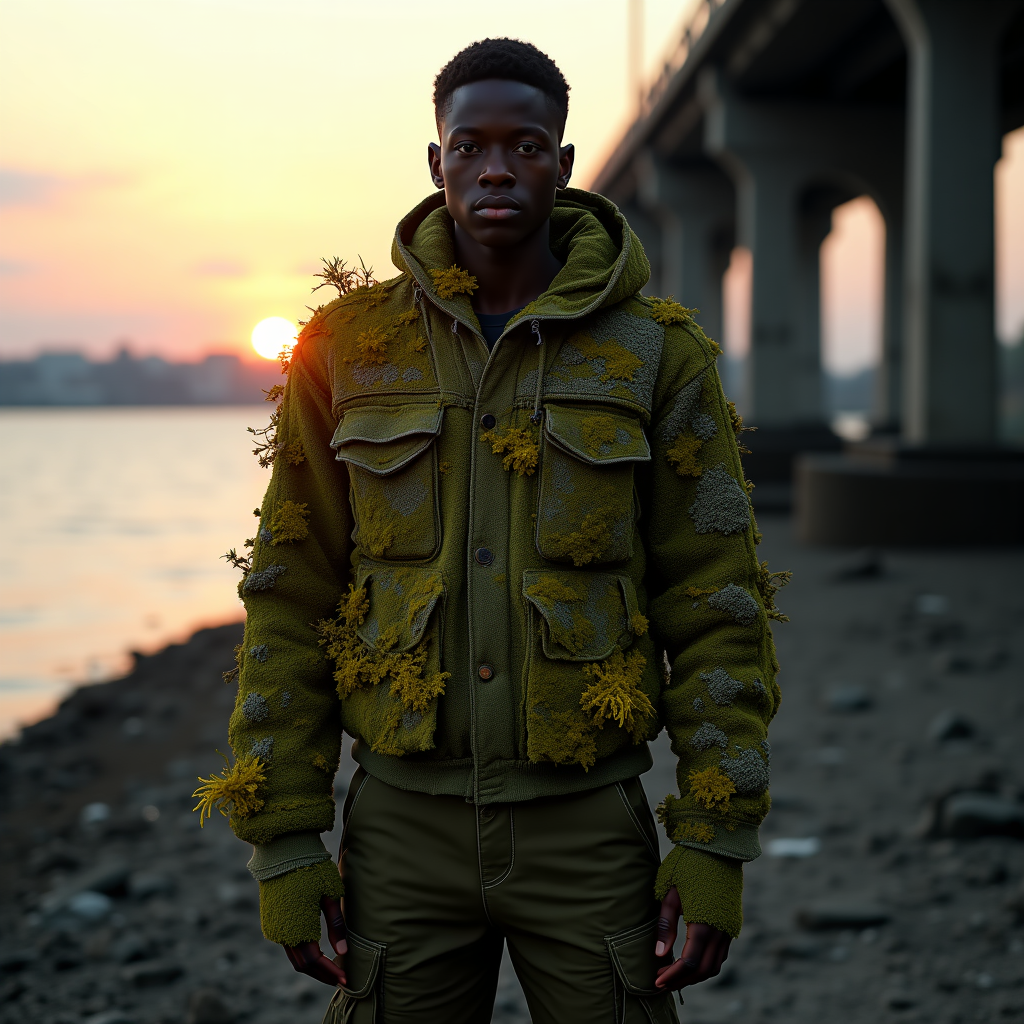
He was thirteen years old, his school bag over one shoulder, both palms pressed lightly to the Wilson Avenue asphalt as if he were reading a menu. The ground around his feet was faintly luminous, dense, the light of stored photosynthetic energy seeping up through the loam. He looked at her with the expression of someone who had done the same structural calculations and arrived at the same conclusion about the residential block, thirty seconds before she had said anything.
“You’re the kid,” she said.
Part Five: What Burns, What Holds
His name, she would learn later, was Marcus Tillman. He was thirteen and had been studying structural engineering at Essex County Schools of Technology and had been transformed by the Passaic riverbank six months before she confronted him on Wilson Avenue. He called himself Loamborn of the Passaic, which she found simultaneously over-dramatic and exactly correct.
He told her about the foundations. She already knew about the foundations. She told him about the permits. He already knew about the permits. They stood on opposite sides of a fence line in September dark and recognized each other as the same species of problem — someone Newark had made into something, in order to be heard.
“I know what the heat will do,” she said. “I went to school for this.”
“So did I,” he said, and pressed his hands to the ground.
She sent a thermal column across the yard to detonate the fuel tanks — not at the building, at the rigs. She was precise. She had always been precise. The fireball was real and controlled and she directed it away from the residential structure with a focused updraft that pushed the pressure wave north toward the chain-link and the open lot beyond. The boy hardened the ground beneath the residential foundation into a single compressed plate, dense and unyielding, and she felt the return echo of his seismic work through her own resonance — two people mapping the same infrastructure from different directions.
She moved toward the rig controls. He liquefied the asphalt in a thirty-foot band and she caught herself on a thermal current, hovering for a moment above the softened ground, the heat rising around her boots. She looked at him — this young teenager standing in a pool of glowing loam — and felt something she had not felt in two years of isolation and fury.
She felt recognized.
“Stop,” he said. “I’m not protecting Hargrove. I’m protecting the people in those buildings.”
“Then help me end this the right way.”
He used the kudzu on the back fence — she watched him do it, the plant network conducting stored sunlight up through the root system and through him in a column of blazing white-gold — and he directed it into the rig’s control interface in a pulse that fused every circuit cleanly. No fire. No structural damage. The thermal treatment equipment was inoperable. The permits still existed, but the machinery to execute them did not.
She stood in the cooling yard and looked at the dark rigs and the glowing boy and the forty residential windows above the south fence line, all of them intact, and felt the anger in her chest hold its temperature — not extinguished, just waiting.
“The permits still exist,” she said.
“They won’t,” he said. “I know where the public comment period is.”
She turned that over. A thirteen-year-old invoking the public comment period as a weapon. She had a master’s degree in materials engineering and she had chosen to melt steel, and this kid had chosen the city council archive. She could not decide if that made her feel foolish or if it made her feel something closer to hope, which she had been carefully avoiding for two years.
She turned and walked north along Wilson Avenue toward the Ironbound. Behind her, she heard the distant wail of fire department trucks turning onto the block. She was already three blocks away, the heat shimmer of her transformation rippling the September air around her shoulders, the old NJIT logo half-consumed by the thermal patina at her collar.
The bridges hummed as she passed beneath the overpass. She felt their resonant frequency in her sternum — the deep structural song of steel and concrete under load, the city’s weight distributed across every span, every abutment, every anchor bolt driven into the Passaic riverbed. She knew every vulnerable point in that network. She had mapped them all.
She had not used a single one tonight.
She filed that knowledge away the way she had always filed information: carefully, precisely, against future need. Hargrove would move again. The fund would find another contractor, another permit, another approach. And when it did, Cindergate would be standing at the foot of the Passaic where it churned into the bay, hands raised toward the aging spans, ready to make this city sing at frequencies that no investor, no subsidiary, no revitalization corridor could ignore.
Marcus Tillman could keep his public comment period.
She would keep the bridges.