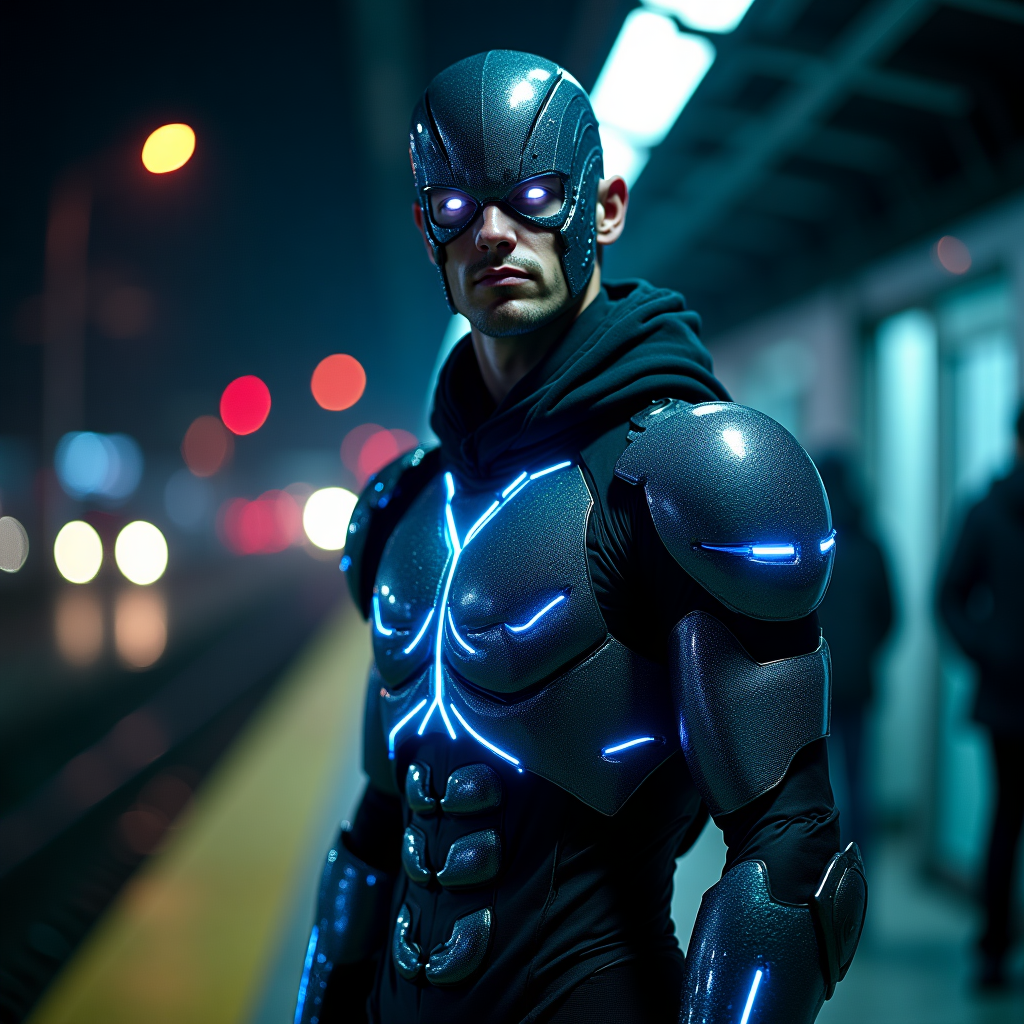



Coldwick of the Third Rail
Part One: The Boy Who Read the Fine Print
Grant Vance has always understood systems better than people.
He knows, for instance, that the NJ Transit Morris & Essex Line — the rail corridor that slices through South Orange’s historic heart like a surgeon’s incision, its catenary wires strung above the tracks at precisely 25,000 volts AC stepped down to 600 volts DC at the third rail — is older than most of the arguments people have about it. He knows the overhead wire tensions, the maintenance cycles, the average dwell time at Mountain Station during the 7:42 AM express. He knows these things because he spent six months studying them — not out of curiosity, but out of strategy, the way you study a river before you dam it.
He is twenty-two years old, white, sharp-featured, with pale eyes that tend to linger on things longer than is comfortable. He graduated twelve months ago from a mid-tier urban planning program, finished third in his cohort, and arrived in South Orange on the payroll of the Coldwick Capital Initiative with a rental agreement on a studio apartment above the dry cleaner on Irvington Avenue and a mandate he has described to exactly no one in full.
The Initiative — its principals careful to exist only as LLC strata stacked inside Delaware holding companies — has a thesis: the walkable historic villages of Essex County are sitting on a century of deferred structural maintenance, and the next several wet springs will shake that maintenance debt loose into visible, acquirable distress. Grant’s job is to map the vulnerabilities, cultivate the relationships, and be present at the moment of maximum despair with a clean offer and a short closing timeline.
He is good at his job. He is good at it the way a cold front is good at its job — not malicious exactly, but indifferent to what it disrupts, its efficiency its own kind of beauty.
What Grant tells himself, in the apartment above the dry cleaner, in the evenings when the Morris & Essex Line hums its low electrical song through the walls and the floor, is that he is a realist. That the carriage houses and Victorian commercial blocks of South Orange are not preservable indefinitely. That the people clinging to them are clinging to a tax burden dressed up as heritage. That the highest and best use of land is not a formula for cruelty but a formula for efficiency, and efficiency is the only honest language.
He almost believes it. He has been almost believing it for three years.
The humming does not stop. It is there when he wakes at 5 AM and there when he sleeps at midnight. The catenary system runs forty meters from his building. He starts, without deciding to, mapping the electrical pulse. Its rhythm. Its peaks and valleys. The surge when the 6:18 express accelerates out of Mountain Station. The brownout harmonic when two trains hold on the approach simultaneously. He maps it the way you map something that has begun, quietly, to feel like your own heartbeat.
Part Two: The Platform at 11:47 PM
It happens in December, five months before the events that will bring him face to face with Siltborn.
Grant is working late — he is always working late, the Initiative’s acquisition pipeline a living document he updates obsessively — and he has come out to Mountain Station’s commuter platform because his apartment feels too small for the arithmetic he is trying to do. The platform at Mountain Station is a particular kind of beautiful in December: the old brick station house on the uphill side, the bare-limbed pin oaks catching the sodium light, the twin rails vanishing into the dark in both directions. Essex County’s commuter infrastructure is unglamorous and specific and, on a December night with no trains due, almost peaceful.
He sits on the platform bench. The third rail is four feet from the platform edge, its protective cover a strip of gray plastic — a formality, really, for anyone who knows where to step. He knows where to step. He has always known where to step.
He doesn’t decide to touch it. He will tell himself this later. He will spend weeks examining the sequence of decisions and find, every time, that there is a gap he cannot account for — a span of perhaps three seconds between sitting on the bench and crouching at the platform edge with his palm pressed to the cover strip, and in that gap something that felt like gravity, like inevitability, like the system recognizing him the way a river recognizes a channel.
The current finds him through a hairline fracture in the cover. Six hundred volts, DC, the kind of current that should stop a heart and ignite cotton and end the arithmetic permanently.
Instead it fills him.
It floods up through his palm and into his arm and detonates somewhere behind his sternum in a cascade of crackling phosphene light — his teeth ache, his vision whites out, the December platform vanishes into a roar of blue-white electrical fire — and then settles. Settles into him like something that has been looking for a container and finally found one proportionate to its volume. He sits on the platform for a very long time. His fingertips glow faintly blue in the dark. He can hear the catenary wires above him singing their 60-cycle harmonic with a clarity that feels, improbably, like language.
He walks home. The apartment above the dry cleaner has never felt so small.
Part Three: The Education of a Live Wire
Over the following weeks, Grant learns what he is.
He learns it methodically, the way he has learned everything — through documented repetition, hypothesis testing, careful iteration. He returns to the Mountain Station platform at off-peak hours. He learns to draw on the third rail without contact, pulling the 600-volt DC charge through proximity, through the aluminum oxide layer of the cover strip, through the ground current diffusing into the platform substrate. He learns to hold it. He learns to spend it.
The crackling euphoria of the initial surge gives way to something more functional: a perpetual low-level charge that lives in him like a second metabolism. His hands conduct. His nervous system runs faster than it should. He sleeps three hours a night and wakes feeling like a transformer at full load — energized beyond what his body was built to handle, but handling it anyway, the architecture of his flesh having quietly restructured itself to accommodate what he has become.
The pharmaceutical absorption reveals itself more slowly. He is standing on the Mountain Station platform one morning during the peak commute — the 7:42 express, 340 passengers, the recycled air of the boarding rush carrying the invisible biochemical signature of everything the Essex County commuter class takes to get through the day — and he breathes in and feels something shift. A metabolic acceleration that isn’t his. A second heartbeat, exactly as precise and foreign as that sounds, arriving from the aerosol exhale of the man three feet to his left, who is on an albuterol inhaler, who will never know what he has briefly donated to Grant Vance’s pharmacological profile.
He learns to read the platforms the way a sommelier reads a cellar. Morning rush carries the beta-blockers and SSRIs of the anxious professional class; evening rush carries the analgesics and antihistamines of the tired; the weekend trains carry something looser, more diffuse, less chemically useful. He does not know the names of the compounds his body absorbs and metabolizes — he only knows the effects, catalogued over eight weeks of standing on platforms and breathing carefully: clarity, endurance, the occasional twenty-minute window of something that feels uncomfortably like joy.
He discovers the EMP capacity by accident. He is arguing — on the platform, on the phone, in January, with one of the Initiative’s principals about the timeline on a Montrose Park parcel — when his frustration spikes, the charge in him surges, and the overhead lighting for a hundred meters in either direction simply goes out. His phone dies. Three commuters’ phones die. A signal relay box on the south approach stops functioning. It comes back in ninety seconds. He hangs up. He stands in the restored light and understands, finally, that he is not a tool the Initiative has deployed in South Orange.
He is a weapon. He is deciding what that means.
Part Four: The Realist Meets the Ground
He finds out about Rohan Pillai in March.
He does not find out who he is at first — only that something is wrong with the degradation schedule. The Carriage House corner should have cracked. The Seton Hall west quad buildings should be showing the seasonal stress his consultant flagged. The Montrose perimeter basements should be wet. They are not. The spring rains are doing exactly what spring rains have always done to Essex County clay, but the buildings are not responding the way clay buildings on Essex County clay are supposed to respond.
Grant’s model is good. He trusts his model. When the model and the evidence diverge, his first instinct is not to question the model — it is to find the variable he has missed.
He starts watching the university quad at night. He brings a thermos of coffee and sits in the darkness under the pin oaks near the south perimeter, and on the fourth night he sees a sixteen-year-old boy in a dark hoodie crouching in the rain, pressing his palms to the earth. He watches the geological transformation rise through the boy — the layered volcanic-clay architecture building itself across the teenager’s arms and torso, the living sedimentary plates articulating across his chest, the soil itself climbing into human form — and understands the variable he has been missing.
The anger, when it arrives, surprises him with its clarity. It is not the hot anger of someone who has been wronged. It is the cold, crystalline anger of someone who believes in a system and has found that the system is being cheated. Grant Vance has built his professional life on the reliable physics of structural failure, and this boy from Ridgewood Road is bending those physics by hand.
He thinks: the kid doesn’t understand what he’s preserving. These buildings will fail eventually. The soil will give eventually. Delaying the inevitable doesn’t protect South Orange — it puts off the reckoning while the tab grows. What Grant Vance is offering isn’t destruction. It is honest succession. One era making way for another. Progress as a form of respect for what can’t last.
He stands in the sodium light and watches Siltborn work and tells himself this story until he almost believes it. His fingertips glow faintly blue in the dark. The catenary wires above the tracks two blocks north hum their 60-cycle song, and he breathes in, and breathes in, and becomes Coldwick completely.
Part Five: Live Rail
The confrontation comes on a Thursday evening in late April — the same Thursday, the same quad, the same sodium light.
Rohan feels the intrusion first: a pressure spike driving upward through the aquifer, deliberate and architectural, methodical in the way that only a planned thing can be. He runs toward the oldest building on the south perimeter, and when he sees Grant Vance standing at the quad’s edge in his dark jacket, the Initiative’s clean logic written in his pale, sharp face, the blue glow already crawling from his knuckles to his wrists, Rohan stops.
They have not met before. They have been circling each other for eight weeks without knowing it.
“You’ve been stabilizing properties on my acquisition list,” Grant says. His voice is exactly what Siltborn expected: even, academic, the voice of a man who has rehearsed himself into believing the arithmetic is the argument. “Do you know what happens to a Victorian building on liquefied Essex County clay if you don’t intervene? It fails. And then someone builds something that meets code. That’s not a tragedy. That’s the cycle.”
“The cycle,” Rohan says, and his voice carries that low harmonic resonance, the acoustic architecture of his transformation giving every word a quality of something spoken from below the floor. “You mean the one where you’re standing at the bottom waiting to buy.”
Grant releases the aquifer pressure — a calculated spike, aimed at the 1856 foundation stones twenty meters behind Siltborn. Rohan drives his hands into the ground and compresses it back. The soil holds.
And then Grant does something Rohan doesn’t expect.
He doesn’t try the aquifer again. He reaches upward instead — not literally, but energetically, drawing on the catenary current that runs two blocks north along the Morris & Essex corridor, pulling 600 volts DC across proximity and air and the specific conductive geometry of his transformed body. The charge floods through him, his teeth aching with it, his fingertips blazing blue, and he pushes it outward in a directed pulse — not at Siltborn directly, but at the perimeter lighting, at the relay boxes along the quad’s east side, at the modern structural monitoring sensors that Seton Hall’s facilities team installed last October.
The three-block radius goes dark.
The spring evening becomes, in an instant, something older than its infrastructure. The pin oaks against the black sky. The distant sound of the 9:18 express decelerating into Mountain Station. The quad in darkness except for the blue glow coming from Grant Vance’s hands, casting no warmth at all.
“Without those sensors,” Grant says, “no one knows the building is in distress. Without the lights, no one sees what happens next. I don’t need the aquifer, Pillai. I just need you not to be able to see what I’m doing until it’s done.”
“You know my name,” Rohan says.
“I’ve been watching you for eight weeks.”
Rohan does not need the lights. He has never needed the lights. He kneels and presses both palms to the ground of the Seton Hall quad and reads everything: the pressure gradient from the aquifer, the harmonic resonance of the 9:18 express transmitted through two blocks of Essex County glacial till, the acoustic signature of every stressed mortar joint in a forty-meter radius, the particular vibration of the 1856 foundation stones under the EMP’s electromagnetic interference. He compacts, redirects, reinforces — all of it, simultaneously, in the dark. The soil holds. The building holds. The monitoring sensors are dead but the structure they were monitoring is fine.
Grant projects the EMP again, deeper this time, pulling more from the catenary — too much, a surge that makes the air around him crackle and smell of ozone, that makes the leaves of the pin oaks vibrate at the wrong frequency. His body absorbs the overcharge badly. The charge that was meant to project outward folds back into him instead, the crackling euphoria curdling into something adjacent to pain, his nervous system running faster than it should, his vision phosphene-white at the edges.
He has drawn on too much. The platform pharmacology is wearing thin — the metabolic boost from the morning’s 7:42 express long since metabolized, the beta-blocker residue from the commuter crowd’s exhaled chemistry no longer buffering the overload. He is, under the cold blue glow and the dark jacket, a twenty-two-year-old man who has been awake for nineteen hours, running on six hundred volts and borrowed biochemistry, standing in the rain in the quad of a university he never attended, arguing with a teenager about the meaning of progress.
“You can’t do this forever,” he says. His voice is still even. He is proud of that.
“The ground’s been doing it for two hundred years,” Rohan says, from somewhere in the darkness to his left. “I’m just helping.”
Grant walks away. Not defeated — he refuses the word, turns it over and sets it down. Recalculating. Amending. He walks south through the Seton Hall perimeter, through the gate on South Orange Avenue, past the closed face of Pellington’s Hardware and the dark windows of the Blue Elm Café, past Mountain Station where the catenary sings its 60-cycle harmonic into the wet April air. He stops at the platform edge and stands in the electrical field and lets the charge refill him — the crackling euphoria returning, the ache in his teeth that has come to feel like a greeting.
He looks north along the tracks. The rails vanish into the dark toward Maplewood, toward Newark, toward everything Essex County connects to. The overhead wires carry enough current to power a municipality. The platform carries, in its recycled air, the pharmacological residue of ten thousand daily commuters.
He thinks: the boy is strong. The boy reads the ground faster than anyone has a right to. But the ground is fixed — it answers only the variables it has been given. The rail system is dynamic. New trains, new routes, new voltage loads, new pharmaceutical profiles every morning. The ground is a library. The rail is a river.
Grant Vance, who calls himself Coldwick, after the Initiative that made him and after the cold clarity he has mistaken for wisdom, stands on the Mountain Station platform in the late April dark and begins revising his model.
The foundations of South Orange hold, tonight, against what he has brought to them. He is already calculating what he will bring tomorrow.