
Corriente
Part One: The Girl Who Reads the River
The Delaware River does not sleep. Even at three in the morning, when the rest of Camden holds its breath between the last NJ Transit bus and the first gray light over Philadelphia, the river moves — dark and purposeful, carrying memory the way it carries silt: invisibly, in everything.
Marisol Vega knows this the way she knows her own heartbeat.
She is sixteen, a junior at Camden High School, and she has lived her whole life in the Waterfront South neighborhood, close enough to the river that she can smell it change with the seasons — iron and cold in February, thick with algae and boat exhaust in July. Her abuela called the Delaware la corriente que no descansa — the current that never rests. Marisol used to think it was just an old woman’s poetry. She doesn’t think that anymore.
She is not a straight-A student, not a troublemaker, not a star of anything. She is the girl who volunteers at the Adventure Aquarium on weekends, who knows the name of every nurse shark in the touch tank, who takes the long way home so she can walk the waterfront esplanade and watch the tugboats push barges past the Battleship New Jersey like they are nudging a sleeping giant. She is the kind of person a city produces when it has been through enough to stop making anyone ordinary.
Her mother works two shifts — one at Cooper University Hospital, one at a laundromat on Kaighn Avenue. Her father is in Trenton, not the capitol kind of Trenton. Their apartment on Riverside Drive smells like plantains and Pine-Sol and the faint chemical ghost of the old industrial waterfront that no amount of revitalization has fully washed away.
Camden is her city. She has never once thought of leaving it.
Part Two: What the Shipyard Remembered
The accident — if it can be called that — happens on a Tuesday in April, the kind of evening when the river catches the last light and turns it bronze.
Marisol is not supposed to be inside the old Port of Camden maintenance facility. No one is supposed to be inside the old Port of Camden maintenance facility. The rusted gate at the end of Beckett Street hangs open the way things do when the city has bigger problems, and Marisol has followed a pair of laughing sophomore boys inside on a dare she didn’t technically accept, just didn’t walk away from. She is sixteen and stubborn and sometimes that is enough.
The building is a cathedral of industrial decay: corrugated walls sweating rust, crane tracks running overhead like iron ribs, and beneath the cracked concrete floor, something that hums. Marisol can feel it in her sneakers before she can hear it.
The Port of Camden has a complicated relationship with what it once was. For most of the twentieth century, the New York Shipbuilding Corporation — The Yard, locals called it — built warships and ocean liners here. When The Yard closed in 1967, it didn’t just leave behind unemployment. It left behind something older: the electromagnetic and chemical residue of decades of arc welding, experimental hull treatments, and classified naval contracts that never made it into any public record. The ground remembers what the documents don’t.
Beneath the maintenance facility, a forgotten drainage channel connects directly to the Delaware. Decades of tidal cycling have done something strange to the water that moves through it — mineralized it, charged it, woven it through with dissolved metals and the long ionic memory of ten thousand welding arcs. When the floor gives way under Marisol’s foot — a section of concrete no thicker than a dinner plate over a collapsed culvert — she falls four feet into that channel, and the water closes over her like a fist.
She is underwater for eleven seconds. She counts them later, backward, from the inside.
When she pulls herself out, coughing and furious, the sophomore boys are already gone. She is alone, soaked in Delaware River water that glows faintly around her hands — blue-white, the color of a welder’s arc — and then doesn’t. She stares at her palms. The glow fades. Her heartbeat doesn’t.
Part Three: La Corriente
It takes her three weeks to understand what she has become.
The water in her body has changed. Not metaphorically — literally, at a cellular level, the charged mineral solution she absorbed in that culvert has rewired the bioelectrical field of her nervous system. She can feel currents now: the flow of water through pipes beneath Haddon Avenue, the charge differential between the Delaware’s surface and its riverbed, the electromagnetic hum of NJ Transit’s River LINE tracks running along the waterfront. These are not impressions. They are as clear to her as color is to anyone else. A new sense, as natural as sight.
And she can push back.
The first time it happens deliberately, she is at the aquarium, alone in the utility corridor after hours, running a mop over tile. She holds her hand over a floor drain and pulls — and a thin column of water rises out of it, trembling, reaching for her palm like a compass needle finding north. She holds it there for ten seconds, then lets it fall. She doesn’t drop the mop.
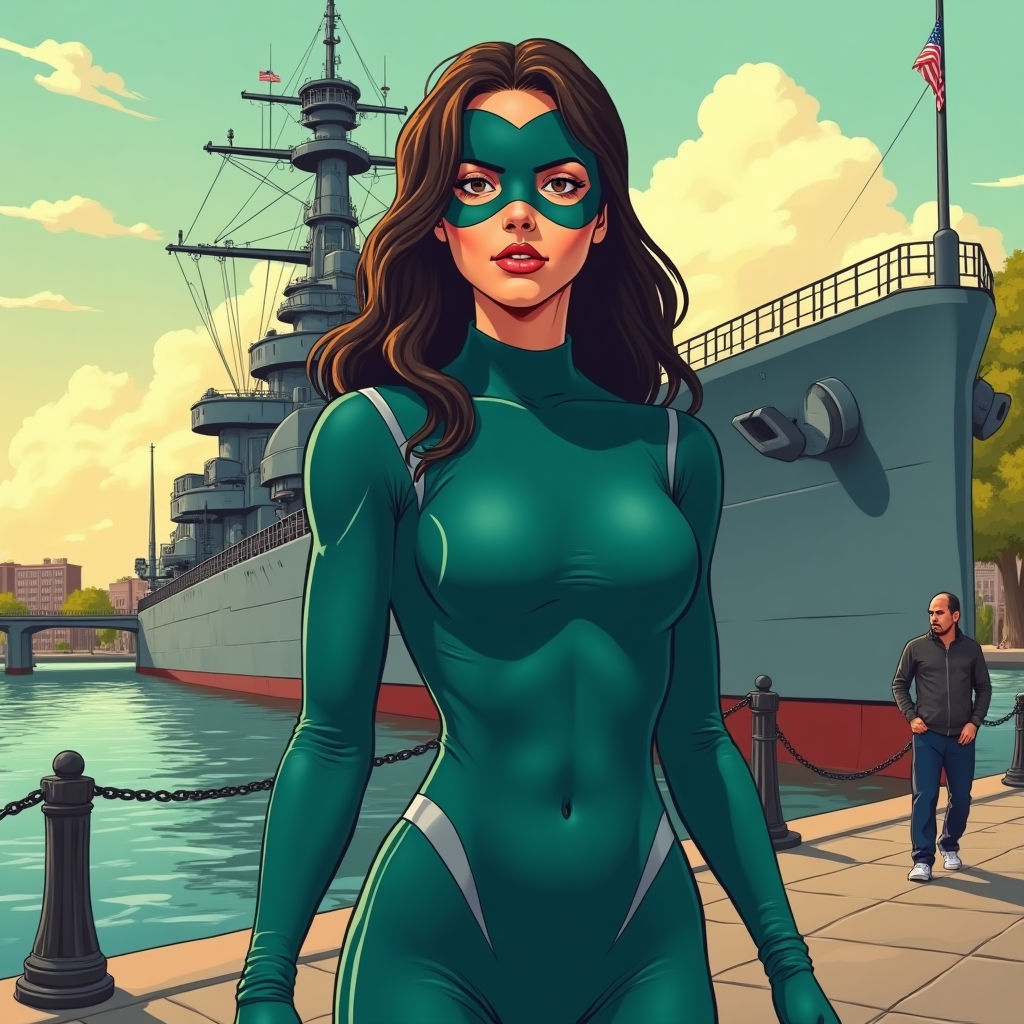
The second time, she is at the waterfront esplanade near the Battleship New Jersey, and a drunk man in a Dodge pickup has jumped the curb and is sliding toward a family of tourists. Marisol doesn’t think. She pushes — through the ground, through the water table, through the charge in the soil — and the truck shudders to a stop as if the earth itself has grabbed its axle. It has, essentially. The family runs. The drunk man passes out. Marisol walks away fast, heart hammering, exhilarated and terrified in equal measure.
She calls herself Corriente the first time she tells anyone, which is her abuela, alone in the kitchen at midnight over instant coffee. Her abuela listens to the whole thing without interrupting, then says, La corriente que no descansa. And nods.
She builds her own suit over four weeks: deep blue-green compression fabric from a sports surplus store on Route 130, silver-grey piping she sews herself, a mask that covers her eyes and nose. She looks like the river at dusk. She intends to.
Part Four: The Architect of Erasure
His name — their name — is Cassian Dray.
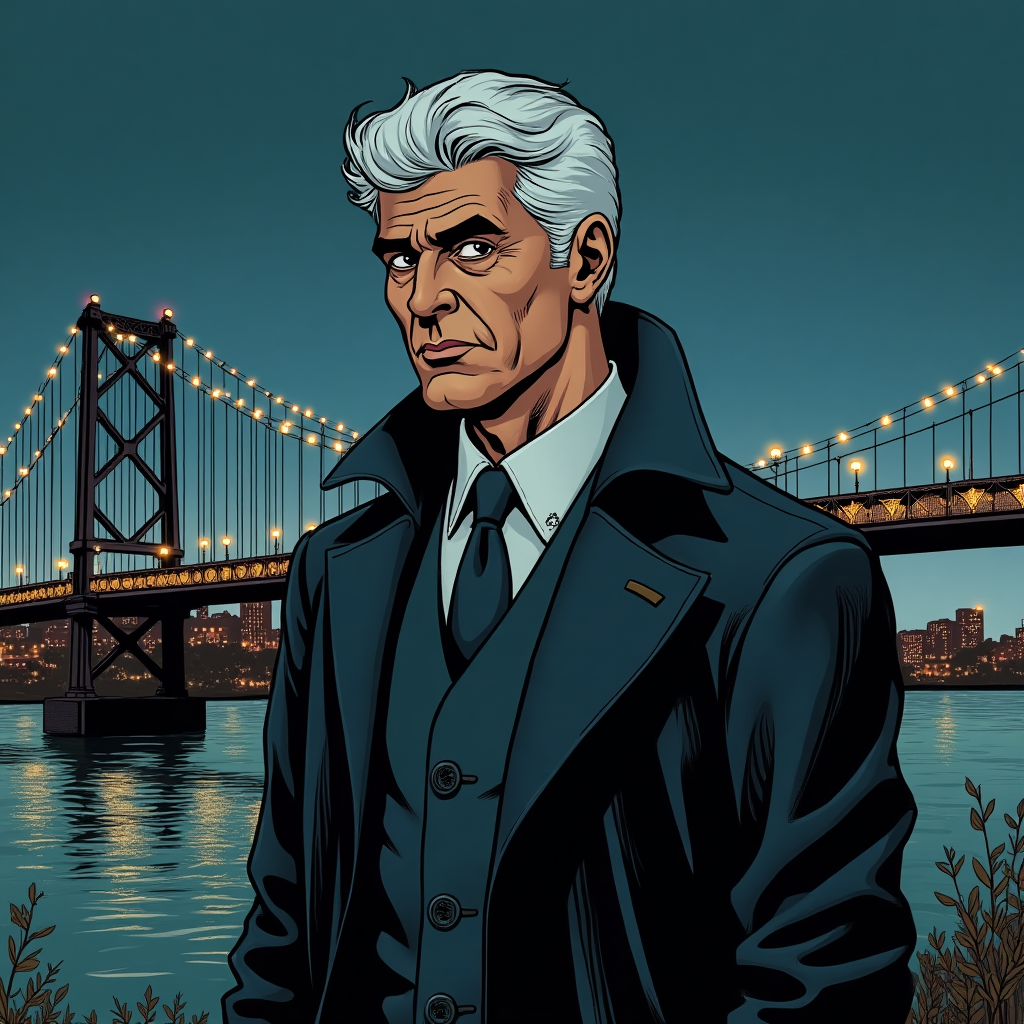
Sixty-three years old, multiracial, nonbinary, silver-haired, with the kind of face that looks simultaneously exhausted and amused by everything, Cassian Dray came to Camden fifteen years ago as the director of a private urban redevelopment consultancy called Meridian Civic Partners. They arrived with TED Talk polish and a gift for quoting James Baldwin at zoning board meetings. They said the right things about community investment, about lifting the city by its own history rather than erasing it.
They lied.
Meridian’s actual model — which Marisol pieces together from records pulled from a Rutgers-Camden law school archive by a sympathetic professor after she drops a water glass and reflexively catches it without touching it, which is the moment the professor figures out who she is — is displacement by design. Buy up flood-risk-zone land cheap using shell corporations. Sit on it. Lobby quietly for federal infrastructure funds that reroute them away from existing neighborhoods. Create the conditions for blight. Then develop.
The Port of Camden maintenance facility is Meridian’s next acquisition target. The collapse that gave Marisol her powers was not entirely accidental — Meridian had been running unlicensed groundwater tests beneath the site, trying to determine if the charged aquifer beneath the old Yard could be commercially harvested as an industrial coolant. They knew the culvert was unstable. They tabled the safety report.
Cassian Dray knows about Corriente before Corriente knows about Meridian. They have city hall contacts and a private investigator and the particular attentiveness of someone who has been running a long con and learned to notice disruptions. When a teenager in a blue-green mask stops a truck with what appears to be a localized seismic event on the waterfront, that is a disruption.
They send a message through intermediaries: Stop interfering with things you don’t understand. Camden is being helped. The message arrives slipped under Marisol’s apartment door. No name. Just a Meridian letterhead she has to Google.
Then she finds the safety report. Then she is done being warned.
Part Five: Current Against Stone
The confrontation happens at Gateway Park, where the Delaware River Walk meets the shadow of the Walt Whitman Bridge. It is eleven at night. Cassian Dray is there with two private security contractors and what they clearly believe is enough leverage — documents, photographs of Marisol’s face and address, the implication of consequence. They wear a charcoal coat and stand with the bridge lights turning their silver hair into something almost regal. They are not physically threatening. They are the other kind.
“You’re a child,” Cassian says, not unkindly. “With a gift you barely understand. And I’ve been reshaping cities since before your mother was born.”
Marisol stands at the river’s edge and feels the Delaware behind her the way she always does: enormous, patient, inexhaustible. She can feel the tidal charge in the bank, the iron content in the bridge’s foundation pilings, the water running beneath the park’s crushed-gravel path. She is connected to all of it.
“You knew that culvert was going to fail,” she says. “You knew someone could get hurt.”
“And instead,” Cassian replies, almost gently, “someone got improved. The city does that, if you let it.”
The security contractors move. Marisol moves faster.
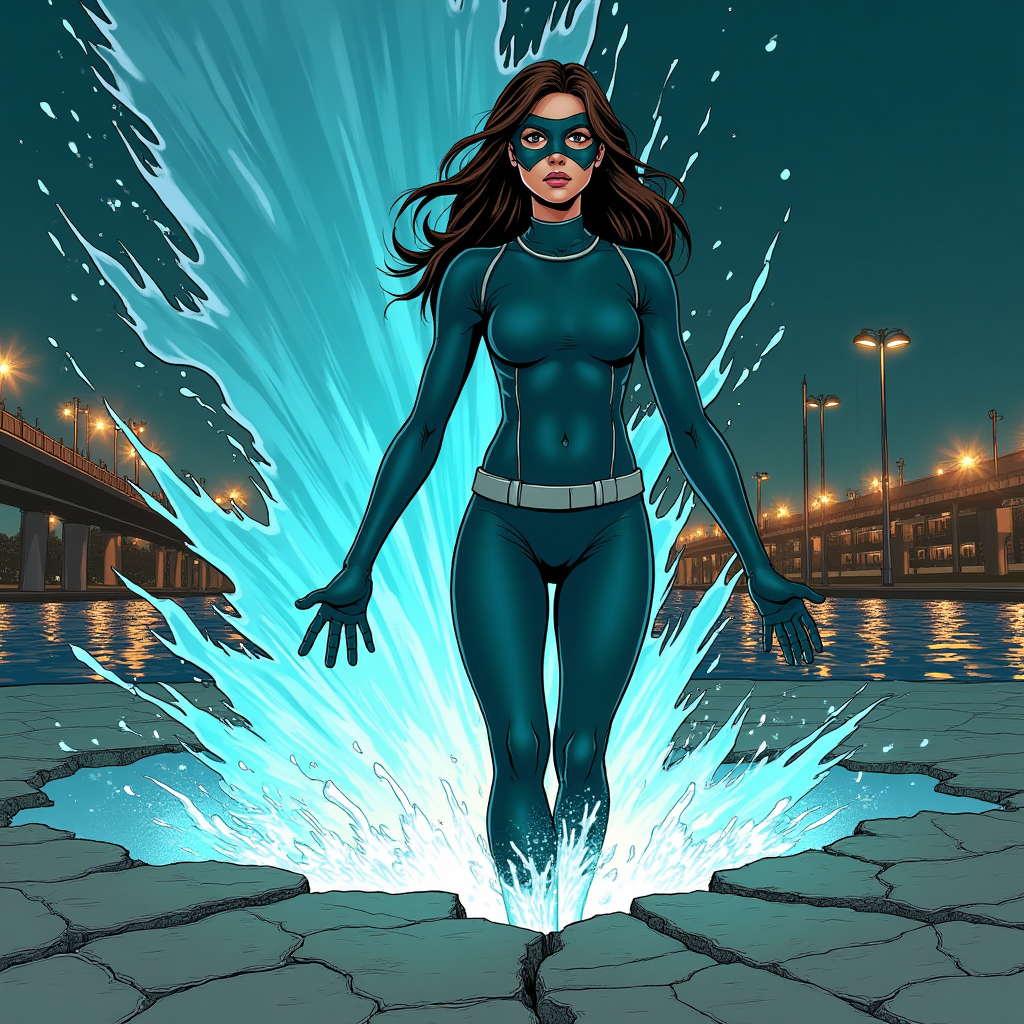
She drives a pulse through the riverbank that cracks the esplanade pavement in a line straight toward them — not at them, past them, a demonstration. A geyser of Delaware water erupts from the break, eight feet high, catching the bridge light and holding it, blue-white and shimmering, like an arc welder’s flame made liquid. The contractors stop. The water hangs there for three full seconds.
Then Marisol lowers it.
“I’m not improved,” she says. “I’m from here.”
She doesn’t arrest Cassian Dray — she is sixteen and that is not how it works. But the Rutgers-Camden law clinic professor gets an encrypted file the next morning, containing the groundwater tests, the safety report, and the shell corporation records. Meridian Civic Partners is served with a state investigation notice before the week is out. Cassian Dray leaves Camden. They will be back — Marisol knows the way a river knows that it always meets the sea again — but not yet.
She walks home along the waterfront esplanade. The Battleship New Jersey sits enormous and gray in the early morning light. A tugboat pushes something south toward the port. The river moves around everything, through everything, the way it always has, carrying memory in solution.
La corriente que no descansa.
Corriente doesn’t sleep either. Not much, anyway. She has school in four hours.