
CORRIENTE
Part One: The Man Who Held the Crossroads Together
Ernesto Villanueva has lived in Jersey City for fifty-seven years, which means he has lived in the crossroads for fifty-seven years. He was born on Manila Avenue in the old Greenville neighborhood, the son of a Puerto Rican dockworker and a Colombian schoolteacher, and he has watched the city shift and breathe like a living thing — the ports filling and emptying, the PATH trains rattling under the Hudson, the faces on Newark Avenue changing language by language, generation by generation.
He drives NJ Transit Bus Route 10 six days a week. He knows every pothole on Communipaw Avenue. He knows when the Hudson River fogs up so thick you can’t see the Colgate Clock from the Paulus Hook waterfront. He knows which corner of Journal Square fills with pigeons in the morning and which corner fills with commuters, and he knows that by 7 a.m. those categories overlap. He is a man made of routes and rhythms. He does not think of himself as anything other than ordinary.
He is wrong about that.
Jersey City is a city of impossible convergence. Forty languages in fifty-two percent of homes. The Holland Tunnel on one end, Port Jersey on the other. Dutch colonial roots beneath Irish and Italian and Cuban and South Asian and Filipino and Dominican layers, pressed together like sedimentary rock by two centuries of tide and commerce. Ernesto does not know it yet, but the city has been building toward him for a long time. It needs someone who can hold all of it together. It has chosen its conductor carefully.
Part Two: The Night the Derailment Shook the Ground
It begins on a Tuesday night in mid-April, when a freight train jumps the tracks near Tonnelle Avenue in North Bergen, just over the Jersey City line. The derailment spills something into the ground — not oil, not chemicals the hazmat reports can name, something the investigators quietly and nervously call anomalous aquifer material, a phrase that gets buried in a paragraph on page eleven of a report very few people read.
What actually spilled was older than the rail line. Older than the Dutch. The freight car had been transporting sealed core samples pulled from deep-bore survey work beneath the Hackensack Meadowlands — geological memory, compressed time, the stratigraphy of ten thousand years of Hudson estuary compressed into cylindrical plugs of sediment. When the seal ruptured, the material didn’t leak into the groundwater so much as join it, following old channels and buried stream beds south and east, threading through the infrastructure of Jersey City the way electricity finds copper.
Ernesto is driving his last run of the night — Route 10, westbound, approaching the Hackensack River crossing — when the bus shudders. Not a mechanical shudder. Something deeper. He feels it in his teeth, in his sternum, in the soles of his feet pressing the brake pedal. The river under the bridge seems to pulse, a slow blue-green luminescence rippling downstream toward Newark Bay. Then the feeling hits him: current. Not electrical. Not metaphorical. Something between tidal force and transit signal, moving through him like he has become part of the grid.
He pulls the bus over. He grabs the door handle. The metal hums.
By the time he steps off the bus into the cold April air, Ernesto Villanueva is already changing.
Part Three: The Crossroads Speaks
It takes two weeks for him to understand what he has become. The changes are not dramatic at first — he feels the PATH trains before he hears them, a low magnetic hum that tells him which platform is active, which line is delayed, which tunnel carries a vibration that doesn’t belong. He puts his hand on the iron fence outside the Liberty State Park terminal and feels the whole port system breathe. He stands at the corner of Grove and Newark Avenue on a Saturday and feels the footfalls of ten thousand people as a kind of music, a city-scale heartbeat.
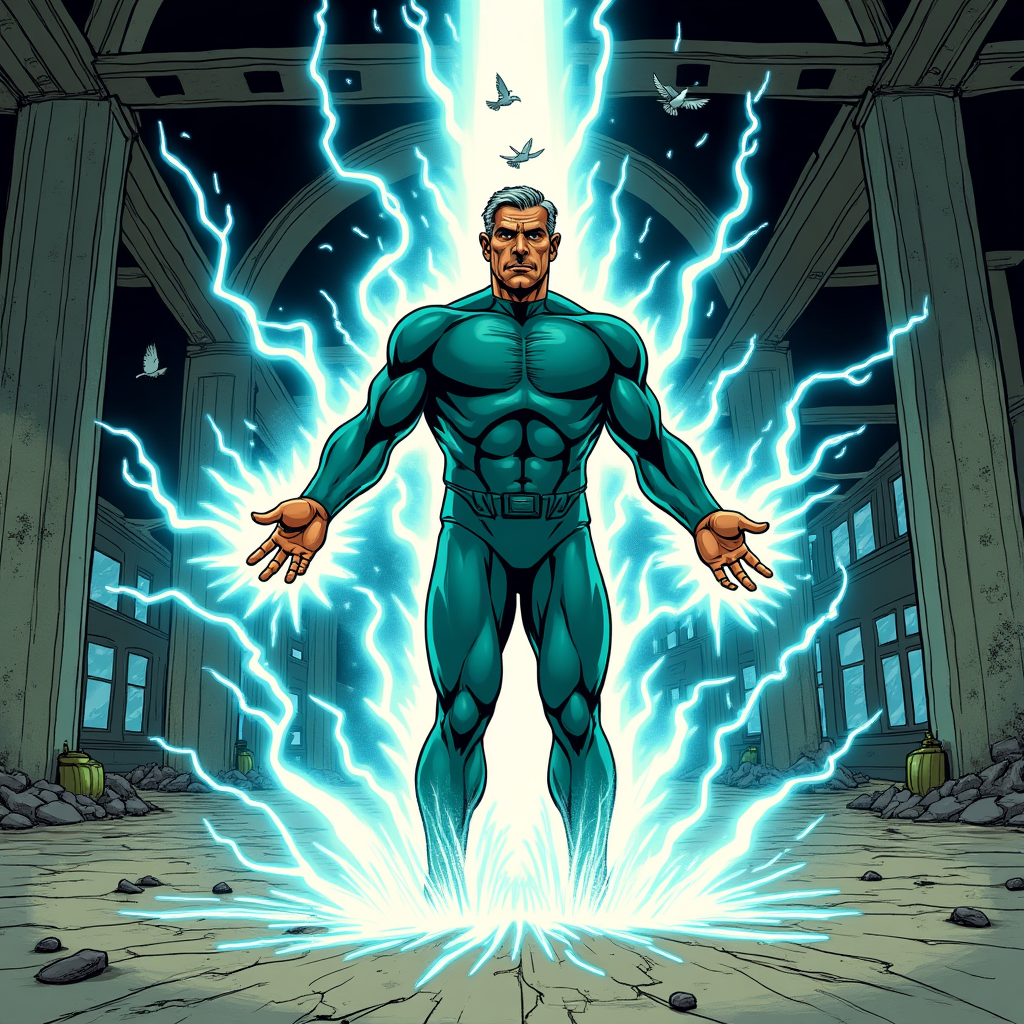
Then comes the day he stops a crane collapse at the Port Jersey container terminal. He is off-duty, buying coffee near the Port Jersey waterfront, when he feels the catastrophic wrongness in the metal above him — a structural failure propagating through the crane’s arm at a frequency he can’t hear but absolutely feels. He doesn’t think. He runs to the base of the crane and presses both palms to the steel. The energy that pours out of him is blue-white and crackling, a counterwave that floods the failing superstructure with stabilizing force, each molecule of steel suddenly singing at the right pitch. The crane shudders. The collapse stops. Three dock workers who were directly beneath the arm walk away confused and shaking.
Ernesto walks away knowing what he is.
He is the transit. He is the convergence. He is every channel and current that runs through Jersey City — water, rail, road, tide, signal, the invisible rivers of movement that keep a port city alive. He takes the name Corriente from the Spanish: current. Flow. The force that moves through things and holds them together.
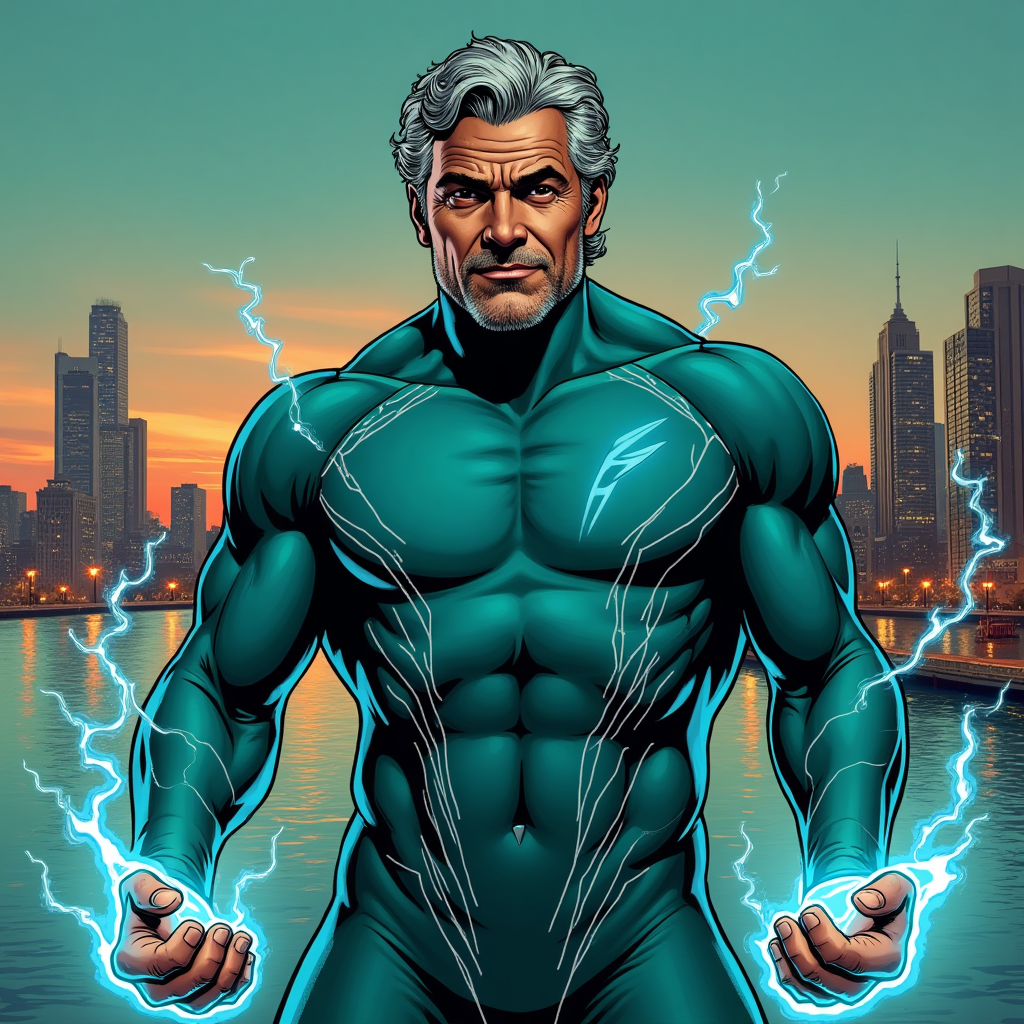
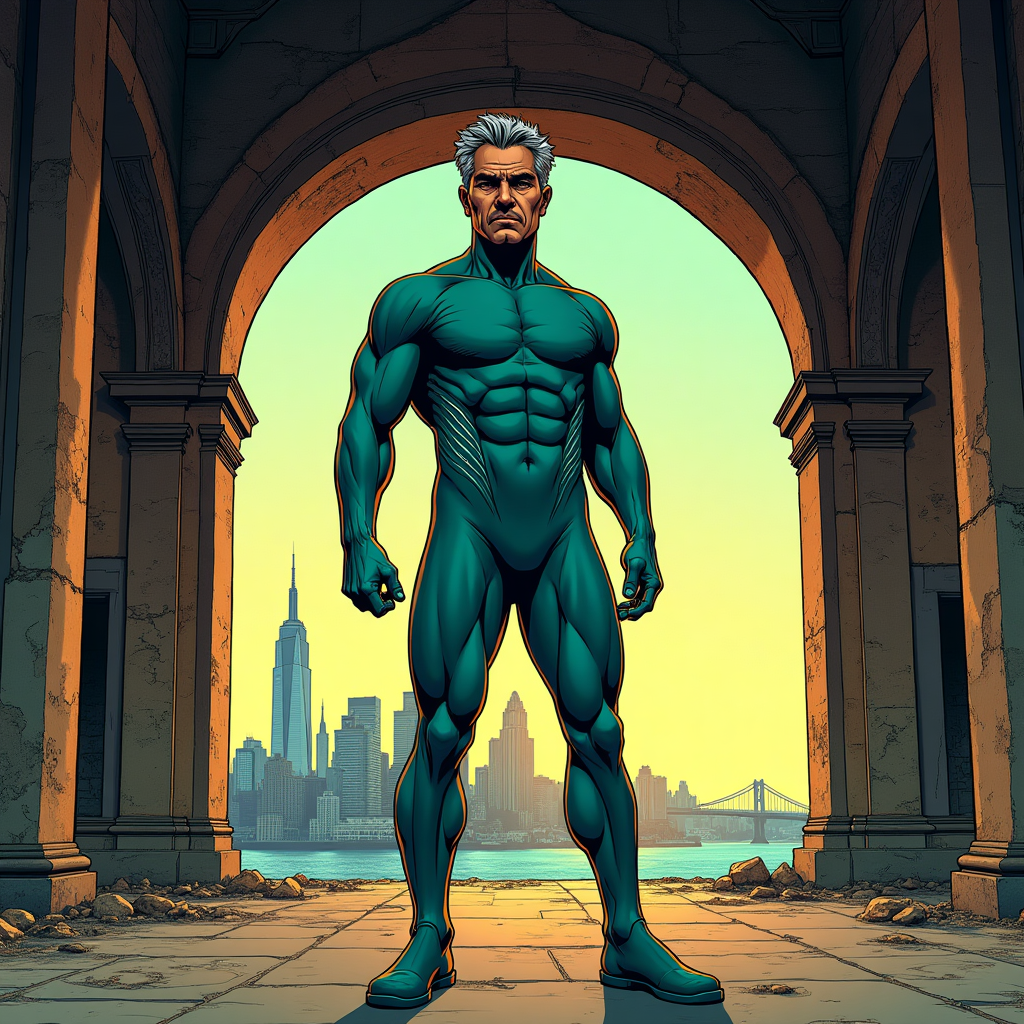
His costume is the color of the Hudson at dusk — deep teal with currents of silver threading from shoulder to hip, reflecting the geometry of the PATH system map. He moves through the city’s infrastructure the way water moves through pipe: inevitable, purposeful, finding every passage.
Part Four: The Architect of Stillness
Her name is Priya Sehgal, and she is thirty-two years old, and she wants Jersey City to stop.
Not destroyed. Not harmed. Stopped. Priya is a brilliant urban systems analyst who came to Hudson County six years ago to work for Halverson Infrastructure Partners, a private development consultancy that has been quietly acquiring former industrial waterfront parcels across the port district. She wrote the algorithm that models population flow, transit load, and real estate pressure as a single system. She is possibly the sharpest mind ever to study Jersey City’s circulatory architecture.
And she has concluded that the city’s diversity, its density, its radical openness — the very things Ernesto embodies — are what make it unstable. Too many languages. Too many competing claims. Too many routes converging in one place. In her model, the city is not a marvel. It is a fault line.
She calls herself Nulltide, and her power is the inverse of Corriente’s. Where he amplifies flow, she cancels it. She can generate localized entropy fields — zones of pure stasis where current stops, signals die, infrastructure freezes. She discovered this ability three months before the derailment, during a solo late-night survey of the old Central Railroad of New Jersey terminal, when she pressed her hand to a rusted rail and felt something ancient and cold move into her — the absence beneath the tide, the geological silence under all that geological memory.
Her plan is elegant and terrible: she intends to use Halverson’s waterfront parcels to deploy a network of entropy nodes beneath the port district, creating a permanent stasis field that will freeze Jersey City’s transit infrastructure, collapse its economic function as a port and transit hub, and — in the resulting vacuum — allow Halverson to remake the waterfront as a controlled, privately managed enclave. Fewer routes. Fewer people. More predictable. More profitable.
She does not think of herself as a villain. She thinks of herself as an engineer correcting an overloaded system.
She is wrong about that.
Part Five: Current Against the Tide
The confrontation happens at the Central Railroad of New Jersey terminal in Liberty State Park — the great ruined hall of the old port, the terminal through which millions of immigrants passed on their way into America, its iron bones still standing above the Hudson. Priya has chosen it deliberately. It is the oldest convergence point in the city. If she can anchor her primary entropy node here, the stasis field will propagate outward through the rail and water infrastructure like a killing frost.
Corriente feels her the moment she begins. He is on the 7 a.m. Route 10, hands on the wheel, when the transit grid goes wrong in a way that has no mechanical explanation — a deep, spreading silence moving from the direction of the park. He pulls the bus to the curb on Audrey Zapp Drive and runs.
He finds Nulltide in the main hall of the terminal, her hands pressed to the iron floor, entropy crackling outward from her in colorless waves that bleach the air of sound and motion. The pigeons nesting in the terminal’s rafters hang suspended mid-flight. The Hudson, visible through the broken walls, has stilled to glass.
“You’re killing the current,” Ernesto says. His voice echoes in the impossible silence.
Priya looks up. She is not surprised. “I’m regulating it,” she says. “This city is unsustainable. It has too many inputs and not enough control. I’m giving it order.”
“You’re giving it a tomb.”
He presses his palm to an iron pillar. The energy that comes out of him is everything the city carries — forty languages of footfall, the percussion of the PATH, the tide-pulse of the Hudson against the seawall, the truck-rumble of Route 1&9, the morning crowd at Journal Square, the fog-horn of a container ship clearing Port Jersey. He floods the terminal with it. Not to destroy her node. To outrun it. Current always finds a path.
The entropy field fractures. The pigeons explode back into motion, a chaos of wings in the old terminal light. The Hudson shudders back to life against the pilings. Nulltide is thrown backward, her field collapsing inward, and she hits the iron wall hard, sliding down it, breathing fast, staring at him with something that is not quite defeat and not quite understanding.
“The city doesn’t need a manager,” Corriente says, standing in the broken light of the old terminal, the Hudson glittering behind him through the empty window frames. “It needs a conductor.”
She is taken into custody. Halverson Infrastructure Partners falls under state investigation before the week is out. The entropy nodes are removed from the waterfront parcels by a hazmat team that files a report using the phrase anomalous geological material — on page eleven, where few people read it.
Ernesto Villanueva takes the 7 a.m. Route 10 the next morning. He knows every pothole on Communipaw Avenue. He feels the PATH trains before he hears them. The city hums in his bones.
He is the crossroads. He is the current. He is home.