

CORRIENTE
Part One: The River Remembers
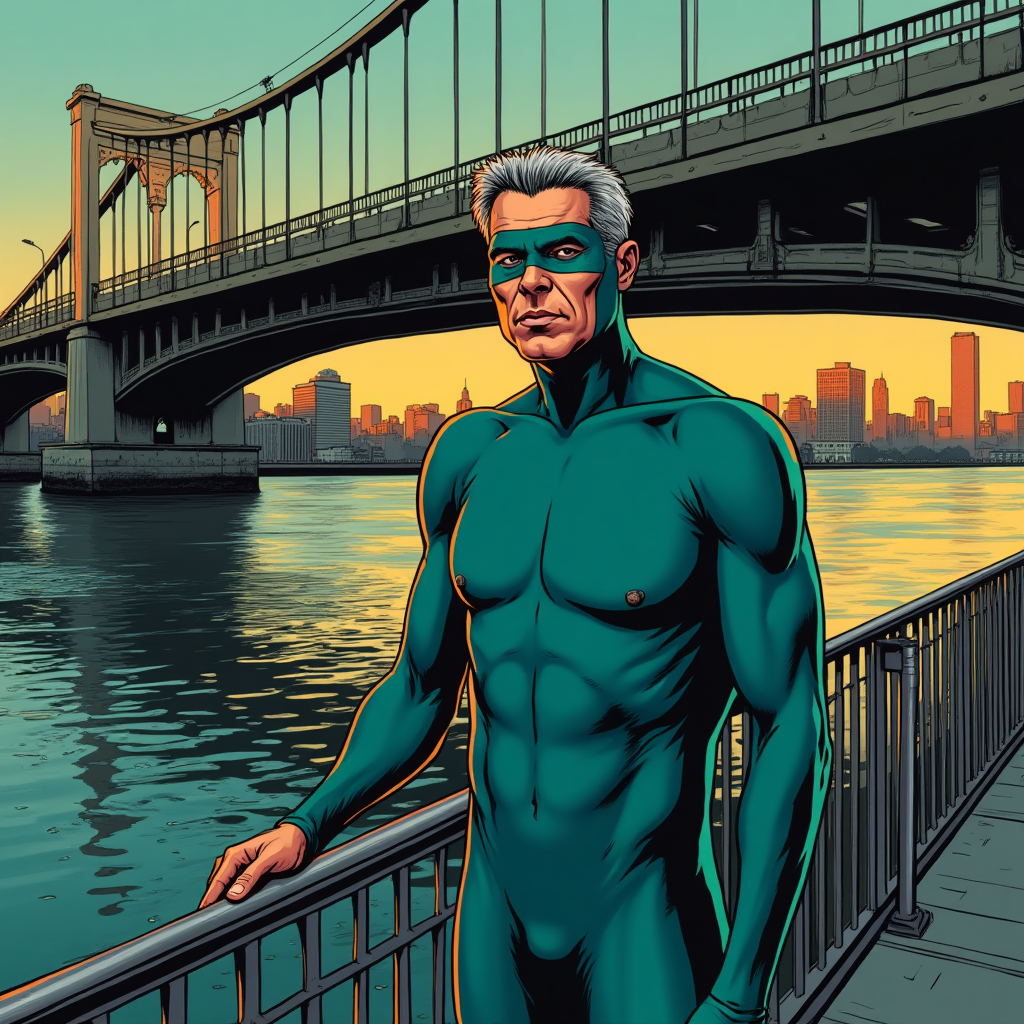
The Raritan moves slow and dark beneath the Albany Street Bridge in April, carrying snowmelt from the highlands, sediment from a dozen tributaries, and the accumulated memory of three centuries of industry. Teodoro Vásquez-Mena has crossed this bridge ten thousand times — on foot, on a borrowed bicycle, once in a cab during a blizzard that buried the Northeast Corridor under two feet of white silence — and every time, they pause at the railing to watch the current.
Teo is fifty-eight years old, broad-shouldered and deliberate in the way of someone who has spent decades listening more than speaking. Their silver-streaked black hair falls past their collar, and their hands — calloused from years of fieldwork before the lab, soft now from pipettes and keyboards — grip the railing with the ease of long habit. They are a senior research hydrologist at the Raritan Basin Environmental Institute, a university-adjacent research center tucked between two glass towers on George Street, and they have spent the better part of three decades studying the Raritan River’s chemistry, its moods, its long and complicated relationship with the humans who built a civilization on its banks.
New Brunswick is their city. Not by birth — Teo was born in Bayamón, Puerto Rico, came to Rutgers at nineteen on a merit scholarship, and simply never left — but by choice, which is the truer kind of belonging. They know the Court Tavern’s Tuesday regulars by name. They know which corner of Elmer B. Boyd Park floods first after a nor’easter. They know the smell of the Raritan in spring, mineral and alive, and the smell of it in August, when the heat presses down and the water turns brackish and strange.
What they do not know — what no one knows yet — is what the river is about to give them.
Part Two: The Spill at Pier Fourteen
The crisis begins on a Tuesday evening in mid-April, three days after a subsidiary of Coronal BioSynth Group — a pharmaceutical logistics firm operating out of a converted warehouse complex along the waterfront south of the Basilone Memorial Bridge — suffers a catastrophic failure in its temperature-controlled holding tanks. The company’s night crew, skeleton-staffed and undertrained, attempts to manage a rupture in a pressurized bioreactor conduit without triggering the mandatory environmental reporting protocol.
They fail at both tasks.
Forty thousand liters of experimental enzymatic compound — a proprietary nanobiotix precursor solution under early-stage clinical evaluation, intended for targeted cellular repair — flows through a cracked secondary containment wall and drains, via a corroded storm outfall, directly into the Raritan.
Teo gets the call at 11:47 p.m. By midnight they are at the riverbank with a field kit, wading into the shallows in chest waders, pulling water samples in the beam of a headlamp. The water feels different. Not wrong, exactly — not the slick wrongness of crude oil or the acid bite of industrial runoff — but charged, almost effervescent, as though the river itself is humming at a frequency just below hearing.
They are halfway through their third sample collection when the bank gives way.
The collapse is sudden and total — a section of eroded riprap undermined by the abnormal flow pressure, and Teo goes in without time to brace. The current takes them downstream fast, the cold a physical shock, and then the outfall plume closes over them and the world becomes dark water and the sensation of something enormous and ancient pressing into every cell of their body at once.
They do not lose consciousness. That is the strange part, they will think later. They should have. Instead, they feel the river — truly feel it, the way you feel a song in your sternum — and the river feels them back.
Part Three: What the Water Made
Teo surfaces downstream, gasping, dragging themselves onto the mudflat beneath the Donald and Morris Goodkind Bridges. They lie on their back in the April dark, staring at the orange-grey sky above New Brunswick, and feel the change moving through them like a slow tide.
It takes two weeks to understand what has happened. Two weeks of calling in sick, of lying on the bathroom floor while their nervous system rewrites itself, of watching the tap water arc toward their outstretched hand like a compass needle finding north. The enzymatic compound — they piece this together from their own expertise and from stolen glimpses at Coronal BioSynth’s leaked internal documentation — was designed to enhance cellular membrane permeability in targeted tissue. In the concentrations Teo absorbed, immersed in the outfall at the moment of the spill’s peak saturation, it has done something far more radical.
They can feel water. All of it. The moisture in the air over the Raritan Valley, the water table beneath College Avenue, the pressurized mains running under George Street and Albany Street and the whole humming grid of the city. They feel it the way a musician feels rhythm — not as data but as presence, as relationship.
And they can move it.
Not wildly. Not with the brute spectacle of a hurricane. Teo is a scientist; they approach the new ability the way they approach every research problem: methodically, with controls, with written notes. They learn that they can redirect water pressure through infrastructure — subtly reshuffling flow through the city’s pipe network. They can draw moisture from the air into coherent streams and direct them with precision. They can accelerate or arrest the Raritan’s current across a fifty-meter span, push back a flood surge, or pull a drowning swimmer to shore with a targeted eddy.
The river, they understand now, is not a passive system. It has been waiting — for what, Teo cannot say. Only that it seems, in its deep and indifferent way, to have chosen them.
They take the name Corriente. Spanish for current. The river’s own word for itself.
Part Four: The Architecture of Drought
The nemesis does not announce himself as a nemesis. He presents, at first, as a solution.
Dr. Raymond Soo is fifty-two years old, lean and impeccably composed, with close-cropped black hair gone silver at the temples and the particular confidence of a man who has spent a career being the smartest person in rooms full of smart people. He holds three patents in environmental remediation technology and serves as the chief scientific officer of Aridion Infrastructure Partners, a private firm that has recently proposed a sweeping water management overhaul for the Raritan Valley — a network of subsurface diversion tunnels, pressure regulators, and automated extraction nodes that would, Aridion claims, solve the region’s periodic flooding problem permanently.
The proposal is elegant. It is also, Teo understands the moment they study the schematics, a mechanism for privatizing the aquifer.
Raymond Soo does not hate the river. He has simply decided that it is a resource to be optimized rather than a system to be respected. His tunnels would redirect groundwater from the public water table into Aridion’s proprietary holding infrastructure, where it could be metered, priced, and sold back to the municipalities that currently access it freely. The flooding relief is real — and it is bait. The Middlesex County water authority, under pressure from three consecutive years of infrastructure complaints, is three weeks from signing the contract.
Teo brings their findings to two council members, a university environmental law clinic, and a journalist at the New Brunswick Ledger-Examiner. The council members are polite and noncommittal. The law clinic is overworked. The journalist publishes a story that Raymond Soo’s communications team neutralizes within forty-eight hours with a coordinated rebuttal citing forty pages of cherry-picked peer review.
Then Aridion’s construction crews begin preliminary drilling at the riverbank near Boyd Park without the required county permits — a calculated provocation, a test of how much they can do before anyone stops them.
Corriente shows up at dawn.
Part Five: What the River Holds
The construction site is lit by portable floodlights when Teo arrives, their field jacket traded for the deep blue-green bodysuit they have sewn from hydrophobic technical fabric, face half-covered by a fitted wrap of the same material. They look, one of the crew members will later say, like something that came up out of the water.
Raymond Soo is there personally, standing at the drill head in a hard hat and a wool coat, watching the bore sink into the riverbank clay. When Corriente steps into the light, he turns with the expression of a man who has prepared for this.
“You’re the anomaly,” he says. “The spill. I wondered if anyone had been in the water that night.”
“You knew about the spill.”
A slight pause. “Coronal BioSynth is a subsidiary of one of our infrastructure partners. I knew about the compound. I didn’t know about the failure.” He tilts his head, studying Teo with the frank curiosity of a scientist encountering unexpected data. “Does the university know what you are now?”
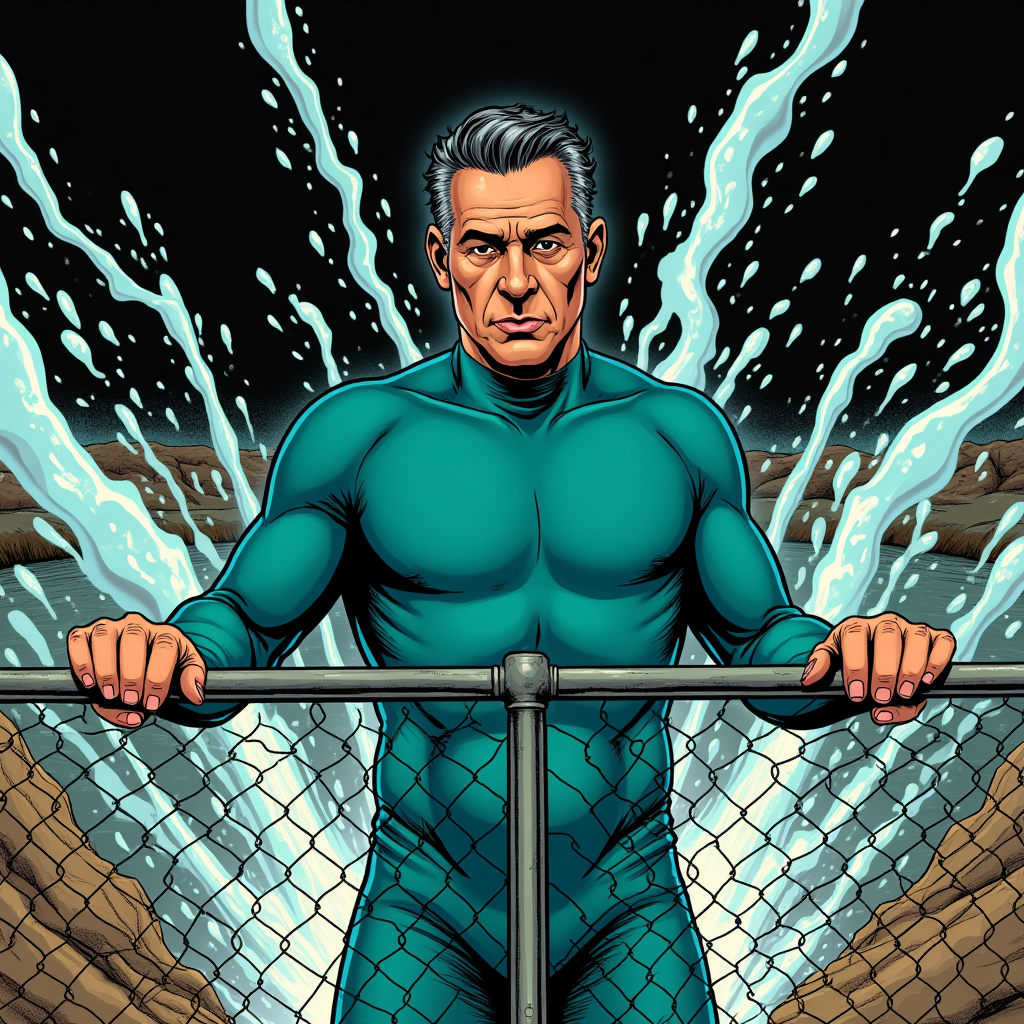
Teo does not answer. They press both hands to the iron fencing at the site perimeter and close their eyes.
The Raritan responds.
The groundwater beneath the site surges upward through the clay in a dozen narrow columns, each one threading between Aridion’s bore casings with surgical precision, filling the drill channels with compressed water pressure that locks the equipment in place as effectively as poured concrete. The floodlights flicker as the water pressure in the site’s own portable supply system reverses, spraying backward through the hoses. The drill head shudders and stops.
Raymond Soo watches all of this with his hands clasped behind his back, his expression shifting from calculation to something cooler and more dangerous.
“This is a delay,” he says. “Not an end.”
“Every day you’re delayed,” Corriente says, “is a day the county has to read the actual contract.”
It takes eleven days. On the twelfth, the Middlesex County executive suspends the Aridion proposal pending an independent environmental review. The Ledger-Examiner runs the permit violation story above the fold. Raymond Soo files three legal challenges and begins lobbying Trenton through channels that will take years to fully trace.
Teo crosses the Albany Street Bridge that evening as the last light goes amber over the Raritan. They pause at the railing, as they always do, and feel the river moving below — feel it the way they feel their own heartbeat, the way they feel the sixty percent of their body that is water and has always, it turns out, been paying attention.
The Raritan runs south and east toward the bay. It has been running longer than the city. It will run longer than any of this.
Corriente straightens, turns, and walks back into New Brunswick.