
The Crossing Keeper
Part One: The Man Who Remembers
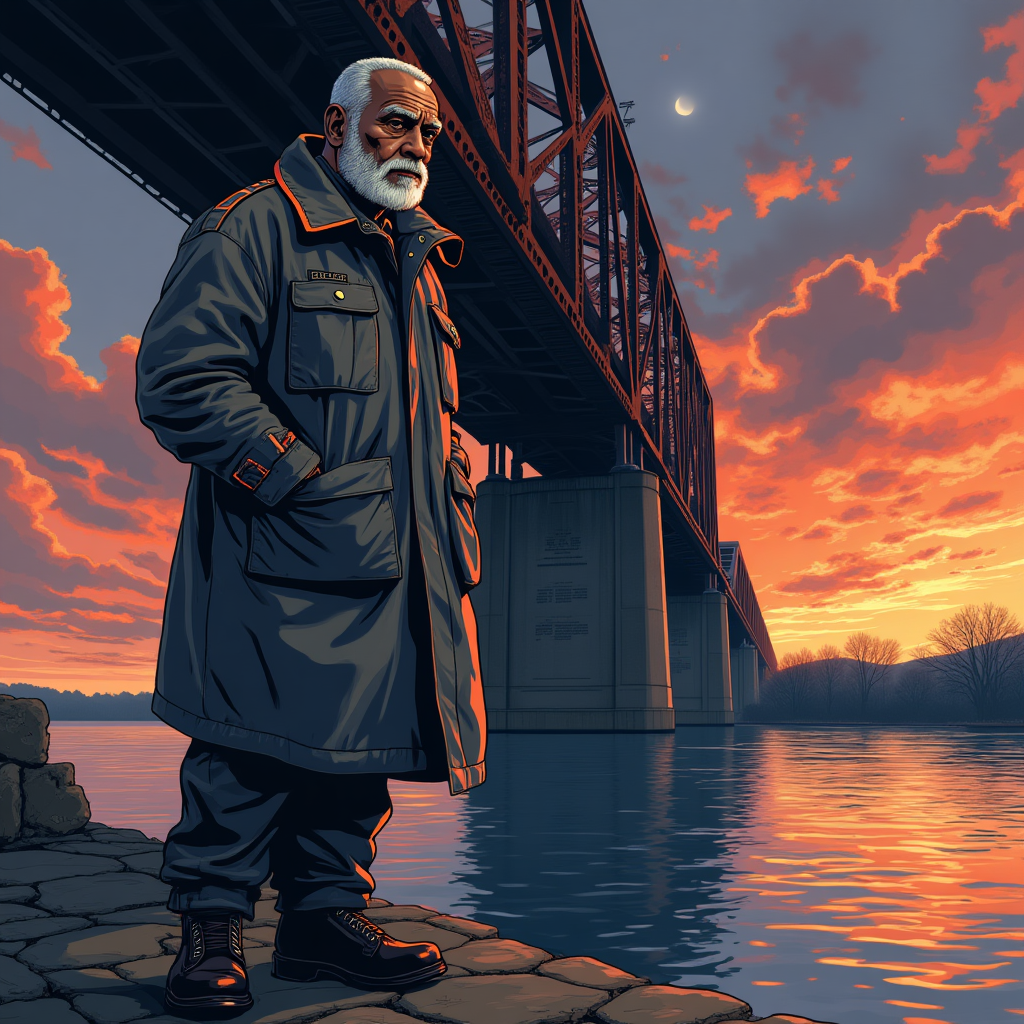
The Delaware River does not forget. It carries everything — colonial blood, industrial runoff, the weight of a nation’s founding — southward toward the sea in silence. On most mornings, Elijah Drummond stands on the bank at Cadwalader Park and watches it move, the way an old man watches a fire he once lit himself.
Elijah is seventy-two years old. He came up in Trenton’s Wilbur section in the late 1950s, when the city still smelled of wire and steel from the old Roebling plant. His father worked those mills. His grandfather’s hands had helped lay the cable for bridges that still stood. Elijah spent his own working life as a transit systems inspector for NJ Transit — thirty-one years riding the corridors between Trenton Transit Center and Penn Station, reading the bones of the infrastructure the way a doctor reads an x-ray. He knew when a rail tie was stressed before the sensors caught it. He knew the rhythm of the Northeast Corridor the way other men know their own heartbeat.
He retired in 2019 and came back to Trenton full-time. He volunteers at the Isles, Inc. community garden on Elm Street on Tuesdays, helps run a youth mentorship program out of a rec center on Greenwood Avenue on Thursdays, and reads the Trentonian every morning with a cup of Bustelo at the kitchen table of the rowhouse on Chestnut Avenue where he has lived for forty years. His wife, Dolores, passed in 2021. His children are in Atlanta and Denver. He is, by most measures, a quiet man living out his final chapter in a city that history keeps threatening to abandon.
But Trenton does not abandon its own. Not entirely. And neither, it turns out, does the Delaware.
Part Two: The Night of the Crossing
It begins on a Thursday in April — the same week every year that Trenton grows strange with memory. The reenactors have already come and gone from Washington Crossing, staging their annual tableau of frozen men in wooden boats, muskets raised against a hypothetical Hessian darkness. The tourists photograph it and leave. The river rolls on, indifferent.
What the tourists don’t know — what most people no longer remember — is that Washington crossed twice. The second crossing, three days after Christmas 1776, was the one that held. The first was the one that cracked something open.
Elijah is on the riverbank at dusk, near the old canal towpath north of the Route 1 bridge, when the ground begins to vibrate. Not an earthquake — he has felt Amtrak’s Acela rattle the city at speed, and this is different. This is older. The vibration travels up through the soles of his boots, through his ankles and shins, into his chest, and settles behind his sternum like a tuning fork finding its note.
The Delaware surges. Not violently — not a flood, not a breach — but purposefully, the way water moves when it has somewhere to be. A plume of luminescent current rises from the center of the river, somewhere between the Jersey and Pennsylvania banks, and it moves toward him. The light is cold and blue-white, shot through with filaments of rust-orange, the color of old iron cable. It smells of river mud and ozone and something older, mineral and absolute.
Elijah does not run. He has lived long enough to recognize moments that are not meant to be escaped.
The current reaches the bank and passes into him like breath filling a pair of lungs — total, immediate, silent. He falls to his knees in the mud. The entire Northeast Corridor flashes through his mind: every signal tower from New Brunswick to Trenton, every bridge truss, every buried cable, every tie plate and expansion joint from the Delaware River Rail Bridge to the Trenton Transit Center platform. He sees it all the way you see a city from a plane — the full shape of it, the way it connects, the way it breathes.
When he stands, the river is still. His hands are steady. He is, in every visible sense, the same seventy-two-year-old man he was ten minutes ago.
But when he places his palm against the iron railing at the edge of the towpath, he feels the rail yards in Hamilton, three miles south, hum back at him.
Part Three: The Weight of the Corridor
The changes come gradually, then all at once.
Within a week, Elijah discovers the scope of what the river gave him. He can feel any transit infrastructure he touches — or that touches the ground he stands on — as though it were an extension of his own nervous system. Signal failures announce themselves to him as phantom headaches. A cracked rail tie on the NEC near the Calhoun Street corridor aches in his left knee until he calls it in anonymously from a payphone. He can redirect electrical current through rail lines the way a conductor redirects an orchestra, and when he chooses, he can move himself along any transit corridor — rail, road, or waterway — at a speed that defies ordinary physics, folding distance the way a map folds paper.
He is also, he discovers, nearly impossible to physically harm when he is in contact with infrastructure. The old cable steel of Trenton’s bridges, the rebar in its century-old civic buildings, the iron buried under its streets — it all flows through him, a second skeleton, harder than bone.
He thinks about calling his son in Atlanta. He thinks about going to a doctor. He does neither.
Instead, he calls the thing by the name that rises in his mind unbidden — the same name carved into the old bridge abutment near the towpath, a remnant of a 1976 Bicentennial marker: THE CROSSING. That is what the river did. That is what he now is.
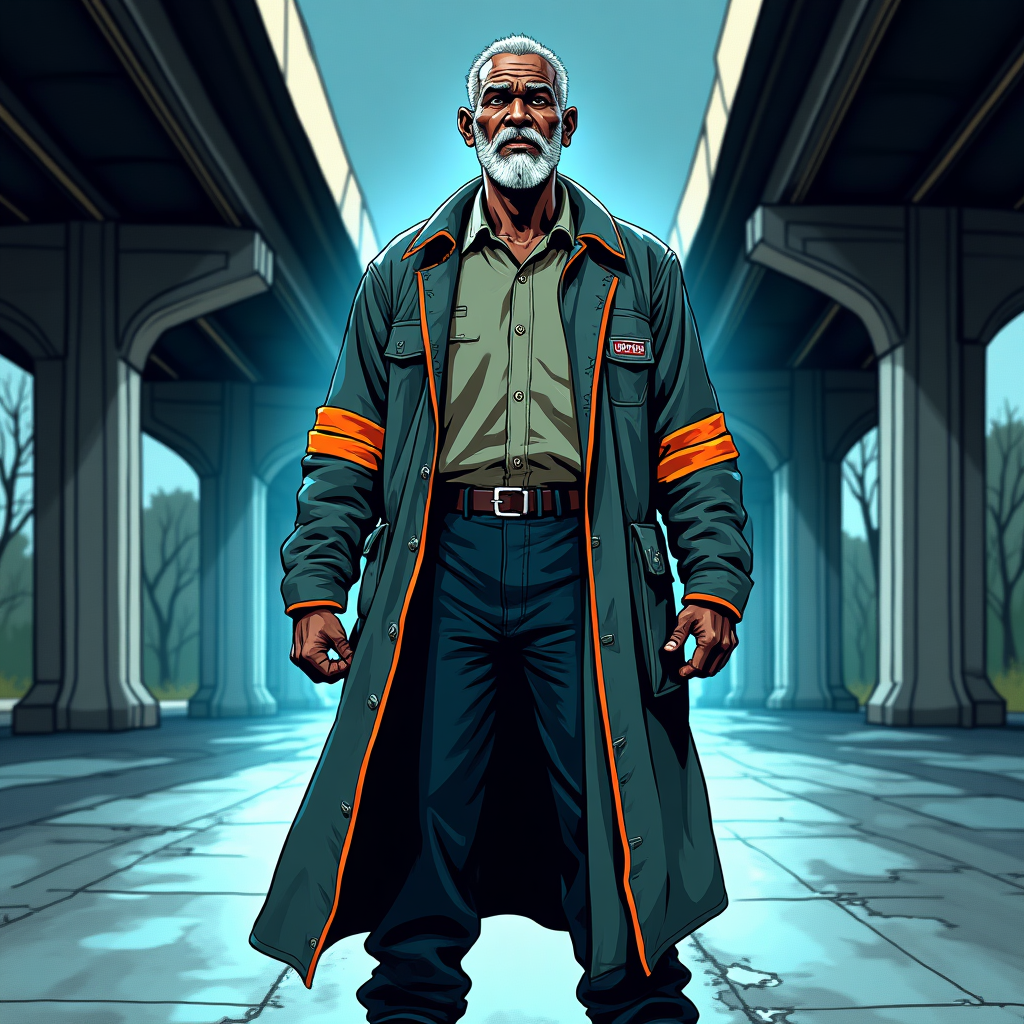
He sews no costume. He finds a long charcoal-grey transit worker’s coat in his closet, the kind he wore on overnight NEC inspection runs — reflective orange piping on the sleeves, deep pockets, worn smooth at the elbows. He keeps his own face. He is seventy-two years old and has nothing left to hide from.
He becomes the Crossing Keeper.
Part Four: The Architect of Erasure
His name is Prescott Hargrove III. He is fifty-eight years old, silver-haired, trim in the way of men who have personal trainers and punishing schedules, and he controls the Hargrove Development Group — the largest private real estate acquisition firm operating in Mercer County. He has been systematically purchasing distressed properties in Trenton’s Chambersburg and South Trenton neighborhoods for three years, and the plan he has registered with the city planning board — under a shell entity called Meridian Transit Partners — is breathtaking in its cynicism.
Hargrove does not want to develop Trenton. He wants to extract it.
His scheme is elegant: use Trenton’s unique status as the only New Jersey city served by three commuter rail systems to designate the entire transit corridor through the city’s residential core as a federal “transit optimization zone” — a classification that triggers eminent domain authority and allows private infrastructure operators to condemn and acquire adjacent property at Depression-era assessed values. He has a lobbyist in Washington. He has a councilmember in his pocket. He has a real estate attorney who has done this in two other mid-sized American cities and left behind parking lots where neighborhoods stood.
What he does not have is patience for the Crossing Keeper.
When Elijah begins routing Hargrove’s surveying crews away from South Trenton — sending tremors through the street grid that crack survey stakes, redirecting a Meridian work vehicle onto a looping detour via the rail yard access road that takes it forty minutes out of the way — Hargrove notices. He is not a man who believes in the supernatural. He is a man who believes in pressure.
He hires a private security firm, Sentinel Bridge Solutions, and gives them one instruction: find the source of the disruptions and eliminate it.
What he does not understand — what men like Prescott Hargrove III almost never understand — is that Trenton has been absorbing pressure for three hundred years. It was the hinge of the Revolution. It was the industrial spine of a state. It has been left for dead by capital before, and it has outlasted every man who wrote it off.
Part Five: The Battle at the Rail Bridge
Sentinel Bridge’s operatives move on a Tuesday night, armed with signal jammers intended to disable the NEC’s switching infrastructure — Hargrove’s theory being that if he can demonstrate the corridor’s vulnerability, his federal “optimization” designation becomes easier to justify. He wants an incident. A delay. A headline that reads Aging Infrastructure Threatens Tri-State Commuters. He wants fear to do the work that money hasn’t finished.
Elijah feels them before he sees them — four men on the Delaware River Rail Bridge, placing devices on the signal housing at the bridge’s center span, 147 feet above the water. He is in his kitchen on Chestnut Avenue when the bridge sends its distress through the city’s buried iron and into the fillings of his back teeth.
He is at the bridge in forty seconds.
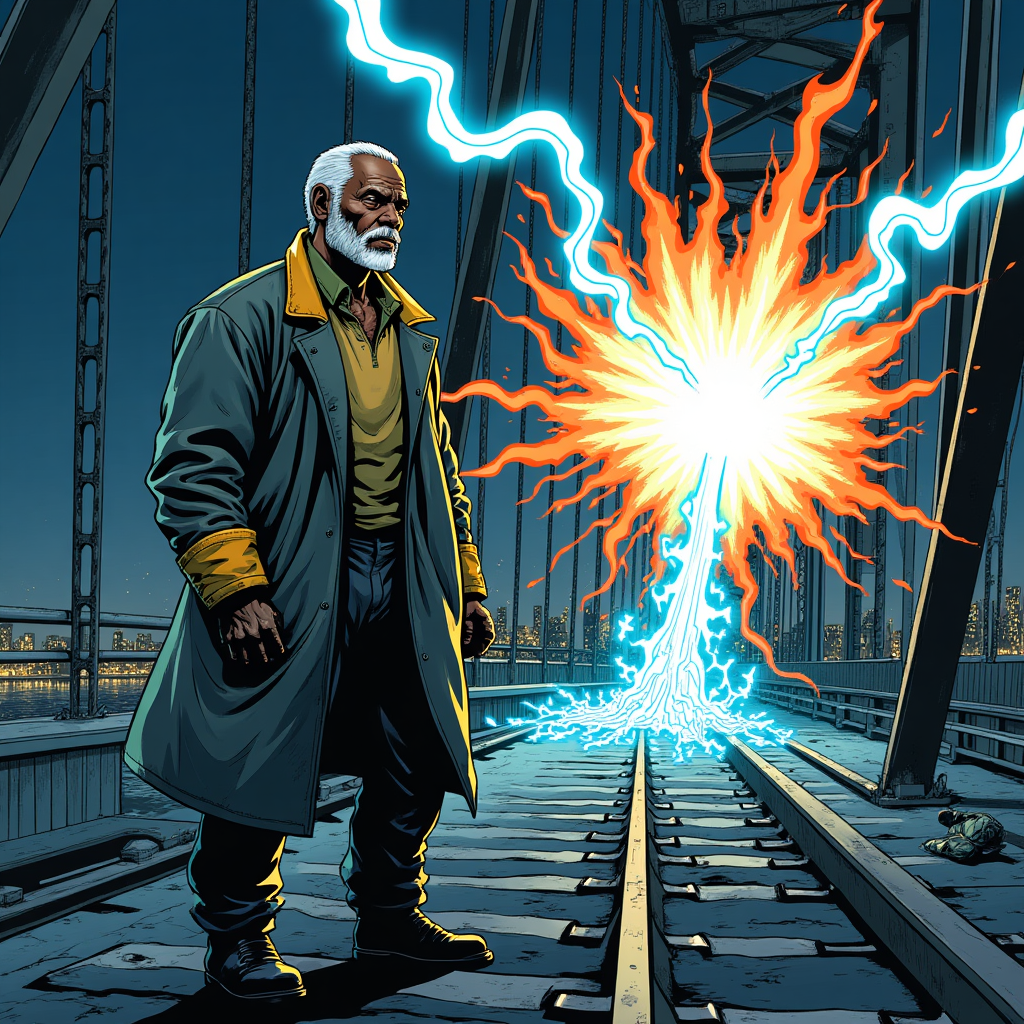
He comes up through the rail corridor itself, moving along the live third rail like a current finding its path, emerging from the access ladder at the bridge’s midpoint in his grey transit coat, the orange piping glowing faint in the darkness. The four Sentinel operatives are professional men. They have seen unusual things. They have not seen a seventy-two-year-old man walk out of the electrified rail infrastructure of the Northeast Corridor and plant his feet on steel grating over the Delaware River as though he were stepping off a bus.
What follows is not a fight in the conventional sense. Elijah does not throw punches. He places both hands on the bridge’s main cable housing and lets the Delaware do the talking. Every vibration the river has stored in the bridge’s iron since 1903 — the year the current structure was completed — releases in a single organized pulse. The signal jammers shatter in the operatives’ hands. The men find themselves magnetized to the bridge railing, held immobile by induced current, unharmed but absolutely still, until the Trenton Police Department arrives eight minutes later.
Prescott Hargrove III is arrested at his suite at a hotel off Route 1 in Lawrence Township at 6:14 the following morning. The councilmember resigns by noon. Meridian Transit Partners’ zoning application is withdrawn before the week is out.
Elijah Drummond is back at the Isles garden by Tuesday, turning compost with a long-handled fork, the Delaware moving in its old inscrutable way two miles west. A kid from the mentorship program, maybe fifteen, asks him why he looks tired.
“I had a late night,” Elijah says.
The kid nods, accepts this, moves on.
The river rolls south. The corridor hums. Trenton holds.