
Delaware Shore: Origin of the Shoreline
Part One: The Woman Who Listened to the River
Trenton has always been a city of two voices. One speaks in marble and ceremony — the gold dome of the State House catching afternoon light on West State Street, the statues of generals fixed in bronze outside the War Memorial. The other voice is older, rougher, and runs beneath everything: the Delaware River, churning dark and purposeful past the rotting pilings of the old industrial waterfront, past the canal locks that once floated coal barges south toward Philadelphia, past the ruins of wire mills and pottery factories whose ghosts still crowd the riverbank below Route 29.
Celestine Okafor has heard both voices her whole life.
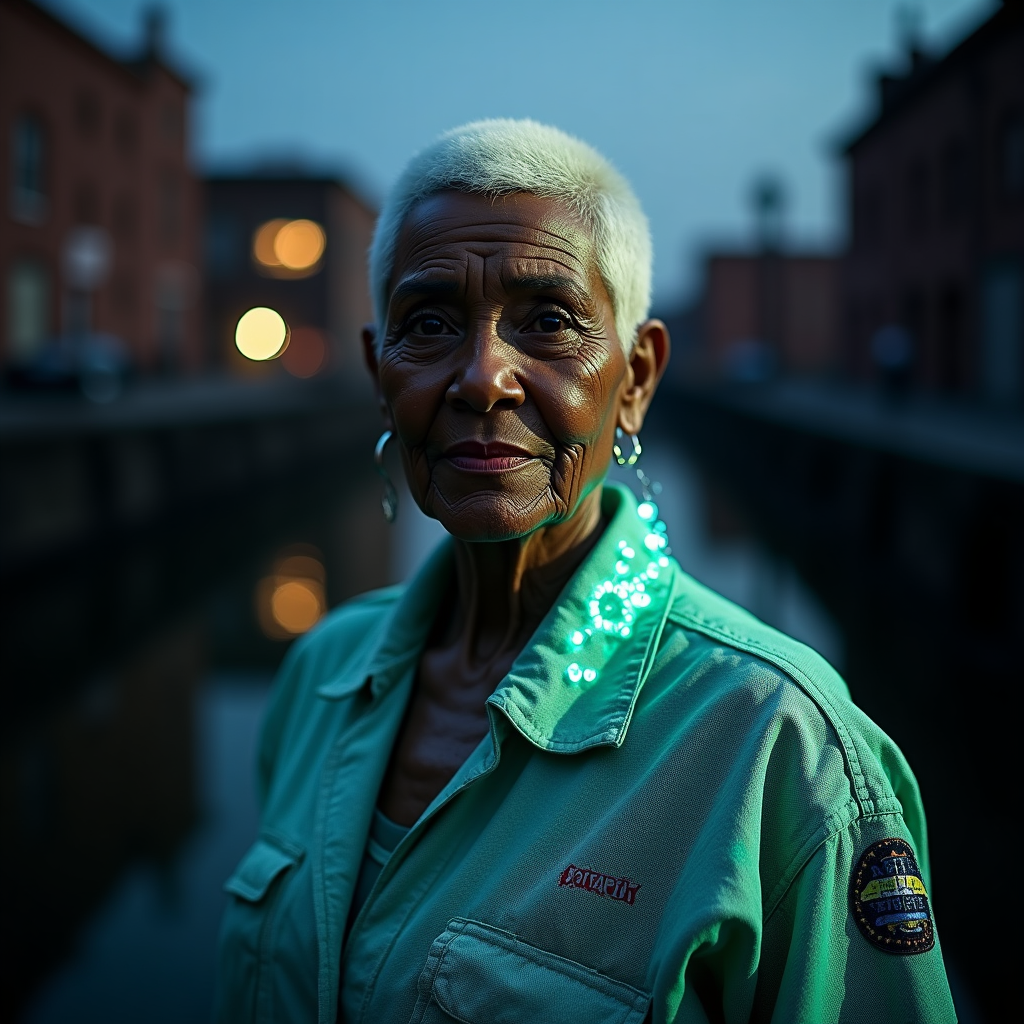
At seventy-one, she is the city’s Chief Waterway Infrastructure Officer — a title that sounds bureaucratic until you understand what it means in Trenton: she is the person responsible for every pump station, every floodgate, every aging concrete retaining wall between the Delaware and the downtown streets. She has spent four decades in service to this city, first as a field engineer for Mercer County Public Works, then as a project lead on the Delaware & Raritan Canal restoration, and finally in her current role, seated three floors above the river in a building on South Stockton Street, reading pressure reports and rainfall projections and trying to hold back catastrophe with spreadsheets and willpower.
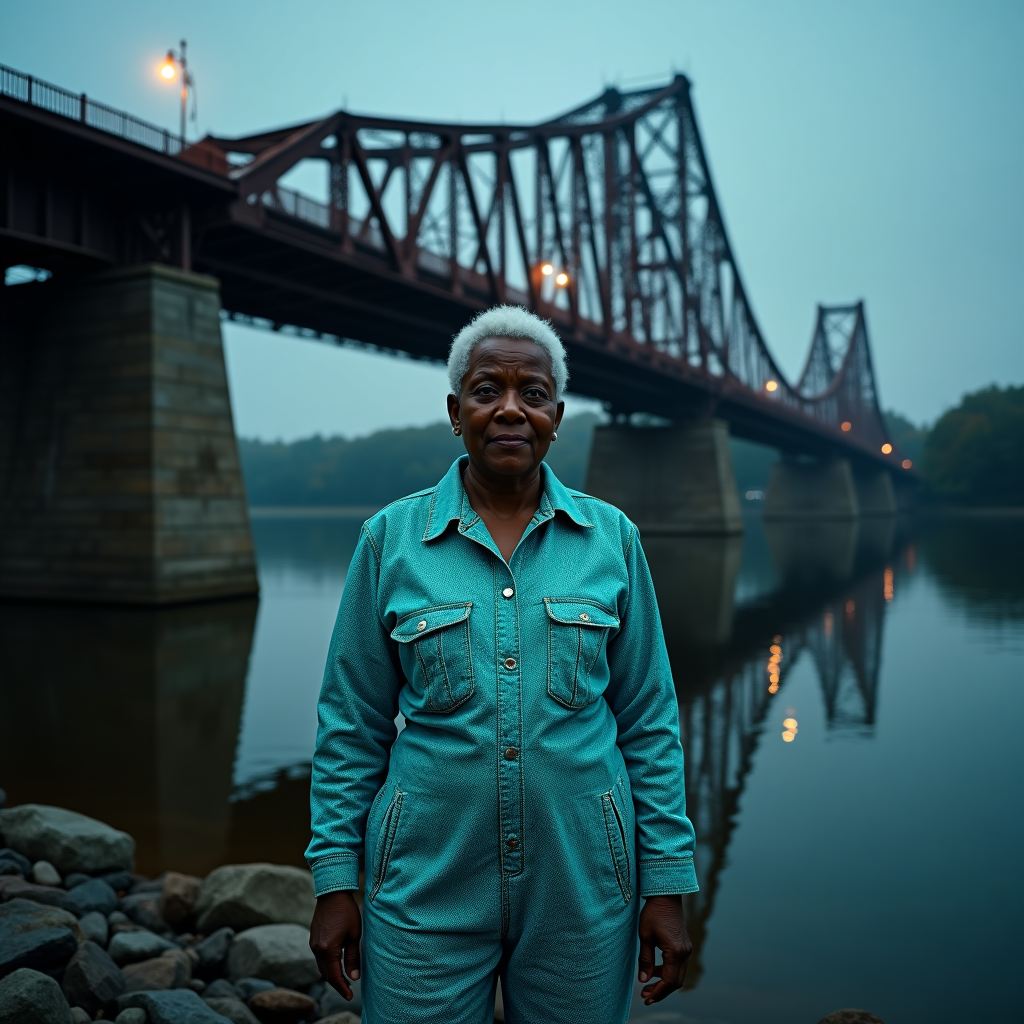
She is a Black woman built like the city she serves — solidly constructed, seasoned, bearing the wear of decades without apology. Her hair has gone fully white, cropped close, and she wears her field coveralls with the Mercer County DPW patch on the shoulder even when she’s presenting to the state legislature. She does not dress up for people who have never stood knee-deep in floodwater.
She has a theory, developed over forty years of watching the Delaware, that the river communicates. Not in metaphor. In frequency. There are pressures and pulses that move through river water — acoustic signatures, electromagnetic fields generated by current moving through mineral-laden channels — and if you have spent enough years in the concrete tunnels under the waterfront, your body begins to learn the language. Celestine Okafor has spent more time in those tunnels than anyone alive.
She does not yet know what that attunement will cost her, or give her.
Part Two: The Night the Canal Locks Failed
It happens in April, during a nor’easter that the weather services have been tracking for a week but that arrives two days early and twenty percent angrier than projected. The Delaware crests past the flood stage markers at the Calhoun Street Bridge. By midnight, the pump stations along the lower waterfront are overwhelmed. By 1 a.m., the retaining gate at Lock 11 of the old Delaware & Raritan Canal feeder — a structure Celestine has been submitting urgent repair requests for since 2022 — buckles.
She is already on site when it goes. Has been for six hours, in waders and a headlamp, running manual override sequences on gates that should have been automated years ago. When Lock 11 fails, a wall of pressurized water tears through the maintenance access tunnel she is standing in. The current catches her before she can reach the ladder. It carries her three hundred yards through pipe and concrete, through darkness absolute, through sound that is no longer sound but something structural — a vibration that enters through the fillings in her back teeth and rewrites itself into every cell of her body.
She hits the emergency retention basin — a concrete cistern the size of a basketball court, built in 1962, fed by overflow from six different canal channels — and goes under.
She is underwater for eleven minutes before the emergency dive team from Trenton Fire Station 2 reaches her.
She should not be alive.
She is not, in the way she was before, entirely alive in the same sense as before.
When she surfaces — when she is pulled out by firefighters who expect a body — she is conscious, breathing, and speaking in a calm voice about the pressure differential in the secondary gate housing. Her coveralls are intact. Her headlamp is still on. And the water in the retention basin is moving in a slow, deliberate spiral around her, as though she is still giving it instructions.
Part Three: The Frequency of the City
The transformation does not announce itself with theater. Celestine Okafor does not wake up the next morning able to fly. What she wakes up to, in the Mercer Medical trauma ward on Bellevue Avenue, is the sensation of the Delaware River in her chest — a low, constant pressure, like a second heartbeat tuned to the tidal cycle of a river forty miles from the ocean that still, faintly, breathes with it.
Over the weeks that follow, she learns:
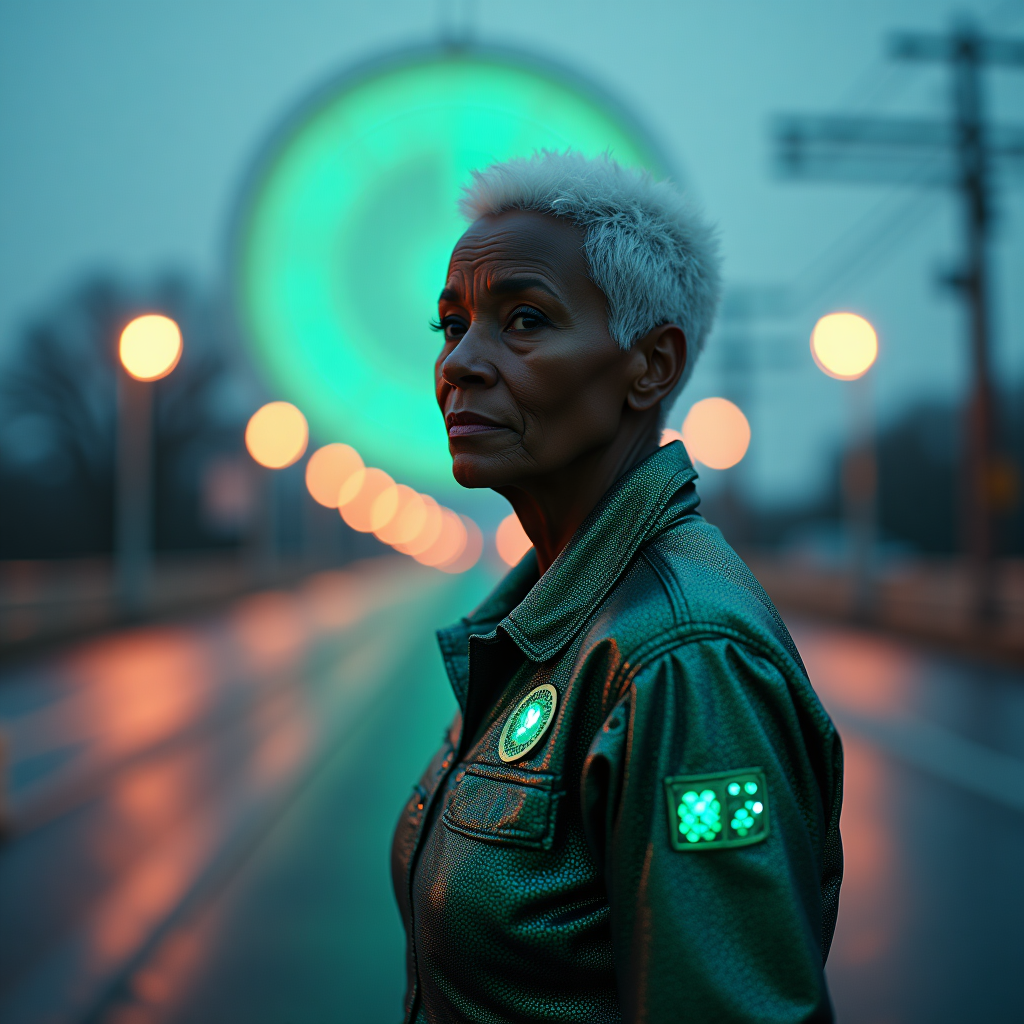
She can feel the current. Not abstractly — physically, the way you feel your own pulse. She can reach into the Delaware’s flow from any point on the Trenton waterfront and redirect it — tighten a channel here, widen a passage there, build a pressure wall across the shipping lane that will deflect debris or containment plumes moving downstream toward Burlington and beyond. The mastery of water she has built over four decades with engineering has become literal and biological. The canal locks that failed her now answer her.
She learns she can hear the city. Standing on the corner of Ferry Street and South Warren, she discovers she can pitch her voice — or a sharp clap of her palms — into a frequency that bounces cleanly off the brick warehouse facades and travels the urban canyon for twelve blocks, arriving at the far end clear and amplified. She can redirect sound the way she redirects current: around corners, into basements, up fire escapes. She begins to understand that the same physics that governs water governs acoustic pressure. She is a conductor now. The city is her instrument.
And the electromagnetic pulse: this one frightens her most, and impresses her most. It emerges the first time when a stolen panel van tries to ram the gate of the State House parking structure on West State Street and she is forty feet away. Without thought, she releases something — a pulse, a frequency, a discharge that originates somewhere in the transformed architecture of her sternum — and the van dies. Every circuit in it, dead. The streetlights around her flicker. Her phone is fine. The cardiac monitor visible through the glass of the medical clinic on the corner does not skip a beat. The precision is instinctual. She does not yet understand it but she knows, with the certainty of an engineer reading a diagram, that she will.
She calls herself Delaware Shore when she first begins to operate publicly — not a dramatic name, but a true one. The shore is where the city meets the river. She has always lived there.
Part Four: The Adversary Who Drinks Silence
Her name, in the world that knows her, is Marisol Ashcroft. In the story she is telling about Trenton — the one that is eating the city from beneath — she calls herself Hollow Ash of the Burning Channel, shortened in the streets to Hollow Ash.
She is an Indigenous woman in her late fifties, tall and angular, her face carrying the sharp architecture of someone who has weathered every weather this Delaware Valley has produced. Her hair is iron-gray, worn loose to her shoulders, and her eyes are the particular amber of the river in late October — warm, clear, and absolutely without mercy when she has decided something.
She is not from Trenton, but she is of this river. Her family’s ancestral territory ran the length of the Delaware long before Trenton was a name, long before Washington crossed it in the winter dark, long before the wire mills and the pottery factories and the canal locks were laid over the land like a grid of wounds. She has watched the Delaware be industrialized, contaminated, cleaned partially, contaminated again. She has watched the capital city drain money that should have protected the river’s corridor communities into new construction projects that serve no one already living there.
Her power is the inverse of Delaware Shore’s. Where Celestine redirects and absorbs, Hollow Ash amplifies and ruptures. She has learned — through means that are chemical and deliberate, a self-administered transformation involving compounds extracted from the contaminated sediment of the old industrial channel near Duck Island — to weaponize the river’s degraded acoustic and electromagnetic signature. She generates destructive interference fields that cancel out emergency communications. She creates resonant frequencies that crack concrete and shatter glass. She can silence a city block — not metaphorically, but physically, every sound wave in a defined radius absorbed into her and discharged as a single catastrophic pulse.
Her stated goal is legitimate: she wants the contaminated industrial corridor along the lower Delaware waterfront declared uninhabitable, the development projects demolished, the land returned to natural floodplain. She is not wrong that the land was taken. She is not wrong that the contamination is real. She is not wrong that the city’s poor have been sacrificed repeatedly to protect the political class on West State Street.
What she is willing to do to prove those points is where she and Celestine Okafor cannot share a world.
Part Five: The Bridge Approaches, the River Between Them
The confrontation that defines Delaware Shore’s first public emergence happens on a Tuesday evening in late April, at the Calhoun Street Bridge.
Hollow Ash has planted disruptive resonance emitters — improvised devices, brilliantly engineered, built from salvaged sonar equipment and chemical batteries — at three points along the bridge’s support structure. Her plan: induce a controlled resonant collapse of the bridge’s approach spans during evening rush. No fatalities intended, she insists, in the transmission she sends to every local newsroom ninety minutes before. Just infrastructure. Just a signal. Just enough to make the governor look out his window on West State Street and understand that the river’s patience, and her own, are finished.
Delaware Shore feels the emitters through the water before anyone spots them. The Delaware hums differently when foreign frequencies are introduced into the channel — she can read it the way she reads a pressure gauge. She moves along the riverbank below Route 29 in the early dusk, the surface of the water responding to her presence, subtle eddies forming and dissolving around her waders.
She gets to the bridge’s eastern approach as the first commuter trains are crossing above — NJ Transit on the upper rail deck, the Dinky connection running south. She projects her voice through the acoustic canyon of the bridge’s understructure: a long, resonant tone that carries the shape of an emergency alert, bouncing off every steel beam and concrete pier until every commuter on the bridge feels it in their teeth. Not words. A frequency that means: stop moving, shelter in place, something is wrong. The trains halt. The bridge clears.
Then she finds Hollow Ash standing at the center span, above the midpoint of the river, the three emitters already cycling.
What follows is not a fight in the way comics usually draw fights. It is a conversation conducted in frequency and current. Delaware Shore reaches into the Delaware beneath the bridge and builds a pressure wall across the channel — a hard redirect of current that introduces counter-vibrations into the bridge’s support pilings, neutralizing the resonance the emitters are generating. Hollow Ash sharpens her interference field into a weapon and drives it at Celestine like a physical blow, a silence that becomes pain when it hits, a cancellation field that tries to disconnect her from the river she is rooted in.
Celestine absorbs it. She was built for retention basins. She takes the pulse into herself and discharges it outward through her palms as a surgical electromagnetic burst — precise, calibrated to the frequency of the emitters’ circuits, stripping them dead without touching the bridge lighting, without touching the signals on the rail line above, without triggering a single hospital alarm downstream.
The emitters die. The bridge stands. The river moves on.
Hollow Ash stands across the span from her, iron-gray hair moving in the April wind off the Delaware, and says nothing for a long moment. Then: “You’re protecting the same thing they used to erase us.”
Celestine Okafor looks at the city behind her — the State House dome visible above the treeline, the old factories dark along the bank, the lights of the Burg neighborhood reflected in the river — and says: “I’m protecting the people who live here now. I know the difference.”
Hollow Ash retreats into the water — her own transformation, her own channel — and the river carries her south toward the dark.
Delaware Shore stands on the Calhoun Street Bridge until the NJ Transit signal clears and the trains begin to move again. She can feel every train car’s weight on the deck above her. She can feel the Delaware adjusting to the season, cold and purposeful, running south.
She has always lived at the shore. Now the shore lives in her.