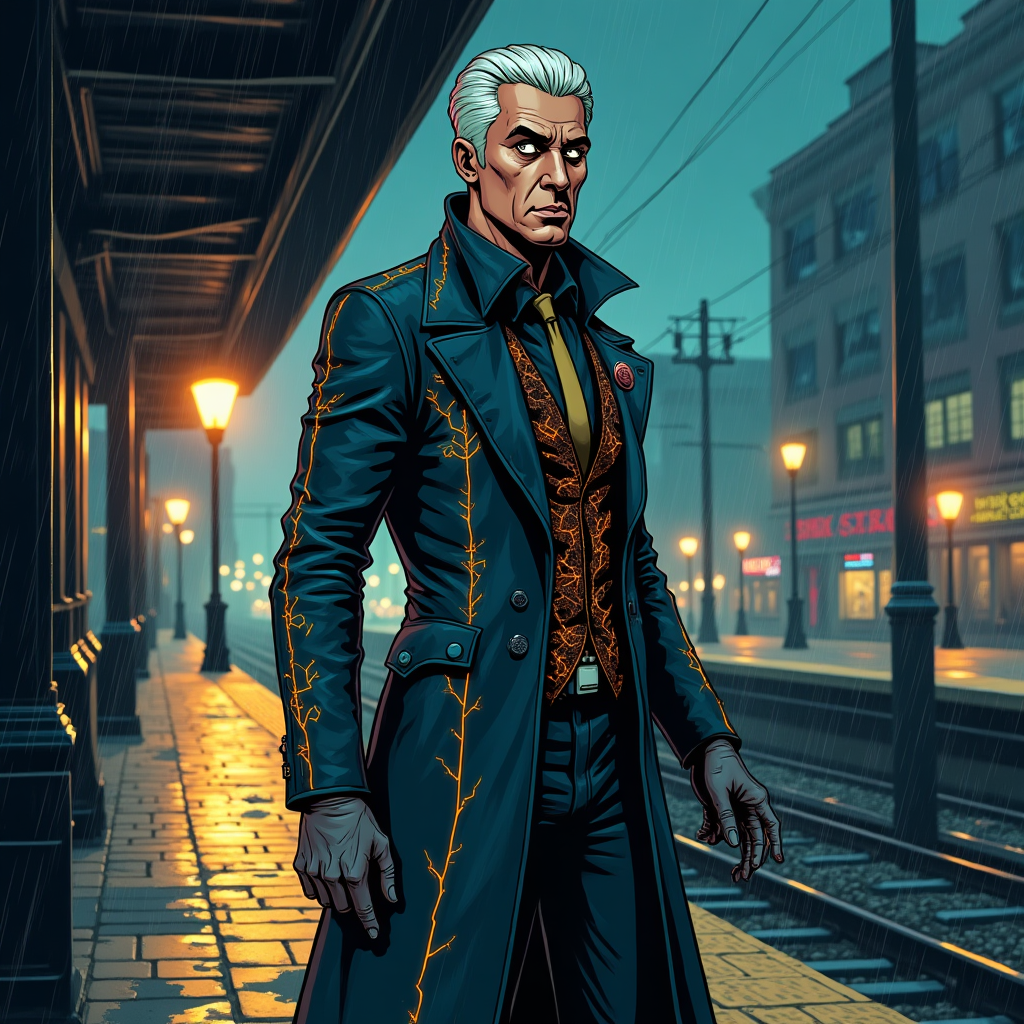


Desmond Vael: The Architect of Ruin
Part One: The City That Forgot Its Name
Trenton makes. The world takes.
Those four words are hammered into the bridge on Route 1, cast in iron above the Delaware River, and Dariush Vael has read them every single day for forty-three years. They drove across that bridge in a secondhand Datsun in the winter of 1983, a young Iranian-American with a city planning degree from Rutgers and a notebook full of dreams for the capital city. They believed in Trenton the way some people believe in God — not because of what it was, but because of what it could become.
Dariush studied the bones of this place and loved them. The colonial grid of Mill Hill. The stout red-brick grandeur of the State House dome catching afternoon light. Cadwalader Park, designed by the great Frederick Law Olmsted himself, its serpentine paths cutting through urban green like a promise. The Delaware and Raritan Canal towpath running south past Duck Island, where the river bends and the herons stand ankle-deep in brown water, patient as saints. Three rail lines converging on a single station — Amtrak, NJ Transit, SEPTA — a transit crossroads that exists nowhere else in New Jersey. Dariush saw all of this and thought: Here. This is the place.
They spent four decades inside Trenton’s machinery. First as a junior planner for Mercer County, then as a senior consultant, finally as the founder of the Vael Urban Futures Institute, a nonprofit think tank operating from a converted textile mill on South Broad Street. They wrote the reports. They gave the testimony. They drew the diagrams that showed how transit-oriented development along the rail corridor could lift every neighborhood — the North Ward, the South Ward, Chambersburg, Prospect Village — not just the parcels closest to the river that developers kept circling like buzzards.
And every single time, the plans were shelved. The funding was redirected. The reports were cited in press releases and then buried in archive boxes in the basement of City Hall.
Dariush is seventy-one years old now, and Trenton still makes. The world still takes.
Part Two: The Lottery of Ruins
The night it begins, Dariush is not thinking about vengeance. They are thinking about the press.
There is a story in the paper — a digital story, because the paper barely exists anymore, another gutted newsroom, another city losing its institutional memory — about the Hargrove Development Group. Hargrove has just received approval to demolish the last surviving section of the old Roebling Wire Works complex on South Clinton Avenue. John Roebling’s factory. The place where the wire for the Brooklyn Bridge was spun. Trenton’s single most irrefutable claim to American industrial mythology, and Hargrove is going to put luxury condominiums on it, units priced so far above Trenton’s median income they might as well be built on the moon.
Dariush has testified against this project four times. They have submitted a 200-page impact analysis. They have organized residents of the Roebling neighborhood, have sat in folding chairs in the basement of Sacred Heart Church on Ferry Street while people described their grandparents working those factory floors.
None of it mattered. The city council voted six to one.
Dariush closes the laptop. They put on their coat — a long charcoal wool coat, worn soft at the elbows — and walks out into the April night, down to the Delaware River, past the stub of the old Lower Trenton Bridge abutment, and stands on the bank where Washington crossed the ice in 1776 and changed the course of a war.
The river is running high and dark with spring melt. Somewhere upstream, a drainage pipe is purging what smells like industrial runoff — the old sins of the canal corridor, leaching back into the water table after years of disturbed remediation. Dariush kneels at the bank without quite knowing why. They press both palms into the cold mud at the river’s edge.
The Delaware speaks.
Not in words. In memory. In centuries of industrial current, of mill wheels and wire coils and coal barges and the specific electromagnetic signature of three rail lines converging two miles east. The river has absorbed all of it — every plan ever drawn, every promise ever broken, every vote ever sold — and now it gives it all back to Dariush Vael in a single, shattering instant.
They scream. No one hears them over the water.
When they stand, their eyes are the grey-green of the Delaware in March. And they understand exactly what they are now: not a planner. Not a consultant. Not a nonprofit director with a stack of unread reports.
They are the city’s reckoning, wearing a human body like a blueprint.
Part Three: The Geometry of Consequence
Dariush does not transform immediately into Desmond Vael. That is not how grief works.
They spend three weeks testing the edges of what the river gave them. They walk the canal towpath at midnight and feel the geological memory of the Delaware and Raritan Canal system beneath their feet — the limestone bedrock, the clay-and-shale substrate, the underground aquifer channels running beneath the city’s foundations. They can reach into those channels now. They can conduct through them, the way a lightning rod conducts a storm: drawing the kinetic and electromagnetic energy of Trenton’s three converging rail lines, storing it in the mineral lattice of their own nervous system, and releasing it as focused seismic pulses or directed current arcs.
They stand at the corner of Calhoun and State Street, downtown Trenton, and press one palm flat against a cast-iron fence post. The vibration travels outward through the metal, through the buried gas and water lines, through the foundation limestone, and Dariush feels the entire block as if it is part of their own body. They feel a City Hall office where a developer’s representative is signing a permit. They feel the filing cabinet where the Roebling impact analysis is buried. They feel the structural weakness in the old parking garage on Warren Street that the city refuses to condemn because the owner is a campaign donor.
They feel, most acutely, how much has been stolen.
It is Cadwalader Park that finally tips them over. On a Tuesday morning in early April, Dariush walks the Olmsted paths and finds yellow survey flags staked along the park’s eastern boundary — the advance guard of a new road-widening project, one that will shave forty feet of parkland to ease the commute for a suburban business park that Hargrove Development is building three miles away. No public notice. No environmental review. Just flags in the grass.
Dariush pulls the flags up one by one. When they reach the last one, they are no longer Dariush.
They are Desmond Vael.
The charcoal wool coat becomes something else — a structured, architectural garment of deep iron-grey and canal-blue, lined with the copper-wire veining of circuit diagrams that pulse faintly with conducted energy. Their silver hair, cropped close on the sides and long on top, crackles with static when the power surges. On their hands: thin graphite-grey gloves with copper filament traced along every finger, amplifiers for the current they now carry in their bones. At seventy-one, their face is lined and angular and absolutely unafraid.
They look like what they are: someone who has been patient for a very long time, and is patient no longer.
Part Four: Sovereign at the Crossing
The hero appears on the night Desmond cracks the esplanade.
Desmond has gone to the Trenton Transit Center on Clinton Avenue, to the node where Amtrak and NJ Transit and SEPTA converge. It is 11 PM. The last SEPTA regional rail has just pulled out toward Philadelphia. Desmond presses both gloved palms to the iron rail of the platform fence, drawing the residual kinetic energy of three departing trains up through the track bed, through the platform foundation, through the limestone and clay beneath, and then releasing it — a seismic pulse directed outward along South Clinton Avenue toward the Hargrove Development Group’s construction trailer, parked outside the Roebling site. The pavement buckles and splits in a forty-foot arc. The construction trailer’s foundation pins shear clean. It tilts, groans, settles at a drunken angle into the cracked asphalt.
Nobody is hurt. Desmond has checked twice.
But then a figure drops from the roof of the transit center — landing on the platform in a low crouch, resolving into the shape of a young woman in a white and gold bodysuit, the seal of New Jersey’s statehouse dome somehow suggested in her silhouette without being literally depicted. Sovereign. Trenton’s own.
“I know who you are, Dariush.” Her voice is not unkind. That is the thing Desmond did not expect. “I’ve read the Roebling report. All two hundred pages.”
“Then you understand,” Desmond says.
“I understand that you’re right about almost everything.” Sovereign steps forward slowly. “And I understand that this —” she gestures at the cracked esplanade, the listing trailer ”— is the part where you stop being right.”
Desmond feels the rail energy still singing in their fingertips. “They had forty years to listen. They didn’t listen to reports. What language do they speak?”
“Not this one.” Sovereign’s hands are raised. Not threatening — an old gesture, the gesture of someone who has read enough history to know what happens when the city’s protector and the city’s conscience become enemies. “Not yet. Please.”
Desmond looks at her for a long moment. At the transit center behind her, its triple-rail convergence still humming in their bones. At the Delaware a half-mile west, pulling endlessly toward the sea, taking everything with it.
“Come back when the Roebling site is protected,” Desmond says. “Come back when Cadwalader’s boundary is restored. Come back when there is a single plan on record that was written for the people who actually live here.”
They step off the platform edge and dissolve into the electrical current of the track bed, conducted out through the rail network into the sleeping city.
Part Five: What the River Remembers
Sovereign does not stop Desmond Vael that night. She will not stop them the next night, either, when Desmond surfaces through a storm drain on Perry Street and holds a city council emergency session in place — literally in place, the chamber doors fused shut by conducted current — until the vote on the Roebling demolition permit is reopened.
The council votes the same way. Six to one.
Desmond expected this. They are not naive. They spent forty years inside the machinery; they know how it is lubricated and by whom. But the story gets out — because one junior reporter at a surviving local newsroom was there, because the doors being fused shut was something that could not be buried in an archive box. The story runs. Then it runs again, larger, picked up by outlets that had stopped paying attention to Trenton sometime around 2009.
People start reading the two-hundred-page report.
Sovereign tracks Desmond to the Duck Island wetlands two weeks later, where they have been living in a kind of communion with the river, drawing strength from the Delaware’s memory. They face each other at dawn, standing in shallow water, herons circling overhead.
“You’re changing things,” Sovereign admits. “Not the way I’d choose. But you’re changing things.”
“Trenton makes,” Desmond says quietly. “It has always made. It made wire for bridges that connected cities all over this country. It made pottery and rubber and steel. It made the argument for American democracy in 1776, right here, on this river. And for a hundred years it has been told to be grateful for scraps.” They look at their copper-veined gloves, at the grey-green light playing in their changed eyes. “I am what happens when the city finally refuses.”
Sovereign watches them. She does not move to stop them when Desmond wades deeper and lets the current take them downstream, back toward the bridge, back toward the iron letters that have always known the truth.
The Delaware runs on. The city hums. Three rail lines converge at a single point in the capital of New Jersey, and somewhere beneath the limestone and clay, an old planner’s grief has become something harder and more permanent than stone.
Desmond Vael will be heard. One way or another.