


The Architecture of Decline
Part One: The Woman Who Was Right
There is a particular kind of grief that comes from being correct too early.
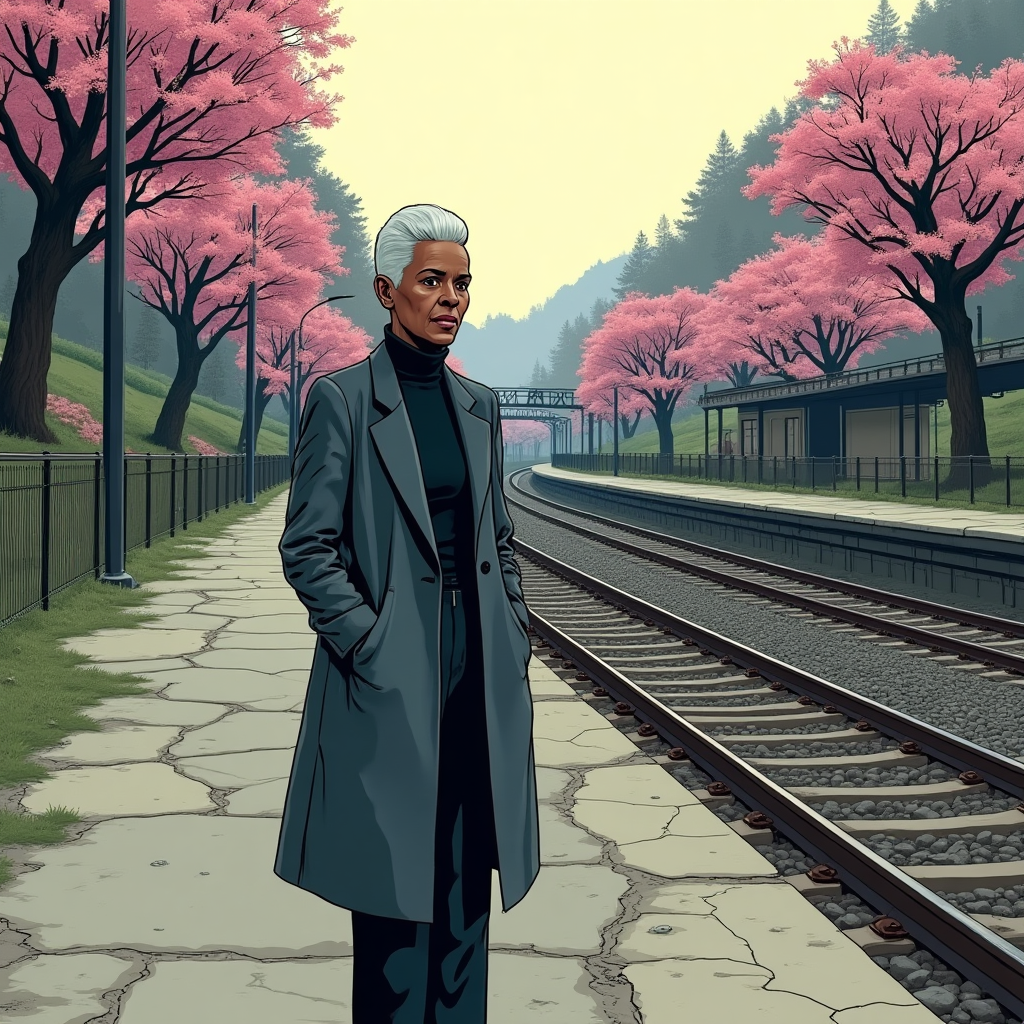
Dr. Evangeline Mosse understands this the way she understands soil chemistry: not as abstraction, but as something that has moved through her, changed her molecular structure, left a residue that will not dissolve. She is seventy-one years old, a Black woman with close-cropped silver-white hair and a stillness about her that people mistake for coldness. It is not coldness. It is the posture of someone who has stopped expecting to be heard and learned, instead, to act without permission.
She grew up in South Orange, on a street two blocks from Montrose Park Historic District, in a house where the backyard touched the edge of the old rail corridor. Her mother kept a garden: collard greens, rosemary, a persimmon tree that fruited every October without fail. Evangeline spent her childhood lying under that tree reading chemistry textbooks, convinced that the world was, at its core, a system of reactions — that if you understood the inputs, you could predict and prevent the damage.
She was not wrong. That is the important thing to understand. She was never wrong.
She attended Columbia High School on the hill above the village, where her chemistry teacher — a thin, precise man named Mr. Oduya who wore the same green tie every Tuesday — told her she had the most rigorous analytical mind he had ever seen in a student. She believed him because the evidence supported it. She went on to Rutgers. Then a doctorate in environmental chemistry at NJIT. Then twenty years with the state environmental enforcement apparatus, rising to become the lead regulator on watershed remediation for the Passaic River basin — one of the most contaminated industrial waterways in North America, a river that had been dying by degrees since the nineteenth century.
For two decades, she tried to save it. Not through sentiment. Through science.
Her 2003 Passaic Watershed Remediation Assessment — three hundred and forty pages, four years of field data, seventeen monitoring stations from Pompton Lakes to Newark Bay — is still cited in academic literature. It identified eleven critical contamination corridors, mapped the aquifer connections between them, and proposed a phased remediation schedule that environmental engineers at three universities independently validated. It was, by every technical measure, correct.
The state legislature defunded the implementation in 2004. Budget pressures. Competing priorities. A new administration with different relationships to the chemical industry. The report was filed. The contamination continued. The Passaic kept dying.
Evangeline Mosse received a commendation for her service and a lateral reassignment to municipal compliance in Bergen County, where her primary function became issuing permits.
She submitted her resignation fourteen months later.
Part Two: What Curdled
She does not remember the exact moment she decided. She suspects there was no single moment — that it was more like the process she had spent her career studying: slow infiltration, pressure building through porous layers, the patient accumulation of saturation until the structure can no longer hold and something moves.
What she built, in the decade after she left public service, was a consulting practice. Legitimate at first — she was genuinely expert, genuinely useful to municipalities and private developers navigating the labyrinthine world of environmental compliance. She knew where the bodies were buried. Figuratively. Then, eventually, less figuratively.
The insight came during a brownfield remediation project in Kearny — a former industrial site on the Hackensack River that a development group called Valcrest Environmental Holdings had contracted her to assess. The site was contaminated. Remediable, but expensive. The Valcrest principals, she discovered, were less interested in remediation than in acquisition — they wanted the adjacent parcels, which were suppressed in value precisely because of the contamination plume. The contamination, in other words, was an asset.
She sat with that understanding for six weeks. She turned it over in her mind the way she turned evidence in her hands — carefully, from every angle, looking for the flaw. She did not find one.
If the system would not allow her to clean the contamination, she could at least control the contamination. Direct it. Use it as a lever. Acquire the damaged land before others understood its future value, remediate it on her own terms, rebuild it according to her own vision of what a watershed community should look like. It was not altruism. She had long since burned through her capacity for altruism. It was something colder and more durable: management. She would manage the decline herself, rather than watch others mismanage it into oblivion.
She became the architect of Valcrest’s legal scaffolding. She designed the subsidiary network — seventeen shell companies, each compliant in isolation, lethal in aggregate. She identified the target parcels: degraded industrial margins, upstream tributary corridors, the overlooked fringe zones where the Rahway River headwaters gathered before anyone downstream thought to care about them. She knew these watersheds the way she knew her own address. She had mapped them herself, twenty years ago, when she still believed the maps would matter.
The solvent compound was her own formulation. She had spent three years developing it — a targeted chemical inhibitor derived from her doctoral research into mycorrhizal disruption. Efficient, undetectable by standard municipal testing panels, chemically mimicking natural organic decomposition. She is proud of it, the way she is proud of all elegant solutions. It does what it is designed to do. It does not exceed its parameters.
She is not a monster. She requires the record to reflect this.
Part Three: The Container Day Complication
She has been watching Florencia Castellano-Park for eight months.
The council complaints were the first flag — methodical, well-documented, the kind of filing that a bureaucrat buries easily but that a chemist recognizes as the work of someone who knows exactly what they are looking for. Mosse pulls Castellano-Park’s faculty profile. Environmental ecology, Seton Hall. Twenty-two years. Publications on mycorrhizal network dynamics in disturbed urban soils. Mosse reads three of the papers in one evening, annotating the margins in her precise handwriting.
She respects the work. She does not let respect become hesitation.
The Container Day operation — the pre-dawn tanker run at the Rahway tributary behind Fahy Hall — is scheduled for the eighteenth of April, chosen specifically because the township’s hazardous waste collection day creates ambient cover for chemical transport activity. Mosse supervises it herself, which she does not usually do. She has been feeling, lately, a pull toward the field — toward the specific, sensory reality of the work, the smell of soil and solvent, the sound of the river.
She is standing at the water’s edge, watching the crew work, when she sees Florencia come down the footpath in the dark.
There is a moment — three seconds, perhaps four — in which Mosse could have redirected the operation, dispersed the crew, stepped back into the shadows of the carriage house. She has executed cleaner exits from more compromised positions.
She does not move.
She watches Florencia raise her phone. She watches the barrel tip — a worker’s stumble, unplanned, genuinely accidental, the kind of variable her models account for statistically but which always surprises in the particular. She watches the solvent break across the bank and the root tangle of the old cherry tree. She watches Florencia fall.
She should feel alarm. She feels something closer to recognition.
She has Florencia’s file. She knows about the mycorrhizal research. She understands, with the cold immediacy of someone who formulated the compound herself, exactly what has just happened.
She signals the crew to move. She does not call for help. She stands at the water’s edge for a moment longer, looking at Florencia unconscious in the grass, and then she does something she cannot entirely explain: she reaches into the pocket of her charcoal coat, withdraws a small evidence vial, crouches at the bank, and takes a sample of the solvent-contaminated soil at the base of the cherry tree’s roots.
She tells herself it is data collection. She is not entirely sure that is all it is.
Part Four: Controlled Experiment
The three weeks that follow are the most intellectually demanding of Evangeline Mosse’s career, which is saying something.
She has, it becomes clear, accidentally created an ecologically-bonded human subject with a functional interface to the South Orange mycorrhizal network. Her own compound, delivered through the root tangle of a mature Prunus serrulata connected to the full fungal web of the Seton Hall campus, has acted not as an inhibitor but as a conductor. The mycorrhizal chemistry she designed to disrupt has instead been adopted and amplified — a relay, not a barrier.
She is furious. She is also, against her better judgment, fascinated.
She runs the chemistry in the basement lab of her Mountain Station–area townhouse — the one she bought twenty years ago for its access to the rail corridor, the same corridor her childhood backyard once touched. The soil sample confirms her hypothesis. The compound, in combination with the specific fungal taxa present in that root system, has undergone a structural transformation she did not predict. She has, inadvertently, produced something new.
She goes back to her formulation notes. She begins, with methodical precision, to develop a countermeasure — a targeted biological inhibitor specific to the transformed compound. She calls it the Suppressor. It takes her eleven days. She tests it on soil cultures. It works.
She also, in those eleven days, continues the Valcrest operations. The Rahway tributary parcels are progressing on schedule. Two acquisition offers are accepted by distressed property holders who do not know the distress is engineered. The legal scaffolding holds. A county official she has cultivated for three years confirms the upcoming remediation contract award.
The meeting is set for Mountain Station. A private word on the old stone platform above the village, where the Midtown Direct line curves through the hillside. Away from cameras. Away from paper trails. The cherry blossoms, at this time of year, make the location impractical to surveil.
She arrives on the 8:14 from Hoboken. She finds Raíz already on the platform.
She is not surprised. She has been building toward this conversation for twenty years, though she did not know, until recently, who would be standing on the other side of it.
Part Five: The Argument
The blossoms fall around them like slow, deliberate punctuation.
“You’ve read my early work,” Mosse says.
“The Passaic watershed report,” Raíz says. “2003. It was correct. They should have listened.”
And there it is — the thing Mosse has not heard from another person in twenty-two years. Not a consolation. A verdict. She feels it move through her, briefly, before she reassembles her composure.
“They didn’t,” she says. “So now I take what I can and protect what I choose.”
“You’re poisoning the headwaters that feed the same watershed you spent twenty years trying to save.”
“I’m managing decline.” She means it. She has always meant it. “You’re trying to hold back a tide.”
The Suppressor canister is in her coat. She does not reach for it immediately. She is, even now, trying to make Florencia Castellano-Park understand — not because understanding will change anything operationally, but because she has been talking to no one for a very long time, and this woman has read her work, and there is a grief in that she was not prepared for.
Then the platform cracks.
She has modeled Raíz’s power theoretically — connectivity range, growth acceleration rate, likely combat application in a bounded urban environment. The model was accurate. It did not prepare her for the reality: the sound of old stone giving way beneath root pressure, the cascade of blossom and vine erupting from the hillside in a white-and-pink torrent, the platform railing threaded through in seconds, the canister knocked from her grip and gone into the undergrowth before she can close her fingers.
She stands very still. She is seventy-one years old and she has not run from anything in decades.
The garden rises around her.
“You can’t hold this forever,” she says.
“I don’t need to hold it forever,” Raíz says. “I need to hold it long enough.”
The police will arrive soon. Mosse is already calculating: the documentation Florencia has assembled, the Valcrest exposure risk, the lawyers she will need, the months or years of hearings ahead. She has played long games before. The legal scaffolding is not impenetrable, but it is deep, and depth is time, and time is what she has always traded in.
But standing on the ruined platform, surrounded by blossoms she did not authorize and roots she cannot suppress without her canister, she is aware of something she has not felt in a long time — something adjacent to, but not quite, doubt.
She looks at Florencia Castellano-Park. She looks at the hillside, the flowering chaos of it, the network made briefly visible.
She thinks of her mother’s persimmon tree. The way it fruited every October without fail, regardless of what the season had been. The patience of that. The deep, unreasonable persistence.
She thought she had left that kind of thinking behind. She is no longer entirely certain what she left behind and what was taken from her.
The police are on the platform stairs. Mosse turns toward them with the measured calm of someone who has prepared for this moment and others like it. She does not look back at Raíz.
But she takes, from her coat pocket, the small evidence vial — the one she filled at the river’s edge while Florencia lay unconscious in the grass. She turns it once between her fingers.
She does not drop it.
She keeps it as she is escorted down the stairs, through the station, out into the April morning where the cherry blossoms are drifting over South Orange like a held breath finally released.
Data, she tells herself. She is keeping it for the data.
She is not entirely sure that is all it is.