


DR. RAYMOND SOO
Part One: The Smartest Man in the Room
Raymond Soo has always understood systems.
Not in the romantic, intuitive way that poets describe — not as a felt sense of harmony or a mystic attunement to the natural order. Raymond understands systems the way a watchmaker understands a movement: as interlocking components with predictable tolerances, failure points that can be mapped, and outputs that can be optimized by anyone disciplined enough to study the mechanism long enough. It is the foundational belief of his life, and it has never once let him down.
He is fifty-two years old, lean and deliberate, with close-cropped black hair gone silver at the temples and the kind of posture that comes not from vanity but from decades of standing at whiteboards, in lecture halls, at press conferences, always slightly ahead of the room. His face is composed in the habitual stillness of a man who learned early that displaying uncertainty was a form of surrender. He speaks in complete sentences. He does not use filler words. In twenty-six years of academic and private-sector work, he has never once been the second-smartest person at the table, and he carries this fact not as arrogance but as simple, verified data.
He grew up in Edison, twenty minutes up the Northeast Corridor from New Brunswick, the son of a Taiwanese-American electrical engineer and a Korean-American pharmacist — two people who had crossed the Pacific and half a continent to arrive in Central Jersey and build, out of sheer methodical effort, a life that worked. Raymond absorbed the lesson completely. You studied the system. You found its inefficiencies. You fixed them, and in fixing them, you prospered.
He took his undergraduate degree at Rutgers — sitting in the same lecture halls he would later visit as a distinguished alumnus — and his doctorate in environmental engineering at MIT. He published eleven peer-reviewed papers before he was thirty-five. He holds three patents in subsurface remediation technology. He built Aridion Infrastructure Partners from a two-person consulting boutique into a regional firm with forty-seven employees, three active municipal contracts, and a proprietary network of pressure-regulation and groundwater diversion technology that has, by any objective metric, performed exactly as designed in every deployment.
What Raymond has never had — what no peer-reviewed journal, no patent filing, no municipal contract has ever required him to have — is doubt.
This is the flaw in the mechanism. He will not discover it until the river shows him.
Part Two: The Proposal and the Compound
The Raritan Valley flooding problem is real. Raymond wants to be clear about this, even in his own private accounting, even in the version of events he rehearses alone in the glass-walled corner office of Aridion’s George Street suite. Three consecutive years of nor’easters have driven the Raritan over its banks at Boyd Park, at the riverfront near the Basilone Memorial Bridge, at a dozen low-lying residential streets in the flood-prone corridor south of the rail line. The county water authority is overwhelmed. The existing infrastructure was designed for mid-twentieth-century precipitation patterns that no longer exist. People’s basements fill with brown water. Their cars are ruined. Their insurance lapses.
The Aridion proposal genuinely solves this. Raymond’s subsurface diversion network — a grid of automated pressure nodes and groundwater extraction tunnels routed beneath the Raritan floodplain — will redirect peak-surge water volume before it reaches residential grade. The engineering is sound. He has run the models ten thousand times.
The fact that the same infrastructure also positions Aridion to meter, manage, and eventually price access to the aquifer that underlies the entire Raritan Valley is not, in Raymond’s framework, a contradiction. It is a business model. Public utilities are inefficient. Private management, properly regulated, produces better outcomes. He has studies. He has data.
What he also has, through a dormant stake in a logistics holding company called Consolidated Environmental Partners, is a quiet financial relationship with Coronal BioSynth Group — the pharmaceutical logistics firm operating out of a converted waterfront warehouse south of the Basilone Memorial Bridge. Raymond does not manage Coronal BioSynth. He does not set its safety protocols or staff its night crews. He is an investor, one remove away, and investors are not responsible for operational failures.
This is what he tells himself on the night of April 13th, when his phone lights up at 12:30 a.m. with an encrypted message from a Coronal BioSynth compliance officer he has never officially met: Containment breach at Pier 14. Forty thousand liters. In the river. No report filed.
Raymond lies in the dark for eleven minutes, running calculations. Then he types back: Understood. Manage it quietly.
He does not know that a hydrologist named Teodoro Vásquez-Mena is already at the riverbank with a field kit. He does not know that the bank will give way. He does not know, yet, that the Raritan is about to make something new out of what Coronal BioSynth has put into it.
He will.
Part Three: The Architecture of Optimization
The Aridion proposal moves through the Middlesex County approval process with the momentum of a project that has been expertly pre-sold. Raymond has spent fourteen months cultivating relationships with infrastructure committee members, commissioning favorable independent reviews from consultants whose independence is, on close examination, somewhat theoretical, and crafting a public-facing narrative about flood relief that is both accurate and carefully incomplete. By early April, the county executive is three weeks from signing.
Then Coronal BioSynth’s subsidiary relationship to Aridion surfaces — partially, incompletely, in a story in the New Brunswick Ledger-Examiner — and the momentum slows.
Raymond responds the way he always responds to resistance: with superior preparation. His communications team produces forty pages of rebuttal citing peer-reviewed literature. His legal team files preemptive injunctions against two environmental advocacy groups that have filed public comment objections. He schedules a community meeting at the Hyatt on Albany Street and fields every question with patient, detailed, technically accurate answers that leave the room impressed and somehow more unsettled than before.
He is winning. He knows he is winning. The data confirms it.
It is in this window — confident, overextended, certain — that he authorizes the preliminary drilling at Boyd Park. The county permits are pending, not denied. The distinction is fine but defensible. The drilling is a calculated demonstration of inevitability: by the time the permits clear, the work will already be halfway done, and no politician in the county wants to order a crew to backfill a completed bore. Raymond has seen this dynamic work four times in other municipalities.
He is at the drill site personally, in a hard hat and a wool coat, watching the bore sink into the riverbank clay, when the figure in the deep blue-green bodysuit steps into the floodlights.
He recognizes the profile even before he sees the face. He has been monitoring the university-adjacent environmental community for months. He knows who Teodoro Vásquez-Mena is. He has read their publications. He suspected, from the moment he learned about the Pier 14 breach, that the Raritan might have found a new variable.
He says: You’re the anomaly. Because that is what Teo is, in his framework. An anomaly. A system variable he had not modeled.
He watches what happens next — the hands on the iron fencing, the groundwater rising through the clay in precise columns, the drill shuddering to a stop — with the detached attention of a scientist documenting a result. Somewhere beneath the detachment, in a register he has not accessed since childhood, something that might be wonder moves through him.
He suppresses it. Wonder is not a mechanism. It does not optimize.
Part Four: The Transformation He Did Not Plan
The county suspension comes on day twelve. Raymond files his legal challenges and begins working the Trenton lobbying channels, and this is all proceeding according to contingency plans he had prepared months ago — except that something has shifted in the mechanism of Raymond Soo himself, and he cannot locate the source of the error.
He returns to the Pier 14 site two weeks after the breach, alone, on a Sunday evening, ostensibly to review the remediation contractor’s preliminary assessment. The contractor’s report is thorough and unsurprising. Raymond reads it in his car, parked at the corroded chain-link perimeter, and then sits for a long time looking at the river.
The Raritan is dark and slow in the April dusk, carrying its accumulated memory of three centuries in the deliberate way of something that knows it has time. Raymond watches it with the expression of a man trying to locate a calculation error in a long proof — scanning backward through his assumptions, looking for the step where the logic departed from the reality.
He goes to the water’s edge. He is not sure why. It is not a thing he does.
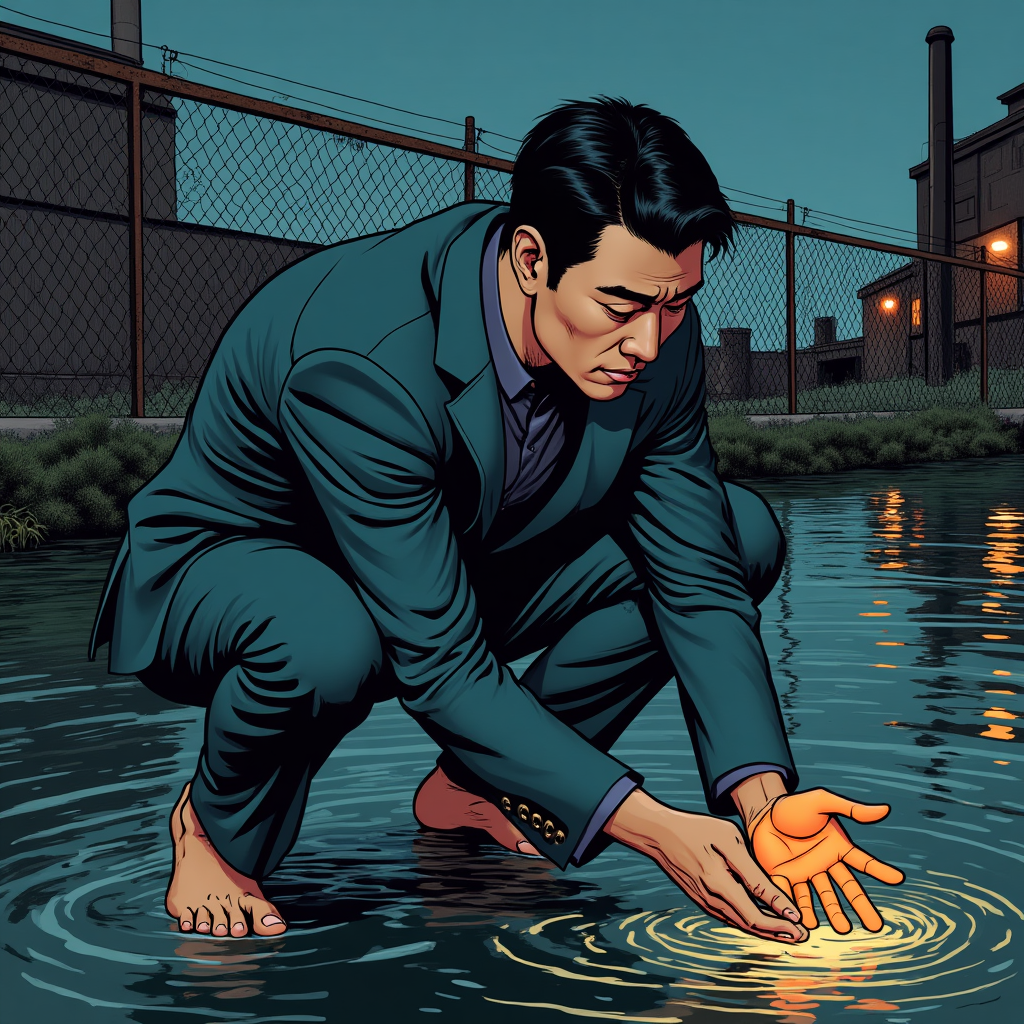
He crouches at the bank and puts his hand in.
The compound is still in the river. Diluted — enormously diluted, fractional parts per billion — but present, because Coronal BioSynth’s remediation has been, like everything Coronal BioSynth does, inadequate. Raymond feels nothing for a long moment. Then he feels something.
Not the total, cellular overwhelm that Teo experienced in the full outfall plume. What reaches Raymond Soo through the cold water of the Raritan is not a torrent but a trickle — a ghost of the compound, a whisper of what it did to Vásquez-Mena multiplied by the concentrated intelligence of a man who has spent a career training his nervous system to read data at the finest possible resolution.
He can feel water. Barely. Imprecisely. Like hearing a familiar song through a wall.
But what he can do — with the particular discipline of a mind that has spent fifty-two years building systems — is understand, in a way no one else on earth currently understands, exactly what Corriente can do. He can feel the potential of the Raritan the way a structural engineer can feel the load-bearing capacity of a bridge by pressing their palm to the steel. He cannot move rivers. But he can, he begins to understand over the weeks that follow, design systems to channel what Corriente can move — to trap it, redirect it, use it.
The river gave Teodoro Vásquez-Mena a gift. It gave Raymond Soo a tool.
He does not find this distinction troubling. He finds it clarifying.
Part Five: What Optimization Costs
By late spring, Aridion’s legal challenges have stalled the county review. Raymond is in Trenton twice a week, in conference rooms with legislative aides who drink bad coffee and listen to his presentations with the careful blankness of people who are not yet sure which way the wind is blowing. He is patient. He has always been patient.
But the Boyd Park confrontation has changed his calculations in ways he is only beginning to map. Corriente is not a protestor with a sign and a media strategy. Corriente is a peer-reviewed variable with the Raritan River as a force multiplier, and any infrastructure proposal Raymond puts forward in this county will now have to account for that variable directly.
He begins drafting what he calls, in his private notes, the Counter-Current Protocol — a series of modifications to the Aridion diversion network that would, if Corriente attempted to use groundwater pressure to disrupt the system again, automatically redirect that interference into Aridion’s own holding infrastructure. Turn the anomaly into an asset. Use the river’s defender to fill the reservoir.
It is, he thinks, elegant. It is the kind of solution that makes him feel, briefly, like the mechanism of the world is running correctly again.
Late on a Thursday night, the Aridion office emptied, he stands at the floor-to-ceiling window of his corner suite and looks out over the George Street corridor — the glass towers, the university buildings, the orange-grey sky above the Raritan Valley — and he does something he has not done in a very long time.
He tries to feel the river.
It is there. Faint, at this distance, at this dilution. The Raritan moving in the dark below the city, carrying its sediment and its memory and its forty-thousand-liter secret. And in it, somewhere, the particular frequency of a hydrologist who has spent thirty years listening to the water and whom the water has chosen to listen back.
Raymond presses his fingertips to the cold glass and closes his eyes.
He tells himself he is running calculations. Mapping the variable. Understanding the system.
He does not examine what it means that the feeling he is reaching for is not data.
The Raritan runs south and east toward the bay. Raymond Soo turns from the window, smooths the front of his jacket, and sits back down at his desk.
There is work to do. There is always work to do.
The system will not optimize itself.