
LUMINARY: Origin of the Filament Queen
Part One: The Woman Who Kept the Light On
The Raritan Valley hums at dusk. Commuter trains slide through Edison’s corridors like lit needles threading a dark hem, and the great mall on Parsonage Road blazes against the purple sky — but the real light, the one that matters, belongs to Dr. Farida Moussavi.
She is seventy-two years old and she does not slow down for anyone.
Her laboratory occupies the third floor of the Whitmore Biomedical Research Institute on Plainfield Avenue, a low-slung building that smells of cold coffee and ionized air. She has worked there for thirty-one years, ever since she emigrated from Tehran with two suitcases, a doctoral degree in RNA biochemistry, and a conviction that the body’s own code could be made to speak clearly enough to heal itself. Her colleagues, most of them decades younger, call her Dr. M. Her graduate students call her The Oracle. Her enemies — she has some — call her an obstacle.
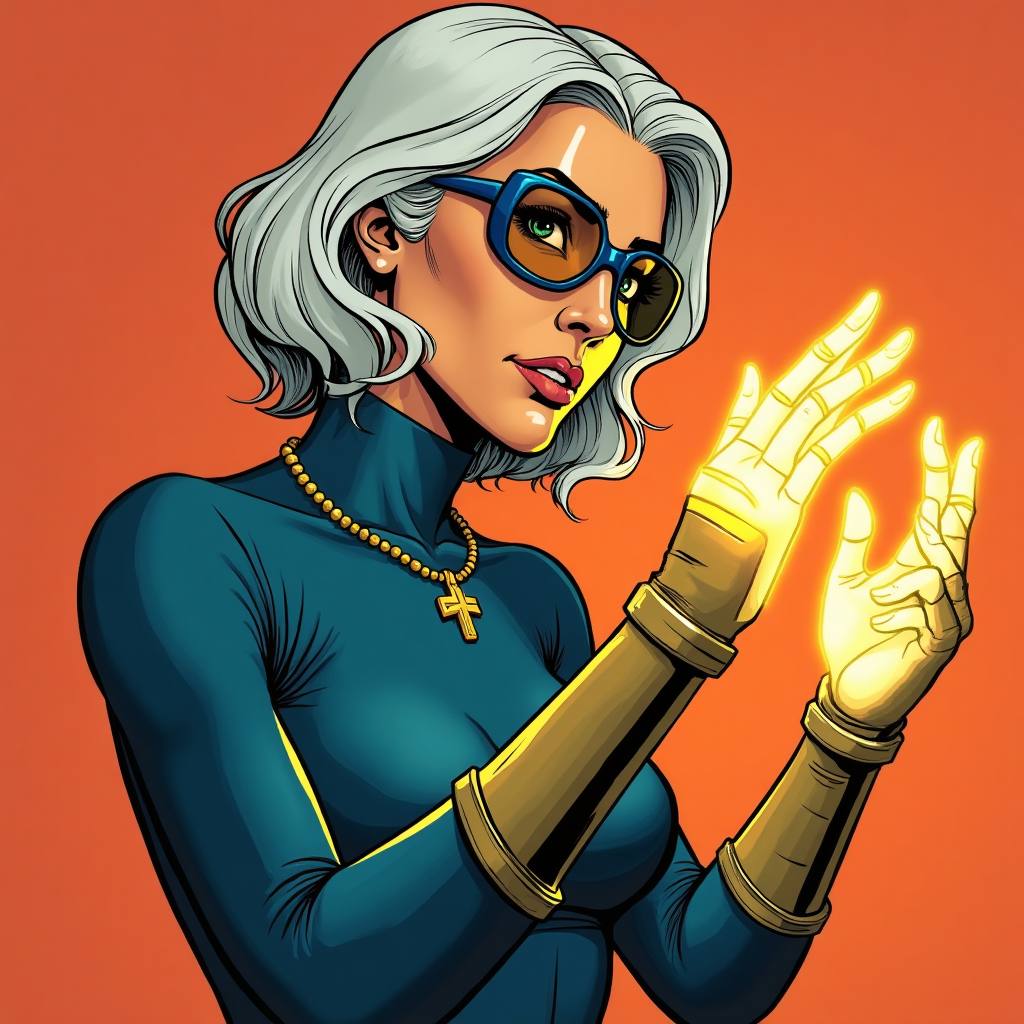
Farida’s hair is silver-white, cut close at the temples and longer at the crown, and she wears reading glasses on a beaded chain that her late husband Dariush gave her in 1987, the year the U.S. Women’s Open came to Plainfield Country Club and the whole township felt briefly famous. She is small and precise in her movements, like a bird that has decided the world is worth examining one millimeter at a time.
Her current work borders on the revolutionary. Using long-read RNA sequencing — technology that unspools an entire transcript rather than chopping it into fragments — she has been mapping the genetic signatures of hepatocellular carcinoma, the most lethal form of liver cancer. The goal: a targeted delivery system that kills tumors without poisoning everything around them. She is close. Closer than she has ever been to anything.
She works late every night. She takes the NJ Transit train home from Metropark station, walking through the parking lot with her rolling briefcase, past the Raritan River smell that drifts up from the south, past the Korean grocery on Amboy Avenue where she buys persimmons even though they are expensive. She is not lonely. She is concentrated.
What she does not know, not yet, is that the ground beneath Edison is about to speak to her in a language only she will be able to translate.
Part Two: A Hundred Years of Buried Fire
Edison does not advertise its darknesses. They are absorbed into strip malls and subdivisions, smoothed over by decades of asphalt and optimism — but they remain. Beneath the township, the soil holds the memory of catastrophe.
On the night of April 16th, Farida stays late beyond her usual hour. A result has come back from the sequencer — a haplotype pattern she has never seen, a strand of RNA folded in an impossible configuration that suggests a new mechanism of allele-specific expression. She is printing the data when the power flickers.
She thinks: a transformer on Wood Avenue, probably. It happens.
Then the floor moves.
Not an earthquake — nothing so clean. A subsurface tremor, a groaning from deep in the earth, a vibration that resonates at a frequency she can feel in her molars. Whitmore Biomedical is only a mile from the old Nixon Nitration Works site, where in 1924 an explosion killed twenty people and scorched the earth to glass. The site has been remediated, built over, forgotten — but the industrial compounds never fully left. Benzene, nitrocellulose residue, and a century of chemical legacy have migrated through the water table, and tonight, for reasons that will take engineers months to understand, a subterranean pocket of accumulated gas ignites.
A pillar of blue-white light erupts from the ground in the parking lot behind Whitmore Biomedical. Farida, standing at her window with her printout in her hand, takes the full force of the flash directly through the glass.
She does not burn. She absorbs.
The light enters her through her eyes, her skin, the pores of her hands. She feels the RNA sequencing data in her fist merge with something larger, something cellular and electric. The flash lasts three seconds. The parking lot is a scorch mark. The building’s windows are blown in. And Farida Moussavi is standing in the wreckage of her office, uninjured, luminescent — fingertips trailing light like filaments, like the carbon threads Thomas Edison coaxed into his first incandescent bulb less than two miles from this exact spot.
She holds up her hand. The light steadies. It obeys her.
She thinks: Oh.
Part Three: The Filament Queen Rises
The weeks that follow are terrifying and magnificent in equal measure.
Farida does not tell the Institute. She does not tell her daughter in Parsippany or her son in Palo Alto. She tells no one, at first — she is a scientist, and a scientist does not publish before she understands her results.
She experiments carefully, systematically, in the Dismal Swamp nature preserve on the edge of town, where the cedar scrub and dark water absorb her mistakes without witness. She discovers that she can generate light — not just white brilliance but structured, coherent beams that she can modulate at the frequency level, the way a body modulates RNA expression. She can produce targeted bursts of photonic energy that disrupt cellular membranes selectively. She can excite specific molecular bonds without igniting adjacent structures. Her decades of biochemical knowledge have become, overnight, an operating system for a power no one has ever held before.
She also discovers the other gift: she can read the light that already exists in living tissue. Every body emits biophotons — ultra-weak light produced by metabolic processes — and now Farida can perceive them. Standing on the Basilone Memorial Bridge over the Raritan, she looks at the commuters crossing and sees their inner light, the soft foxfire of cellular health and cellular distress. She can read illness in the spectrum. She is, she realizes, the world’s most sensitive diagnostic instrument.
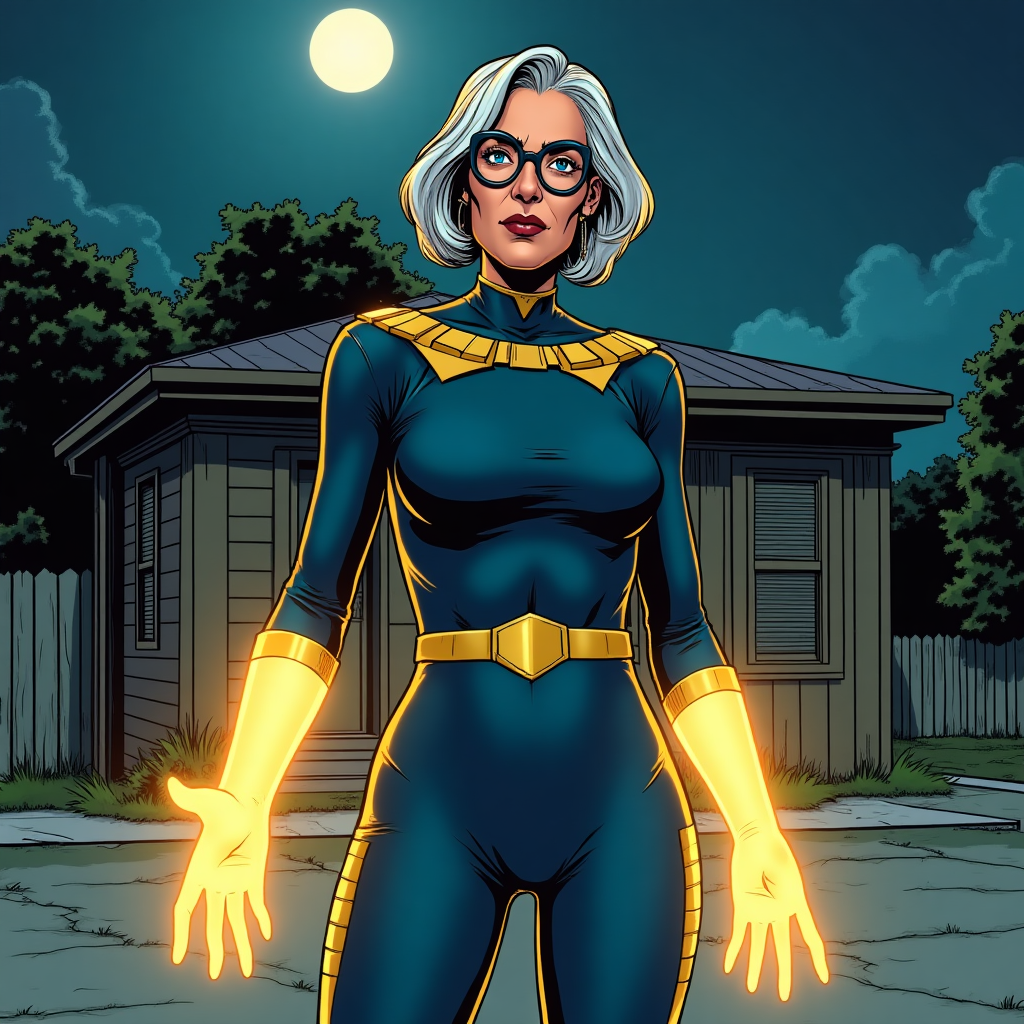
She makes herself a suit. She is practical about this. A friend in Woodbridge who does theatrical costuming asks no questions when Farida commissions a deep indigo bodysuit with gold reinforced paneling at the forearms and collar. She wears the reading glasses on the chain — she will not give them up. She calls herself, with the dry humor of a woman who has earned her gravitas, Filament.
She is a superhero at seventy-two, and she finds this mostly reasonable.
Part Four: The Architecture of Compliance
Corinna Vane is twenty-nine years old, blonde-haired, pale-skinned, and she has the smile of someone who has decided that other people’s discomfort is simply the cost of progress.
She is the founder and CEO of ClearPath Genomic Solutions, a biotech startup headquartered in a glass-and-steel building on Route 1 that looks like it was designed to impress venture capitalists and no one else. ClearPath’s pitch is seductive: AI-driven genomic compliance software that helps pharmaceutical companies navigate FDA regulations faster, cheaper, with less friction. What the pitch does not mention is that ClearPath’s compliance is fake — a sophisticated scaffold of generated documentation, statistical smoothing, and regulatory theater that allows dangerous therapies to reach clinical trials without genuine safety review.
Corinna knows this. She built it this way on purpose.
She has been watching Farida Moussavi’s research for two years, since before the incident. Farida’s RNA sequencing work on liver cancer is the closest thing in the world to a genuine breakthrough — and a genuine breakthrough, if published and adopted, would demolish the market for ClearPath’s false-safety framework. Real data makes fake compliance visible. Farida’s methodology, if it becomes the standard, will expose what Corinna has built.
Corinna’s solution is not subtle. She sends a pair of operatives to the Whitmore Biomedical Institute to steal Farida’s sequencing data and replace it with corrupted files. What she does not account for is that Farida works late. What she especially does not account for is that Farida is no longer merely a scientist.
The operatives trigger the building’s alarm at 11:40 p.m. Farida, at her desk reviewing the data she has already memorized, watches two figures in black move through the corridor outside her glass office wall. She sees, too, the biophotonic dimness around them — the flat, cold light of people who have cauterized their empathy.
She stands up. She turns on every light in the building at once, from the inside.
Part Five: First Light Over Menlo Park
The confrontation spills into the parking lot behind Whitmore Biomedical — the same scorched asphalt where the column of blue fire changed everything.
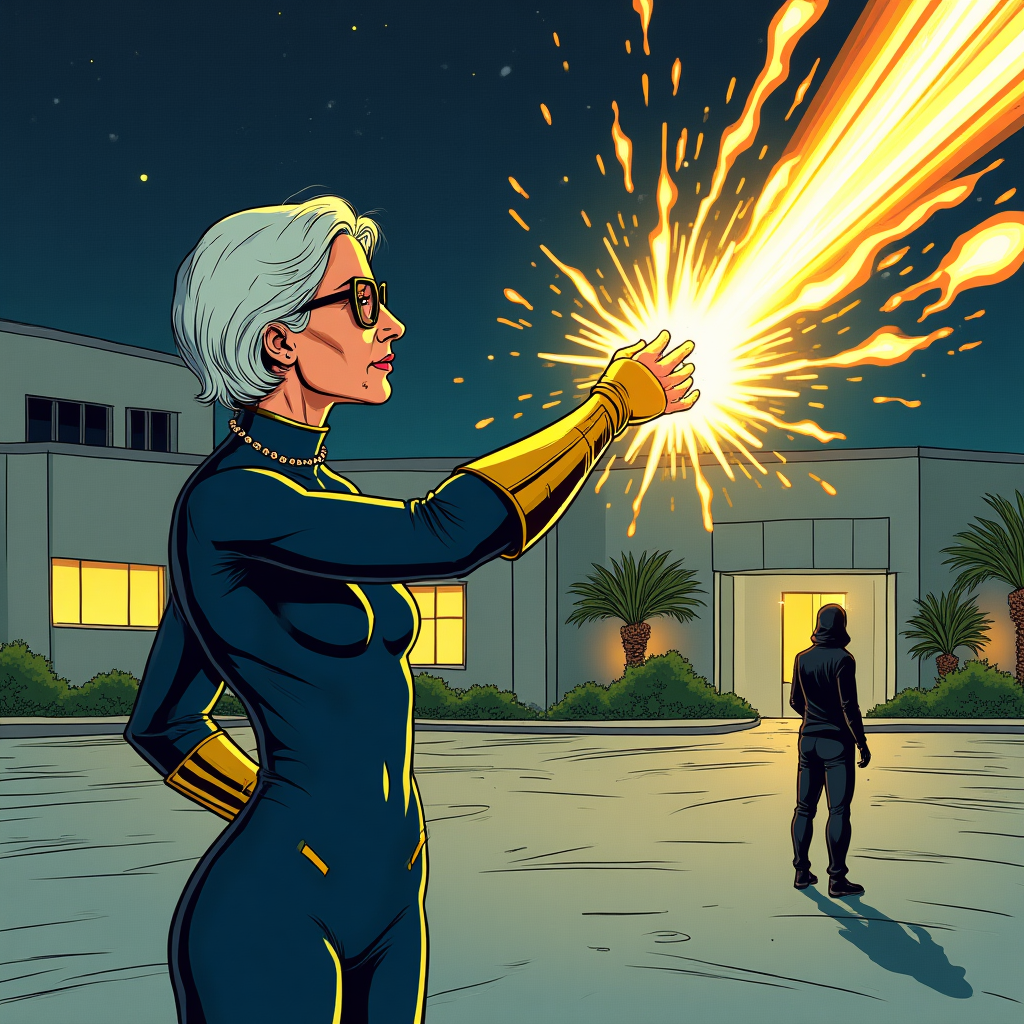
The operatives are disoriented by the sudden blaze of light that Farida pours through the building’s exterior fixtures, bending photonic energy through wiring and glass with the precision she once reserved for sequencing primers. One drops the stolen drive and runs. The other raises a pulse weapon — illegal, untraceable — and fires.
Farida steps aside. The discharge misses by a centimeter. She responds with a focused filament beam, a coherent burst at the precise frequency that disrupts neuromuscular signaling without causing permanent harm. The operative drops. The drive is recovered.
But Corinna Vane is already on the phone to her lawyers.
In the weeks that follow, Filament becomes a presence in Edison and across Middlesex County — visible at Metropark station when something feels wrong, a shimmer of gold-indigo at the edge of the NJ Transit platform. She appears above the Raritan at midnight, reading the river’s biophotonic signature, checking for contamination. She is seen near the BAPS Shri Swaminarayan Mandir on Sutton Avenue, standing in the parking lot at dusk, the temple’s carved marble lit softly behind her, speaking quietly to a teenager whose inner light has the particular dimness of someone in crisis.
She is not the loudest hero Edison could have asked for. She is the most precise.
Corinna Vane dissolves ClearPath’s most incriminating assets into three shell entities and moves her operation to a facility in South Plainfield. She is furious, patient, and already planning. She has commissioned a study on photonic countermeasures. She has hired someone who understands biophotonic suppression.
She will not underestimate Dr. Farida Moussavi again.
On the night of Thomas Edison’s birthday, Filament stands at the edge of the original Menlo Park laboratory site on Christie Street — the spot where the first practical incandescent bulb burned for thirteen and a half hours while the world was not yet watching. The soil here is sacred in a secular way. It smells of old industry and persistence.
Farida holds up her hand. Light blooms from her fingers, steady and warm, and she thinks about RNA folded in impossible configurations, about light that heals, about a hundred years of buried fire finally finding a purpose.
She is seventy-two years old. She is just getting started.