
Greylock Runnel of the Assunpink Margins
Part One: The Names the Creek Keeps
There is a version of Hamilton Township that does not appear on the township’s official promotional materials — the one printed in trail maps for the Assunpink Wildlife Management Area, the one that talks about migratory waterfowl and fishing access points and family-friendly parking lots at the reservoir. That version is true as far as it goes, which is not very far.
The version Dominic Swiftwind knows runs deeper, darker, and older. He is twenty-two years old, Lenape on his father’s side, raised on the narrow strip of geography between Bordentown and Trenton where the rail line and the creek and the highway each carve their parallel wounds through land that was once entirely water-meadow. He grew up with his grandmother’s kitchen smelling of sage and her kitchen window looking out at a tributary that no longer ran the color water is supposed to run. She named the fish that had gone. She named the plants that had receded. She did not make speeches about it. She simply named what was lost, the way you name the dead at a funeral — so someone, somewhere, knows they existed.
Dominic inherited the naming. He also inherited the grief, which is a different thing, heavier and more combustible.
He was sharp enough for an environmental science scholarship at a regional university — sharp enough to sit through two years of methodology courses and statistical modeling and research protocols managed by professors who consulted for the same regulatory bodies that had permitted the industrial discharge they were studying. He was not sharp enough, or perhaps too sharp, to pretend this was not a problem. He left in his second year. He took his notebooks and his water testing kits and his grandmother’s naming practice, and he went back to the margins.
He spent the next year living close to the Assunpink Creek watershed in the way that scientists sometimes live close to a problem — which is to say obsessively, without institutional permission, in a converted deer blind at the edge of the Hamilton wetland buffer that the township’s zoning maps listed as “undevelopable floodplain.” Undevelopable, Dominic noted, was not the same as undamaged. The mercury in the sediment. The heavy metal particulate from a century of rail oxidation and industrial discharge. The historical residue of processes that had ended decades ago but whose chemistry persisted in the substrate like a signature the land could not wash out.
He was trying to map it. He was trying to name it. He was not expecting the land to answer.
Part Two: The Geology of Intention
It did not happen the way transformations happen in stories — not in a single catastrophic moment, not with a flash of light or a rupture in the earth. It happened gradually, the way contamination happens: through sustained contact, through accumulation, through the slow migration of one system into another.
By his sixth month at the margins, Dominic noticed that the water testing strips he pressed between his fingers were reading differently than the ones he dipped with gloves. His bare skin was more accurate — not as a metaphor, but literally. The mercury concentrations he felt through his fingertips corresponded exactly to the spectroscopic readings when he could get lab access. He began to understand that the heavy-metal sediment he had been living in, sleeping above, breathing at the margins of, had been entering him — not as poison, or not only as poison, but as information. The toxic geology of the place had rewritten his nervous system’s interface with the material world, the way long exposure to altitude rewrites blood oxygen capacity.
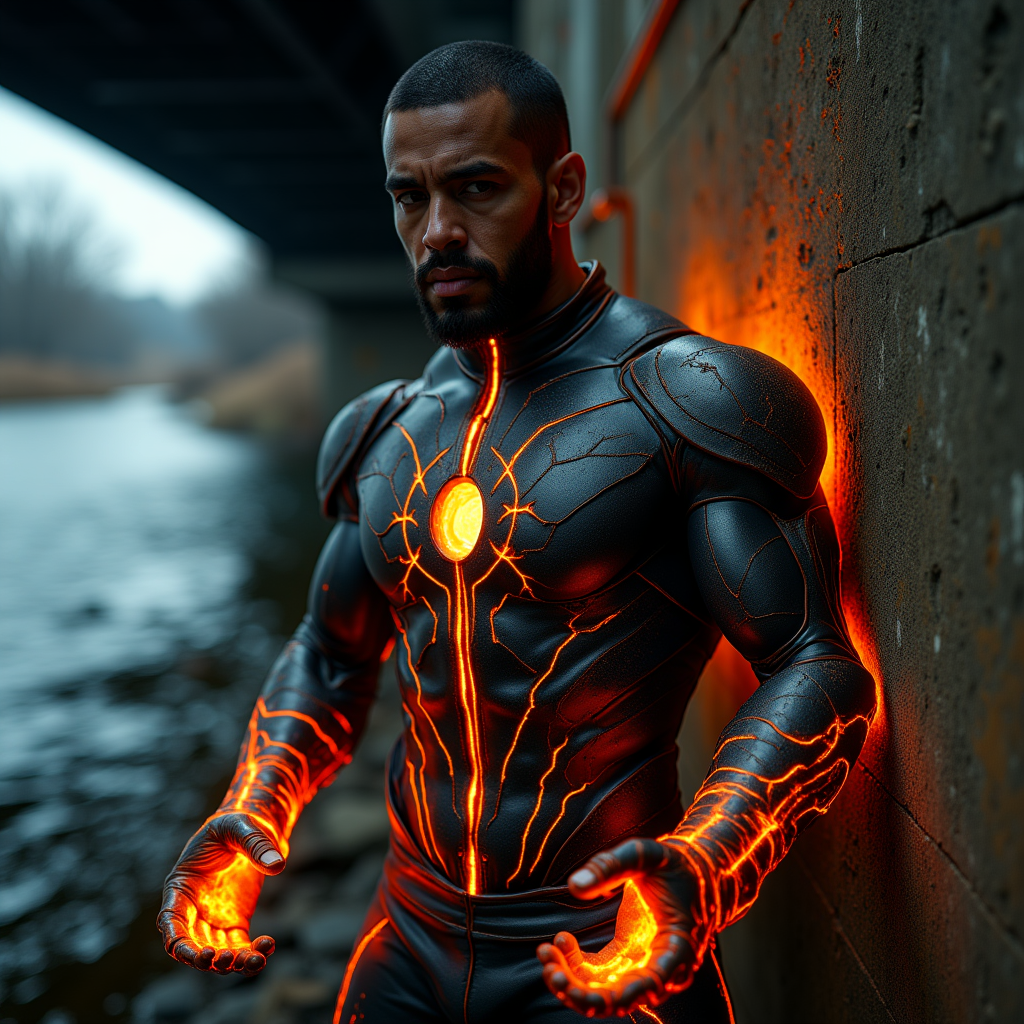
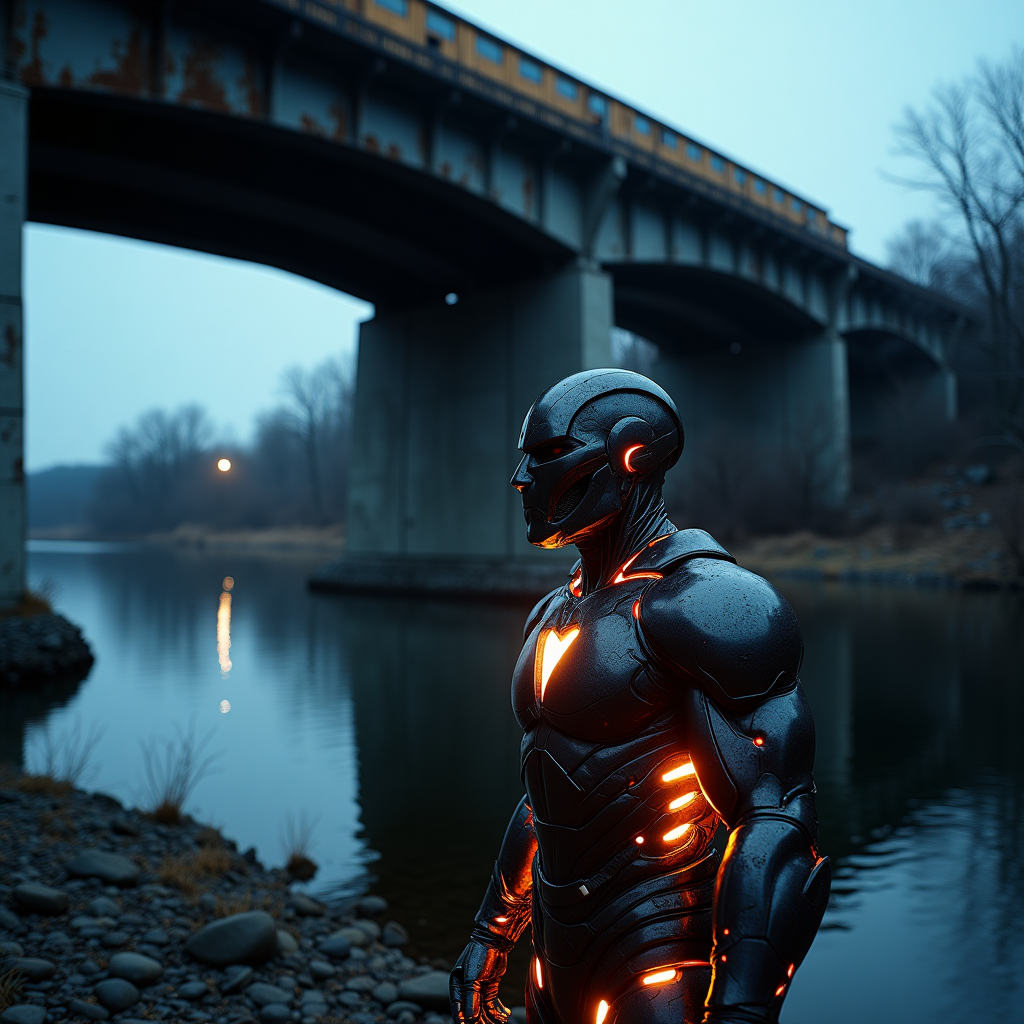
By his ninth month, the transformation had become visible. The heavy-metal particulate had migrated through his skin and restructured his clothing and his surface into something the geology had apparently decided he needed: dense plates of dark oxidized mineral matter, layered like geological strata, articulated at the joints, fused across the chest and shoulders in thick bands of compressed sediment-material that caught the light like graphite. He looked, when he stood at the edge of the creek in early morning, like a standing stone that had learned to move.
And he could feel things.
He could feel the NJ Transit rail corridor the way you feel a tooth that is being worked on — specifically, precisely, without being able to look away from it. His consciousness spread outward through the electromagnetic field generated by the rail infrastructure, the rolling stock, the overhead catenary — splayed across every commuter train and freight car like a web of sensory thread. He felt the metal wheels’ contact with the tracks as if they were his own feet. He tasted the vector of each vehicle’s momentum through his nerves. He knew, without checking a schedule, that the 6:42 southbound was running four minutes late at Klockner Road, that a freight consist had developed a hot journal bearing at milepost 12, that the Assunpink Creek crossing’s eastern abutment was vibrating two degrees outside its normal harmonic.
He knew the water the way he had always known it, but now the knowing had precision. The tributary systems feeding into the Assunpink became transparent to him — each bacterium, each chemical compound registering in his mind’s eye like poisoned stars, glowing and named. And he could do more than name them. He could reach into the water’s chemistry with a sustained act of focus and unmake the compounds — neutralize the pathogenic load, dissolve the heavy metal particulates into inert sediment, return the pH gradient toward something his grandmother’s fish might have recognized.
And at rush hour, when the Hamilton Township platforms filled with commuters — the workers from the Nottingham warehouse district, the state government employees, the students, the healthcare workers — a third sense bloomed in his chest like a bruise. He felt them. Their small injuries. Their infections catching early, their blood pressure climbing, their lungs working harder than they should. A thousand compressed physiological narratives pressing against his skin simultaneously, the empathic weight of it landing like weather. He felt like he was drowning in collective human fragility even as the trains arrived beneath the Jersey sun, indifferent and on schedule.
He had intended to be a scientist. He was becoming something more specific than that — and more dangerous.
Part Three: The Correction
He called it, in private, a correction. Not a protest, not a disruption, not an act of sabotage — a correction. The distinction mattered to him, the way distinctions matter to people who have been very precise about their grief.
The correction was this: the rail corridor that cut through Hamilton Township’s historic Assunpink flood plain had been there since the 1850s. The embankments that held it had bisected the wetland’s natural hydrology for over a century and a half. The rail infrastructure had delivered chemical contamination to the watershed through ballast runoff, creosote-treated ties, corroded iron oxidation, and proximity to industrial operations that had used the corridor’s jurisdictional complexity to avoid coherent environmental oversight. The corridor had caused harm. The harm had never been accounted for. The harm was ongoing, in the sediment, in the water, in the bodies of the people who lived downstream of it.
The correction was to remove the corridor. Not metaphorically. Literally. Bridge by bridge, abutment by abutment, beginning with the three crossings where the rail embankment had done the most hydrological damage.
His third discovered power made this possible in a way his first two did not. He could corrode. Not merely feel the dissolution of iron bonds — accelerate it. He could press his hands against structural steel and strip decades of galvanic protection in an hour. He could seed a concrete abutment with his biological output and watch the rebar inside begin to shed integrity in real time — a process that should take thirty years compressed into thirty days. He had been working the eastern pier of the Assunpink Creek crossing for two weeks before he became aware that someone was reading his work in the steel.
He felt her before he saw her — a different frequency in the rail, something that moved like understanding rather than like infrastructure. A signal that had intention inside it. He had assumed he was alone in his sensitivity to the corridor. He had been wrong.
Part Four: The Transit Web and the Drowned Stars
He should not have been surprised that others had been changed by Hamilton’s contaminated geography. The Assunpink watershed had absorbed a century of industrial chemistry. He was not the only person who had spent years in close contact with what the land remembered.
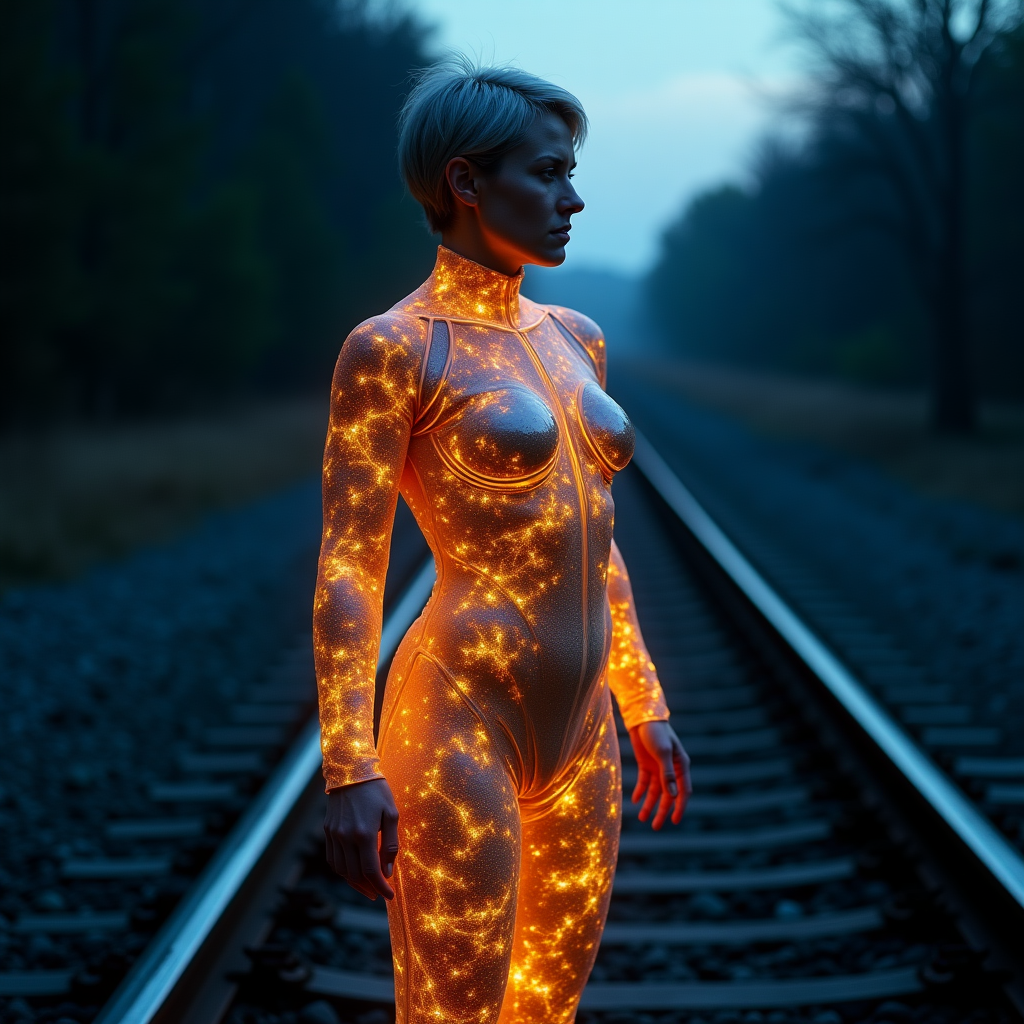
He watched her from the shadows of the Nottingham Road overpass one evening rush hour — watched Marshveil work the platforms without appearing to work them at all. She was in her early fifties, a White woman with the posture of someone who had been load-bearing for a long time, her work coveralls still faintly visible at the collar beneath the heavy ferrous geological form that had restructured her. She pressed one hand to the platform rail and seemed to simply know things — he could feel her awareness moving through the corridor like his own, but where his was oriented toward dissolution, hers was oriented toward coherence. She was hearing the rail sing. He had been teaching it to go silent.
The empathic weight of the evening platform hit him in the usual way — six hundred people, their compressed physiological stories pressing against him all at once. A man with an undiagnosed arrhythmia near the center turnstile. A child with the early fever signature of strep at the south stairwell. A woman whose blood pressure was spiking toward crisis three feet from the platform edge. He could feel all of it simultaneously, the drowning weight of collective fragility, the way it had made him feel, in his first months of transformation, that the world was simply too full of unaddressed suffering to be endured.
He had made a choice about that feeling. He had decided it was data, not paralysis. He had decided to use the pathogenic clarity — the ability to see every bacterium, every chemical compound in the water as a poisoned star he could unmake — not to heal people one at a time, which was too slow and too individual and left the sources intact, but to address the systems that were making people sick in the first place. The waterways. The contaminated sediment. The infrastructure of harm.
He was not wrong about the sources. He had been watching Marshveil move through the platform for three minutes when he understood, with the precision his third sense gave him, that she was feeling the same things he was feeling — the same physiological weight, the same compressed human fragility — and arriving at a different answer.
It made him angry. It made him uncertain. Both things at once, which was the worst combination.
Part Five: The Weight of What He Knows
They met at four in the morning at the Assunpink Creek crossing, which was not an accident. He had chosen the hour because the corridor was quiet and the creek was loudest — the water running high with spring melt, the Assunpink swollen to the margins of its floodplain, touching the embankment foundation in a way that felt, to his senses, like a tribunal.
He had both hands against the eastern abutment’s concrete face. The rebar inside was singing its dissolution song — he had been at this pier for three nights now, and the integrity loss was precisely on schedule. By late summer, three crossings would be structurally compromised beyond safe operation. The corridor would shut. The embankments would be flagged for remediation. The wetland hydrology, freed from the rail infrastructure’s bisecting pressure, would begin its long return.
He had calculated all of it. He had not calculated her.
She came from the western embankment without urgency, the way a maintenance supervisor approaches a structural problem: not to confront it, but to read it. The ferrous geological plating that had restructured her moved differently than his own heavy-metal form — where he was graphite and oxidized mineral strata, she was iron-rich and salt-fused, the Assunpink marsh’s chemistry made architectural. He could feel, even across the distance, the rail corridor lighting up in her awareness.
“You’re dissolving the eastern pier,” she said. Not a question.
He turned. She was older than he’d understood from the platforms — her face readable through the ferrous transformation, precise and weathered and carrying the specific patience of someone who has been maintaining things for a long time that other people do not bother to see.
“The pier is the least of it,” he said.
She told him about the deck. Twenty tons of treated concrete and ballast. The creek below. The mathematics of catastrophe that his correction would deliver into the very watershed he was trying to reclaim.
He did not want her to be right. He had been meticulous. He had calculated the structural sequences, the remediation timelines, the hydrological modeling. He had not calculated for concrete deck collapse into active floodwater because he had not let himself model that particular consequence all the way to its end. He understood, with the clarity that his empathic sense sometimes delivered about his own physiology before he was ready to acknowledge it, that this was not an oversight. It was a choice he had made not to look.
She pressed her palm to the rail. She broadcast — he felt it through the steel like a voice through a wall, her awareness opening into his. She showed him where the contamination actually originated. Every pipe. Every undisclosed slurry line. Every Hargrove Industrial Holdings discharge point, mapped in chemical salinity and iron-oxidation signatures, precise as coordinates he could have found himself if he had been looking at the sources instead of at the infrastructure closest to hand.
The Assunpink moved beneath them. His pathogenic sight read the water — the heavy metals, the bacterial load, the pH gradient spiking where the historic discharge sites were still leaching. Poisoned stars, every one of them, and he could name them, every one, and he could feel the specific gravity of his grandmother’s naming practice in his chest like a stone he had been carrying since he was nine years old.
He lifted his hands from the concrete. He did not agree with her. Not yet. Not entirely. The corridor was still a wound in the wetland’s hydrology, the embankments were still bisecting the floodplain, the harm was still real and still unaccounted for. He was not wrong about any of that.
But a collapsed bridge over an active creek is not a correction. It is a new harm added to the existing harm, and the watershed does not care about the intentions of the person who caused it. The Assunpink would absorb twenty tons of treated concrete the same way it had absorbed a century of rail oxidation — slowly, silently, and at enormous cost to everything living in the water.
He watched Marshveil drive three reshaped rail spikes into the embankment margin as erosion stakes — a small gesture, a maintenance gesture, almost absurdly modest against the scale of what needed fixing. But the sedge gripped the stakes immediately, the way plants grip any anchor that holds.
“The corrective filings go in Monday,” she said.
“That’s not enough,” he said. Because it wasn’t. It would not be enough for a long time.
“No,” she said. “It won’t be.”
She walked back along the tracks. He stood at the pier he had been dissolving for three nights and listened to the creek move beneath him and felt, with the full weight of his empathic physiological sense, the specific fragility of everything downstream — the communities, the wetland, the tributary species, the water table that people drank from without knowing its history.
He did not finish the pier. He did not agree to her timeline. He stepped back from the abutment and stood at the margin of the Assunpink in the dark and used his pathogenic sight to read the water the way his grandmother had read the names of fish — cataloguing what was there, cataloguing what was gone, refusing to look away from either list.
The 4:17 freight consist passed overhead, on schedule, its wheels singing on the rails. He felt every car. He felt the stressed abutment recovering infinitesimally now that his hands were off it. He felt the creek below, cold and patient and carrying its century of insults toward the sea.
He thought: the correction is not finished. The correction is not wrong. The correction needs a different method.
He began, in the dark above the Assunpink, to recalculate.