

Part One: The Cold Open
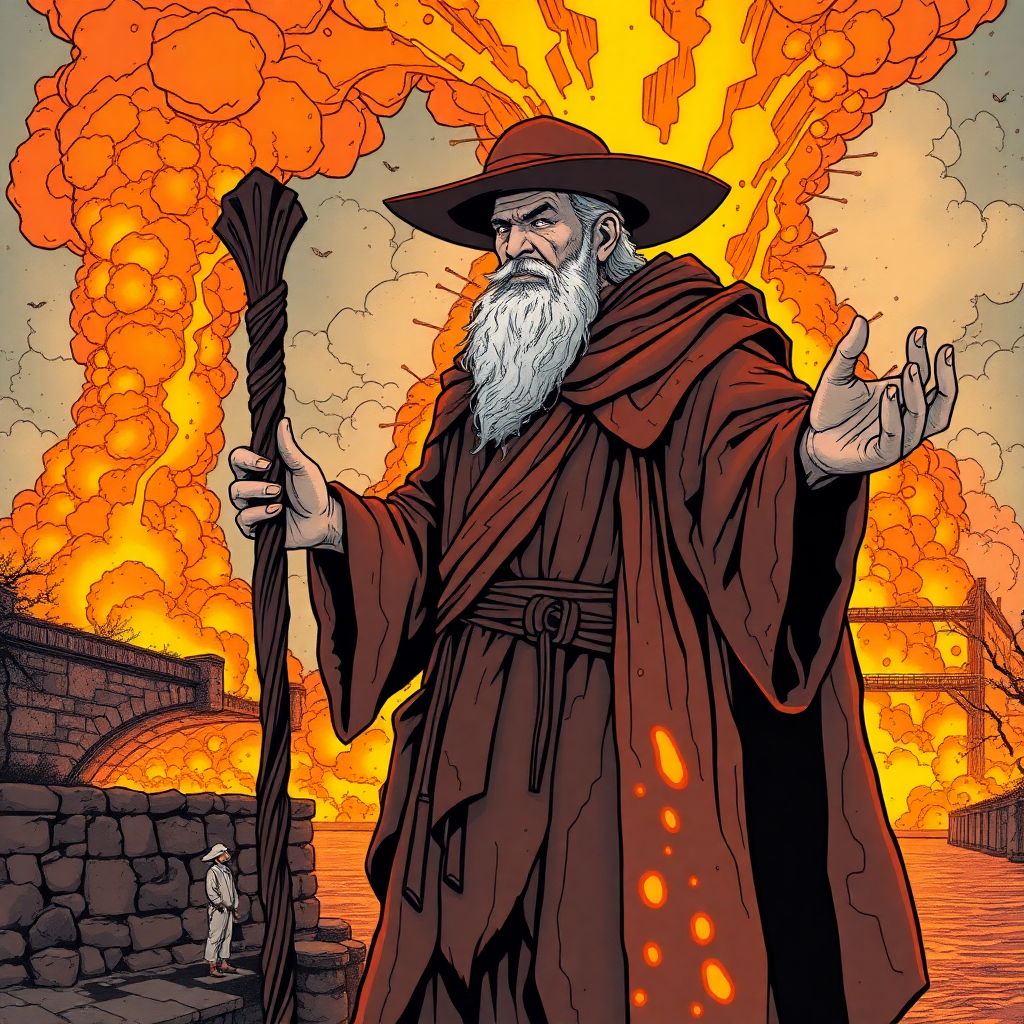
Alderman Harlan Grimshaw had not planned to become a supervillain on a Thursday. He had planned to attend the Paper Mill Playhouse renovation committee meeting, collect his per diem, and be home in time for the six o’clock news.
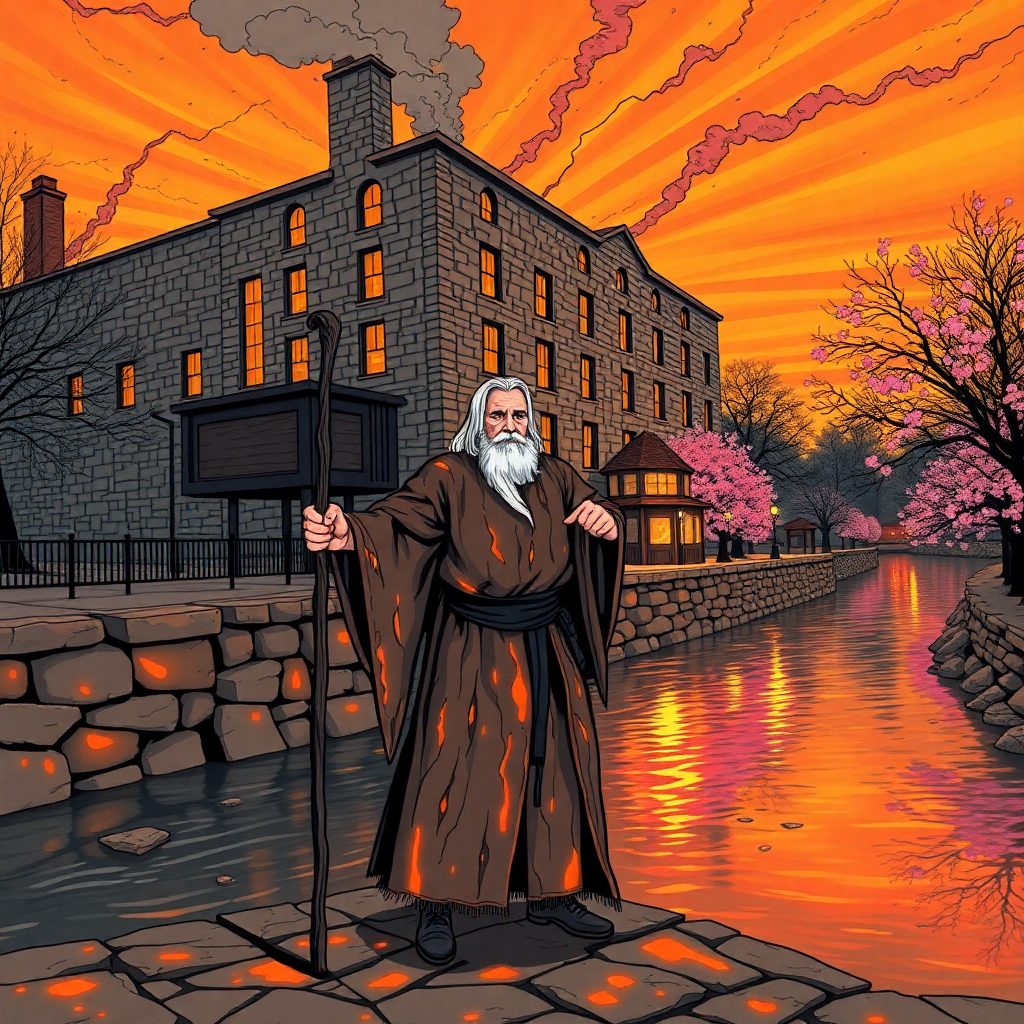
Then the heat exchanger along the river wall called to him — the way it always called, low and insistent, like a kettle that had been waiting for someone competent to arrive — and twenty minutes later the cherry blossoms were wilting from the inside out and the Belleville volleyball squad was dragging through drills like men who’d trained all night in a sauna.
Grimshaw watched the warm air bend above the river, smoothed his lapel, and thought: right on schedule.
Part Two: The Investigation
The Smokecroft Clan’s claim to the West Branch riverfront was older than Millburn’s incorporation papers, older than the Paper Mill Playhouse, older than every oak and ash in South Mountain Reservation that had watched the Wrenfields steal the milling contracts in 1902 and smile about it. Harlan had not forgotten. Harlan’s father had not forgotten. Harlan’s grandfather had written it down in a ledger that still lived in a fireproof box under the floorboards of his Short Hills study.
The Playhouse renovation was the opening he’d waited nine years to find. The township easement was the lever. The heat exchanger bolted to the river wall — left over from a 1970s drainage project and ignored by everyone except Harlan, who had spent thirty-seven years quietly ensuring it was never removed — was the mechanism.
He pressed both palms to the iron housing. The exhaust heat poured into him, familiar and enormous, and he let it flow back out through the river wall in a slow, deliberate column aimed directly at the Playhouse’s new HVAC calibration sensors.
At the Millburn Station parking lot behind him, an elderly woman named Delia Oost was writing something down. He noted this with mild displeasure and continued.
Part Three: The Pivot
The math was elegant, which was why Harlan respected it. One failed HVAC calibration would trigger a contractor dispute. The contractor dispute would delay the renovation by sixty days. Sixty days’ delay would void the township easement under the 1987 riverfront ordinance — an ordinance Harlan had, in fact, helped draft, under a different name, as a favor to himself across time. The voided easement would reopen the 1901 land survey. The 1901 land survey still bore the Smokecroft name.
The Wrenfields had used water rights to freeze the Smokecroft Clan out of every heat-dependent industry for two generations. It was only fitting that Harlan use heat to take back the riverbank they’d stolen with water.
He was not sabotaging a theater. He was correcting a clerical error in the historical record.
The distinction mattered to him enormously.
Part Four: The Reckoning
She came at dusk. He had expected her — had half-expected her since the morning, when the ash tree beside the culvert shuddered in a way that had nothing to do with wind. The Wrenfield girl. Small. Ten years old. Standing at the edge of the riverbank in that unsettling way she had, as if she could read the electromagnetic frequency of his irritation.
She could. That was the infuriating part.
Grimshaw drew the exhaust heat up through both palms and pushed it outward in a wide thermal column, the kind that cracked stone and made grown men dizzy. The air above the river bent and shimmered. He had, by conservative estimate, absorbed enough ambient industrial heat over the past forty-seven years to warm a small borough.
Sophie Wrenfield raised her forearm. The hexblade bow formed along it like a current finding ground — pale, luminous, strung with what looked uncomfortably like nerve fiber — and she loosed.
The arrow was not physical. It hit the heat exchanger’s electrical panel and read his entire thermal network as a catastrophic short. Every loop Grimshaw had built in the river corridor discharged at once — upward, away, in a vast invisible column above Millburn Station that scattered the April clouds and startled three commuters who were politely pretending not to look.
Grimshaw staggered. The heat left him all at once, and he felt seventy-three years old in a way he usually managed to avoid.
“The easement holds,” Sophie said.
He straightened his jacket with the dignity of a man who has been inconvenienced across multiple centuries and has learned to pace himself. “For now,” he said, and walked toward the platform.
Part Five: The Resolution
The renovation resumed. The river cooled. The Belleville volleyball squad posted their seventh win before breakfast.
Harlan Grimshaw rode the 7:42 Midtown Direct home to Short Hills, opened the fireproof box under his study floor, and made a small annotation in the ledger beside his grandfather’s entry for 1902.
First attempt. Countered. Wrenfield girl confirmed active.
The deed was still out there. He had waited nine years for one opening. He was patient. He was thorough. He was also, according to the six o’clock news, being praised in a township newsletter for his years of service to the Playhouse renovation committee.
He poured himself a bourbon and thought about the 1987 riverfront ordinance, and the seventeen other ordinances he had not yet needed.
Sources
- Belleville boys volleyball starts 6-0, earns state ranking
- Athletics Top 36 Prospects
- Athlete of the Week – Nutley’s DeJianne has Raiders in first place
- In bloom: NY and NJ cherry blossoms are objectively the best in the nation
- Nutley’s DiPiano is named NJWCA State Coach of the Year
- Millburn, New Jersey — Wikipedia
- U.S. Census Bureau, American Community Survey 5-Year Estimates (2022)