

Grimward of the Garden State
Part One: What the Numbers Actually Mean
Desmond Pallister has spent thirty years learning that systems fail slowly, then all at once.
He knows this the way a structural engineer knows it — not as metaphor but as physics. Stress is a patient thing. It accumulates in silence, invisible to inspection cycles and municipal budgets and the comfortable fiction that infrastructure built in 1951 can carry the load of 2026 indefinitely. He has walked the support columns of the Garden State Parkway overpass where it crosses Route 1 in Woodbridge Township, run his palm along the cold aggregate face of the concrete, and felt the micro-vibrations that nobody else bothers to measure anymore. He has read the inspection reports — the real ones, not the summaries — and understood what the flagged anomalies in Section 7-C actually mean when you translate them from bureaucratic euphemism into load-bearing mathematics.
They mean the structure is tired.
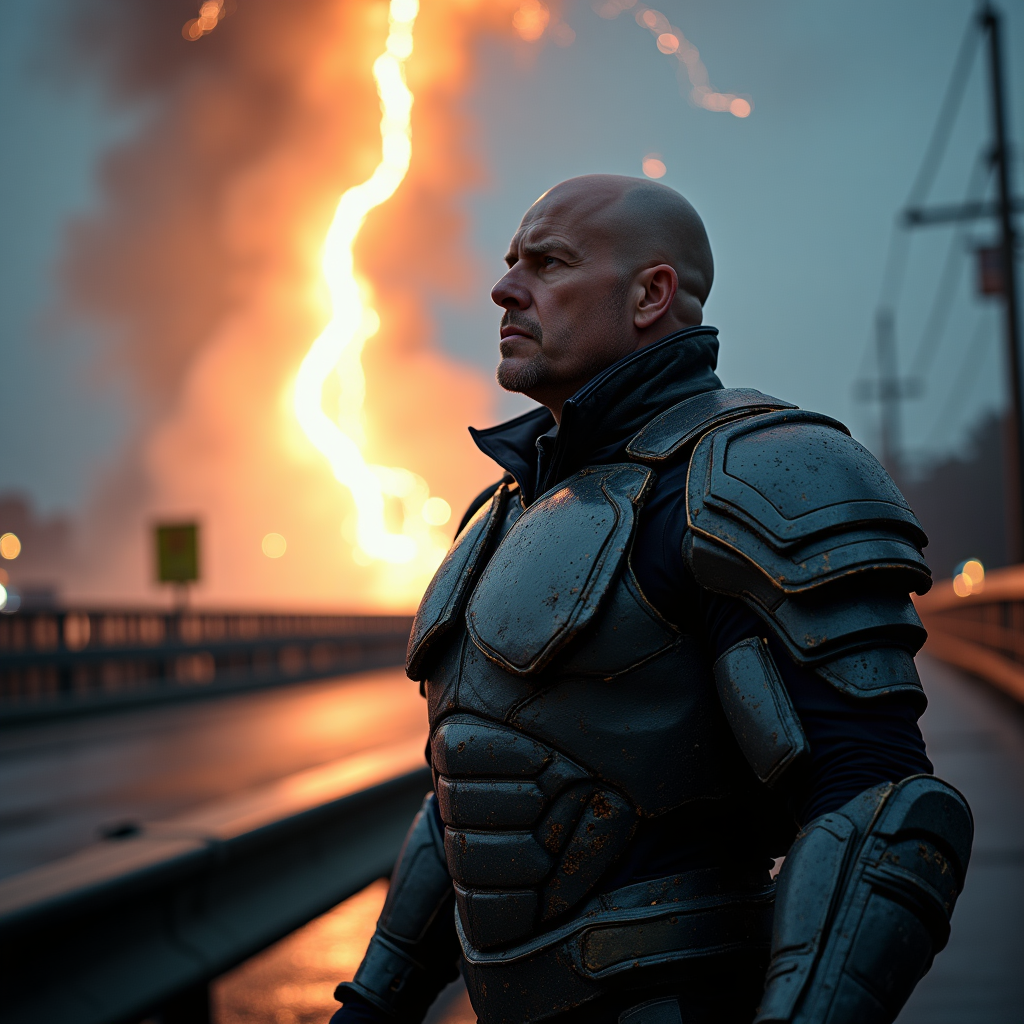
Before the change, he is a White man in his early fifties, broad-shouldered and ruddy, with the settled confidence of someone who has outlasted four department directors and two mayoral administrations and still knows where every buried cable in Middlesex County runs. His name on the county engineering contract is Pallister Infrastructure Consulting Group, LLC, and for nineteen years it has been a business that functions: bridge assessments, roadway stress analyses, subsurface cable surveys for the Turnpike Authority, the kind of unglamorous technical work that keeps New Jersey from collapsing into itself. He is good at it. He has always been good at it.
The problem is that no one acts on what he finds.
The Section 7-C report goes to the Turnpike Authority’s capital planning office in December. By February, it has been absorbed into a queue behind forty-seven other deferred maintenance items, assigned a priority tier that will not see funding for six fiscal years. By March, he has submitted two follow-up memos and received two automated acknowledgments. By April, the overpass above Route 1 still carries 280,000 vehicles per day, and the support beams still vibrate with the accumulated stress of three generations of freight.
He drives beneath it every morning.
He knows which column will fail first.
Part Two: The Storm Survey
It is the kind of April evening that New Jersey specializes in — humidity clinging to everything, the sky over the Raritan Valley building toward a charge that has been accumulating since noon. Desmond is on a routine cable tension survey beneath the Parkway overpass interchange, the junction where the GSP and the Turnpike braid together in their monumental concrete enormity above the Route 1 service corridor. He is alone with his equipment, the way he often is: a tension gauge in one hand, a clipboard in the other, a headlamp cutting pale light across the underside of a deck that vibrates constantly with the weight of commerce.
The survey brings him to Column 12, the one he has been documenting for eight months.
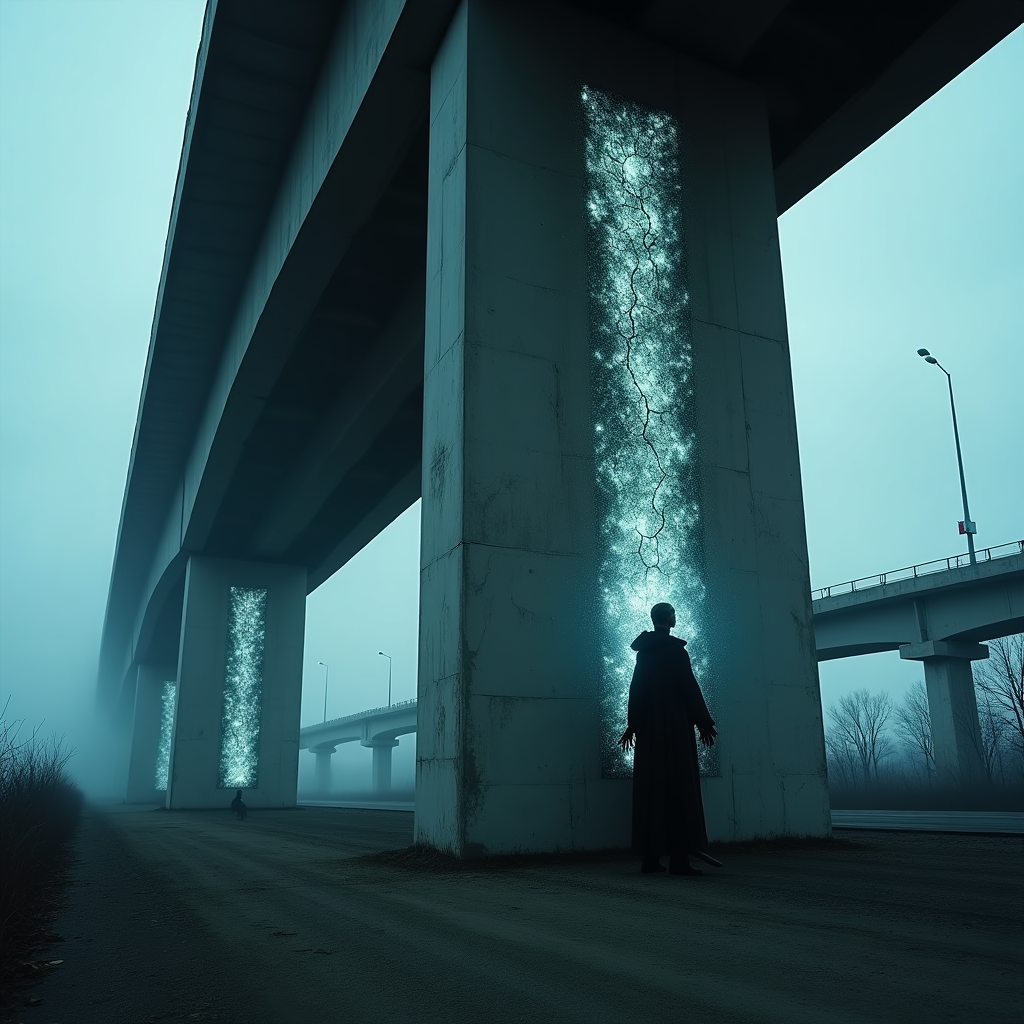
He runs his fingertips along the aggregate face of the beam and feels what he always feels: the singing. Not a sound exactly — a transmission. The stress fractures radiating through the reinforced structure like fault lines in bedrock, each one a whisper he has learned to read the way a physician reads a pulse. Micro-vibration at 6.4 Hz, the resonance frequency of compromised rebar. He closes his eyes and the column speaks to him in the language of physics, and what it says is: soon.
The storm breaks without warning.
The lightning strike is a kilometer away — a ground strike on the Turnpike’s elevated deck near Interchange 12 — but the electromagnetic pulse travels the steel suspension cables instantly, and Desmond is standing with both hands pressed flat against a grounded column when it arrives. The discharge is not lethal. It should have been nothing — a jolt, a thrown man, a story he would tell at the emergency room. Instead the current finds something in him it recognizes, something in the particular arrangement of his nervous system that has spent nineteen years learning to feel what metal feels, and it does not pass through him.
It stays.
He lies on the service road for eleven minutes before he can stand. The storm is already moving east toward the bay. Above him, the Parkway and the Turnpike are river of headlights, indifferent and continuous. The cables he has measured a hundred times are still singing — but now he can hear every note.
Part Three: The Instrument
The change does not give him new knowledge. It gives him range.
What he could feel through his palms before — the subtle tremor of compromised concrete, the resonant frequency of stressed steel — he can now feel from forty meters, from a hundred, from the length of a highway span. Standing on the shoulder of Route 1 at dawn, he runs awareness through the overpass infrastructure above him like fingers through a harp: every suspension cable reporting its tension load, every stress fracture broadcasting its depth and vector, the whole structural nervous system of the interchange laid open to his perception in complete, devastating detail.
He knows, now, exactly how close it is.
And with the atmospheric charge he carries in his body — building constantly from the humid New Jersey air, from the electromagnetic environment of the most trafficked highway corridor in the state — he can do more than feel. He can act. He raises his hand toward the suspension cable array above Column 12 and feels the charge in his palm lock onto the steel like a key finding a lock. The cable sings back at him. He could, he understands, make it sing its last note.
He does not. Not yet.
He goes home to his office on Gill Lane and spreads the inspection reports across his desk — eight years of them, his own and the Authority’s — and builds the case in numbers that cannot be argued with. He submits it again. He marks it URGENT. He requests an emergency structural review.
Three weeks pass. The automated acknowledgment arrives on a Tuesday.
That night, he stands beneath Column 12 in the dark and feels the structure breathing above him — 280,000 daily crossings, the rhythmic assault of freight and commuter traffic on concrete and steel that was never designed for this century’s load. He thinks about what would happen if he let the charge go. A controlled failure. A spectacular, undeniable, structurally-documented event that forces the closure, the inspection, the $340 million rehabilitation that his reports have been demanding for nearly a decade. Nobody dies — he knows exactly which cables to strike, which fracture lines will propagate safely toward the shoulder span rather than the travel lanes, how to create maximum structural drama with minimum casualties if he times the lightning discharge to a maintenance window.
He tells himself this is still engineering. Just with a more direct application of force.
Part Four: The Compliance Officer
He knows about Claire Vandermeer before she knows about him.
It is her thermal signature, initially — anomalous electromagnetic readings near the Woodbridge Creek tributaries, appearing in the data from his survey equipment in early April, consistent with a biological source of unusual electrochemical output. He triangulates the events over two weeks. Same general movement corridor: Rahway Avenue, the creek confluence, the service road beneath the Turnpike deck. He runs the pattern against the county employee directory and finds her easily enough — environmental compliance officer, Middlesex County Water Authority. Filed eleven reports in the last eight months, zero regulatory actions resulting.
He reads her reports. They are meticulous. They are ignored.
He understands her completely, the way he understands his own inspection memos: correct, documented, inert. Two people who have spent years producing accurate analyses of systems failing in slow motion, submitting them to institutions constitutionally incapable of acting on them. He feels a kinship with her that is not comfort exactly but recognition. He considers reaching out.
He does not. Because he has also read the discharge reports that trace back to Grimward Environmental Remediation and Infrastructure Services — the company, not the man; the man, he has gathered, operates through a web of municipal relationships and variance approvals that make direct confrontation structurally impossible — and he understands that Claire is on a parallel track to his own. She is trying to fix Woodbridge with documentation. He tried that. It does not work.
There is a moment, standing at his office window watching the headlights stream across the elevated Parkway deck against the April dark, when he names what he is becoming. Not the superhero name — that comes later, from the press, from the fear he begins to generate. The name he gives himself in private is simpler.
The thing that makes the numbers matter.
He begins to think of himself as Grimward — not Desmond Pallister the consultant, the memo-writer, the man who sat in county offices and explained load calculations to people who had already decided not to care. Grimward. A name with weight. With the Germanic solidity of something that does not yield.
Part Five: First Strike
The night Claire Vandermeer becomes Harborfall and sends her evidence package to federal investigators and three journalists, Grimward is three hundred meters away.
He does not know what she has done yet. He is standing beneath Column 12 at 4:47 AM with both hands pressed against the concrete, feeling the stress fractures’ familiar song and making a decision. The storm cell is forty miles west, moving fast, building the atmospheric charge he needs. The Authority’s maintenance log shows no scheduled activity on the span until 6:30 AM. There is a window of ninety minutes in which the travel lanes above the shoulder span will carry only the lightest pre-dawn freight.
He raises his hand. The suspension cables lock into his awareness — seventeen of them, each reporting its load and fatigue coefficient with the clarity of a diagnostic screen. He knows which three are already at 73% of rated tensile capacity. He knows the fracture propagation angle of the column below. He knows exactly how the failure will cascade.
He brings the lightning down.
The strike hits the cable array at the shoulder span junction with a crack that shakes the service road underpass and sends a shower of concrete spall across the Route 1 shoulder. For four seconds, Grimward watches the span shift — a lateral displacement of nine centimeters, enough to trigger every automated sensor on the deck — and then the secondary load redistribution kicks in and the span holds, groaning, in its compromised position.
Exactly as he calculated.
The Authority’s emergency alert system activates. Within eleven minutes, there are state police cruisers on the Route 1 shoulder and the span is closed in both directions. Within two hours, the structural engineering firm contracted for emergency inspection is on site with equipment Grimward helped specify years ago. Within six hours, the preliminary report has been filed with the Governor’s infrastructure office, and the words imminent failure risk appear in a document that will, for the first time in eight years, be read before it is filed.
Standing in the shadows of the service road, Grimward feels the cables above him settling into their new configuration — stressed, exposed, documented. He feels no triumph. He feels the precision satisfaction of a system that has finally, correctly, responded to the data. Forty meters away, at the creek confluence, he sees a figure at the water’s edge — a woman in a living suit of lichen and moss, hands in the current, the creek running fractionally cleaner in her wake.
He watches her for a moment. She does not see him.
She is fixing what she can fix, the way she knows how. So is he. The difference between them — and he knows there is a difference, he is not fool enough to think otherwise — is a matter of method and collateral and the particular calculus of urgency. She has found a way to work from below, through patience and accumulated remedy. He has found a way to work from above, through force and the physics of failure.
Woodbridge is a township of 103,000 people driving the same two highways every morning, crossing the same aging spans, trusting that someone upstream has done the math. Grimward has done the math. He has been doing it for nineteen years. He is done waiting for someone else to act on the answer.
The cables above him sing in the morning dark. He knows every voice in the chorus. He knows which notes come next.
He turns and walks back toward his truck on Gill Lane, leaving the lights of the emergency response vehicles strobing red and blue across the concrete columns — the infrastructure, finally, getting the attention it has always deserved.