HARBORWATCH: The Bayonne Sentinel
Part One: The Last Honest Signal
The Kill Van Kull does not sleep. Even at 3 a.m., its dark water churns with the passage of tankers, their running lights blinking like slow heartbeats against the New Jersey sky. Connor Maguire knows this the way he knows his own pulse — by feel, by instinct, by years of watching from the pilothouse of a Port Jersey tugboat while the rest of Bayonne dreamed.
He is thirty-one years old and built like the docks themselves: broad-shouldered, deliberate, with the kind of quiet that comes not from shyness but from a man who has learned to listen more than he speaks. His hair is the color of harbor mud in winter, his eyes a flat, watchful grey. He grew up on West 5th Street, two blocks from Newark Bay, and he has never once wanted to live anywhere else.
Connor works as a marine signal technician for the Bayonne Port Authority — a fictional agency, a real function — maintaining the network of navigational beacons, fog horns, and maritime communication arrays that keep the Kill Van Kull and Newark Bay from swallowing ships whole. He knows the frequency of every signal buoy between Constable Hook and Port Jersey. He knows which lights have drifted three degrees off-bearing after a storm, which horn housings corrode faster in the sulfur-tinted air near the old refinery sites along Hook Road. He is, in every measurable way, invisible — a civil servant with a hard hat and a handheld spectrum analyzer, moving through the infrastructure of the harbor like a ghost with a maintenance log.
But Connor carries something else. He carries the memory of the 1958 Newark Bay rail disaster — not as a survivor, but as a grandson. His grandfather, Patrick Maguire, was a PRR signal maintainer who spent forty years telling anyone who would listen that the Central Railroad drawbridge mechanism was failing, that the signals were unreliable, that someone was going to die. Nobody listened. Forty-eight people died. Patrick Maguire lived with that silence for the rest of his life, and he passed it — like a stone placed in the chest — to his son, and his son passed it to Connor.
You give the warning, Patrick told Connor once, his hands still scarred from years of working with live signal cable. Even when nobody wants to hear it. Especially then.
Connor gives the warning. Every time. It has cost him two promotions and one girlfriend.
It has not yet cost him enough.
Part Two: The Night the Harbor Spoke
It happens on a Tuesday in April, during a nor’easter that comes in fast off New York Bay, pushing a grey wall of rain across the Bayonne Bridge and turning the Kill Van Kull into a shuddering, white-capped corridor. Connor is on the Constable Hook seawall doing emergency maintenance on beacon array C-7, a navigational transmitter that serves the tanker approach lane from the Narrows. The wind is forty knots and climbing. The rain is horizontal.
He is elbow-deep in the beacon’s signal housing when the lightning strikes.
Not nearby. Not close. Directly. A bolt of such specific, almost surgical violence that it does not scatter — it enters the beacon array through the copper antenna mast, travels down through the signal conduit, and finds Connor Maguire’s hands, which are wrapped around the internal wiring harness of a 50-kilowatt maritime transmitter.
What happens next is not death. Connor will think about this later — lying in the Bayonne Medical Center, his hands wrapped in bandages that glow faintly blue in the dark, the heart monitor beeping with suspicious regularity — and he will think: it should have been death. The current should have stopped his heart. Should have cooked the tissue. Should have left nothing but scorched rubber gloves and a cautionary tale for Port Authority safety training.
Instead, the harbor speaks to him.
Every signal in the bay — every beacon, every fog horn, every navigational transmitter from Bergen Point to the Bayonne Energy Center to the buoys off Cape Liberty — every one of them comes alive in his nervous system simultaneously, a roaring, coherent chorus of electromagnetic information that he understands, instantly and completely, the way you understand your own name. He can feel the position of every vessel in Newark Bay. He can sense the structural stress on the Bayonne Bridge’s signal pylons. He can hear — hear, in his bones — the misaligned drawbridge warning system at the rail crossing on the northern seawall, the one he filed a maintenance report about six weeks ago that has not yet been acted on.
He can feel the whole harbor the way his grandfather felt a single failing switch: as a moral weight, a responsibility, a warning waiting to be given.
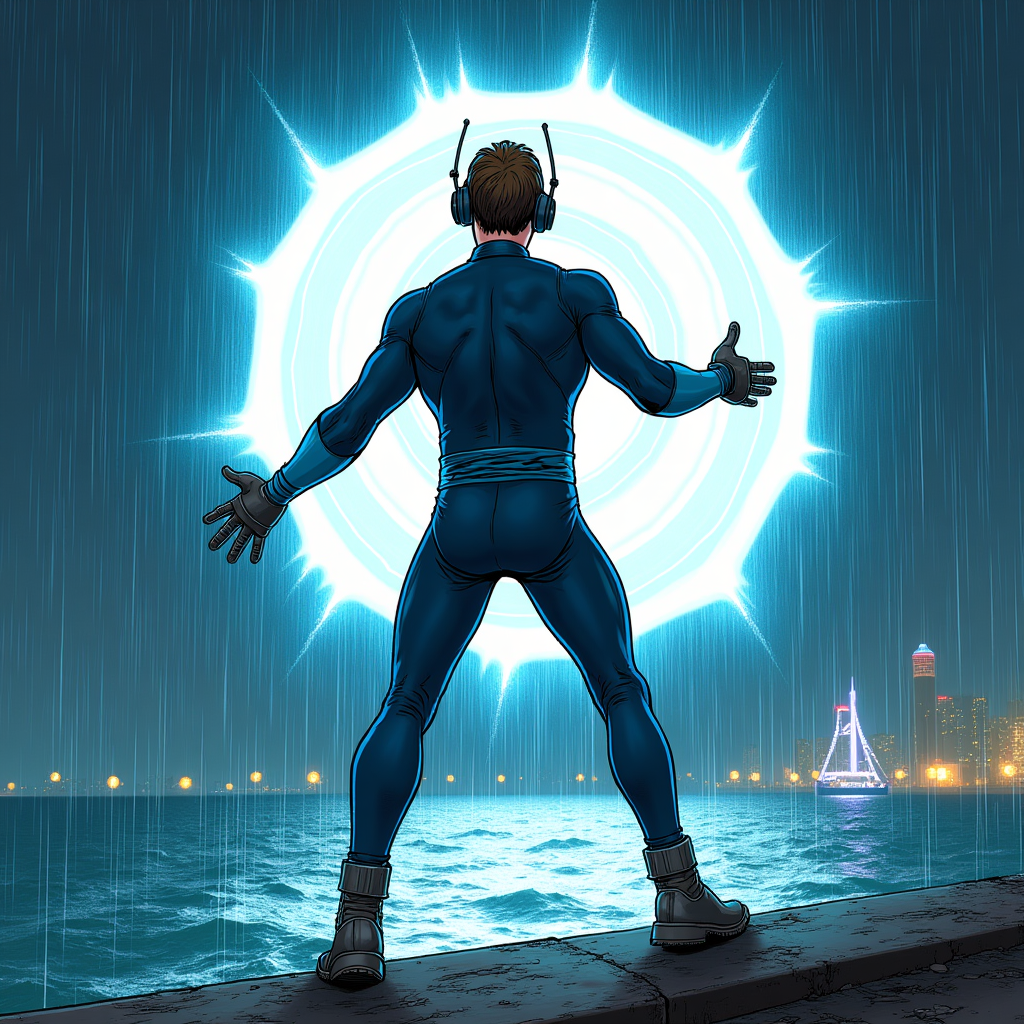
When the paramedics arrive, Connor is standing on the seawall in the rain, arms outstretched, and every signal light on Newark Bay is blinking in perfect unison — a pattern no automated system could produce. A pattern that spells, in old maritime code: I am here. I am watching.
Part Three: The Signal Becomes a Sentinel
The weeks that follow are private ones. Connor tells the doctors the bandages can come off sooner than they think. He tells his supervisor he needs medical leave. He goes home to West 5th Street and sits with what has happened.
The power is not a simple thing. It is not flight, not strength, not fire. It is signal — the ability to generate, intercept, amplify, and direct electromagnetic transmissions across the maritime and terrestrial spectrum. He can project navigational pulses that disorient electronic guidance systems. He can emit focused sonic bursts through the same frequencies used by industrial fog horns — concussive, directional, precise. He can interface directly with any wired or wireless infrastructure connected to the harbor network, reading data as easily as reading a printed page, rewriting it with a thought. And most powerfully: he can generate a pulse — he comes to think of it as the beacon — a spherical burst of electromagnetic force that disrupts, resets, and silences any electronic system within a quarter-mile radius.
He is not a weapon. He is a signal maintainer. He thinks about this carefully.
What Bayonne needs is not someone who fights. It needs someone who warns. Someone who finds the fault in the system before the bridge goes down, before the ship runs aground, before the forty-eight people die.
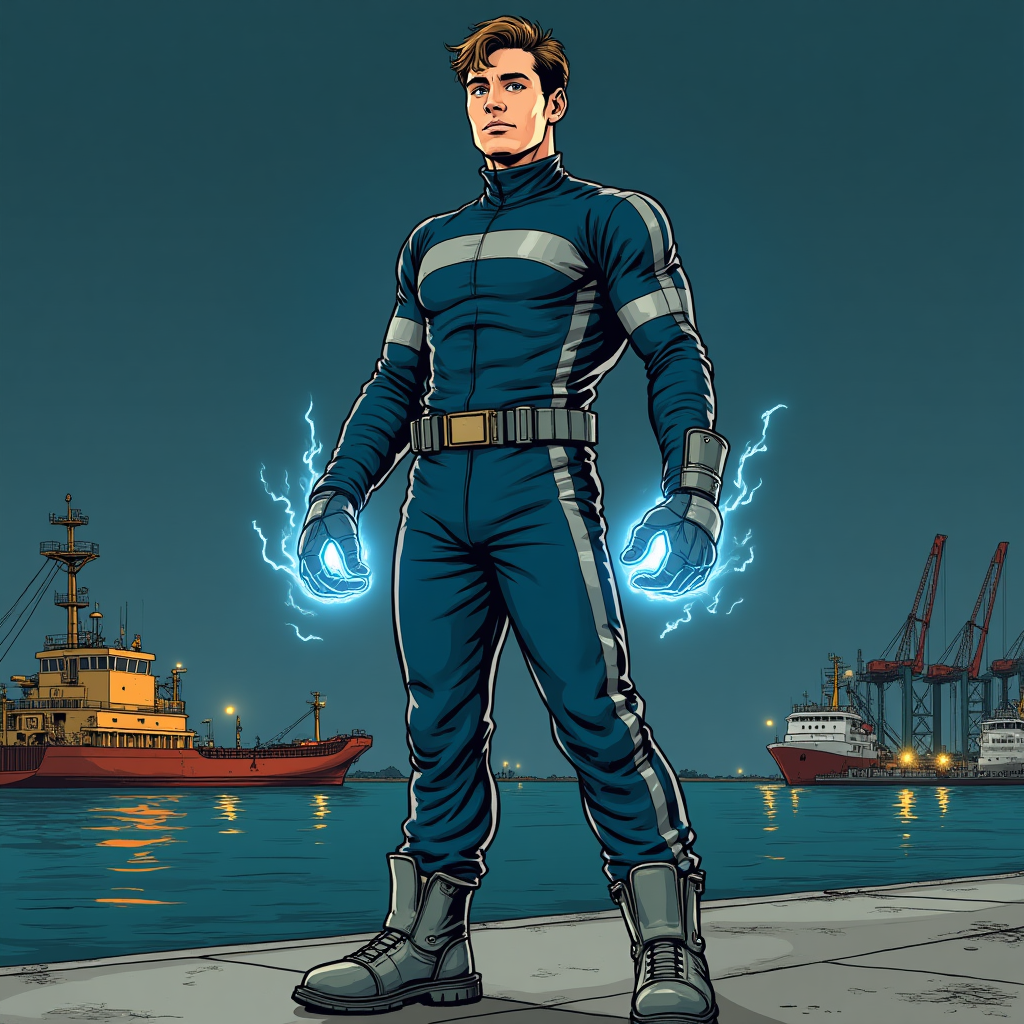
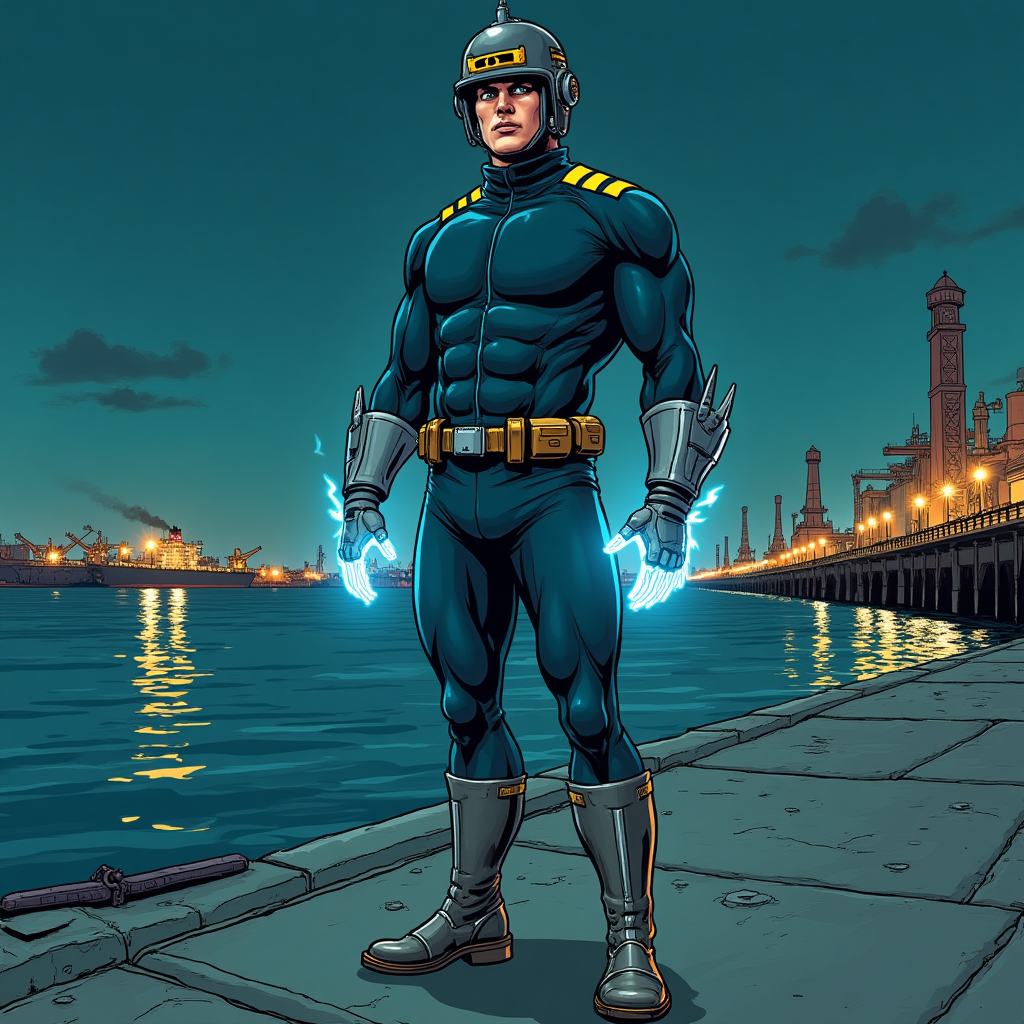
He builds the suit himself — deep navy blue, the color of the Kill Van Kull at midnight, with reflective silver striping along the arms and shoulders that mirrors the retro-reflective tape on maritime safety gear. A helmet with an integrated antenna array, functional, not decorative. Work boots with magnetic sole inserts for stability on wet metal decking. No emblem. No theater. The suit of a man who expects to be on a seawall in a nor’easter.
He chooses a name that his grandfather would have recognized: Harborwatch.
He begins with the small things. A freighter’s GPS is being fed false positioning data near Port Jersey — he finds the source, a spoofing transmitter hidden in a shipping container on Terminal Road, and silences it with a pulse. A fire at the Bayonne Energy Center is being concealed from dispatch systems by a deliberately jammed alarm network — he restores the signal, the trucks arrive in time. He is invisible in the way that good infrastructure is invisible: you only notice it when it’s working.
But something larger is wrong in Bayonne. Connor can feel it in the signals — not a malfunction, but a pattern. Someone is designing this. Someone who knows the harbor’s nervous system as well as he does.
Part Four: The Architect of Silence
Their name is Nullveil.
Connor pieces it together over three weeks of signal forensics — tracing interference patterns, logging anomalous transmissions, following the electromagnetic breadcrumbs through the Port Jersey terminal network to a decommissioned signal relay station on Hook Road, a rusting brick building that once served the old Standard Oil refinery infrastructure. Inside, the building has been gutted and rebuilt as something between a laboratory and a command center, every surface humming with repurposed maritime and industrial hardware.
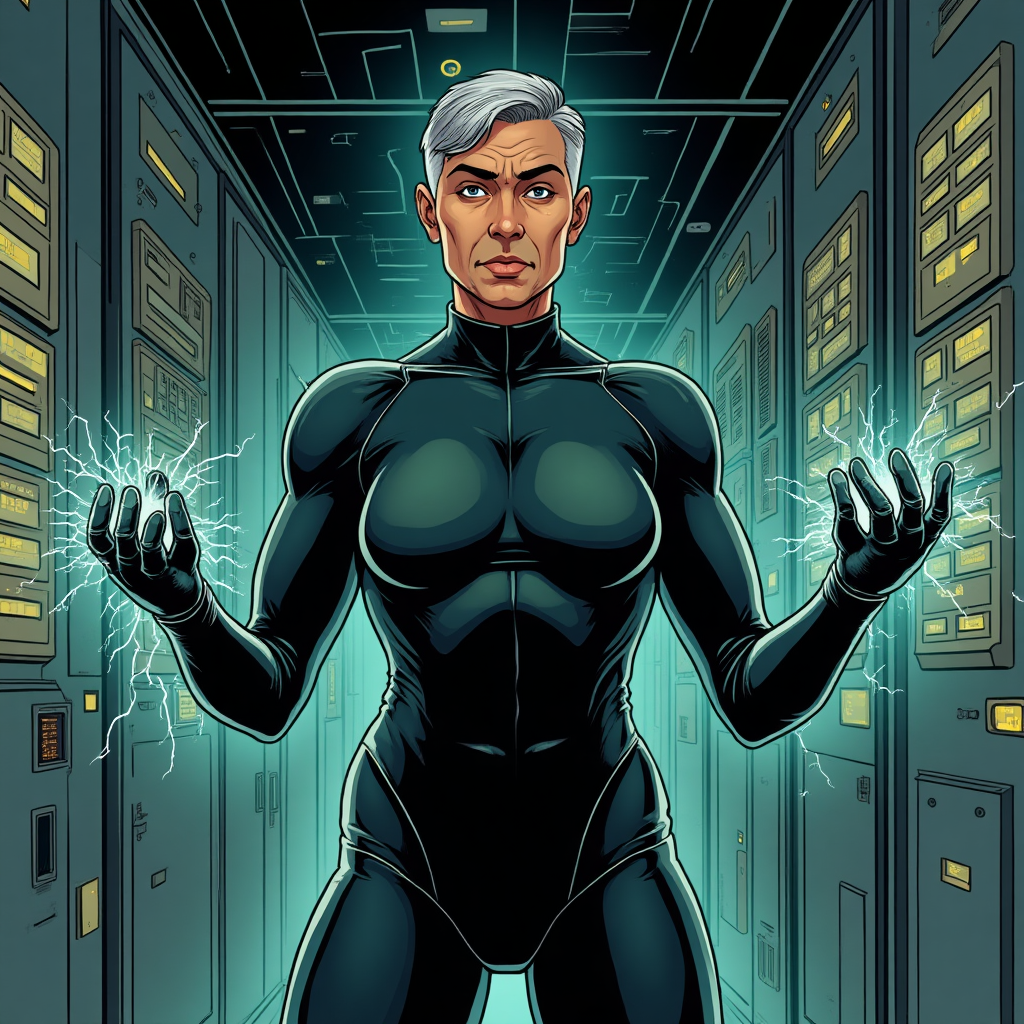
Nullveil is in their mid-sixties, with a face that holds the weathered, ambiguous authority of someone who has been many things in many places. Their heritage is written in the complex architecture of their features — a plurality that resists easy categorization — and they carry themselves with the stillness of a person who has decided, long ago, that the world would have to come to them. Their grey-streaked hair is cropped close, their clothing functional and dark, their hands moving across their equipment with the practiced ease of an engineer who built systems before Connor was born.
And they did. Nullveil — born Reyes Callahan, a former telecommunications infrastructure architect who helped design the original Port Jersey signal network in the 1990s — watched for three decades as the harbor’s public infrastructure was quietly sold, leased, rerouted, and monetized by private interests. They watched the signal arrays they built to protect ships and people become revenue streams for corporations. They watched a government shutdown leave harbor safety workers without pay while the infrastructure they maintained quietly degraded. They watched the Jersey Journal close, the local newsrooms die, the watchdog institutions that might have amplified the warning fail one by one.
Nullveil’s power is human-built, not lightning-given: a suite of electromagnetic warfare tools, refined over years, capable of projecting coordinated blackouts across the entire regional signal grid. Their plan is not destruction. It is revelation — a controlled, cascading failure of the entire Port Jersey navigation and communication infrastructure, designed to force a federal reckoning with the privatization of critical maritime safety systems. Forty-eight hours of silence, broadcast to every news agency still functioning. A demonstration. A warning.
The same logic as Patrick Maguire’s. The same moral weight. The same stone in the chest.
Connor stands in the doorway of the relay station and understands this immediately. It does not make Nullveil right. Forty-eight hours of signal silence in one of the busiest ports on the Eastern Seaboard means ships running dark through the Kill Van Kull. It means collisions, groundings, explosions. It means the forty-eight die again, and this time there is no one left to say they weren’t warned.
I know what you’re trying to say, Connor says. But you know what silence costs.
Nullveil looks at him with eyes that are not unkind. So does nobody listening.
Part Five: Frequency
The confrontation takes place on the Constable Hook seawall — the same concrete ledge where Connor was struck, where the harbor first spoke to him — as Nullveil initiates the cascade sequence remotely, the signal blackout rolling outward from the Hook Road relay station like a wave.
Connor feels it in his chest like a held breath. Every beacon going dark, one by one. The Kill Van Kull going blind.
He does something he has never done before. He reaches out — not into the infrastructure, but through it — extending the beacon pulse not as a weapon but as a carrier wave, flooding the entire spectrum with a navigational signal so strong, so clean, so precisely calibrated that it cannot be overridden. Every ship in Newark Bay receives it. Every automated system in Port Jersey locks onto it. He becomes, for the length of the confrontation, the harbor itself — its voice, its warning system, its conscience made electromagnetic.
Nullveil throws everything at him. Directed EMP bursts that would have killed the suit’s systems if Connor weren’t already integrated with them at the neural level. Sonic disruptors. Spoofed positioning data designed to override his own transmissions. Connor takes it all and keeps broadcasting, his feet planted on the seawall, the rain driving in from New York Bay, the lights of Staten Island blurring behind the weather.
When it is over — when the cascade is interrupted, when the beacon holds, when the ships in the channel find their bearing and continue — Connor walks to where Nullveil sits on the seawall, their equipment dead, their hands shaking, their face carrying the particular grief of someone whose warning was, once again, not enough.
File the report, Connor says quietly. He means it. I’ll sign it. Both our names.
He doesn’t know if anyone will listen. He knows the newsrooms are dying. He knows the shutdown stretches on. He knows the signal he’s broadcasting goes out into a world that is very good at not receiving.
He broadcasts it anyway.
On the Kill Van Kull, the navigational beacons blink in their steady, patient rhythm — one flash, pause, one flash — the oldest signal in maritime code:
All clear. For now. Keep watch.
Harborwatch keeps watch.