
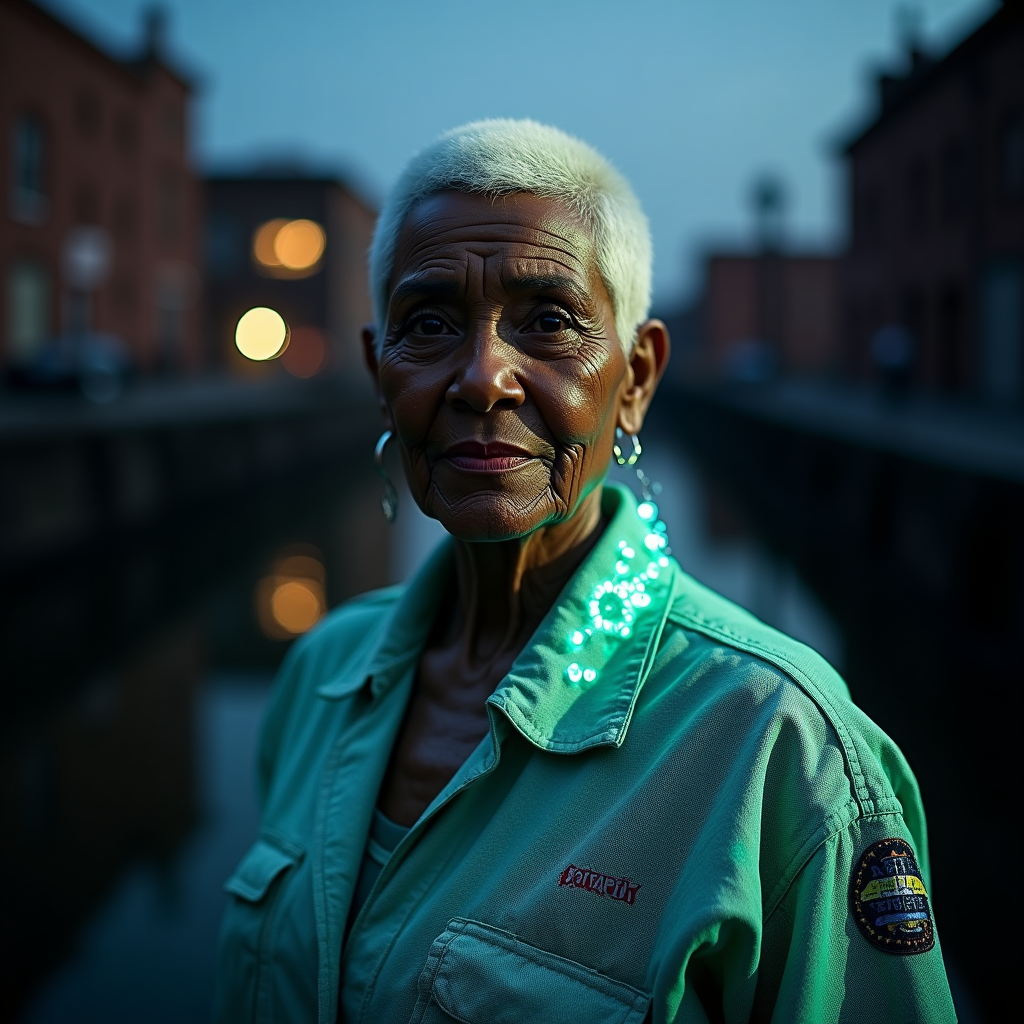


Hollow Ash of the Burning Channel
Part One: The Woman Who Remembers the River’s True Name
Before Trenton was Trenton — before the King’s Highway cut through the valley, before the ferry landing turned into a colonial port, before Washington loaded his frostbitten soldiers into Durham boats on a December night that history would spend three centuries romanticizing — this stretch of the Delaware had a name that did not belong to any European cartographer. Marisol Ashcroft knows that name. Her grandmother spoke it. Her great-grandmother walked the riverbank where the State House parking structure now stands, reading the water the way other people read weather.
Marisol is fifty-eight years old. She is tall and angular, built like someone who has carried weight — real weight, not metaphorical — through difficult terrain for most of her life. Her hair is iron-gray, worn loose to her shoulders. Her face holds the sharp architecture of the Delaware Valley itself: high cheekbones, a jaw that does not soften under pressure, eyes the color of the river in late October — amber, clear, and measuring everything they look at. She works for the Mercer County Environmental Assessment Office, has for twenty-two years, cataloguing contamination in the waterways and soils of the capital corridor. She holds two graduate degrees. She has testified before the state legislature fourteen times. She has been correct every single time, and the river keeps getting sicker.
Her office is on the second floor of a building on Perry Street, three blocks from the Delaware. From her window, she can see the water on clear days, shining between the rooftops of the old warehouse district below Route 29. She can see the Calhoun Street Bridge. She can see, on certain mornings, the specific light that falls on the river’s surface when the wind is running south — the same light her grandmother described in the stories that were the only inheritance Marisol received that was not taken, diluted, or translated out of meaning.
She has a filing cabinet that contains twenty-two years of contamination reports. She has a second filing cabinet that contains twenty-two years of documented non-responses.
She has been patient in the way that people are patient when they believe, against accumulating evidence, that systems can be persuaded.
She is nearly finished being patient.
Part Two: The Sediment Speaks
It is a Tuesday in late March when she takes the sample that changes everything — or rather, when the sample takes her.
She is working the lower industrial channel near Duck Island, the scrubby landmass in the Delaware just south of the Route 1 bridge where the old channel narrows and the sediment has been accumulating pharmaceutical runoff, heavy metal leachate, and the chemical memory of a century of wire mill operations. The county’s monitoring buoys here have been returning anomalous readings for three months — compound concentrations that don’t match any single industrial source, as though the sediment itself is synthesizing something new from the collision of everything that has been dumped into it over a hundred years.
She is in waders, taking a core sample at the shoreline edge, when the riverbank gives way.
Not dramatically — not a collapse, not a flood. A slow subsidence, the kind that happens in saturated ground when the clay layer beneath the silt reaches saturation and simply loses its architecture. She goes in to her hip, then her chest, then she is submerged in the shallows of the industrial channel, face-down in water that smells of iron and old medicine and something older than either.
She gets herself out in forty seconds. She is not in danger. But something has already happened.
She feels it on the drive back to the office: a low, insistent hum in her back teeth, as though the fillings in her molars have become antennae. She feels the iron rebar in the Route 29 overpass as she passes beneath it — not sees, not infers — feels, magnetically, the precise geometry of the buried reinforcement, singing at a frequency just below sound. By the time she reaches Perry Street, she can feel every sewer main under the road, every buried gas line, every copper pipe in every building she passes. The city’s substructure has become a tactile map that she cannot turn off.
That night, standing on the waterfront below the old Roebling anchorage, she reaches downward with her hands flat at her sides and feels, forty feet below the riverbank’s surface, the iron nails of a colonial-era warehouse foundation — hand-wrought, irregular, singing to her nerves like a chord played on an instrument she was born knowing how to read. Every rivet and rebar in the district joins the chorus. The Delaware acts as a conductor beneath her feet, the water carrying the electromagnetic resonance of mineral-laden sediment up through the soil and into her, amplifying what she is becoming.
She does not report the incident. She goes home. She sits in the dark for a long time.
Then she goes back to the river with her sample kit and begins to understand what the sediment gave her.
Part Three: The Pharmacopeia of the Damaged City
The pharmaceutical absorption comes slower, and it comes with a cost she doesn’t fully understand until she begins walking the city’s crowded corridors.
The compounds in the Duck Island channel sediment — a century’s worth of pharmaceutical leachate, industrial solvent residue, and medical waste that the county’s treatment systems were never designed to fully capture — have restructured something in her cellular absorption mechanism. Her body now processes chemical compounds the way it processes food: contextually, selectively, integrating what it can use and storing the rest. Walking past the row of pharmacies on Broad Street, she absorbs trace aerosols of dispensed medications through her skin and breath. Near the water treatment outflows below the Route 29 corridor, she takes in the bleed of prescription runoff and metabolizes it into something her nervous system repurposes as information.
It is the empathic diagnosis that is the hardest gift to carry.
It arrives without warning the first time — she is walking through the Chambersburg neighborhood on a Saturday morning, past the bodegas and the laundromat and the knot of people outside the methadone clinic on Broad, and suddenly she is submerged in a city of pain. Not her pain. Theirs. The warehouse worker three doors down whose L4 disc is compressed by years of loading pallets. The grandmother in 4C whose blood sugar has been running at 340 for two weeks. The young man outside the clinic whose body is in a specific agony she recognizes as opioid withdrawal — she can feel the receptor profiles, the physiological architecture of his craving, as clearly as she can feel the iron pipes beneath the sidewalk.
Every crowded street becomes a relentless barrage of suffering. The Ferry Street market. The bus stops along Pennington Avenue. The plaza outside the Mercer County Courthouse where people sit waiting for news of someone inside. She feels all of them, simultaneously, like a radio receiving every station at once with no way to change the dial.
She begins to understand: the city has been sick for a long time, and no one with the power to fix it has ever been made to feel what she feels walking through it.
That is when the patience runs out. That is when Hollow Ash of the Burning Channel stops being a woman with a filing cabinet and becomes something the city built without meaning to.
Part Four: The Architecture of Rupture
She does not set out to become a villain. That is the word Delaware Shore will eventually use for her, and she understands why Celestine Okafor has to use it, and she rejects it completely.
What she sets out to do is make the contamination legible in a language that state legislators and county developers cannot ignore or table until the next session. Twenty-two years of reports have not done it. Fourteen testimonies have not done it. The Hargrove Development Group has broken ground on the lower waterfront corridor — luxury mixed-use on a brownfield site whose soil remediation certifications Marisol knows are fraudulent, because she has the original sample data and she has held it for six months waiting for someone with authority to act and no one has acted.
So she acts.
Her magnetic sense has grown precise enough that she can feel the structural resonance of the Calhoun Street Bridge’s aging approach spans from the eastern bank — can feel the fatigue in the steel, the micro-fractures in the concrete pier caps, the specific frequencies at which the structure is vulnerable. Her pharmaceutical absorption has given her access to compound libraries she has synthesized herself from the channel sediment, improvised chemical batteries with acoustic and electromagnetic properties that her engineering background allows her to build into devices of considerable precision. Her empathic diagnosis has mapped every load-bearing pain point in the city’s body.
She has designed the emitters carefully. She is not trying to kill anyone. She has never been trying to kill anyone. She is trying to make the governor look out his window at the State House dome — which she can see clearly from the Calhoun Street Bridge, lit against the April sky — and understand that the river’s accounting has come due.
She plants the three emitters at the bridge’s support structure on a Tuesday evening in late April and broadcasts her intentions to every local newsroom ninety minutes in advance. No ambiguity. Full transparency. This is a signal. This is what happens when you do not listen.
What she does not fully account for is Celestine Okafor — who feels the emitters through the Delaware before anyone sees them, because the Delaware has given Celestine a language too, and it is nearly the mirror of Marisol’s own.
Part Five: What the River Carries South
They face each other at the center span of the Calhoun Street Bridge as the April wind runs cold off the Delaware below.
The NJ Transit trains have been stopped — Marisol felt Delaware Shore’s acoustic warning move through the bridge’s understructure like a hand clearing a table, precise and authoritative, every commuter on the deck above already sheltering before Marisol has a chance to wonder how Celestine found her so quickly. The river below them is moving in slow, deliberate eddies around the piers — not natural currents. Celestine’s currents. Marisol can feel the counter-vibrations entering the bridge’s support pilings from beneath, her emitters being neutralized frequency by frequency, the work of months disassembled in minutes by a woman standing forty feet away in field coveralls with a Mercer County DPW patch on the shoulder.
Marisol drives her interference field forward like a fist — a cancellation pulse designed to sever whatever connection Celestine has built with the river beneath them, a silence weaponized into pain. She feels it hit. She sees Celestine absorb it.
And then the emitters die. One, two, three. A surgical electromagnetic burst, calibrated to the circuit frequency of each device, leaving everything else on the bridge completely untouched. The bridge lighting holds. The rail signals hold. The river moves on.
For a long moment neither of them speaks. Marisol stands with her iron-gray hair moving in the wind, looking at the city behind Celestine’s shoulder — the State House dome above the treeline, the dark warehouses along the bank, the Hargrove Development Group’s construction cranes visible against the sky, lit with warning lights, building something new on contaminated ground that Marisol’s own reports certified as contaminated. Something that should never have been permitted.
“You’re protecting the same thing they used to erase us,” Marisol says.
Celestine says she’s protecting the people who live here now. Says she knows the difference.
Marisol looks at her for a long moment — at this seventy-one-year-old Black woman who has also spent decades in service to this city, who has also been ignored and overridden and outlasted bureaucracies that should have listened to her, who has also stood in the water and been changed by it — and she thinks: we were built by the same river. We were broken by the same failures. We are standing on the same bridge.
And we cannot share a world anyway.
She retreats into the water, her transformation carrying her into the channel the way the current carries everything south — toward Burlington, toward the bay, toward the open Atlantic that has never belonged to anyone who tried to own it. Behind her, the Delaware adjusts to the season, cold and purposeful.
Hollow Ash is not finished. The contamination reports are still in her filing cabinet. The Hargrove Development Group’s cranes are still turning. The soil beneath the waterfront corridor still holds a century of poisons that no luxury development will remediate, no matter what the certification documents say.
She will be back. The river will carry her back.
It always has.