
INTERCHANGE
Part One: The Man Who Kept the County Moving
Gerald Mast has spent thirty-one years watching traffic flow.
Not metaphorically — literally. From his second-floor office in the Turnpike Authority’s administrative building on Woodbridge Center Drive, he can see the overpass where the New Jersey Turnpike and the Garden State Parkway knit together in a concrete braid that carries more weight than any other intersection in the state. On a clear morning, the elevated lanes shimmer like rivers. On a bad one, they seize up, and something in Gerald’s chest seizes with them.
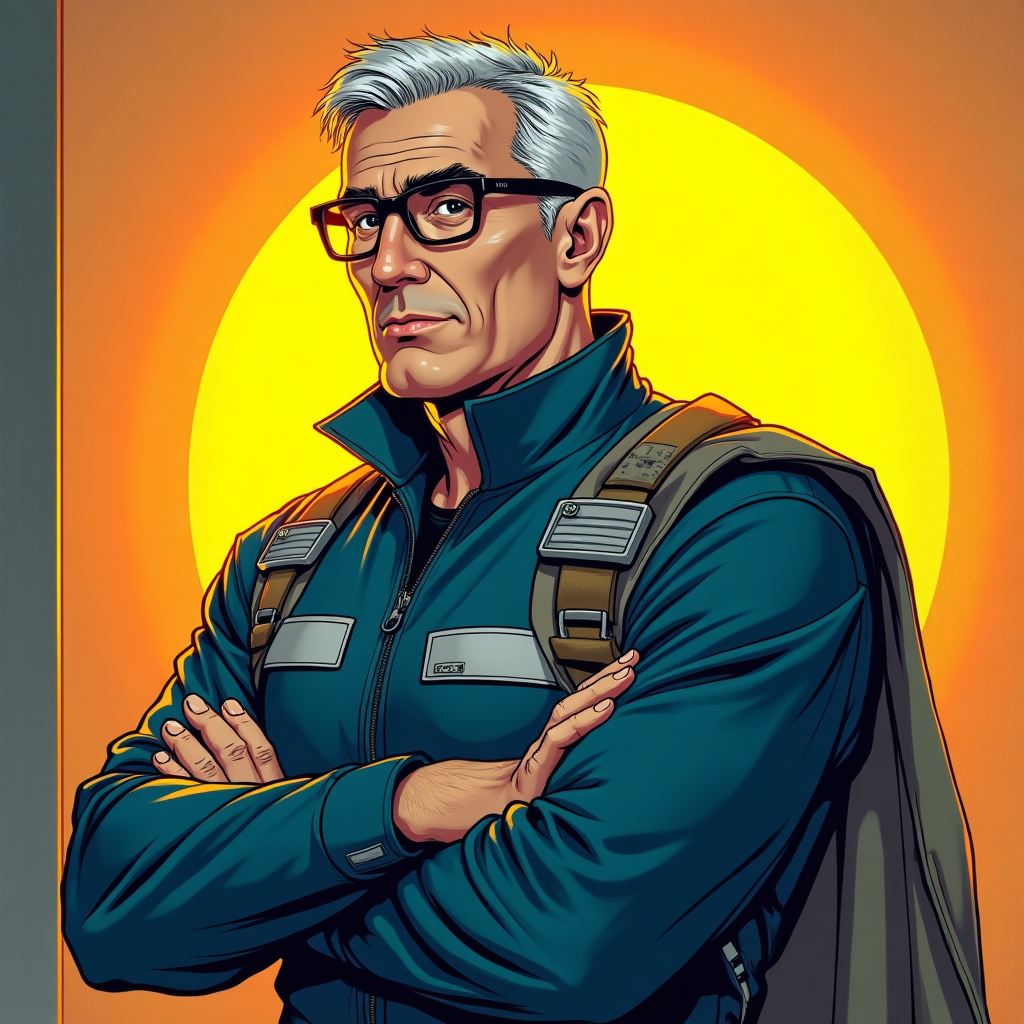
He is fifty-two years old, broad-shouldered, with close-cropped silver hair and reading glasses perpetually pushed up onto his forehead. He wears the same style of navy windbreaker every day — the kind with the Authority’s name embroidered on the chest pocket — and he drinks his coffee black from a thermos he fills at a diner on Route 9 called the Cloverleaf. He is the kind of man who knows every mile marker, every toll plaza staffing shift, every ramp closure schedule by heart. His colleagues call him the Grid.
Gerald grew up in Woodbridge proper, in a row house off Main Street within earshot of the train whistle from the NJ Transit station on Green Street. His father was a toll collector. His mother drove a school bus along Rahway Avenue for twenty-three years. Movement was the family religion. The idea that things had to keep moving — people, vehicles, commerce, time — was the closest thing to a creed Gerald had ever held.
He never wanted to be extraordinary. He wanted to be reliable.
That changed on the night of April 16th.
Part Two: Grid Failure
The storm comes in off Raritan Bay without much warning — a fast-moving nor’easter that meteorologists had downgraded twice too many times. By 9 PM, rain is sheeting sideways across the Parkway, and Gerald is still at his desk running incident reports from a three-car pile-up near Exit 127. The building empties around him. He doesn’t notice.
What he does notice, at 9:47 PM, is that the monitoring board goes dark.
Not a screen glitch. Not a power flicker. The entire integrated traffic management system — cameras, sensors, signal controllers, the data backbone that synchronizes every interchange from Exit 124 to Exit 131 — drops to black simultaneously. Gerald has never seen anything like it. Not in thirty-one years.
He grabs his radio and heads for the maintenance corridor that runs beneath the administrative building, a tunnel of humming conduit and fiber-optic cable that connects to the substation feeding the Interchange 13 complex. The tunnel smells like machine oil and damp concrete. Emergency lighting throws everything in amber.
He finds the breach at the main junction box — a panel that should be sealed, standing open. Inside, something has been attached to the primary relay: a compact device, matte black, webbed with circuitry Gerald doesn’t recognize. It is not Authority hardware.
Before he can key his radio, the device activates.
The surge is not electrical in any conventional sense. It moves through the conduit like a living thing — a pressurized wave of encoded signal and raw voltage that finds Gerald Mast standing at the exact nexus of Woodbridge’s nervous system, where thirty-one years of infrastructure knowledge and one catastrophic data pulse collide in a single human body.
Gerald doesn’t remember hitting the floor.
Part Three: The Interchange
He wakes up in the Raritan Bay Medical Center on Route 9, forty hours later, and the first thing he notices is that he can hear the traffic.
Not the sound of it — the pattern. The rhythm. He can sense, at the edge of his awareness, the pulse of vehicles moving through the interchange complex two miles north. He can feel the stagger of a signal timing that’s running four seconds off-cycle on Rahway Avenue. He can perceive the weight differential between a loaded freight truck and an empty one on the Turnpike’s inner roadway, the way a sonar operator reads a return signal — not seeing it, but knowing it.
The doctors find nothing wrong with him. His bloodwork is clean. His scans are unremarkable. They attribute his confusion to the electrical shock and send him home.
Gerald sits in his row house on Main Street and tries to understand what he has become.
Over the following two weeks, he maps it methodically — the way he would map a traffic study. He can interface with any networked infrastructure system within roughly a quarter mile by touch: power conduit, fiber-optic line, signal cable, transit control hardware. The contact sends his consciousness into the network like a packet of data, letting him read, reroute, and rewrite the logic of connected systems at will. On the Turnpike’s test server, he reroutes seventeen virtual toll scenarios in four seconds. In the Green Street station, he touches the signal relay box and finds he can feel every NJ Transit train on the Northeast Corridor within twenty miles — their speeds, positions, headways — like blood moving through veins.
More than that: he can push. He can redirect. He can, with effort and concentration, move those systems — not by hacking but by becoming, briefly, part of their architecture.
He is not a computer. He is an interchange.
He builds the suit himself — navy blue and reflective silver, utilitarian, no flourishes — from modified Authority maintenance gear and conductive mesh he sources from an electrical supply house on Port Reading Avenue. He doesn’t think of himself as a hero. He thinks of himself as a man with a grid to protect.
He calls himself Interchange.
Part Four: The Architect of Gridlock
The device in the maintenance tunnel was not random. Gerald knows this before the Woodbridge Police Department does, before anyone does, because he has spent his recovery doing what he does best: following the pattern.
The device’s circuitry, he determines by cross-referencing procurement records, came through a shell company called Nexway Infrastructure Solutions — a firm with a Woodbridge mailing address, a PO box on Avenel Street, and no employees except one: a man named Corden Vale.
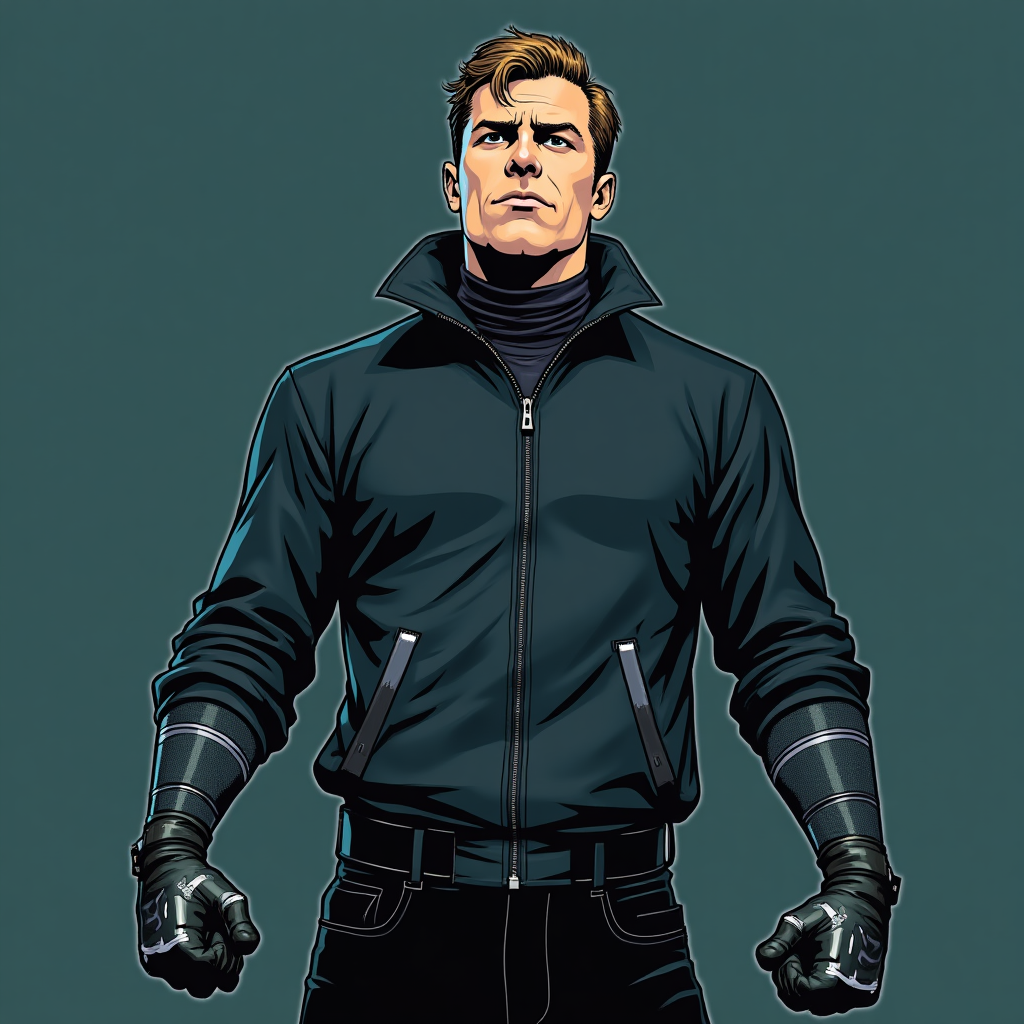
Vale is thirty-one years old. Gerald finds his photo in a Rutgers-New Brunswick alumni database — a lean, pale young man with sharp features and light brown hair, who graduated with a degree in network systems engineering and spent three years at a legitimate infrastructure consulting firm before vanishing from the professional record. What Gerald finds instead, buried in public contracting data and municipal meeting minutes, is a pattern of bids. Nexway Infrastructure Solutions has submitted proposals to Woodbridge Township, to Middlesex County, and to the New Jersey Turnpike Authority itself — all rejected. All for the same basic concept: privatize the interchange’s traffic management grid. Hand control of New Jersey’s most critical highway nexus to a single, proprietary operator.
Vale didn’t want to destroy the grid. He wanted to own it.
The pulse device wasn’t a weapon. It was a demonstration — proof that the existing system was vulnerable, meant to manufacture a crisis that would make his privatization pitch irresistible. Gerald was simply in the wrong place. Or the right one.
Vale operates under the name GRIDLOCK in the anonymous infrastructure forums where he has cultivated a following of disaffected engineers and anti-public-transit ideologues who believe that New Jersey’s transportation arteries should belong to whoever is bold enough to seize them. He has a second device. Gerald is certain of it.
He surfaces three nights later at the Interchange 13 maintenance yard off New Jersey Turnpike, where a crew of Vale’s recruited technicians is attempting to install a master override junction into the primary signal infrastructure. The override, once active, would give Nexway a kill switch for every managed lane in the complex.
Gerald arrives before the police do.
Part Five: Pressure and Flow
The maintenance yard is lit by portable halogen floods, casting white pools across wet asphalt. Gerald comes in through the fence line on the south side, near the equipment shed, and touches the chain-link with one gloved hand.
The yard’s sensor network opens to him like a map.
He counts seven technicians. He counts Vale standing at the primary junction housing, directing the installation with the focused efficiency of a man who has rehearsed this for years. Vale is dressed practically — dark jacket, work boots — and there is nothing theatrical about him. That is what makes him dangerous. He is not a man who wants spectacle. He wants control.
Gerald moves through the yard with the grid’s own logic — triggering flood lamps in sequences that redirect the technicians away from the junction, isolating them in the dark corners of the yard, using the intercom system to broadcast Authority emergency tones that scatter two more. When a technician spots him and shouts, he puts his palm flat against the surface of a power conduit running along the ground, and the halogen floods on that side of the yard cycle off in a controlled cascade, plunging the man into darkness and confusion.
Vale sees him. Recognizes the Authority windbreaker beneath the silver mesh.
“Mast,” Vale says. Not surprised. Perhaps he always expected this.
“You picked the wrong system to hijack,” Gerald says. His voice is calm. He has spent thirty-one years keeping things moving. He is calm when it matters.
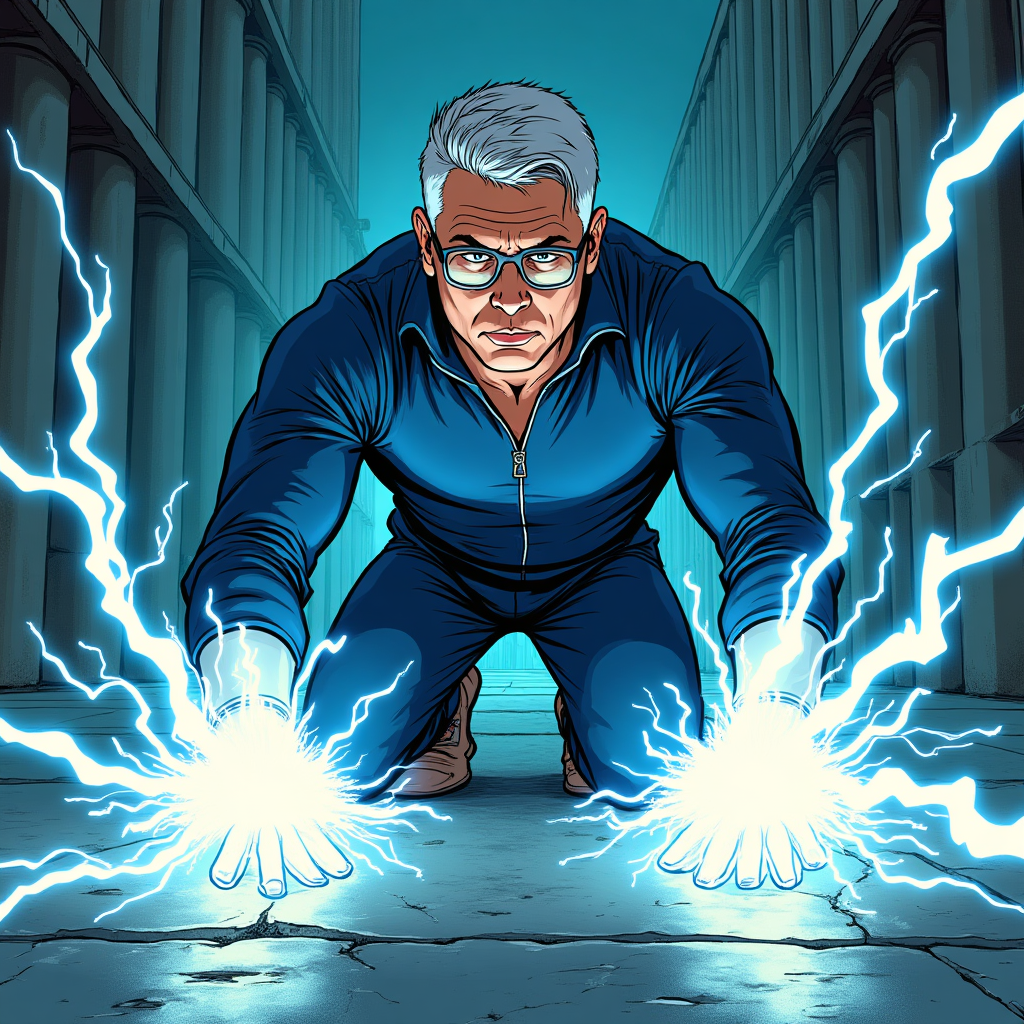
Vale activates the second pulse device — a handheld variant, pulled from his jacket. Gerald feels it before it fires, the way he would feel a signal anomaly on the monitoring board: wrong frequency, wrong timing, wrong. He drops to one knee and drives both palms into the reinforced concrete of the maintenance pad, pushing his consciousness into the ground-level conduit grid with everything he has.
The pulse fires.
Gerald catches it.
Not all of it — it costs him, badly. But he redirects enough of the surge into the yard’s own grounding infrastructure that the override junction fries itself, Vale’s device shorts out, and every portable light in the yard blazes to full power simultaneously, flooding the scene in white.
The technicians run. Vale does not.
He stands in the overlit yard with his ruined device and looks at Gerald Mast — a middle-aged man on one knee in a modified maintenance windbreaker, silver-haired and breathing hard — and for a moment he seems genuinely at a loss. He expected a system. He got a person.
“The grid belongs to everyone,” Gerald says. “That’s not an ideology. That’s just how it works.”
The Woodbridge Police arrive four minutes later, which is — Gerald notes privately — eleven seconds ahead of the response time the system models predicted for this location.
He is gone before they think to look for him.
On the overpass above Interchange 13, in the small hours of an April morning, Interchange stands at the rail and watches the highway lights stretch north and south in twin rivers of amber. The Turnpike. The Parkway. The braided arteries of a region in motion. Somewhere on the Northeast Corridor, an NJ Transit train is running forty seconds late out of the Woodbridge station. He can feel it, already compensating, already closing the gap.
Everything is moving. Everything is connected. The grid holds.
Gerald Mast tucks his thermos under his arm and heads home on Route 9.