


BLOSSOM WARD
An East Orange Origin Story
Part One: The Boy from Ampere
The Number 21 NJ Transit bus idles at the corner of Central Avenue and Ampere Parkway, exhaling a long breath of diesel into the April morning. Marcus Okafor, thirteen years old, backpack slung over one shoulder, steps off without looking up. He never looks up on school mornings. Looking up means seeing things — things that make his chest tight, his jaw clench, his sneakers drag.
Today is the day of the Cicely Tyson performing arts showcase, and Marcus has a solo. A percussion solo he has been rehearsing for eleven weeks on a snare drum borrowed from the school music room. He is not thinking about glory. He is thinking about whether his hands will shake.
East Orange is the kind of city that teaches you to move fast and think faster. Marcus has lived his whole life in the shadow of Branch Brook Park, two miles north and over the county line in Newark — close enough that in spring, when the cherry blossoms peak, the pink haze drifts south like a slow tide and settles over the neighborhood rooftops. His grandmother calls it God’s paint. His mother calls it allergies. Marcus calls it the most beautiful thing he has ever seen that nobody seems to photograph from this side of the border.
He cuts through the side street behind Ampere station — a squat, redbrick NJ Transit stop that smells like iron and old rain — and passes the ghost-fence of the old AP Smith Manufacturing site on Frelinghuysen Avenue. The factory has been shuttered for decades, but the wrought iron boundary fence still stands, its posts thick as forearms, painted black over layers of rust. Local kids say the fence is haunted. Marcus doesn’t believe in haunted. He believes in old, and old things in East Orange have weight.
He is three blocks from Cicely Tyson School when he hears the shouting.
Part Two: Pinned Against the Boxes
It happens in the narrow stockroom corridor of Demarco’s Corner Mart on North Arlington Avenue. Marcus ducks inside to grab a water bottle — a habit, a routine, the same route he walks every single Thursday. He is facing the exit when the door explodes inward.
Two officers in plainclothes — no visible badges, no introduction — are moving fast, shouting commands at a shape they have apparently decided to pursue. The shape is Marcus. Thirteen years old, five-foot-four, wearing a grey hoodie, carrying a backpack full of sheet music and a borrowed snare practice pad.
The first officer pins him against a stack of canned goods before Marcus can turn around. Cardboard tears. A can of tomatoes hits the floor and rolls. Marcus hears his own voice say I didn’t do anything and watches it disappear into the noise. The second officer is already reaching for zip ties.
The store owner, Mr. Fenwick Demarco, is shouting from behind the counter. A customer is filming on her phone. The officers are looking for a tattooed twenty-two-year-old suspect. Marcus is a child. The resemblance exists only in their certainty.
What happens next, Marcus will never be able to fully explain.
His hands, pressed flat against the cold iron shelf bracket behind the canned goods stack, find something. Not in the metal. Through it. A current — not electrical, not thermal — a resonance, like the lowest note a drum can produce, the note that lives in the floor and travels through your feet before you ever hear it with your ears. The AP Smith fence has stood for a hundred years two blocks away. The Ampere station platform has absorbed sixty years of train vibration. The iron in East Orange’s bones is old and it remembers.
The shelf bracket hums. The floor cracks in a clean line from the stockroom to the front door. Both officers stumble backward. The zip ties fall. Marcus is standing in the center of a circle of cracked linoleum, hands open, breathing like he has just surfaced from deep water.
He runs.
Part Three: What the Iron Remembers
He runs to Branch Brook Park. Not the East Orange section — the full expanse, northeast, where the cherry blossoms are thickest and the petals are falling in the April wind like pink snow. He does not stop until his sneakers hit the grass near the park’s old iron footbridge, a Victorian-era span that arches over a narrow creek, its railings ornate and green with age.
When his hands touch the bridge railing, it sings.
Not metaphorically. The iron hums a low, sustained chord that Marcus can feel from his palms to his sternum. And in that hum he finds something that has no name yet — a conversation between him and every piece of worked metal in Essex County. The Ampere station tracks. The AP Smith fence. The decorative ironwork on the Ambrose-Ward Mansion on Prospect Street. The old water mains beneath Central Avenue. Every bolt and hinge and rail spike. All of it connected. All of it his.
He sits on the bridge for two hours. Petals fall on his shoulders. He learns that he can send a pulse through iron and steel — a vibrational shockwave that travels through any contiguous metal structure. He learns that he can feel what the metal feels: weight, stress fractures, movement. The NJ Transit rails tell him when a train is twelve minutes out by the way they flex and whisper. A water main on Dodd Street is about to fail — he can hear it groaning from three blocks away.
He is not thinking about being a hero. He is thinking about the crack in the floor of Demarco’s Corner Mart, and whether he can control this, and whether anyone will believe him, and whether control even matters if the world keeps putting him in stockrooms.
His grandmother finds him at the bridge just before sunset. She looks at the iron railing, still faintly vibrating, and then at her grandson’s hands, and she says nothing for a long moment.
“Your grandfather worked the Smith plant,” she says finally. “Forty years. Said the metal got into your blood if you stayed long enough.”
She does not sound surprised.
Part Four: The Architect of Erasure
Nullveil does not arrive loudly.
They arrive as a rezoning application filed with the East Orange City Council — forty-seven pages of cold language proposing the demolition of the AP Smith site, the Ampere station transit hub, and six blocks of Central Avenue commercial corridor, to be replaced by a mixed-use development cluster managed by the Hargrove Development Group. The application was prepared by a consultant named Devlin Morse, a multiracial nonbinary person in their mid-forties, lean and precise, with close-cropped silver-streaked hair and warm brown skin and eyes the color of old amber behind rectangular wire-rimmed glasses. They dress in architectural grey and carry a leather portfolio that never seems to close.
Devlin Morse is Nullveil. And Nullveil’s power is the erasure of resonance — the ability to dampen, nullify, and ultimately silence the vibrational memory stored in old materials. When Nullveil touches a piece of century-old iron, it goes quiet. Not just physically inert — historically silent. The memory of every laborer, every commuter, every child who ever pressed their hands to that metal: gone.
Their motivation is not greed, exactly. Nullveil believes in clean slates. They watched their own neighborhood demolished in childhood — a different city, a different decade — and they converted that grief into ideology. Old things, Nullveil reasons, hold old wounds. Tear them down, silence them, and the wound goes with them. Progress as anesthetic.
What Nullveil does not understand — what they have never understood — is that the wound and the memory are not the same thing. The Ampere station platform remembers sixty years of commuters trusting it to carry them home. That is not a wound. That is a covenant.
Marcus learns about the rezoning application from his social studies teacher. He reads all forty-seven pages.
He becomes Ironbloom that night.
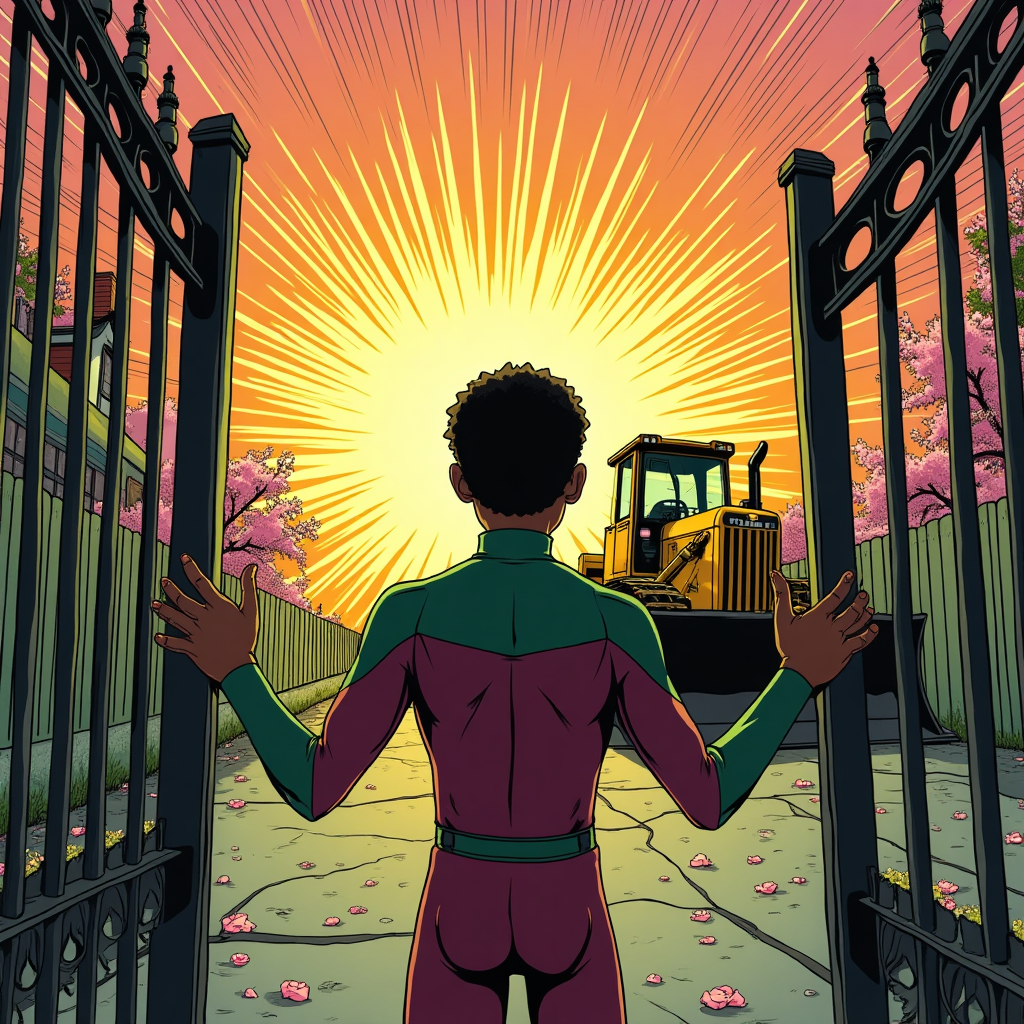
The name comes from the cherry blossoms on the Branch Brook iron bridge — bloom and iron, grace and endurance, the thing that is soft and the thing that holds. His grandmother sews the first version of the costume: dark burgundy with deep green at the collar and cuffs, no insignia, just the colors of East Orange in April.
Part Five: First Confrontation at Ampere Station
The Hargrove demolition crew arrives at the AP Smith fence on a Tuesday morning before dawn. Marcus has been awake since 3 AM — the fence told him they were coming. He felt the surveyors’ stakes being driven the night before, vibrating through the soil, and by 5 AM he is standing on the Ampere Parkway sidewalk in the burgundy-and-green, hands loose at his sides, while the first excavator rolls into position.
Nullveil is already there.
They stand in front of the fence in their architectural grey, portfolio under one arm, looking at Marcus with something that is not quite contempt and not quite pity. Their amber eyes are calm. Around them, the old iron fence has already gone partially silent — a three-panel section near the gate dead and gray in a way that has nothing to do with rust.
“You feel it, don’t you,” Nullveil says. It is not a question. “The silence. It’s kinder than you think.”
Marcus puts both palms flat on the fence.
The remaining panels scream back to life.
The vibration travels from the AP Smith site up through the buried iron water mains, north along Frelinghuysen Avenue, and connects — improbably, perfectly — to the Ampere station platform rail. The NJ Transit morning train, still eight minutes out, sends its own low thunder back down the line like a reply. The ground beneath the excavator shivers. The machine’s operator kills the engine. The surveyors’ stakes pop out of the earth one by one, neat as a card trick.
Nullveil staggers. In twenty years of nullifying old iron, they have never met iron that talked back.
“This fence remembers,” Marcus says. His voice is steadier than he expected. “The station remembers. All of it. You can’t silence what this whole city is still saying.”
Nullveil recovers quickly — they always do — and the silence pushes back, a cold damping wave that makes Marcus’s palms ache. The fight is not over. It will not be over for a long time. The Hargrove application has lawyers and amendments and city council votes left in it. Nullveil has more silences to spend.
But the fence is still standing when the cherry blossom petals start to fall, drifting south from Branch Brook on the April wind, settling pink and weightless on iron that is old and awake and will not be forgotten.
Marcus Okafor — Ironbloom — is thirteen years old. He has a percussion solo at Cicely Tyson School this afternoon.
His hands are not shaking.