

Silkfall: The Origin of Ironhollow of the Great Falls
Part One: The City Beneath the City
Paterson breathes in layers.
Above, the streets of the Fourth Ward hum with the smell of halal grills and bakery sugar, with the call to prayer drifting from the minarets near Straight Street, with the horn-blast of a NJ Transit bus negotiating the curve at Market and Main. Below, the city is older and stranger — a skeleton of brick culverts, mill-race tunnels, and iron rail beds laid down when Paterson was the engine of the American century, when the silk looms ran twenty-two hours a day and the Passaic River was the most productive waterfall in the hemisphere.
Valentina Reyes knows both cities. She is thirteen years old, daughter of a Colombian mother and a Puerto Rican father, and she has grown up at the intersection of Paterson’s immigrant present and its industrial ghost. Her mother, Elena, works a double shift most Fridays at the textile remnant warehouse on Oliver Street — a different kind of fabric trade than the silk barons ran, but fabric trade still. Her father, Marcos, drives an NJ Transit bus on the 190 line out of the Broadway terminal. Between her parents, Valentina has absorbed the city’s two circulatory systems — the physical transit network her father navigates each day, and the informal network of community and commerce her mother keeps alive through sheer relentless human contact.
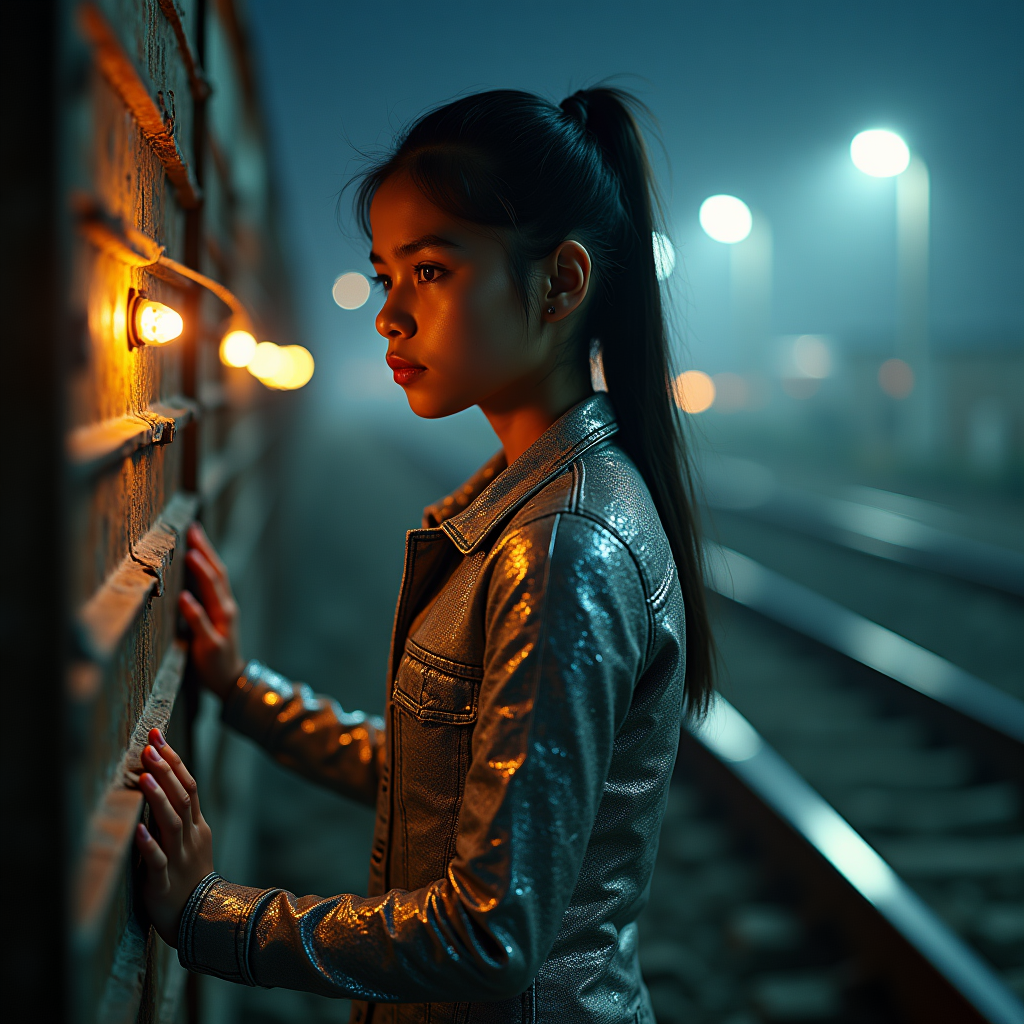
Valentina herself is a walker. After school at School 2 on Straight Street, she traces Paterson’s bones: down to the Great Falls overlook, along Spruce Street to the old Ryle mill complex, under the Route 20 overpass where the NJ Transit Northeast Corridor spur cuts through on the embankment — rusted rails and corroded ties, decommissioned but not removed, vibrating faintly whenever the active freight line nearby carries a load. She sketches what she sees in a composition notebook — bridge trusses, mill wheel housings, the geometric logic of old water channels. She is not an artist exactly. She is a reader of infrastructure. She understands intuitively that the bones of a city are its argument — and Paterson’s argument is complicated, layered, and unfinished.
She does not know, walking home along the river on an April evening with cherry blossom petals drifting down from the trees above the gorge, that the city is about to make her its instrument.
Part Two: The Pulse in the Rail
It begins with the ground.
Paterson’s industrial corridor, particularly the stretch between the old Hamil Mill ruins and the eastern embankment of the Passaic gorge, sits on centuries of compressed river silt — clay-heavy, water-saturated, the kind of soil engineers call treacherous. The old mill foundations were sunk deep, on timber pilings that have been rotting since the Depression. When the Meridian Development Consortium began their covert survey work that April — drilling test bores for a planned stadium-adjacent commercial redevelopment that would require condemning three city blocks of the Fourth Ward — they hit something wrong.
The bore drill at Site 7, just below the embankment where the old spur rail line runs, punched into a sealed culvert chamber: a pre-Civil War brick vault that had been used as a storage space for the mill’s experimental chemical reserves in the 1880s. The chamber was full of a century-old fermentation — organic acids, mineral compounds, and something the company’s contracted geologist had never documented in forty years of survey work. Something that had been under pressure in that sealed vault for one hundred and forty years, crystallizing and condensing, waiting.
The drill broke the seal at 4:47 PM on a Thursday. The plume vented upward through the test bore, through the embankment soil, and erupted through a gap in the old rail bed directly beneath Valentina Reyes, who had stopped as she always did on her walk home to press her palm flat against the cold corroded rail — a habit she had developed without knowing why, as though the metal had always been trying to tell her something.
It tells her everything at once.
The force of the exposure throws her backward into the gravel slope. She lies still for six seconds — she counts them later, in the retelling, though she has no memory of counting — and then the world reorganizes itself around a new set of rules. The rails beneath her are vibrating. Not from a train. They are vibrating because she is vibrating, and the frequency she generates is traveling outward through the metal at the speed of electrical conduction, threading through every junction and switching station on the regional network, a resonant pulse singing from Paterson to Newark to Jersey City and back.
She can feel, simultaneously, every train in motion on that network. She can feel the commuter weight on the 7:12 departure from Newark Penn. She can feel a switching fault outside Secaucus. She can feel the NJ Transit 190 bus — her father’s bus — making the curve at Broadway, because the bus stop anchor bolt is in contact with a ground wire that feeds back through the municipal conduit system into the same network she is now wired into.
She sits up in the gravel, cherry blossom petals settling in her dark hair, and she understands that the Silk City’s circulatory system has just made her its center.
Part Three: Learning the Instrument
Valentina does not tell her parents. This is not from fear — she is, as her mother often observes, not a child who fears things — but from a need to understand what she is before she tries to explain it. She spends the next three weeks learning.
The rail resonance is the first power and the clearest. She can transmit through any conductive infrastructure in contact with the regional transit network — rails, signal wires, catenary cable, grounding rods. What she sends is not electricity but a vibration that carries information: she can read the state of every node on the system, and she can interrupt or reroute signals with a concentrated pulse. She practices on a decommissioned switching station off of Market Street — carefully, surgically, never disrupting active service. She learns that the network is more fragile than anyone in a conductor’s uniform knows. And she learns that fragility is not the same as weakness.
The digital infiltration comes second, and it frightens her more, because it has no physical substrate she can hold. Standing at the Great Falls overlook one evening, watching the Passaic crash seventy-seven feet into the gorge below, she realizes her consciousness can thread through the wireless nodes embedded in the city’s infrastructure — the traffic management system on Main Street, the water authority’s sensor grid running along the underground pipes, the municipal camera network on Market. It is not hacking in any sense she has a word for. It is more like being a frequency that the system recognizes. She can read and she can write. She chooses, for now, only to read.
The soil compaction is the last, and the most visceral. When she presses her hands against the earth and focuses — a specific, effortful concentration, like holding a note — she can feel the silt and clay beneath the old mill corridor as a physical substance under her command. She can compact it, tightening its molecular structure until the ground becomes iron-hard. She can release it into liquefaction — the treacherous behavior engineers fear, where saturated soil loses all cohesion and flows like slurry. She practices in a vacant lot off of Spruce Street, compressing a patch of mud to the density of concrete and then releasing it back to slurry and back again. She thinks about the mill foundations. She thinks about the clay and the pilings and what it would mean to make the ground rebel.
Her mother’s friend — an older Yemeni woman named Hajja Fatima who has lived on the block since before Valentina was born — watches her from across the chain-link fence one afternoon and says nothing for a long time.
“The city chose you,” Hajja Fatima finally says, in Arabic that Valentina shouldn’t be able to understand and somehow does. “Don’t let the city down.”
She takes the name from the mills and the rails. The hollow spaces — the culverts, the mill-race channels, the sealed vaults — are the hidden architecture of Paterson’s power. And iron is what the rails are made of. She is the voice in the hollow. She is Ironhollow of the Great Falls.
Part Four: The Ironfall Meridian
The Meridian Development Consortium is run, at its operational center, by a man named Desmond Falk.
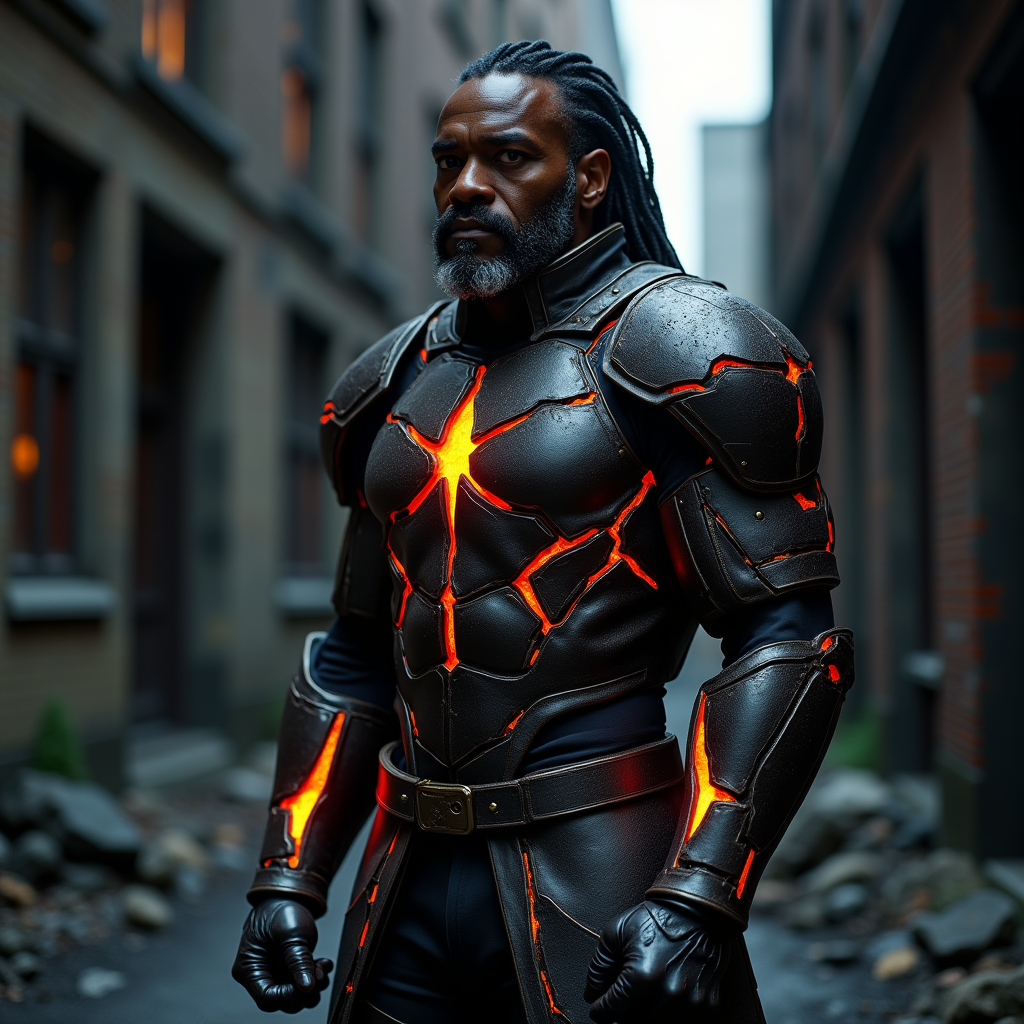
Falk is in his late fifties, multiracial — his father was Trinidadian, his mother grew up in a Paterson Italian household on East 38th Street — and he carries both inheritances with a careful, studied ambiguity that he has learned to deploy as a professional asset. He has silver-threaded locs pulled back tightly, deep brown skin mapped with a network of fine lines earned across three decades of urban redevelopment work, and eyes the color of river water in November. He is not a villain by temperament. He is a believer, in the specific and dangerous way that men who have survived poverty and made wealth sometimes become believers: he believes that the old Paterson — the crumbling mill corridors, the flooded basements, the contaminated lots — must be erased before anything real can be built. He believes this with the fervor of a convert.
The Meridian project was supposed to be clean — demolition, remediation, luxury mixed-use construction, FIFA World Cup 2026 hospitality overflow revenue funding the infrastructure bond. But the bore site accident changed Falk’s equation. His contracted geologist, Dr. Carmela Hess, delivered her report privately: the sealed culvert had contained a century of pressure-cooked organic-mineral compound unlike anything in the literature. Hess estimated there were seven additional sealed chambers along the old mill-race corridor. And whatever had erupted from Site 7 — she could not account for the mass. Something had been absorbed. Someone had been near the bore site.
Falk does not call the EPA. He calls his own people.
He has been exposed too — not through the soil, not through the rails, but through the digital network. Three nights after the bore accident, trying to access the city’s subsurface utility maps through Meridian’s survey system, his terminal became a conduit for something else: a presence that moved through the municipal network with the fluency of a native intelligence. Something read everything on his server in eleven seconds flat and withdrew without a trace. Falk’s own network security chief found the intrusion signature and could not classify it as any known threat actor.
Falk has resources and no patience. He has his team begin drawing from the chambers — controlled extraction of the compound, pressurized containment, experimental exposure. What he builds in himself is rougher than what happened to Valentina. Cruder. The soil compaction he develops is a blunt instrument — he cannot liquify, he can only harden, turning earth into a crushing, compressing force. He cannot thread the rails. But what he can do is use Meridian’s legitimate access to the city’s transit infrastructure contracts to embed killswitch firmware in the regional signal network. He doesn’t need to be Ironhollow. He just needs to be able to shut her down.
He calls himself Ironfall. It is the name his father used to describe what happened to promises that couldn’t hold their own weight.
Part Five: The Great Falls Hold
The confrontation comes on a Friday night in late April, when the cherry blossoms are at peak and the mist from the Great Falls hangs over the gorge like a veil.
Meridian’s demolition crews arrive after dark on the Fourth Ward blocks — three city council votes secured, condemnation notices served, the legal structure airtight. But Valentina had been in the city’s digital network earlier that afternoon and had read the demolition order before it was formally filed. She had also read Dr. Hess’s suppressed report. She knows what Falk extracted from the chambers. She knows what he built himself into.
She reaches the Spruce Street perimeter when the first compactor is already in position. She presses both palms against the rail embankment and sends a resonant pulse through the entire regional network — not disruptive, not a weapon. A signal. Her father’s bus, six blocks away, feels it through the ground anchor. The traffic lights on Main Street cycle to red in sequence, slowing incoming Meridian vehicles. The water authority’s pressure sensors flag an anomaly in the Fourth Ward grid and an automatic alert goes to the city emergency management office. She is not destroying the system. She is playing it.
Falk is waiting at the site perimeter. She sees him across the vacant lot — tall, silver-locked, his face carrying an expression she recognizes as the specific grief of a man who has convinced himself that harm is necessary. Beneath his feet, the ground is hardened to bedrock density in a ten-foot radius. He has been practicing too.
“You’re a child,” he says. It is not contemptuous. It is almost apologetic.
“The city isn’t,” she answers.
What follows is not a fistfight. It is a contest of ground.
Falk compresses the earth beneath her — driving her down, trying to trap her feet in liquefied clay turned suddenly rigid. She feels it through the soles of her shoes and releases the soil beneath the compactor behind him before he can lock it: the machine tilts, sinks six inches, stalls. He pushes harder. She threads a pulse through the signal junction twenty feet to her left and every piece of Meridian’s GPS-dependent heavy equipment loses its guidance system simultaneously — not destroyed, just blind.
She drives her palms into the earth and liquefies the silt beneath the Meridian site in a controlled cascade, turning the compacted demolition staging area into a twelve-inch-deep slurry pool that swallows the compactor’s treads. Nobody is hurt. Nobody can move forward.
Falk stands at the edge of his hardened circle and looks at the equipment mired in the mud, and then he looks at the girl standing barefoot in the silt with her hair wild and her hands black with clay, and something in his face breaks open briefly — not defeat, but recognition.
“This city is going to outlast both of us,” Valentina says quietly.
Emergency management arrives eleven minutes later, alerted by the automated sensor flag she seeded earlier. The suppressed geologist’s report — which she extracted from Meridian’s server that same afternoon and routed to three journalists and the city’s environmental ombudsman — runs in the morning digital edition of the Paterson community news service.
Desmond Falk walks away from the site. He is not arrested. Not yet. But the Meridian project is suspended pending investigation, and the sealed culvert chambers are flagged for historic preservation review.
Valentina walks home along the river. The Great Falls roar behind her, seventy-seven feet of Passaic River water crashing into the gorge that Hamilton himself once stood beside and called the engine of a nation. She can feel the rail vibrating two blocks east — the first morning freight already moving — and beneath her feet the clay is soft and patient and deep.
The Silk City’s bones hold.
She is their voice.