


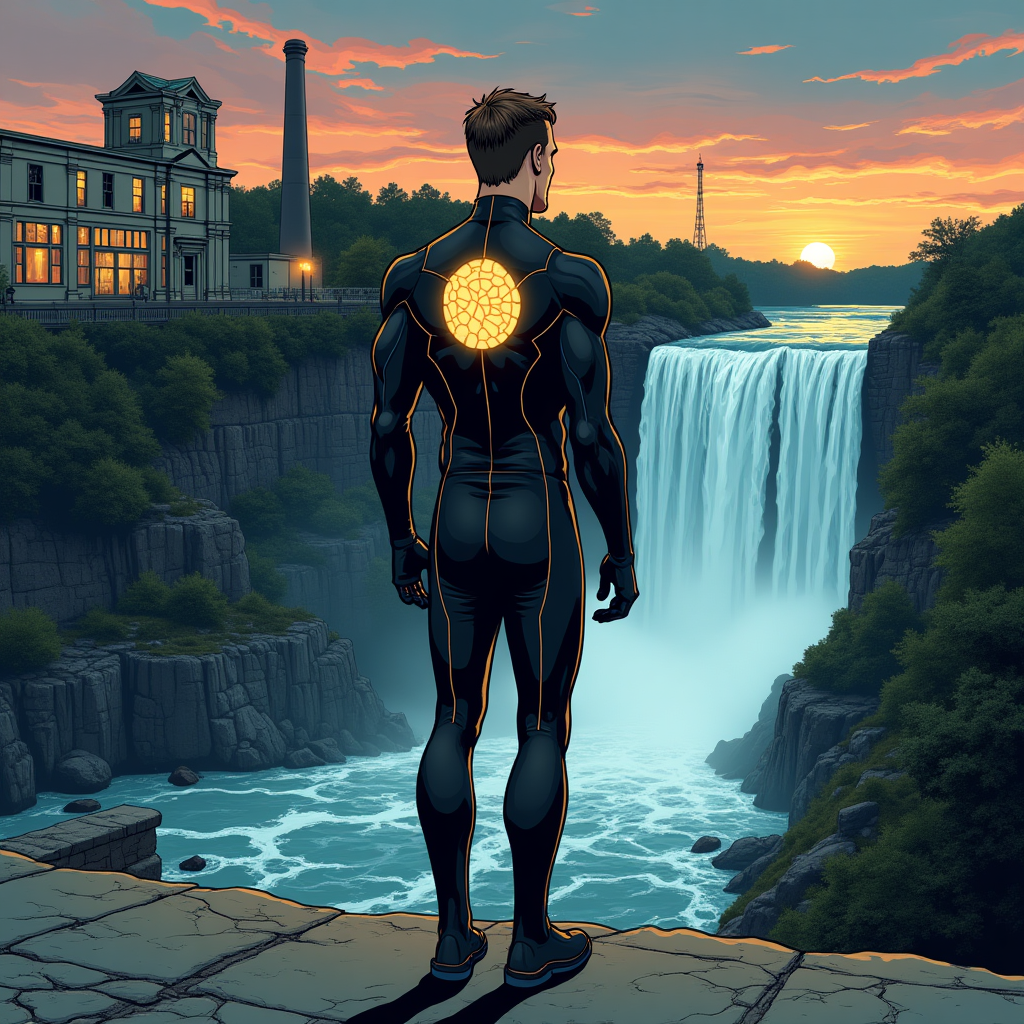
LACHLAN
An Origin Story from the LOCAL HERO Universe — Paterson, NJ
Part One: The Language of Underperforming Assets
Caden Morrow has always understood cities the way a surgeon understands a body on a table — as a system of parts, some functional, some not, all of them available for rearrangement if you have the right tools and sufficient nerve.
He grew up in Westfield, Union County, in a house with a three-car garage and a father who flipped commercial properties along Route 22 the way other men collected baseball cards. His father taught him two things before the divorce: that sentiment is a liability, and that the difference between a slum and a luxury district is mostly paperwork and patience. Caden internalized both lessons with the focused efficiency of someone who understood, even at twelve, that the world rewards people who move first.
He graduates from Whitmore Technical Institute in Connecticut with an engineering degree and a minor in urban development economics. He is twenty-two when he takes his first job with the Lachlan Group, a real estate acquisition firm incorporated in Delaware and operating across seven legacy industrial cities in the Northeast. He is twenty-five when he becomes their youngest site accelerator. He is twenty-eight when they send him to Paterson.
Paterson, the Lachlan Group’s intake brief reads, is an underperforming urban asset with significant remediation upside. Seven contiguous blocks of mill buildings along the Passaic River gorge. Nineteenth-century industrial architecture in remarkably good structural condition. Proximity to the Great Falls National Historical Park — a federally designated attraction that generates foot traffic but not, in the Lachlan Group’s assessment, sufficient revenue capture. The current occupants: artists, small manufacturers, and approximately four hundred families in three residential buildings, most of them first- and second-generation immigrants. Colombian, Dominican, Guatemalan, Turkish, Bangladeshi. The brief describes them as a transitional residential population.
Caden reads this on a Midtown Direct train out of Penn Station, his Porsche already parked in a garage on Market Street. He looks up from his laptop as the train crosses into Passaic County, watches the Paterson skyline resolve out of the morning haze — the brick mill towers, the water towers, the steeples and minarets crowding the hill above the gorge. He thinks: sixty days to first notices.
He does not hear the Falls yet. But he will.
Part Two: What the City Buried
The sub-basement of the Dolphin Mill smells like wet limestone and old iron and something else — something that doesn’t have a name in any building code or environmental survey Caden has ever read. His geologist, a contracted specialist named Dr. Priya Ansari from the firm’s technical division, calls him down on the third day of the survey with the particular tone of someone who is professionally excited and personally alarmed.
The crystalline deposit runs the entire length of the eastern millrace wall. It formed over a hundred and fifty years of specific conditions: industrial runoff from the silk-dyeing operations, heavy metals from the ironworks upstream, Passaic River sediment, and the constant low-frequency vibration of the Falls transmitted through the gorge bedrock. Dr. Ansari has never seen anything like it. She calls it Sericum-7. She tells him it stores mechanical and vibrational energy at a density that shouldn’t be chemically possible. She tells him it releases that energy on a specific resonant trigger. She tells him it is, functionally, a natural battery grown from the bones of Silk City itself.
Caden stands in the sub-basement with his flashlight and looks at the crystalline wall — pale gold and faintly luminescent in the dark, humming at a frequency he can feel in his back teeth — and he does not feel wonder. He feels the clean, cold satisfaction of a man who has found what he came for, and found it bigger than expected.
He calls the Singapore contact from the parking garage. He does not mention Dr. Ansari’s secondary note, the one she flagged at the bottom of her report in cautious, hedged language: that the deposit appears to be structurally integrated with the mill’s foundation, that extraction without full environmental modeling could produce unpredictable energetic discharge events, and that she would recommend a minimum six-month assessment period before any mechanical intervention.
Caden schedules the extraction trigger for midnight, three weeks out. He tells Dr. Ansari the timeline has been approved at the executive level. He does not tell her he has already begun the eviction paperwork on the three residential buildings.
He does not think about what might be inside the mill when the trigger fires.
This is, in the accounting of his life, a familiar kind of not-thinking.
Part Three: The Night the City Answered
The geologist miscalculated. Caden will acknowledge this much, privately, in the weeks afterward. The discharge is not supposed to be that large. The remote trigger fires at midnight from his phone — he is at a restaurant on Getty Square, halfway through a glass of Barolo, watching the reflection of the street lights in the window — and the alert that comes back eleven seconds later is not the extraction complete confirmation he expected.
It is a seismic event notification from the Passaic County Office of Emergency Management.
He drives to the Dolphin Mill in three minutes and finds the sub-basement wall partially collapsed, the millrace flooded, the Sericum-7 deposit cracked open from within, and his extraction rig scattered across the raceway bank like it was thrown by a child. He finds Dr. Ansari’s equipment fried. He finds, in the morning, the report from his security contractor: a teenage girl, found on the raceway bank outside the mill, who walked away from the blast site under her own power. Whose hands were glowing.
He finds, two weeks later, what the girl can do.
He watches from his Porsche on McBride Avenue — it is a Thursday evening, his crews have arrived at the Hamilton Street overlook to begin the unauthorized raceway demolition, and she drops from the pedestrian bridge above Spruce Street on a line of energy spun from her own hands and puts her palms flat on his excavator and kills it. Just kills it. Every hydraulic line vibrating at a frequency that trips the safety lockdown simultaneously. His crews scatter. She stands in the middle of the work site in a jacket he recognizes from the building on Rosa Parks Boulevard and she is thirteen years old and she is humming.
He sits very still in the Porsche and does the calculation he is always doing.
The Sericum-7 is inside her. She is the deposit. She is also, he notes with professional detachment, more capable and more dangerous than raw mineral. The Singapore buyer will need to be approached differently. The conversation will need new framing. But Caden Morrow has been reframing conversations his entire career.
He drives home and gets to work.
Part Four: The Suit That Steals
Dr. Ansari quits the following Monday. She cites ethical concerns with the project’s revised scope in her resignation letter, which Caden files without reading past the second line. He brings in a new contractor — a materials engineer named Fortis who works out of a lab in Carlstadt and does not ask questions about applications — and gives him the fragment of Sericum-7 he recovered from the blast site and a very specific design brief.
The neuro-conductive suit takes nineteen days to build.
It is matte black with silver traces seamed along the limbs and spine, the synthetic Sericum-7 fragment embedded in a neuro-conductive lattice across the torso. The principle is elegant in the way Caden has always found engineering elegant when it is purely extractive: the suit cannot generate vibrational energy on its own. It can only receive it. It reads incoming resonant frequency, matches it in real time, and absorbs it — pulling the energy from its source like a siphon, storing it in the synthetic lattice, redistributing it as kinetic force through the limbs.
He cannot do what she does. He has never been able to make the city sing.
But he can take what she makes of it.
He puts the suit on for the first time in the Carlstadt lab and stands in front of a mirror for a long time. His pale, angular features look back at him, the silver traces of the suit catching the fluorescent light. He is twenty-eight years old and he has just built the most sophisticated piece of energy-theft technology in human history out of the mineral remnant of a city he is in the process of dismantling.
He calls himself Lachlan. It is the name on the company letterhead. It has always been the name on the company letterhead. He is not, he tells himself, becoming something new. He is just finally being legible.
He files the eviction notices the same afternoon. Sixty days, as planned.
He drives back to Paterson in the dark, the suit in a case in the Porsche’s trunk, the Falls audible for the first time as he crosses the city line — low and constant and completely indifferent to anything he has planned. He turns the radio up.
He has a meeting at the Hamilton Street overlook to prepare for. He knows she will come. She is thirteen years old and she has not yet learned to let things go when they feel wrong. He was never that age. But he has learned to use it in others.
Part Five: The Frequency He Cannot Own
He arrives at the overlook with two security contractors and the suit humming warm against his ribs, and she is already there.
She is standing on the railing above the gorge like she grew up there — which, Caden supposes, she effectively did. The Great Falls roar seventy-seven feet below, loud enough to feel in the chest, and she stands above them with the particular stillness of someone listening to something he cannot hear. The city hums in her. He can see it — a faint shimmer at her hands, a vibration in the air around her that the suit’s sensors read as incoming frequency, broad-spectrum, sustained.
He walks to the center of the overlook and he says what he has planned to say. He has always been good at the speech before the transaction.
“You’re a resource,” he tells her. “The most valuable one in the city.”
She hits him with the first pulse and the suit catches it perfectly — all that resonant force flowing into the synthetic lattice, his limbs suddenly warm and strong with borrowed power. He grins because he has earned the grin. He spent nineteen days in a Carlstadt lab earning it.
What he has not spent nineteen days doing is listening.
She stops trying to force him off the overlook — he registers this shift, files it, does not yet understand what it means. She presses her palms flat against the old stone parapet and she goes very still and the shimmer around her changes quality. It stops broadcasting outward. It turns inward, focused, precise. The suit’s sensors spike and then go strange — the incoming frequency is changing, cycling through registers, hunting for something. He takes a step toward her.
She finds it.
The suit fractures at every seam simultaneously.
It is not painful, exactly — it is the sensation of something that was holding being suddenly not. The silver traces go dark, the synthetic Sericum-7 fragment vibrates itself apart in his chest like a tuning fork struck too hard, and Caden Morrow sits down on the stone path of the Hamilton Street overlook with a force that is entirely ungraceful and entirely his own.
His contractors are gone. The Falls are still roaring. The suit is dead weight.
She drops down from the railing and stands over him and she says something about belonging, about ownership, about the city making both of them. He hears the words. He understands their grammar. But the thing they are pointing at — the thing she clearly feels in her chest like a fact of physics — is a frequency he does not have the architecture to receive.
He sits on the cold limestone path and looks up at her and, for the first time in his professional life, does not immediately begin calculating the next move.
The Passaic County Sheriff’s deputies arrive nine minutes later.
He rides in the back of the cruiser past the mill buildings on McBride Avenue, past the bodegas on Market, past the old Ryle Mill carved into apartments where four hundred families are still, tonight, at home. The eviction notices are in a folder on his laptop. The Singapore contact’s number is in his phone. The Lachlan Group has lawyers who have been in worse situations than this.
He stares out the window at the city going past and he listens, for the first time without a suit to filter it, for the sound of the Falls. He can hear them faintly, still, receding behind him as the cruiser moves north.
He does not understand what they are saying.
He suspects, in the coldest part of his careful mind, that he never will.
LACHLAN will return.