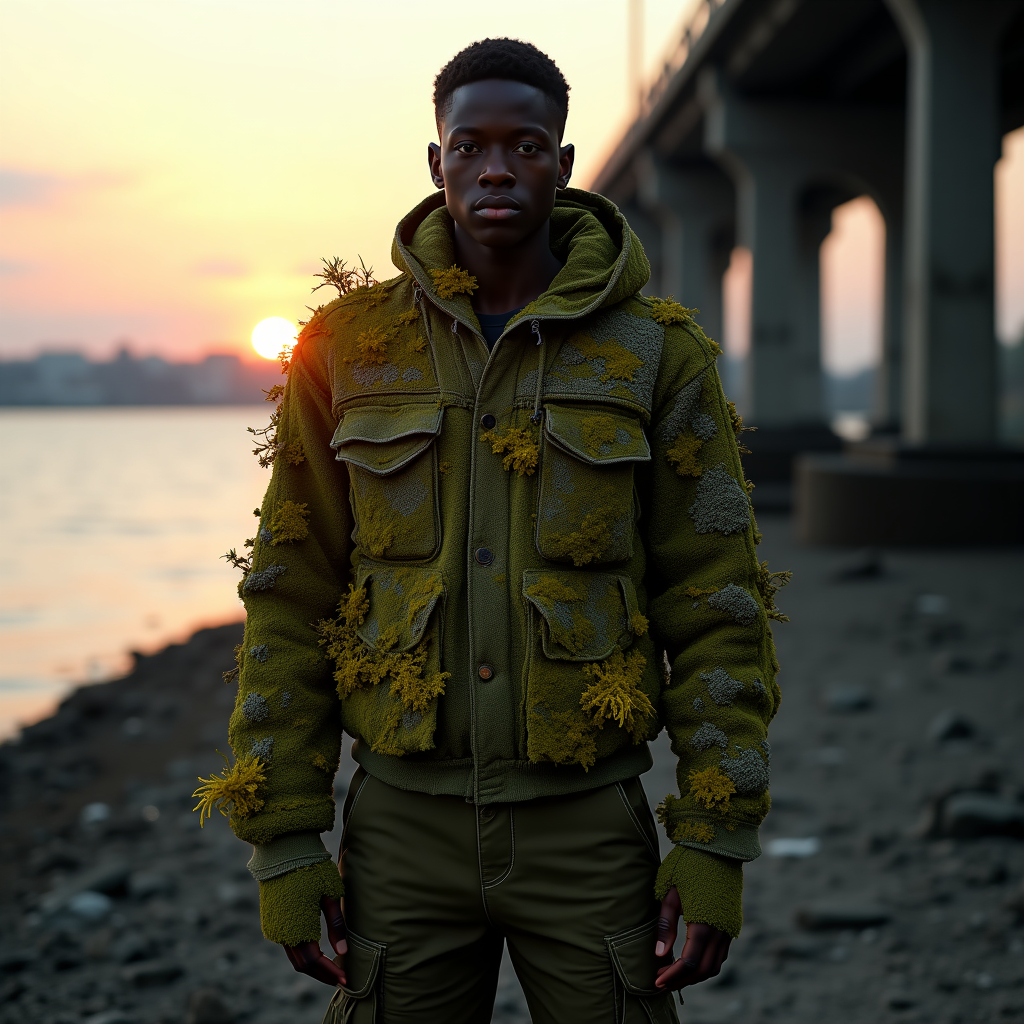



Part One: The Root Beneath the Ruin
Newark does not forget what is buried beneath it.
Three hundred and sixty years of history press down through every layer of this city — Puritan foundations, colonial cobblestone, industrial slab, cracked post-war asphalt — all of it compressed into a living record that hums faintly to anyone patient enough to listen. Most people never hear it. They are in too much of a hurry, rushing through Penn Station on their way somewhere that isn’t here, glancing up at the skyline from the New Jersey Turnpike and moving on.
Marcus Tillman hears it.
He is thirteen years old, wiry and sharp-eyed, the kind of kid who notices everything — the way the cherry blossoms in Branch Brook Park blow north when the bay wind shifts, the way the Passaic River goes copper-brown near the old industrial stretch south of the Ironbound, the way the soil near the old Port Newark bulkhead smells different after rain, heavy and ancient, like something buried there long before any of them were born. Marcus lives on Bloomfield Avenue in the North Ward with his grandmother, Rosemary, who grows collard greens and tomatoes in five-gallon buckets on the fire escape because the ground-level lot next door has been fenced off by the Hargrove Development Group for four years without a single shovel breaking earth. Just a chain-link fence and a promise.
Marcus goes to a magnet program at Essex County Schools of Technology. He is supposed to be studying structural engineering this semester — foundations, load-bearing soil, the way cities press weight into the earth. His teacher, Mr. Adesanya, has assigned a field project: document a site of historical significance in Newark, measure its soil compaction, present findings. Most kids pick something near campus or downtown. Marcus picks the Passaic riverbank just south of the Raymond Boulevard bridge, where the industrial waterfront has been left to go wild — kudzu and ailanthus taking back the chain-link, phragmites choking the old dock pilings, and beneath it all, a ground that remembers everything.
He goes on a Saturday morning in early April, the light low and gold across the river, Newark Bay glinting silver in the distance. He has his school-issued soil probe, a notebook, a granola bar. He is entirely alone.
He should not be here.
Part Two: The Confluence
The site is stranger than any photograph prepared him for. The kudzu here is extraordinary — sheets of it, decades thick, draped over collapsed fence posts and rusted crane housings like a living burial shroud. The ground beneath it is soft in some places, hard as concrete in others, and Marcus is on one knee prodding his soil probe into the earth when he first feels it.
A vibration. Not mechanical. Not from the highway above or the container cranes across the bay. Something older. Something that moves the way roots move — slow, purposeful, lateral.
He pushes the probe deeper.
The ground liquefies.
Not dramatically — not a sinkhole, not a collapse. A twelve-inch circle of earth around his probe simply becomes fluid, dark and silky, and the probe sinks to its hilt. Marcus yanks his hand back and stumbles, and his palm comes down flat on a patch of kudzu-covered ground — and that is when it happens.
The plant network ignites.
That is the only word for it. The kudzu, the phragmites, the ailanthus, every invasive root that has spent decades threading through the contaminated riverbank soil — all of it becomes a conduit. The stored solar energy is immense: years of April light, July afternoons, October gold, all of it captured in the chlorophyll matrix of a thousand overlapping root systems. It travels through the soil. It travels through the plant fiber. It travels through Marcus.
He does not scream. There is no time to scream. The light comes out of him in a column — straight up, blazing white-gold, a second sunrise over the Passaic — and when it fades, Marcus Tillman is still kneeling on the riverbank, both palms flat on the earth, and the ground beneath his hands has hardened to the density of compressed granite.
He can feel everything below him.
Three feet down: the old dock foundation, creosote-soaked timber laid in the 1890s. Eight feet: a stratum of colonial-era fill, broken pottery, charcoal, bone. Twenty feet: the original river delta clay, the substrate that the 1666 Puritan settlers chose for its firmness. Thirty-two feet: bedrock.
And he can move all of it. Every layer. As easily as thought.
Marcus Tillman stays on that riverbank for four hours, learning what he has become.
Part Three: Loamborn of the Passaic
He does not tell his grandmother immediately. He is thirteen and he is terrified and he is also, quietly, exhilarated in a way he cannot fully describe — like the city itself has been waiting for him specifically, has chosen him the way a root chooses a crack in foundation stone: inevitable, patient, precise.
He goes back to the riverbank every weekend for six weeks. He learns the grammar of his power the way he learns everything — methodically, taking notes, making mistakes. He learns that he can draw photosynthetic energy from any plant material in contact with the soil, channeling it through himself into a burst of concentrated light — brilliant and hot, capable of illuminating a city block or, in a focused beam, cutting through six inches of corroded steel. He learns that he can harden any soil or asphalt beneath his feet to the compaction density of bedrock, creating pathways that can bear extraordinary weight, or shock-absorbing platforms that flex without cracking. And he learns — this one frightens him the most — that he can liquefy the earth, reduce compacted soil to something close to quicksand across a span of thirty yards.
He is not naive about what that last power means. He is studying structural engineering. He knows what happens to buildings when their foundations lose support.
He decides he will never use that one unless he has to.
By June he has chosen a name. Not from a comic book. From the ground itself: Loamborn of the Passaic — loam being the living stratum of soil, mixed earth and organic matter, the layer between bedrock and surface where roots take hold and cities are planted. Newark was planted here. He was planted here. The name feels honest.
He is still thirteen, so he also thinks it sounds extremely cool.
Part Four: The Ashen Signal
The threat arrives, as threats so often do in Newark, through a permit application.
The Hargrove Development Group has finally moved on the fenced lot on Bloomfield Avenue — and on eighteen other parcels across the North and Central wards. The plan, buried in city council meeting minutes that Marcus only finds because Mr. Adesanya assigns a civic engagement project, involves deep soil remediation across all nineteen sites: high-temperature thermal treatment, essentially baking the earth at industrial scale to neutralize contaminants. On paper, environmental cleanup. In practice — Marcus does the math — the process would sterilize the soil biome across a combined area of nearly forty acres, destroying the root network connections that thread through the North Ward like a subterranean nervous system.
It would not just kill the plants. It would sever his connection to the ground.
That is when he meets Cindergate.
Her name — the one she has given herself — is a reference to the old Newark industrial waterfront: cinder, the residue of the iron furnaces that lined the Passaic banks in the 1880s; gate, for the Penn Station gateway and the city’s identity as a portal to everywhere else. Her real name is Yuna Chae. She is twenty-two, Korean American, born in the Ironbound to parents who ran a dry goods import business until Hargrove Development’s “revitalization” campaign priced them out. She studied materials engineering at NJIT, one campus block from where Marcus goes to school, and she graduated into a city she no longer recognized — and could no longer afford.
She found the Hargrove permits before Marcus did. She found the thermal treatment contracts. She found the subsidiary company that holds the remediation license and traced it to a private infrastructure fund headquartered, ironically, in Port Newark’s administrative complex.
And she decided that if the old city was going to be burned out, she might as well be the one to light the match.
Cindergate’s power is industrial combustion — she has spent two years in Hargrove’s demolition sites, exposed to the pyrolytic chemicals used in thermal soil treatment, and the exposure has not killed her. It has made her a living furnace. She can generate concentrated thermal plumes, reduce structural materials to slag with sustained contact, and — her most precise ability — she can superheat the air in a localized column, creating a thermal updraft that functions like an invisible column of crushing pressure. She is not trying to destroy Newark. She is trying to force Hargrove’s infrastructure to collapse so dramatically that the permits become untenable, the investors flee, and the North Ward stays the North Ward.
Her methods are about to level a city block.
Part Five: Deep Roots, Open Light
The confrontation comes on a Thursday evening in late September, at the Hargrove staging yard on Wilson Avenue, where the thermal treatment rigs are being assembled for the first planned soil burn. Cindergate arrives first — Marcus picks up her heat signature through the root network three blocks away, a warm pulse moving against the cool September earth like a coal dropped into river mud.
He intercepts her at the fence line.
“You’re the kid,” she says. She is lean and fierce, her work jacket crackling at the seams with heat distortion, the collar edges still visible — gray canvas, NJIT logo half-consumed by the thermal patina that has restructured her entire form. Her face is sharp beneath the char-shimmer of her transformation. She does not look evil. She looks tired and correct about almost everything.
“You’re going to bring the foundations down,” Marcus says. “The building on the south end of this block has forty residential units. The soil liquefaction from that heat will—”
“I know what it will do,” Yuna says. “I went to school for this.”
“So did I,” Marcus says, and presses his hands to the ground.
What follows is not a simple fight. It is a negotiation conducted in the language of force. Cindergate sends a thermal column screaming across the staging yard, detonating three fuel tanks in a rolling orange fireball — and Marcus hardens the ground beneath the residential building’s foundation into a single plate of compacted earth, dense as bedrock, effectively pinning the structure against the shockwave. She tries to cross the yard toward the rig controls; he liquefies the asphalt in a thirty-foot band between them, and she sinks to her ankles before catching herself on a thermal updraft.
“Stop,” he says. “I’m not protecting Hargrove. I’m protecting the people in those buildings.”
She is breathing hard. The air around her shimmers. “Then help me end this the right way.”
He thinks about Mr. Adesanya’s civic engagement assignment. He thinks about the city council meeting minutes. He thinks about his grandmother’s tomatoes in their five-gallon buckets because the ground-floor lot has been fenced off for four years.
He draws down sunlight through the kudzu running along the staging yard’s back fence — April light stored in the root network since spring — and releases it in a controlled burst directly into the Hargrove rig’s control interface, fusing every circuit. The thermal treatment equipment is inoperable. Not destroyed. Just ended.
“The permits still exist,” Cindergate says.
“They won’t,” Marcus says. “I know where the public comment period is.”
She looks at him for a long moment — this thirteen-year-old standing in a pool of glowing earth, the loam around his feet dense and luminous. Then she turns and walks north along Wilson Avenue and disappears into the Ironbound dark.
Marcus Tillman stays until the fire department arrives. He is already three blocks away, his school bag over one shoulder, when the first trucks come around the corner. Somewhere below him, thirty-two feet down, the bedrock of Newark holds everything up. It always has.
He just needed to learn to listen to it.