Marejada: Origin of the Tide-Keeper
Part One: The City by the Bay
The Raritan Bay does not forgive carelessness. It swallows hooks, drags anchors, and swallows the light on cloudy afternoons until the water looks like hammered pewter. Valentina Reyes grew up watching it from the fire escape of her family’s apartment on Catalpa Avenue, two blocks from the Perth Amboy Ferry Slip, where the rusted iron pilings still hold the memory of every tide that has ever come and gone.
Her abuela called the bay la voz del pueblo — the voice of the people. Valentina, twenty-eight years old and a marine technician for the Middlesex County Waterway Authority, has spent her entire adult life learning to listen to it. She tracks salinity levels, monitors tidal surge data, and crawls into the bilge spaces of inspection vessels that smell like diesel and brine. Her coworkers joke that she bleeds saltwater. She does not correct them.
Perth Amboy is a city of layers. Beneath the bright murals on Smith Street, beneath the plátano vendors and the quinceañera dress shops and the deep-fried everything at the boardwalk carts, there is a city that was once a colonial capital, a city where Scottish lords named streets after their distant estates, a city whose waterfront shipped clay and copper and ambition out into the wider world. Valentina knows all of this because she read every plaque and every crumbling document she could find in the Perth Amboy City Hall archives, where she volunteered on Saturdays as a teenager. History, she believes, is just geology for people — it is always pressing upward through the present.
She is not, by any measure, a woman who expects miracles. She is a woman who expects tides.
Part Two: The Ompoge Event
It begins on a Thursday in April — the kind of grey, cold-shouldered spring day the Jersey shore does best — when Valentina is running a routine water-column survey beneath the old Perth Amboy Ferry Slip.
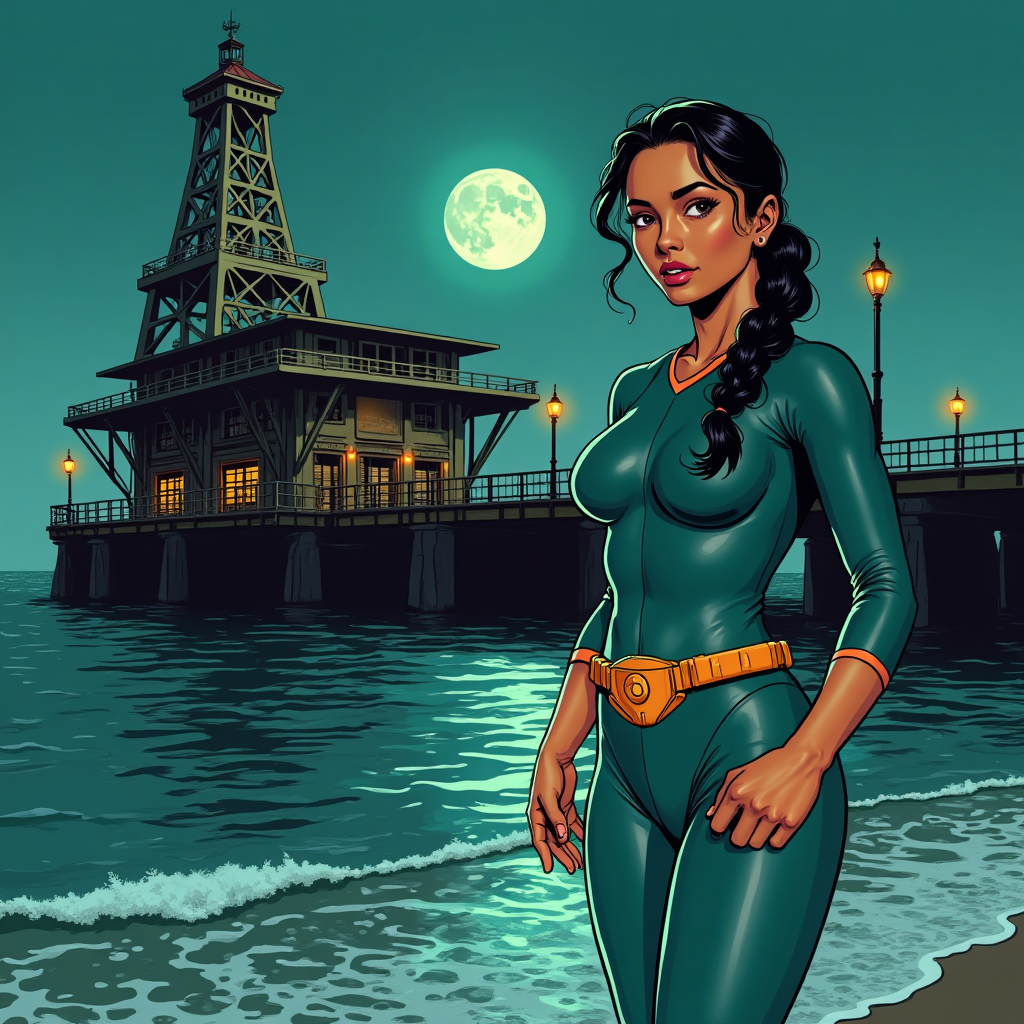
The Ferry Slip, added to the National Register of Historic Places in 1978, is a cathedral of iron and timber that the city has never quite known what to do with. Its bones creak with every tidal shift. Valentina’s inspection submersible, a battered ROV the Authority calls Muñeca, is threading between the barnacled pilings when the sonar pings something strange: a thermal anomaly, twenty meters down, directly beneath the oldest section of the slip’s submerged foundation.
She dives herself. That is not protocol. Protocol went out the window the moment the sonar reading made no physical sense — a heat source at the bottom of a tidal estuary, shaped like a spiral, pulsing at exactly the frequency of a moderate-period ocean swell. The Lenape knew this point as Ompoge, a place of gathering, of convergence. Something, Valentina thinks as she pulls on her drysuit, has been gathering here for a very long time.
The water is black and close. Her dive light cuts a white cone through suspended silt. She finds it wedged between two foundation stones: a formation of Atlantic terra cotta — the same distinctive red-orange fired clay that the old Atlantic Terra Cotta Company once shipped from this very waterfront — but reshaped by centuries of tidal pressure and mineral accretion into something that resembles, impossibly, an intentional form. A vessel. A coiled amphora the size of a car battery, sealed with a mineralized cap, radiating warmth through her neoprene gloves.
She should bag it, tag it, bring it up. She should not, under any circumstances, open it.
The cap dissolves at her touch.
What comes out is not gas and it is not light and it is not water, though it moves like all three simultaneously. It is the compressed kinetic memory of four hundred years of tidal data — every surge, every ebb, every storm that has ever moved through Raritan Bay — and it enters Valentina Reyes through her palms, her sternum, the base of her skull, like a key finding a lock that did not know it existed.
She surfaces thirty seconds later, gasping. The bay around her is perfectly flat. Not calm — flat, as if it is holding its breath.
Then the first wave she has ever consciously called rolls outward from her body in a perfect circle, and the old Ferry Slip groans like a living thing.
Part Three: The Learning
She calls in sick for four days.
In her apartment — windows facing the bay, walls covered in tide charts and colonial maps — Valentina learns what she has become. The process is disorienting and occasionally violent. She floods the bathroom twice. She cracks the kitchen floor when a surge of panic translates directly into a hydraulic shockwave through the building’s pipes. Her neighbor, Mr. Dominguez, knocks to ask if everything is okay. She tells him a pipe burst. He brings her arroz con pollo. She eats it and tries not to cry.
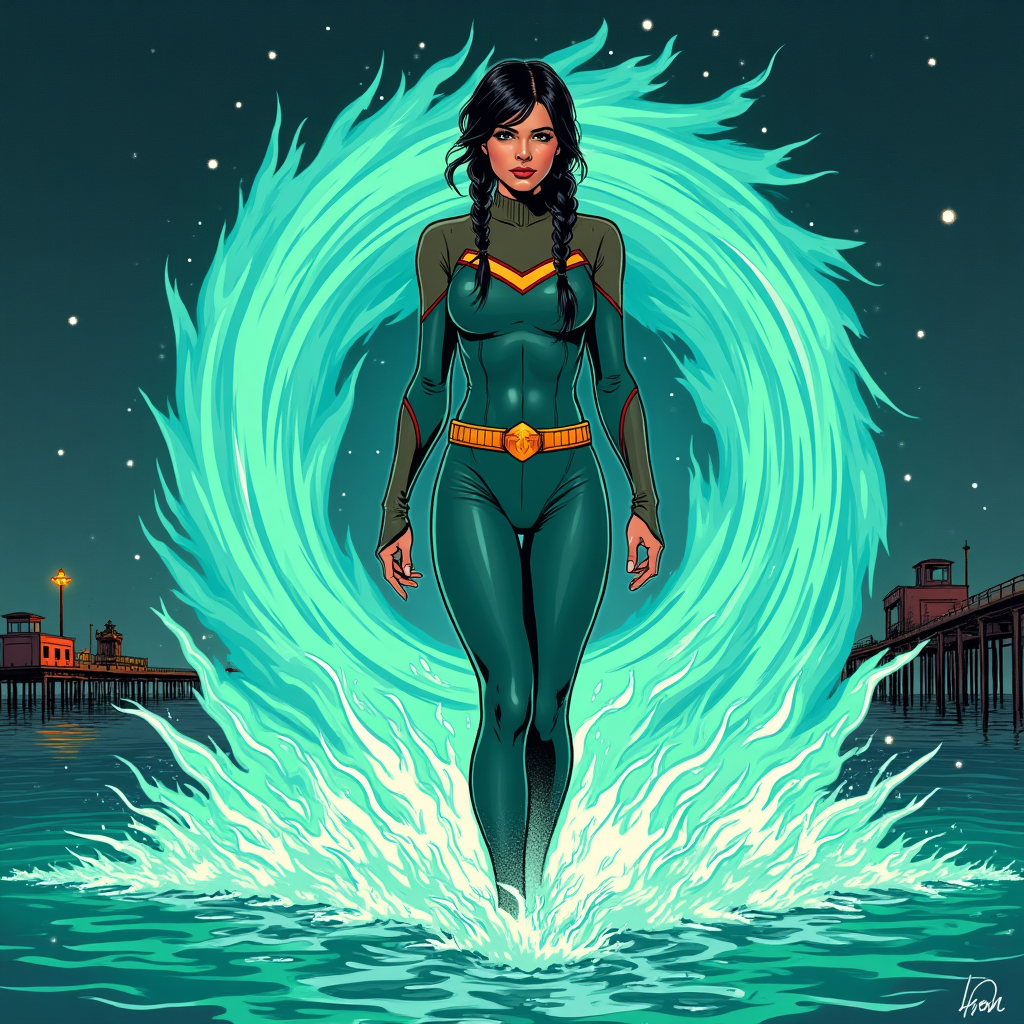
By the fourth day, she has the basic grammar of it. She can feel every body of water within roughly a quarter mile as a kind of pressure map in her chest — the bay, the Arthur Kill, the storm drains beneath Smith Street, the water towers on the high blocks. She can accelerate or arrest the movement of water with a focused act of will, generating tidal surges, directing currents, condensing humidity into localized rain or redirecting it entirely. At her most focused, she can pressurize water into jets hard enough to cut through sheet metal, or spread it thin and still as a mirror, reading the surface for information the way her abuela read café grounds.
She also discovers that the terra cotta vessel’s energy has done something to her cellular structure. She no longer bruises. Her skin sheds water like a cormorant’s feathers. She can hold her breath for eleven minutes and counting.
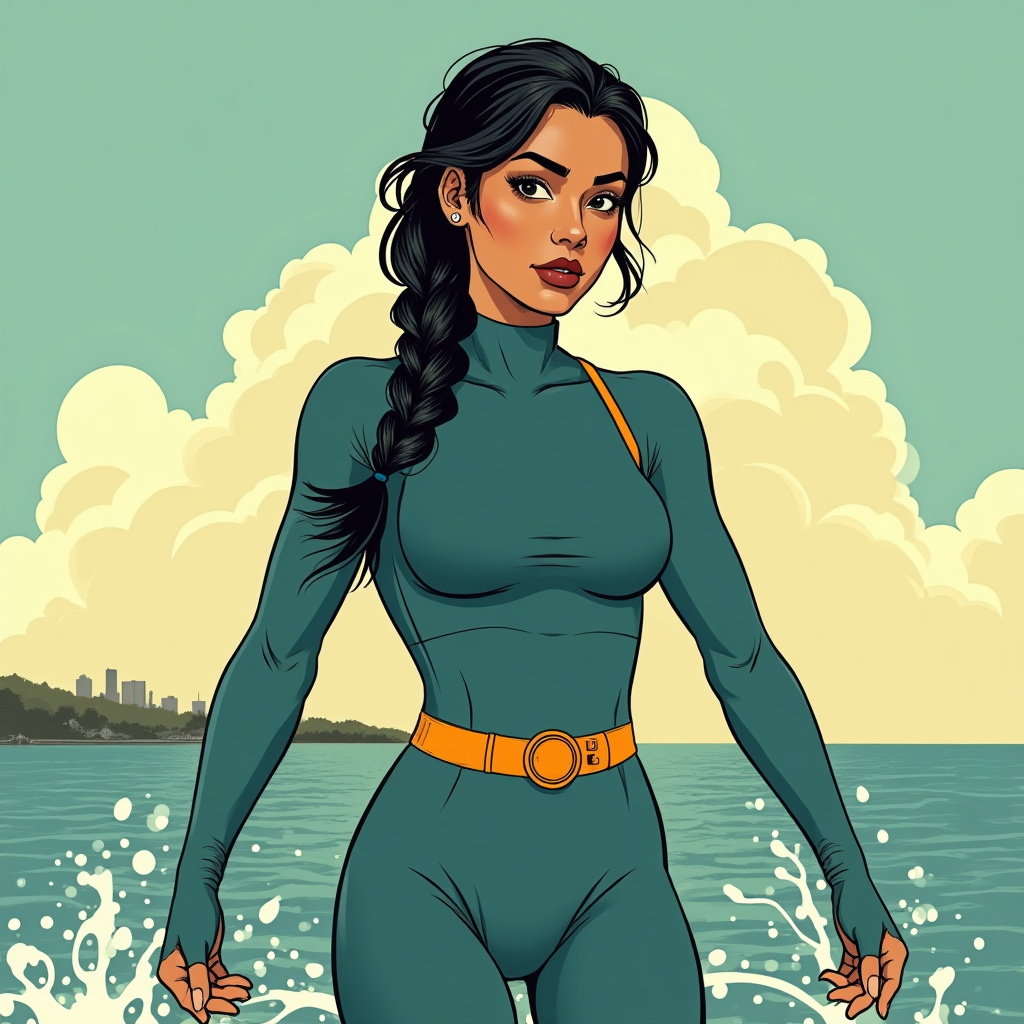
She makes a suit from a repurposed drysuit and the iridescent blue-grey fabric of a competitive open-water racing wetsuit she finds at the Atlantic Outdoor Exchange on New Brunswick Avenue. She stitches the colors of the bay into it — deep teal at the shoulders, storm-cloud grey at the arms, the warm amber of the Ferry Slip’s old iron at the belt. She is not trying to be a symbol. She is trying to be useful.
The name comes from her abuela’s word for the surge that precedes a storm: marejada. The wave before the wave.
She is Marejada.
Part Four: The Archivist’s Gambit
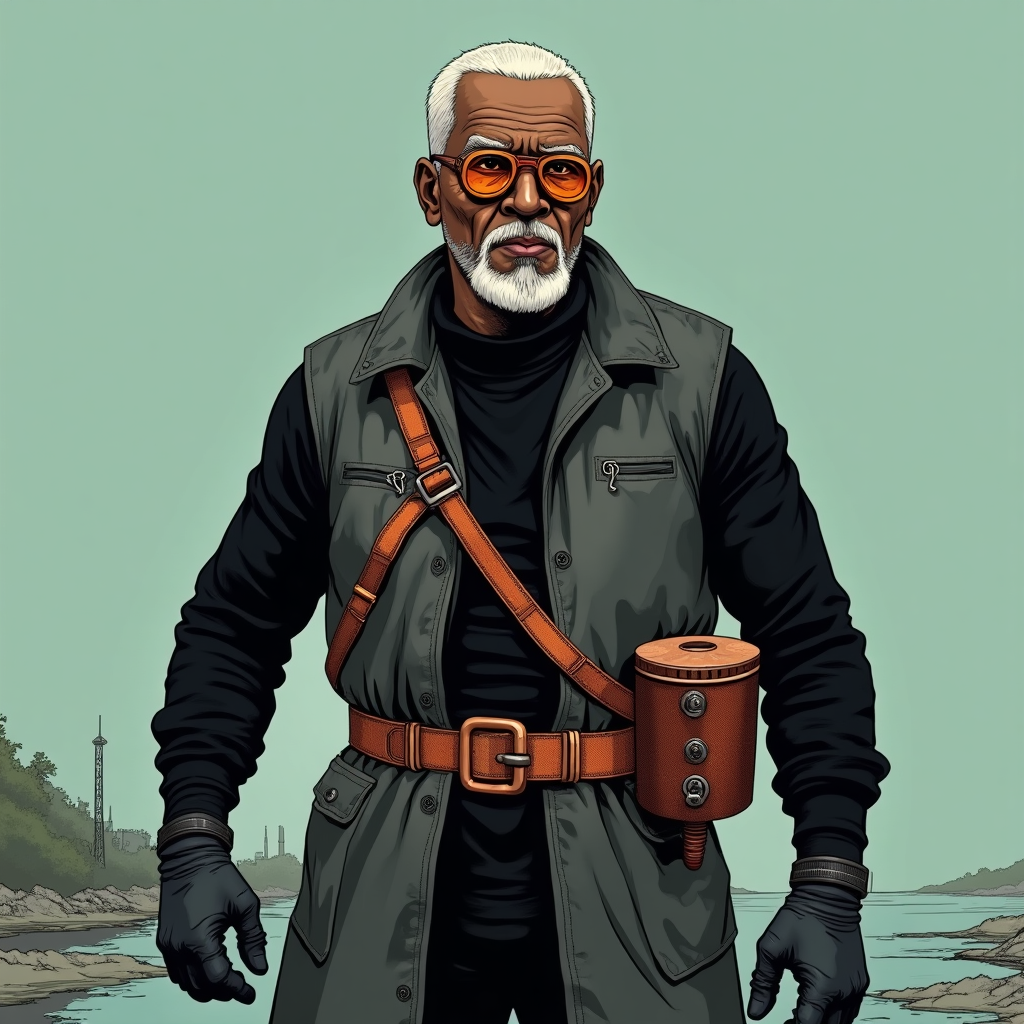
His name is Deverell Okafor, and Perth Amboy’s older residents remember him as the man who spent thirty years as the city’s chief historical archivist — a brilliant, meticulous Black nonbinary elder, now in their early seventies, with close-cropped white hair, deep brown skin carved with the specific dignity of someone who has outlived their own patience. They wear, always, a long charcoal vest over black clothes, and their hands are permanently ink-stained. They retired from the city archives five years ago under circumstances that were called a “budget restructuring” and were, in fact, a forced removal orchestrated by a new development-aligned city council that found their historical preservation work inconvenient.
Deverell Okafor did not take this graciously.
They had spent three decades documenting the colonial extraction buried beneath Perth Amboy’s streets — the Lenape dispossession at Ompoge, the copper trade, the terra cotta industry’s environmental legacy along the waterfront. They had found, in particular, references in a 1689 Scottish colonial deed to what the document called “the tidal archive” — a Lenape-made repository of concentrated waterway energy, sealed at the convergence point beneath the Ferry Slip, intended as a guardian mechanism for the land itself.
Deverell believed that artifact belonged to the community. To history. To the city.
And now, it belongs to a twenty-eight-year-old pipe technician.
Under the name the Nulltide — a name whispered in the server channels of a small, fanatical network of historical reclamation activists Deverell has cultivated across Middlesex County — they have spent the past two years developing a counter-technology: a resonance device, built from salvaged terra cotta shards recovered from the old Atlantic Terra Cotta Company site on Convery Boulevard, designed to drain and redirect tidal energy. Not to destroy. To extract. To pull the power from whoever the artifact chose, and place it in the hands of an institution — a land trust, a Lenape heritage council, a community foundation — rather than a single person the bay happened to touch.
Deverell Okafor is not wrong about the injustice. Valentina Reyes knows this. That is what makes the Nulltide so genuinely dangerous.
Part Five: Convergence at the Ferry Slip
The confrontation happens at 2 a.m. on a Wednesday, in the shadow of the Ferry Slip, while the Arthur Kill reflects the orange glow of the refineries across the water on Staten Island.
Deverell has brought the resonance device to the pilings themselves — a cylindrical assembly of fired clay and scavenged electronics, humming at that same low tidal frequency Valentina felt the night she opened the vessel. Around them, the Nulltide’s network has positioned a dozen supporters on the Ferry Slip’s upper walkway, ready to document, to witness, to claim.
Valentina arrives on the water itself, walking the surface of Raritan Bay in the way that still surprises her — a film of pressurized water millimeters thick beneath each step, the bay lifting her up like a hand it trusts.
“You know what that thing is,” Deverell says. Their voice is calm and immense, like a tide announcement. “You know it was never meant for one person.”
“I know what you’ve read about it,” Valentina says, and her voice is steadier than she feels. “I know what it felt like when it chose.”
“Things choose their colonizers too. That doesn’t make it right.”
The resonance device activates. Valentina feels it immediately — a deep systemic pull, like the bay trying to pour out of her — and she staggers. The water beneath her feet sloshes, uncertain. She drops to one knee on the surface of the harbor.
But she has spent four days learning to listen to this bay. And the bay, she realizes, is telling her something the resonance device cannot override: you are not the artifact. You are the relationship.
She does not fight the drain. She opens to it — lets the extracted energy flow outward into the bay itself, feeds it back into the water table, into the storm drains, into the tidal current moving beneath the Ferry Slip’s foundations. The resonance device spins up trying to chase it, consuming its own stored terra cotta energy in the pursuit, and then, with a sound like a wave breaking backward, it goes dark.
Deverell Okafor stands very still.
“I’m not keeping it from the community,” Valentina says, standing again, the bay flat around her ankles. “I am the community. I grew up two blocks from here. My abuela is buried in Raritan Cemetery. This city is in my chest the same way the water is.” She pauses. “But if you want to talk about the land trust — about what’s real in those documents you found — I’m here. I’ve been here my whole life.”
The supporters on the walkway are silent. The Arthur Kill moves past them all, unhurried, carrying the night toward the sea.
Deverell does not apologize. Valentina does not expect them to.
But when they leave, they leave alone, without the device — and Valentina stands at the edge of the Perth Amboy Ferry Slip as she has stood at the edge of things her whole life, watching the water, listening for the wave before the wave.
Marejada endures. The bay remembers. The city holds.