


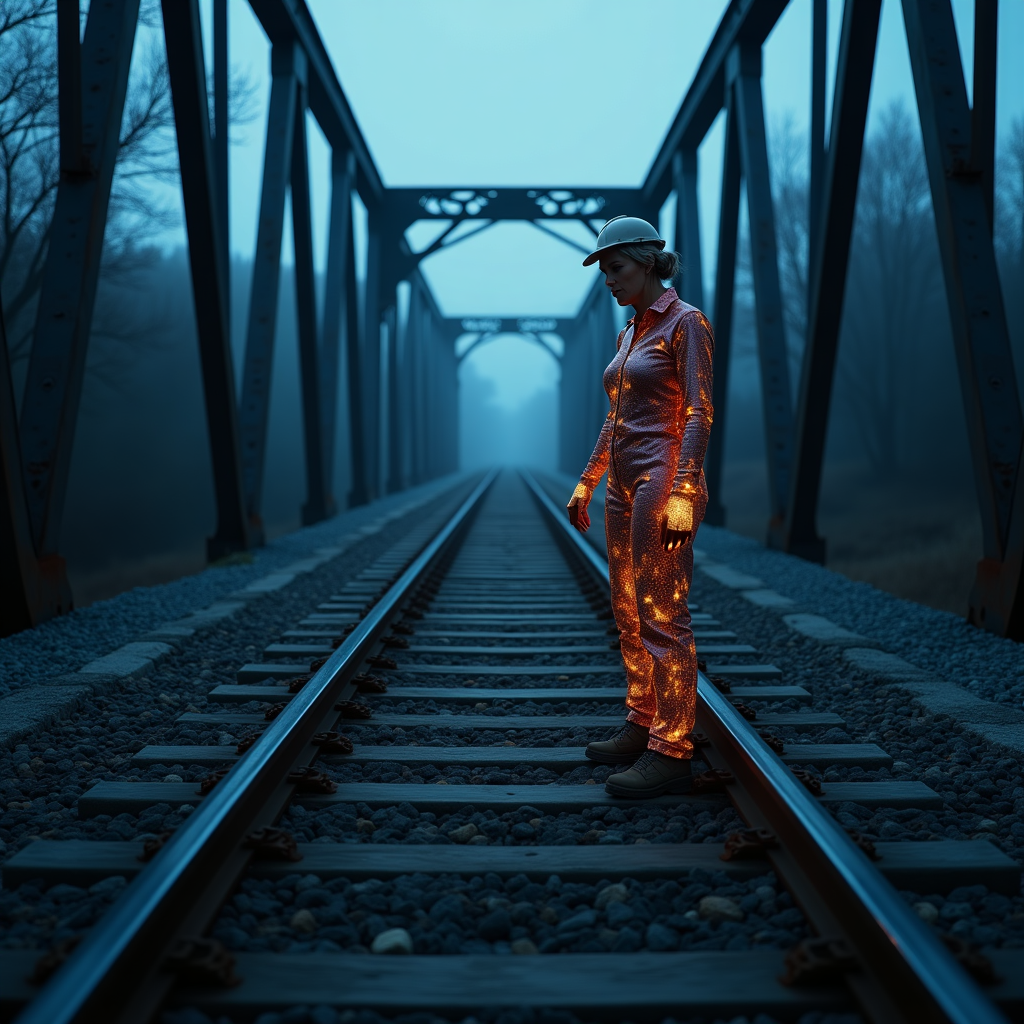
Marshveil of the Rariton Corridor
Part One: The Weight of the Rails
The NJ Transit line through Hamilton Township doesn’t announce itself. It slides through the back of the township like a seam in old cloth — past the loading docks off Klockner Road, behind the warehouse rows near Nottingham, threading the flat geography of Mercer County without ceremony or fanfare. Most residents hear it only as a low tremor in their kitchen floors, a rattling of cabinet glass, then nothing. Margaret Calloway heard it differently.
She was fifty-two years old, a track maintenance supervisor for the regional rail authority, the kind of woman who wore her seniority in the density of her silence rather than in any declaration of rank. She had worked this corridor for twenty-one years. She knew the rails the way a river knows its bed — by feel, by pressure, by the way a vibration changes when something upstream has shifted. Her crew called her “Calloway” without the prefix, not disrespectfully, but because it seemed wrong to shorten her into anything smaller. She was precise in the way that bridges are precise: not decorative, but load-bearing.
She lived alone in a double-wide just south of Yardville, close enough to the Crosswicks Creek wetlands that she could hear the red-winged blackbirds through her bedroom window in early April. She had never thought of herself as someone connected to the land in any mystical sense. She was connected to it practically — she knew where the soft ground swallowed rail ties, where frost heave buckled the ballast, where the salt from winter road treatment migrated east toward the marshy fringes and corroded the steel from beneath. It was not poetry. It was maintenance.
That changed on a Thursday evening in late March, when a freight company — later identified only in regulatory filings as operating through a subsidiary of Hargrove Industrial Holdings — ruptured a buried slurry pipe two hundred meters north of the Assunpink Creek rail crossing. The chemical runoff entered the creek quietly. By the time anyone at the township’s environmental desk noted the anomaly in the water table sensors, Margaret was already on the embankment with a track lamp and a clipboard, measuring rail deflection after an unexplained signal delay on the southbound line.
She stepped off the ballast and into the sedge to check a drainage culvert, and the ground opened.
Not violently. Not with drama. The saturated soil simply released beneath her boot, and she went down into the cold dark of it — into the contaminated soak, the chemical slurry, the iron-rich runoff from decades of rail oxidation pooling in the marsh substrate. She went under, and the marsh closed above her like a hand.
Part Two: What the Salt Teaches
She did not drown. She was not sure, afterward, that she understood why — only that something happened in the dark beneath the soil that she had no language for, not yet.
What she remembered: cold, and then warmth — not the warmth of fever but of current, as if the earth had a pulse and she had accidentally synchronized with it. The iron in the soil. The corroded spikes. The leaching rail sediment that had been dissolving into the Assunpink’s salt gradient for thirty years. The chemical contamination had destabilized something in the substrate — some electrochemical threshold that, when it collapsed, released a charge through the wet iron-rich ground with enough specificity to rewrite the interface between Margaret Calloway’s nervous system and the ferrous world around her.
She crawled out of the culvert an hour later, soaked and shaking, her work coveralls dark with silt. Her crew found her sitting on the rail tie, staring at her hands. One of her gauntlet gloves had been reduced to a fused mass of metal threads — the steel-weave palm reinforcement had migrated to her fingertips like iron filings following a magnet, and when she pressed her fingers to the rail, she felt the entire corridor light up inside her skull.
Northbound: a freight car with an undercarriage bearing failing at milepost 14. Southbound: a local commuter train, on time, sixty-one passengers, a door seal loose on car four. The bridge abutment at the Assunpink crossing: stressed, the iron rebar inside vibrating at a frequency six points outside its tolerance envelope. She knew all of it in the same breath.
She said nothing to her crew. She drove home. She sat in her kitchen and listened to the blackbirds and the distant rail and understood, slowly, that she had become a listening instrument for everything made of iron and everything soaked in salt.
Part Three: The Name the Marsh Gave Her
She tested herself carefully, the way she would test a questionable weld — incrementally, with documentation. She could feel the rail corridor for forty miles in either direction when she pressed her palm flat against the track. She could redirect scrap metal — loose spikes, fallen rebar, loose chain-link fencing — without touching it, the ferromagnetic pull responding to her focus the way her arm responded to her brain: naturally, without effort, the way breathing is natural. When she walked along the Assunpink’s marshy margins at low tide, she felt the salt gradient in her sinuses like weather — she could read ecological distress in the chemistry of the water, feel the industrial contamination as a deep-body ache, precise enough to locate the source.
She spent three weeks telling no one. Then the second breach happened.
The Hargrove subsidiary had a second slurry line — deeper, older, undisclosed in any current environmental filing. It ruptured beneath the wetland buffer east of Route 130, and the contamination reached the Raritan River tributary network within seventy-two hours. Margaret felt it the moment it breached — a scream in her chest she couldn’t trace to lungs or heart, but to the water table itself, the salt gradient spiking, the marsh ecology going into shock.
She went to the site in her work coveralls. She pulled the contamination flow short by redirecting a corroded iron culvert gate — bending it closed with a gesture that still frightened her a little, still felt borrowed from someone else’s body. She then sent a vibrational signal down the rail corridor to alert the regional emergency systems — a patterned frequency in the steel, her version of a distress call, faster than radio in a sector where the cell repeaters had been decommissioned to cut costs.
The emergency crews arrived. The breach was contained. The filing, later, attributed the intervention to “an anonymous tip via infrastructure monitoring systems.”
She drove home. She sat with the blackbirds and the iron and the salt.
She thought about the marsh. She thought about the way a veil of fog sits over the Assunpink in early morning, before the trains come, before anything moves — when the wetland is just itself, still and total and ancient.
She thought: Marshveil.
Part Four: The Weight of Greylock Runnel
His name — the name he had given himself, the one that mattered — was Greylock Runnel. He was twenty-two years old, Lenape on his father’s side, raised between Bordentown and Trenton, and he had spent the last three years building something that he called, in private, a correction.
He had grown up watching the waterways of Mercer County absorb insults that nobody filed reports about. He had watched his grandmother name the fish that no longer came. He had watched the Assunpink Creek turn colors that water should not turn. He had gone to college on an environmental science scholarship, dropped out in his second year when the research felt too slow, too mediated, too managed by institutions that were themselves managed by the people causing the harm.
His Biology & Form had come not from contamination but from intention — from a year spent living at the margins of the Hamilton wetlands, studying the rheostat of toxicity, until the toxic geology of the place had entered him the way it enters everything that stays long enough. The mercury-laced sediment. The heavy metal particulate. The historical discharge from a century of industrial occupation of land that had once been clean.
He could corrode. He could accelerate rust, dissolve iron bonds, cause structural steel to shed integrity over hours rather than decades. He could strip a rail spike to dust. He could eat through a bridge support’s rebar with sustained focus. He was not wrong about the harm that had been done. He was wrong about the solution.
Greylock Runnel wanted to bring the rail corridor down. Not as metaphor — literally. He wanted to collapse the industrial infrastructure that had colonized the wetland margins of Hamilton Township, starting with the rail embankments that had bisected the historic Assunpink flood plain since the 1850s. He had begun seeding the abutments with his corrosive output — gradual, deliberate, patient. He had calculated that by late summer, three bridge crossings would be structurally compromised enough to force a full corridor shutdown.
He was not wrong that the corridor had caused harm. He was not wrong that the harm had been unaccounted for. But a collapsed rail bridge over an active floodplain does not heal a wetland. It creates a new catastrophe — metal, concrete, contaminated ballast, released into the very water he was trying to reclaim.
Margaret had felt his work in the steel before she knew his face. A frequency of dissolution — the opposite of her own signal. Where she heard the rail corridor sing, she felt him silencing it, bar by bar.
Part Five: What Remains
They met at the Assunpink Creek crossing at four in the morning on an April Saturday, with the blackbirds quiet and the rail corridor still. He was already at the eastern abutment, his hands against the concrete, his biological form — the heavy-metal geological plating that had restructured him — bleeding its slow corrosion into the rebar beneath.
She came from the western embankment. She had sent a pulse down the rail ahead of her — not an alarm, a question. The steel had answered with his frequency.
She did not come to stop him the way authorities stop people. She came the way a maintenance supervisor comes to a structural problem: to understand the load before deciding on the repair.
“You’re dissolving the eastern pier,” she said. Not an accusation. An observation.
He turned. He was young — she registered that first, then the geological plating, the heavy-metal skin, the eyes behind it still sharp and unbroken and furious in the precise way of people who have been paying attention for too long.
“The pier is the least of it,” he said.
“The pier falls, the deck drops into the creek. Twenty tons of treated concrete and ballast. Into the Assunpink. Into everything you’re trying to protect.”
He did not speak. She felt him calculating.
She pressed her palm to the rail. She let him feel what she felt — she broadcast it through the steel, the way she had learned to speak in the months since the marsh had remade her. The ecological distress signals from the upper tributary. The Hargrove discharge sites. The real sources, mapped in chemical salinity and iron-oxidation signatures, precise as coordinates.
“I know where it’s coming from,” she said. “I can feel it. Every pipe. Every discharge point. Every buried slurry line they didn’t file for.”
A long silence. The Assunpink moved beneath them, cold and patient.
“Collapsing the corridor doesn’t reach any of those pipes,” she said. “It just adds to the load.”
He looked at her for a long time. He did not dissolve the pier. He did not agree with her either — not yet, not entirely. But he lifted his hands from the concrete.
She reshaped three rail spikes into erosion stakes with a slow gesture, drove them into the embankment margin to anchor the sedge. A small thing. A maintenance thing. The marsh kind of gesture — not grand, not final. Just persistent.
“The corrective filings go in Monday,” she said. “I have the discharge signatures. All of them. It won’t be fast.”
“It’s never fast,” he said.
“No,” said Marshveil of the Assunpink Corridor. “But the marsh has been here longer than the rail. It knows how to wait.”
She walked back along the tracks. The steel sang under the April sky — sixty-one passengers, northbound, on time — and she carried every vibration of it like a name she had finally learned to pronounce.