


Nullbloom: An Irvington Origin
Part One: The Girl Who Learned to Count Losses
Zara Voss has never believed in sentiment. She believes in structure.
She is twenty-three years old, tall and sharp-featured, with close-cropped natural hair and dark eyes that move across a room the way a surveyor’s instrument moves across a parcel — measuring, calculating, finding the margin between what exists and what could be extracted. She dresses with deliberate austerity: black structured coats, clean lines, no ornament. She carries a leather portfolio instead of a bag. She does not wear jewelry. She does not keep plants.
Her grandfather built Vantage Meridian Holdings from a single condemned block in Newark in 1974. Her father expanded it into Essex County’s most quietly aggressive development group. By the time Zara came of age, the company’s philosophy had been distilled into something so clean and compressed it no longer required explanation: land has no memory. Communities are markets. The only honest measure of a place is what it can yield.
Zara absorbed this not as cruelty but as clarity. She grew up watching her father sit across from community boards and zoning committees, listening patiently to residents describe what a neighborhood meant to them — the garden on the corner, the church with the cracked foundation, the century-old trees whose roots were lifting the sidewalk — and then explain, with genuine gentleness, that meaning does not appear on a balance sheet. That sentiment is not a legal category. That what looks like community to one person looks like inefficiency to another, and in the end, the market resolves the question without prejudice.
She thought he was right. She still does.
What she did not expect was to become something more than a believer.
She was seventeen when it first happened — standing in the shell of a derelict factory her father had just acquired on the edge of the Day-Elder neighborhood, kicking through debris, running her fingers along the rotting wooden beams. She was impatient. She wanted it gone. She pressed her palm flat against a support post and thought, very clearly: just fall —
And the wood turned beneath her hand. Darkened. Crumbled at the edges, the rot spreading from her palm outward in a slow blooming pattern, like ink dropped in water. The beam sagged. Zara pulled her hand away and stared at her palm — clean, unmarked, entirely ordinary.
She told no one. She began practicing in private.
Part Two: The Architecture of Entropy
By the time Zara graduates from her father’s conference rooms into her grandfather’s title — Vice President of Acquisitions, Vantage Meridian Holdings — she has spent six years learning the precise geography of her ability.
She can accelerate the decay of organic matter within a radius she has mapped with the same obsessive care she applies to a site survey. Wood rots. Fabric frays. Roots blacken and crumble inward, losing structural integrity in seconds, losing their grip on the soil they have held for decades. Living plants — even old ones, even trees that have survived a century of Newark winters — go grey and brittle at her touch. She cannot affect metal or concrete or glass. Only living things, or things that were once living.
She does not find this troubling. She finds it fitting.
Her philosophy has always held that the organic yields to the structural — that the tangled, inefficient growth of nature and community is simply an early stage in a longer process, and that what she does with a building site, clearing away what has overgrown and outlasted its usefulness, is not so different from what time does anyway. She simply accelerates the inevitable.
She calls herself Nullbloom in the privacy of her own mind, and then in her leather portfolio, where she has begun sketching what a costume might look like, if she ever had reason to wear one.
She thinks she understands Irvington. She has read every parcel record, every zoning variance, every failed redevelopment proposal going back to 1988. She has walked Springfield Avenue and Chancellor Avenue and the blocks around the old bus terminal, counting vacancies, noting structural failures, mapping the gap between assessed value and market potential. She has attended the township council meetings where her proposals move through on split votes, and she has sat in the back row of the ones where residents speak against her, and she has listened with careful attention to what they say.
She does not think they are wrong to love their neighborhood. She simply thinks love is not a land-use designation.
The Clinton Cemetery operation is, in her estimation, straightforward. The western boundary parcels are in tax arrears. The township’s options are limited. The historical preservation argument is sympathetic but not legally binding. She has the permits — or permits close enough to permits that the distinction will take months to litigate. She schedules the survey crew for midnight, not out of malice but out of efficiency: fewer complications, less noise.
She does not expect the ground to fight back.
Part Three: The Wrongness in the Soil
She is not at the cemetery when it happens. She reviews the incident report the next morning — two operators, one stalled backhoe, equipment wrapped in roots that the foreman insists were not there when they arrived, a cherry tree blooming in the dark in April like something from a dream. She reads the report twice. She sets it down. She picks it up again.
Zara Voss does not believe in the inexplicable. She believes in the unexamined.
She begins attending the sites. Not as a developer — she knows what the sites look like as a developer — but differently. Quietly. She stands in the Day-Elder vacant lot where a root wall appeared overnight and presses her palm to the exposed soil and feels nothing, because her ability flows outward, not inward. She cannot read the ground. But she can read what the ground did.
The root wall is deliberate. The geometry is too specific, too targeted. Something — someone — raised it to block access to a specific section of the lot. The same intelligence is present in the retaining wall repair near Irvington High School on Augusta Street: not random growth, not seasonal root expansion, but intentional structural reinforcement, placed precisely where the wall was weakest.
Someone knows this ground the way she knows a balance sheet. Someone has mapped it.
She starts attending the spaces at odd hours, hoping to overlap with whoever is doing this. She is in the community garden on Springfield Avenue one evening when she realizes she has been there for forty minutes and has not pressed her palm to a single planting bed. She is simply standing among the rows of early-spring seedlings, looking at them.
She leaves quickly. She does not examine why.
Part Four: The Name in the Archive
It takes her three weeks to find the pattern, because she is looking at property records and the answer is in the burial records.
She finds it by accident — cross-referencing a zoning dispute from 1999 that involved the cemetery’s boundary and a previous Vantage Meridian proposal her grandfather abandoned. The name in the township file, listed as the community representative who provided historical documentation that killed the proposal: C. Okafor, Head Archivist, Clinton Cemetery.
She pulls the name. She finds thirty-one years of institutional history. Cemetery archivist. Irvington lifer. A woman who has attended more township council meetings than most council members, who has submitted more public comments on development proposals than any other private citizen in Irvington’s recent record, and who — Zara notes — has not submitted a single comment in the past six weeks, despite two pending proposals that would previously have drawn her immediate response.
She stopped submitting comments around the same time the ground started fighting back.
Zara sits with this for a long time.
She does not feel triumph. She feels something more complex — a reluctant recognition, the specific discomfort of encountering a mind that has mapped the same territory from the opposite direction. Celestine Okafor has spent thirty-one years learning what the land remembers. Zara has spent the same years learning how to make it forget. They have been studying the same subject. They have reached opposite conclusions.
She opens her portfolio to the costume sketch she made six months ago and looks at it for the first time with the understanding that she will actually need it.
The confrontation is coming. Zara intends to be ready.
Part Five: The Garden on Springfield Avenue
She arrives at the community garden before Celestine does, which is deliberate. She wants to be standing in it when the archivist arrives — wants the older woman to see her here, in this space, and understand immediately that Zara has read her, mapped her, followed the evidence of her power back to its source. She wants to begin from a position of complete information.
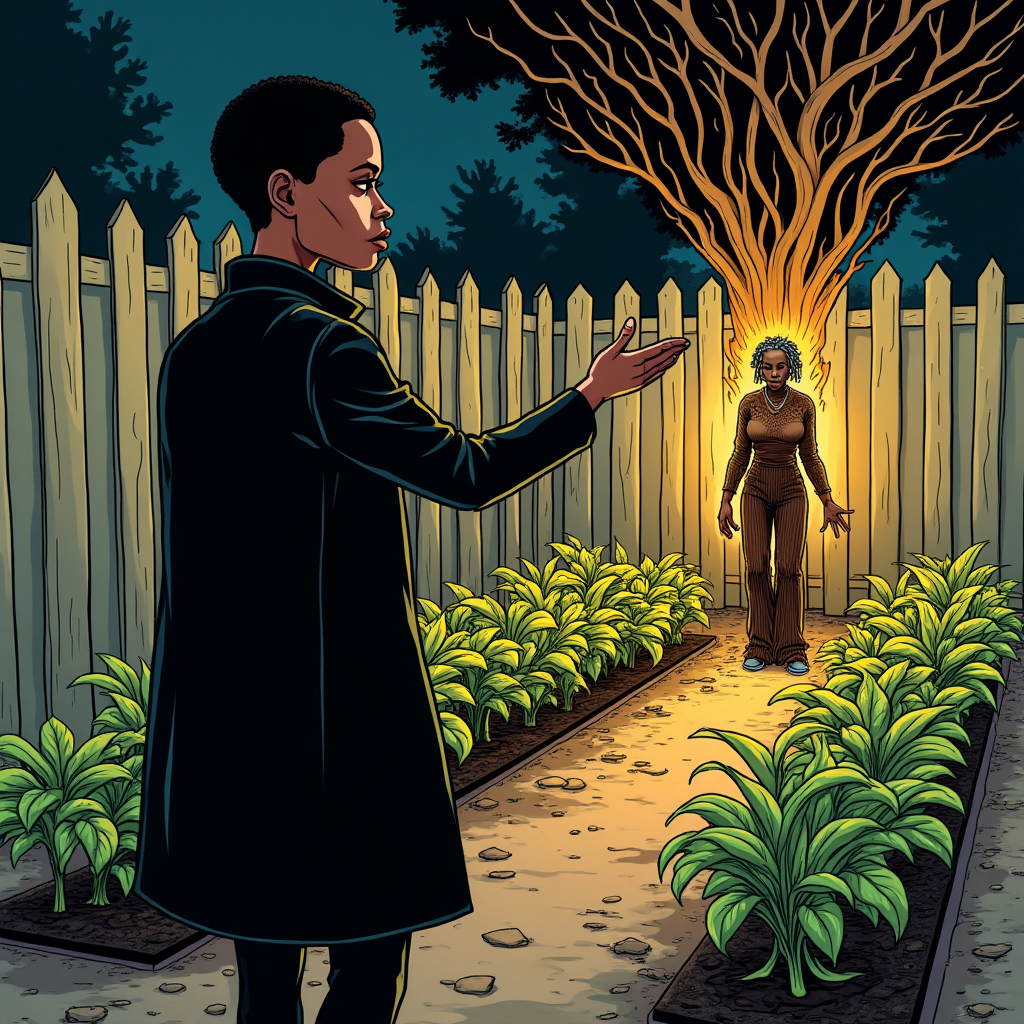
She is standing among the seedling rows when Celestine comes through the gate, and for a moment the two women simply look at each other across the planted beds, and Zara sees something she did not expect: the archivist does not look afraid. She looks, if anything, like a woman who has been expecting this.
You’re the one doing all this, Zara says.
This garden has been here since before you were born, Celestine answers.
Zara tilts her head. She understands the rhetorical move — the appeal to duration, to persistence, to the moral weight of things that have lasted. She has heard it in council chambers for years. She has never found it persuasive, and she finds it less persuasive now, standing in soil that she can feel — faintly, through the soles of her shoes — humming with something warm and structural and alive.
And that’s supposed to matter? she says, and raises her hand.
She sends it through the soil in the way she has practiced — a directed pulse, not a flood, targeting the root network beneath the nearest beds. She feels the organic matter respond immediately: the shallow roots of the seedlings darkening, the old wooden fence posts along the garden’s edge going grey and soft, the rot spreading from each post in that familiar slow-bloom pattern she has known since she was seventeen, standing in a derelict factory wondering what she was becoming.
And then the ground pushes back.
She feels it before she sees it — a warmth rising through the clay in the spaces between her decay, the root network below flaring with something that is not simply growth but intention, a luminous web of connection visible for a moment through the cracked soil, gold against dark earth, surging against her entropy the way a tide surges against erosion. The garden resists her. Worse: the garden responds to her, adapting, routing around the decay she has opened, finding new channels, closing the gaps.
She has never encountered a power that adapted.
The single ornamental cherry tree at the garden’s corner erupts into full blossom, petals filling the air in thick drifting waves, and she recognizes the sedative pollen half a second too late — she covers her face, pulls back, retreats to the concrete steps of the bus terminal where the soil cannot reach her. The pollen blurs her edges but does not take her down. She is too controlled for that. She breathes through her sleeve and watches Celestine rise slowly from the ground with petals in her locs and warm gold light fading from her palms.
You can’t stop what’s coming, Zara says, and hears the thinness in her own voice and does not like it.
I’ve been reading Irvington’s dead for thirty-one years, the archivist says. I know how long things can last when someone tends them.
Zara leaves before the survey crew arrives. She walks back to her car on Springfield Avenue and sits in it for a long time without starting the engine.
The filing is still active. The proposal is still moving through the township council. She has not lost anything she cannot recover. This is what she tells herself, and she is not wrong — the legal architecture she has built around this project is solid, and one night’s setback in a community garden does not change the mathematics.
But she keeps thinking about the way the root network adapted. The way it routed around her. The way Celestine Okafor pressed her palms to the earth of a garden she did not plant and treated it like something she was responsible for.
Zara has spent her entire life believing that nothing is too old to be cleared. She has built a career on the conviction that memory is not an argument.
She is twenty-three years old, and for the first time, she is not entirely certain she is right. She is not certain enough to stop. But the uncertainty is there, small and persistent, like a root finding a crack in concrete, pressing quietly into the dark.
She starts the engine. She drives back toward Newark. The cherry blossoms drift across Springfield Avenue behind her, pink and unhurried, outlasting everything.
The fight is not over. It never is, in a place where the land has memory. Nullbloom will return — with better legal cover, sharper tactics, a decay directed not at gardens but at the institutional frameworks that protect them. She is patient. She is methodical. She has always played a longer game than anyone expects.
But the ground remembers. And so does the woman who tends it.