Nullshard of the Palisades
Part One: The City He Made and the City He Bought
Farouq Nassim arrived in Jersey City in 1987 carrying two things: a leather satchel containing property law textbooks annotated in three languages, and the particular cold clarity of a man who has watched an entire civilization fail around him and drawn the correct conclusions.
He does not name the city he came from. He has not named it in thirty-nine years. The name belongs to rubble now, to a skyline reshaped by the indifference of governments and the mathematics of geopolitical expedience, and Farouq Nassim has no patience for monuments to failure. He came to Jersey City because Jersey City is what cities actually are when you strip the mythology away: infrastructure, drainage, zoning variance, debt load, deferred maintenance, and the extraordinary human willingness to believe that the thing falling apart around you is actually holding together.
He was thirty-three years old. He had a degree in civil engineering from a university in Beirut that no longer exists in the form he attended it, and a second degree in municipal finance from Rutgers that he completed in eighteen months while living in a studio apartment on Palisade Avenue with a view of the Hudson that was obscured by a condemned warehouse he would later acquire, demolish, and sell at four hundred percent return. He was methodical. He was patient. He was, in the particular way of men who have survived genuine catastrophe, entirely unfrightened by the idea of things getting worse before they got better.
His theory of value was simple and correct: cities do not fail suddenly. They fail in increments, each increment invisible to the people living inside the system because human beings are constitutionally optimistic about the built environment. A pipe corrodes for twenty years before it bursts. A load-bearing wall develops a hairline fracture that no one funds the inspection to find. A hospital loses its operating margin over a decade of billing policy changes and deferred capital expenditure, and then one Tuesday it is simply closed, its Palisade Avenue facade staring blankly at the river, its parking structure full of pigeons and the memory of emergencies.
In Hudson County, where the development pressure from Manhattan spillover runs against infrastructure that was adequate in 1955, this theory has made Farouq Nassim extraordinarily wealthy. His holding company — registered under four layers of shell entities, the outermost of which is called Meridian Civic Partners — owns seventeen parcels across the South Ward, the Greenville waterfront, and the old industrial stretch of the Hackensack corridor. He has spent thirty-nine years being the patient presence in the room when the public meeting ends and the cameras leave and the council member needs to make a decision about what to do with the thing that is already, quietly, failing.
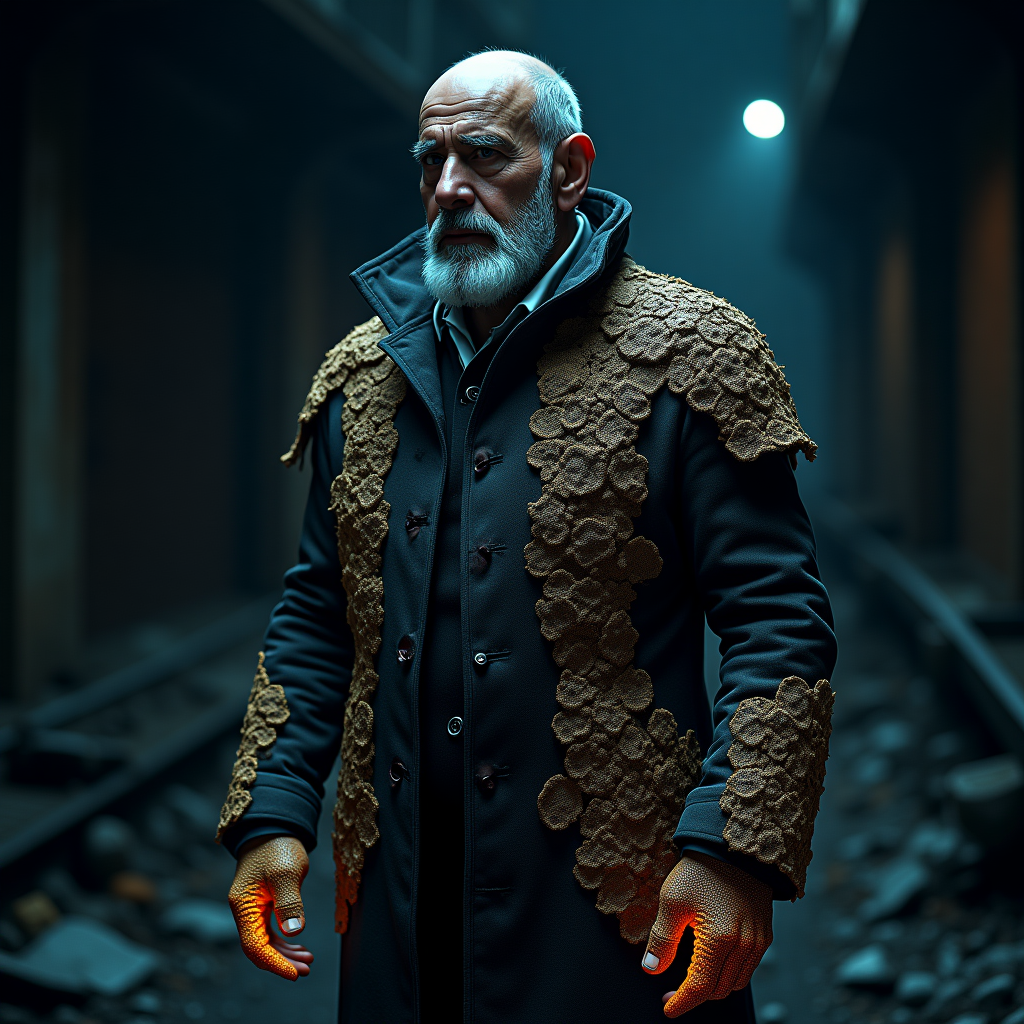
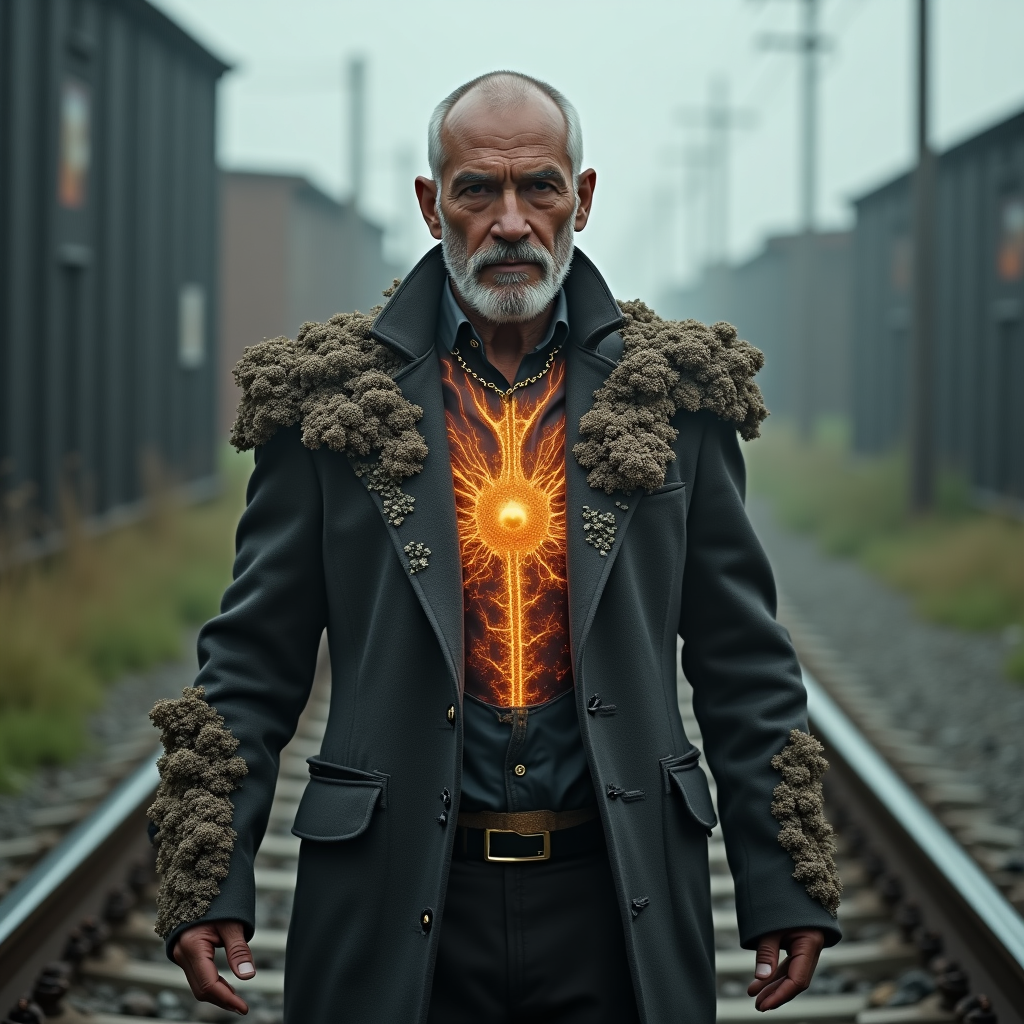
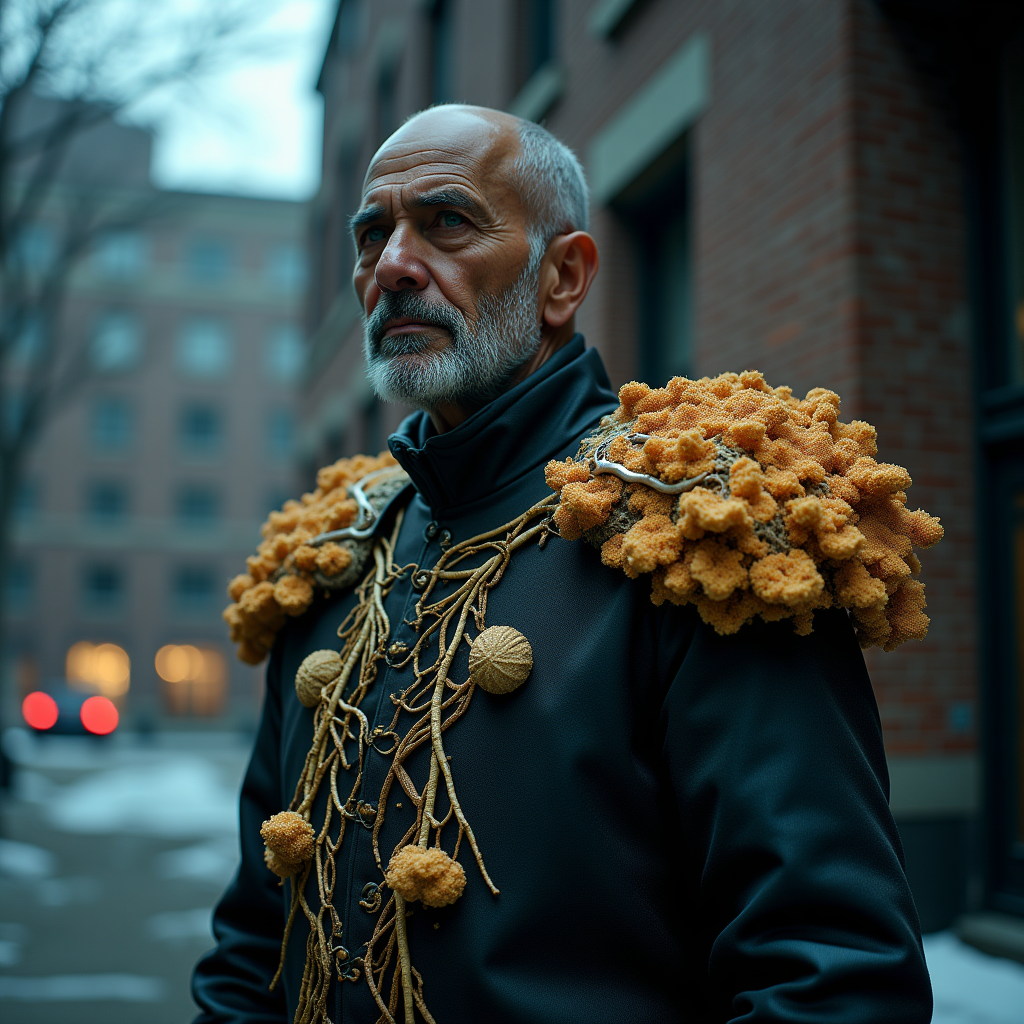
He is seventy-one now, lean and deliberate, white beard cropped close to a sharp jaw, deep-set eyes that hold the particular quality of attention that belongs to men who learned early that the world is not arranged for their comfort. He dresses in charcoal and black. Fine wool. No ostentation. The wardrobe of a man who made all the decisions worth making long ago and has been watching them mature ever since.
He stands at his office window on the thirty-eighth floor of a building he owns in Exchange Place and looks across Newark Bay at the infrastructure of the port — the PortNewark cranes, the container stacks, the intermodal rail spurs, the Hackensack corridor running brown and industrial south toward Kearny — and he sees it not as a city but as a system, and he sees the system with the engineer’s eye: every point of stress, every deferred repair, every culvert undersized for the surge loads that climate change is now delivering to a city built eighteen inches above sea level on top of a marshland.
He sees the whole geometry of it, and for thirty-nine years he has been arranging himself at every pressure point with the patience of water finding the lowest level.
This is the city he made. This is the city he intends to remake.
Part Two: The Compound Beneath Tonnelle
The synthesis took eleven years.
It was not, in the beginning, a weapon. Farouq Nassim is an engineer, not a fantasist. What he funded — through a university endowment that supports a private materials science laboratory in a converted industrial building near the freight corridor — was a research program into environmental signal mapping: a compound that, when introduced into the groundwater of a geologically complex urban site, would bind selectively to the soil’s existing chemical profile and produce a traceable molecular signature. A fingerprint. A way of reading the subsurface of a city the way a geologist reads a core sample — not from above, but from within.
The compound was elegant. It was also, under certain conditions of exposure concentration and individual biochemistry, transformative in ways the research documents classify as unintended and anomalous.
The derailment near 2501 Tonnelle Avenue was not entirely an accident. The freight car in question carried a legal industrial solvent — Farouq’s holding company does not traffic in illegal materials, only in legal ones deployed with strategic precision — but the secondary drainage channel that the spill entered had been pre-seeded, three months earlier, with the compound. The compound and the solvent interacted in the drainage medium the way the laboratory models predicted. The plume moved south through the intermodal rail corridor and into the Hackensack River’s industrial bank exactly as the simulations indicated.
What the simulations did not predict was Marcus Delaine.
Farouq had planned for the compound to transform one subject: himself. He had been managing his own low-level exposure for four years, titrating the dosage through contaminated groundwater samples he consumed in precise amounts with the methodical self-discipline of a man who has decided that the only way to change the terms of the game is to change the nature of the players. He had calculated that the full-exposure event — the Tonnelle seeding, the plume, the deliberate deep-contact dose — would complete a process he had already begun.
He was right. It did complete the process. What it also did was complete the same process, accidentally and irreversibly, in a retired stormwater engineer who waded into the drainage channel before the emergency teams arrived.
Farouq reads the emergency response reports with the same attention he gives to title searches and variance applications. The report on the Hackensack waterfront incident — subject Marcus Delaine, age 64, retired infrastructure engineer, found at the drainage channel before first responders, no apparent injury, claimed no memory of 4-minute interval — goes into a folder he labels Containment.
He understands immediately what has happened. He understands it with the cold clarity of a man who has spent his life identifying pressure points. He has produced, without intending to, a counterforce.
He has been in the city long enough to know what that means. It means the timeline accelerates.
Part Three: The Gift of Cancellation
What the compound gave Farouq Nassim is a vocabulary for what he has always done by intuition.
He calls himself Nullshard of the Palisades. The name is not theatrical. It is architectural. A nullshard is what an engineer calls the zone of perfect destructive interference — the point in a resonant system where two waves meet in precise opposition and cancel each other into silence. The Palisades, the ancient volcanic traprock ridge visible across the Hudson from any point on the Jersey City waterfront, are the geological spine of the region: 200-million-year-old diabase, intruded into the sedimentary substrate during the Triassic rifting of Pangaea, standing now as a wall of dark columnar stone above the river. They are, in Farouq’s private cosmology, the only honest thing in the landscape — stone that has not been rezoned, has not been sold, has not been incrementally condemned and quietly acquired. Stone that simply is.
His power, fully realized after the Tonnelle exposure, is destructive interference at a systemic scale. He cancels the propagation of energy through physical media: sound waves, seismic vibration, electromagnetic radiation. He can silence a building’s structural resonance until its own dead load cracks the foundation. He can cancel the load-bearing harmonics of a tunnel arch until the geometry fails. He can flatten an electrical grid to dead silence across a quarter-mile radius, every frequency of transmission absorbed into the null field that moves with him like a shadow.
But it is not only negation. What the compound also gave him — and this is the part that the chemistry did not predict and that Farouq has spent four months learning to trust — is the complete apparatus of environmental sensing that was always implicit in the compound’s design purpose.
He tracks chemical plumes with molecular precision. Walking the industrial corridor between the Hackensack River and Newark Bay, he reads the air the way he once read balance sheets: every volatile compound in the atmospheric column distinct and quantified, each one’s origin point triangulated by concentration gradient. The Tonnelle derailment’s unknown substance is still seeping through the soil, its plume threading south through the intermodal corridor with the slow inevitability of water finding its level, and Farouq can track it to the centimeter — not by smell, not by instrumentation, but by the direct molecular recognition that the compound has wired into his sensory nervous system.
Through the fungal networks beneath Jersey City’s fragmented green spaces — the pocket parks in the South Ward, the vacant lots along the old freight spur, the thin green margins of the Hackensack bank — he senses, through the mycelium threading like a secret nervous system under the concrete, the biological state of the city at the root level. The soil remembers what the pavement has tried to suppress: industrial spill sites from the 1940s, buried chemical deposits beneath the old railyard, the slow biological panic of a city whose green infrastructure is inadequate to the contamination load it carries. The mycelium maps it all, and Farouq reads the map.
At night, he projects ultraviolet and infrared beams across the industrial waterfront. In those frequencies, invisible to anyone else, the phosphorescent traces of every pollutant bloom in spectacular toxic florescence — cadmium in the storm drains, chromium in the soil column, benzene in the drainage channels — a map of invisible injury written in light only he can read. He walks the Hackensack corridor after dark sometimes and watches the whole contaminated landscape light up in frequencies of harm, and he thinks: This is what they built. This is what they permitted. This is what they let happen to people who never asked to live downwind of every hazard zone.
He is not wrong. This is the part that is not wrong.
Part Four: The Architecture of Erasure
What Farouq Nassim wants is legible and coherent and, in its own terms, internally consistent. This is what makes him dangerous in a way that mere cruelty never could.
He has spent thirty-nine years watching Jersey City — one of the most ethnically diverse cities in the United States, a place where more than forty languages are spoken in more than half its homes, where 42.5% of residents were born somewhere other than here — absorb the full environmental cost of its geography. The industrial corridor between the Hackensack and Newark Bay does not run through the luxury waterfront towers at Exchange Place. It runs through the South Ward. Through Greenville. Through the neighborhoods where the longshoremen’s families settled, where the immigrants from the Philippines and Bangladesh and Honduras and Haiti and Senegal and Egypt built their lives in the spaces the market left behind. The chemical plumes, the contaminated drainage, the toxin maps that bloom in ultraviolet when Farouq walks the waterfront at night — he did not put those there. The port put those there. The railroads put those there. The zoning decisions of 1952 put those there.
His plan is catastrophic and sincere. If the city’s infrastructure fails completely — if the PATH corridor cracks, if the port seizes, if the stormwater network collapses under a surge load the undersized drain collars cannot handle — the land becomes worthless to everyone except the one entity with the capital and the political connections to rebuild it. The same entity that has spent thirty-nine years positioning itself at every pressure point. Him.
What he intends to build in place of Jersey City’s dense, contaminated, magnificent, irreplaceable human mess is something clean, gated, remapped, and profitable. The contaminated soil remediated — yes, genuinely remediated, because he is an engineer and he believes in solving problems — but remediated in preparation for development that will not include the people who currently live on top of the contamination. That is not a bug in the plan. It is the plan.
He has thought about Marcus Delaine for four months. He has read thirty-eight years of infrastructure reports filed by a man who saw every failing drain collar and undersized culvert and deferred capital expenditure and wrote it down faithfully and watched, report after report, as the city chose to defer the cost of its own survival.
He understands Marcus Delaine completely. He has contempt for him in the specific way you have contempt for someone who diagnosed the disease correctly and then accepted palliative care as the outcome.
The chemical compound was supposed to produce only Farouq. The Tonnelle seeding was supposed to be a controlled event with one subject. That Marcus Delaine waded into the drainage channel at 5:47 in the morning and received the full exposure is, in the engineering sense, a failure mode. A pressure point Farouq did not model.
He approaches it the way he approaches every pressure point. He does not panic. He calculates the timeline and moves it forward.
Part Five: The Geometry of Silence
Farouq Nassim walks the Hackensack industrial corridor in the first hour of a nor’easter that is pushing six-foot surge through the Upper New York Bay, and everything around him goes quiet.
Not quiet the way a storm goes quiet in the eye. Quiet the way an equation goes quiet when all the variables cancel. Emergency radio signals flatten to static in a two-hundred-meter radius around him. The floodwater warning sirens along the corridor dim and die. The sound of the rain itself seems to thin, each drop’s kinetic energy absorbed into the null field he trails like a shadow. He moves with the unhurried precision of a man executing a calculation he has been refining for years.
He is heading for the geological weak point beneath the old freight spur. He has mapped it through weeks of mycelium reading, through root network sensing, through ultraviolet surveys of the fault line at night that showed him the precise stress geometry of the bedrock beneath the PATH corridor. A sustained destructive pulse aimed at that location — not dramatic, not explosive, purely surgical, the way a tuning fork silences a bell — would propagate a crack through three miles of underground infrastructure and collapse the oldest section of the stormwater network in a single catastrophic event. Seven South Ward blocks, underwater to the second story inside four hours.
He tracks the chemical signature of the Tonnelle compound through the soil as he walks, the plume a molecular fingerprint in the air as distinct as a name. Through the mycelium threading under the thin strip of Hackensack bank parkland, he reads the biological state of the corridor: earthworms in biological distress, root systems reading elevated heavy metal concentration, the slow underground testimony of everything the industrial century deposited here and called an externality.
He projects a sweep of ultraviolet across the waterfront as he walks, habit now, and the whole landscape blooms in toxic fluorescence — cadmium, chromium, benzene, the spectral signature of a century of commerce — and he walks through it like a man walking through a garden only he can see, reading the names of every injury in frequencies of light.
Marcus Delaine is already at the freight spur.
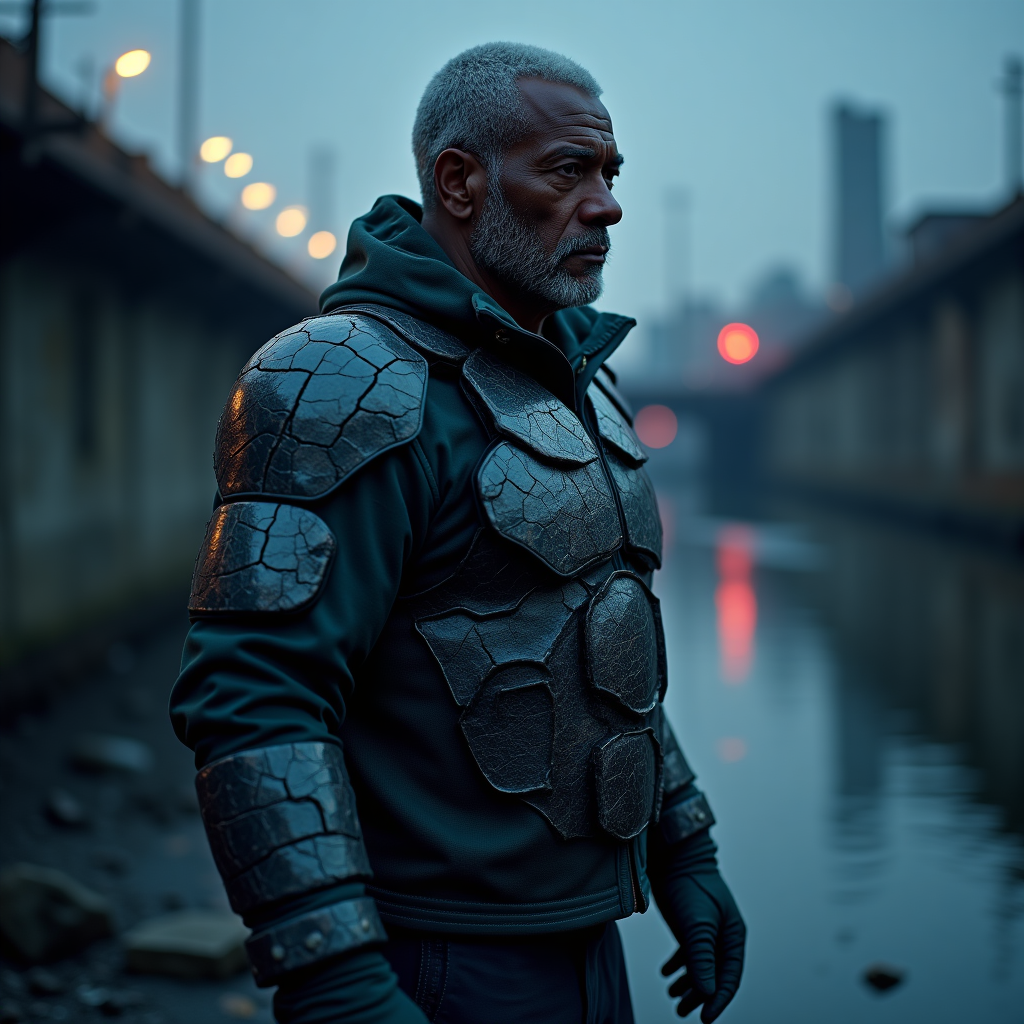
The Tidemark stands at the edge of the drainage channel in the driving rain, his form restructured by the geological force of the Hackensack exposure — basalt plates fused over the shoulders of what was a municipal work jacket, volcanic rock layered across his chest and arms in dense segmented armor, deep fissures across the stone surface of his face glowing a cold harbor-blue. He is sixty-four years old and broad-shouldered and entirely still, and the water is holding behind him the way water holds behind a seawall that was built by someone who understood the load.
Farouq stops twenty meters away. He reads the air between them — the compound’s molecular signature is identical in both of them, the same biochemical fingerprint, the same transformation completed by different exposure vectors. He finds this, genuinely, interesting.
You filed four reports about this culvert, Farouq says. His voice is flat and precise. 2019, 2020, 2021, 2023. All four were deprioritized in the capital budget cycle. I have copies.
So do I, Marcus says.
Then you understand that the system that produced the deprioritization is not going to correct itself.
I understand, Marcus says, that the man who poisoned the freight corridor to manufacture a crisis he could profit from does not get to call himself the solution.
Farouq raises both hands. The null field expands — the rain cancels in a sphere around him, every drop’s energy erased mid-descent, the storm itself falling silent in a perfect geometric radius. He begins the pulse sequence — low frequency, precisely targeted at the geological weak point, the destructive interference propagating downward through the bedrock toward the PATH corridor’s foundation.
Marcus sends the counter-pulse first. A deep seismic push into the fault line, stress released in six incremental bursts that scatter east into the bay substrate, the same technique he has been refining for weeks, the engineer’s patience applied to the body of the earth itself.
The ground trembles for 1.3 seconds. Settles. The PATH corridor holds.
Nullshard recalibrates. His power is surgical — it requires precise targeting, a clean signal environment, the ability to read the resonant frequency of the system he intends to cancel. What Marcus does next destroys that environment completely: he opens the full spectrum across the bay, every wavelength polarized and redirected into the corridor, flooding the industrial waterfront with clarified light — ultraviolet blooming through the toxin maps in brilliant florescence, infrared painting the heat signatures of the drainage system in orange and gold, visible light burning the industrial haze away until the Palisades stand dark and clean above the river and the crane lights of Port Jersey throw hard shadows through the rain.
In that light — in the full catastrophic complexity of the signal environment Marcus has flooded the corridor with — Farouq’s null field loses its calibration. Too many frequencies. Too much signal. The destructive interference requires a clean target; what he has now is noise.
He stands in the storm and the light and feels, for the first time in thirty-nine years, the specific texture of a calculation that has not gone according to the model.
He retreats into the industrial dark, measuring his steps, his power intact, his timeline deferred but not discarded. He is a patient man. He has always been a patient man. The city is still failing. The drain collars are still undersized. The Tonnelle compound is still seeping south through the soil, its plume threading toward the Hackensack with the slow inevitability of water finding its level.
He will be at the next pressure point before Marcus Delaine knows where to look.
He pulls his coat against the nor’easter and walks north toward the Palisades, and around him the storm reasserts itself, the sound and fury of it returning in a wave as the null field contracts, and the rain falls on Jersey City the way it has always fallen — without asking permission, without checking the zoning map, finding the lowest point and settling there, patient and indifferent as time.
He is still the most patient thing in the landscape. That has not changed.
That will not change.