
Nulltide: Origin of the Archivist’s Reckoning
Part One: The Weight of Ink and Iron
There is a particular silence that settles over an archive at closing time — the hush of ten thousand documents holding their breath, waiting for the one person who still cares enough to listen. For thirty years, that person was Deverell Okafor.
They came to the Perth Amboy City Hall archives as a young archivist in their early forties, drawn by a three-line entry in a Rutgers library catalog: “Colonial deed records, Perth Amboy, 1683–1720, partially untranslated.” Partially untranslated. As if someone had started a conversation and simply walked away. Deverell did not walk away from things. It was, their former colleagues would say with equal parts admiration and exhaustion, their defining characteristic.
Perth Amboy City Hall stands on Market Square, a brick-and-stone anchor of civic authority that has watched the city change around it for centuries. Deverell knew every room of it, every drawer, every acid-free box in the sub-basement that smelled of iron gall ink and slow time. They catalogued land disputes and ferry manifests and the colonial correspondence of Scottish proprietors who named streets after their distant estates — Dundee, Kearny, Stratford — as if language were a form of conquest that arrived before the soldiers. They digitized birth records and death records and the administrative minutes of a city that had been, briefly and improbably, the capital of a province, before history moved on and forgot to leave a forwarding address.
They were good at this work. More than good. They were the kind of archivist who found the thing nobody knew to look for, who traced the thread of a single document through four centuries of misfiling and water damage until it revealed something that changed how a city understood itself.
In their fifty-first year, they found the 1689 deed.
It was a Scottish colonial land transfer, water-damaged at the margins, written in a crabbed clerk’s hand that mixed English legal boilerplate with passages of Scots Gaelic that had no business being in a property document. Deverell spent three months on those passages. The translation, when it finally came, referred to an tha tobar mara — the tidal well — and described it as something the colonial grantors did not create, but had agreed, in a private compact with persons unnamed, to leave undisturbed beneath “the ancient convergence point at Ompoge.”
Deverell pulled every Lenape oral history record in the county archives. They contacted researchers at the Reeves-Wyndham Institute for Indigenous Land Studies in New Brunswick. They built a theory, slowly and rigorously, the way a good archivist builds everything: from evidence outward.
The Lenape had created it. A vessel of concentrated waterway energy, a guardian mechanism sealed at the precise convergence of Raritan Bay and the tidal estuary, beneath what would become the Perth Amboy Ferry Slip. Not a weapon. Not a gift for any individual. A communal trust — a living archive of the water itself, meant to be held by the land and the people together.
Deverell wrote a thirty-page report. They submitted it to the city council. They proposed a formal historical designation, a Lenape heritage consultation process, a community land trust with custodial authority over the Ferry Slip site and the artifact they believed lay beneath it.
The council tabled the report. Then the budget restructuring happened.
Part Two: The Removal
The new city council came in on a wave of development money — Hargrove Development Group’s waterfront redevelopment proposal had turned local politics inside out, and the council members who survived the last election cycle were, by and large, the ones who had stopped asking inconvenient questions about what lay beneath the Ferry Slip’s foundations. Deverell had been asking those questions publicly, loudly, and with documentary precision, for four years.
The budget restructuring was announced on a Tuesday in March. By Friday, the archives department had been reduced to a single part-time position. Deverell Okafor, thirty years of institutional knowledge and the only person alive who had read every document in that sub-basement, was offered a severance package and a handshake.
They took the severance. They did not take the handshake.
They carried out what they were legally entitled to carry out: personal research notes, reference copies they had made over the years, and one particular folder — the 1689 deed, their translations, and everything they had built around it — that had never been formally catalogued because Deverell, with the archivist’s instinct for self-preservation, had always kept it one step ahead of bureaucratic obsolescence.
In the five years since, the world had not improved. Hargrove’s waterfront development had broken ground. Three blocks of Smith Street had been rezoned. The Ferry Slip sat in a kind of administrative limbo — historic enough to prevent demolition, neglected enough to prevent preservation — while the people who had grown up in its shadow watched from apartments that cost more each year than the year before.
Deverell watched from their house on Rector Street, a narrow Victorian with a front room that had become, gradually and inevitably, a second archive. They did not stop working. They started working differently.
Part Three: The Resonance
The terra cotta shards came from the old Atlantic Terra Cotta Company site on Convery Boulevard, which anyone with sharp eyes and low expectations could access through a gap in a chain-link fence that Hargrove Development Group had been meaning to repair for eighteen months. The site had shipped decorative architectural clay across the eastern seaboard for decades — gargoyles, friezes, the ornamental bones of a hundred Gilded Age buildings — and what it had left behind in the ground was a layer of fired clay fragments, glazed in the particular red-orange that Deverell recognized from the deed’s description of the convergence point.
They were not an engineer. They were not a physicist. What they were was a person who had spent thirty years learning how information moves through materials — how a document encodes not just content but the pressure of the hand that wrote it, the urgency of the moment, the chemical signature of the ink. Clay, fired at the right temperature, was just another recording medium.
The network helped. Deverell had found them slowly, in the comment threads of local history forums and the back rooms of county preservation board meetings: a former environmental engineer from South Amboy who had lost her job when Hargrove’s consultants recharacterized her water contamination report; a retired dockworker from the Arthur Kill piers who had watched the waterfront transform into something that no longer included him; a young Lenape cultural liaison from the Reeves-Wyndham Institute who had read Deverell’s suppressed report and wept with recognition. A dozen people, maybe more, scattered across Middlesex County, who understood that history is not neutral and that the people who control the archive control the story.
They called themselves the Reclamation Cohort. They were not violent. They were, in the main, profoundly tired. But they believed, as Deverell believed, that what lay beneath the Ferry Slip belonged to all of them, and that the moment it was activated — if it was ever activated — the choice of who held that power should not be left to accident.
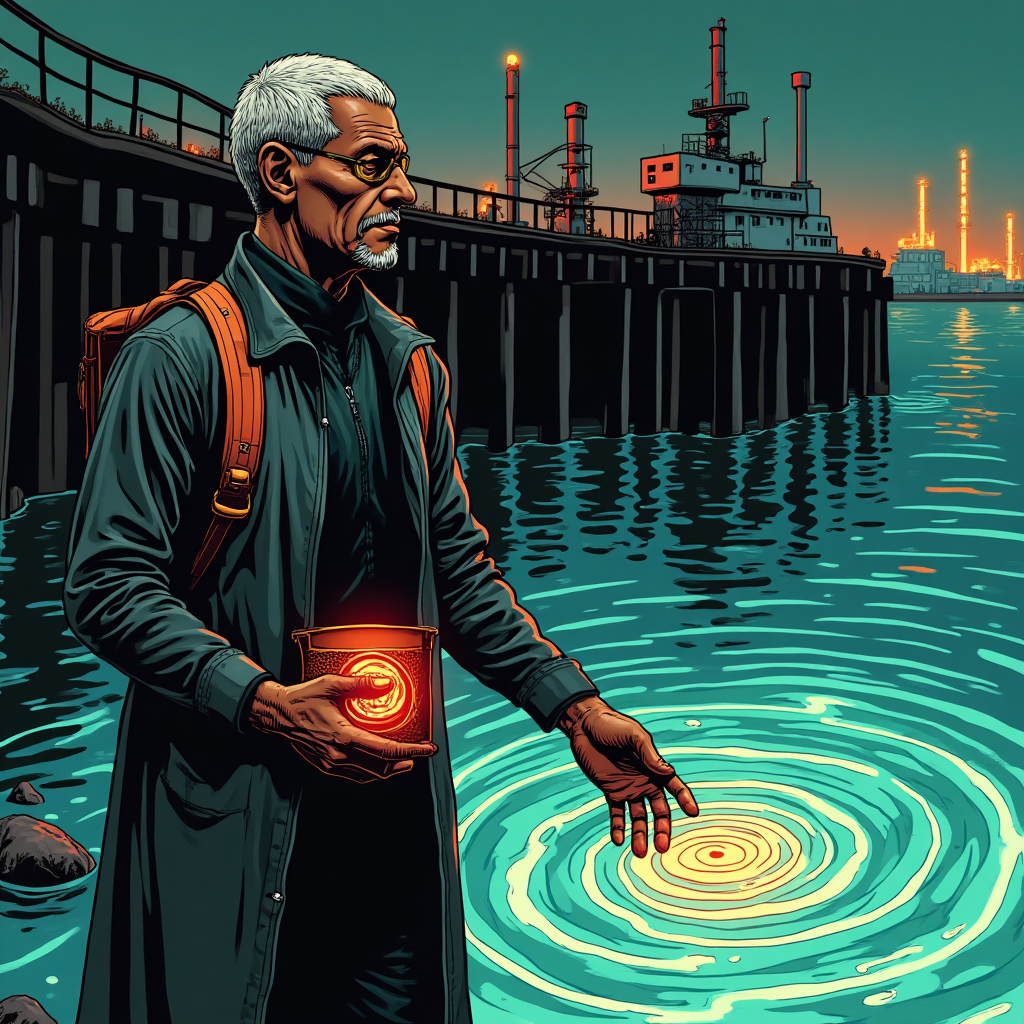
The resonance device took fourteen months to build. It was cylindrical, thirty centimeters long, assembled from terra cotta shards bound in a copper mesh armature and driven by a salvaged sonar transducer tuned to the precise tidal frequency Deverell had extrapolated from the deed’s Gaelic passages and three decades of Raritan Bay tide charts. The theory was this: the artifact’s energy was not fixed in a single vessel. It was a field, a relationship between the water and whatever receiver it had found. The resonance device could interrupt that relationship — draw the energy out, distribute it through the bay’s own tidal system, make it available to a formal custodial institution rather than a single chosen individual.
Deverell had never intended to use it on a person. They had imagined the artifact still sealed, still waiting. They had planned a ceremony. A consultation. A proper transfer.
Then Valentina Reyes opened the vessel and everything changed.
Part Four: The Name in the Water
They felt it before they knew what it was — a shift in the tidal data feed that the former engineer from South Amboy monitored through a sensor array she had installed, without authorization, along the Ferry Slip pilings. A massive discharge of kinetic energy, tidal frequency, centered beneath the slip, dissipating outward through the bay in a perfect circle. The data was unmistakable. Someone had opened the archive.
Deverell sat with this information for three days. They were not angry. Anger was a young person’s response to injustice. What they felt was something older and colder: the specific grief of watching a thing you have spent your life protecting be taken by someone who didn’t know it was yours to protect. Who didn’t know it was anyone’s. Who simply reached out and touched it because it was there.
They did not blame Valentina Reyes specifically. They had looked her up in the city records. Marine technician, Middlesex County Waterway Authority. Born in Perth Amboy, raised on Catalpa Avenue, documented in the City Hall volunteer logs as a teenager. A woman of the city, genuinely. That was not the point. The point was that the artifact had chosen by accident — by proximity, by the blind indifference of a power that did not consult the people it was supposed to protect.
The point was that Deverell Okafor had spent thirty years learning that story, and it had still happened without them.
They took the name from the tide charts — specifically from the notation for a null tide, the rare moment when tidal forces cancel each other out and the water stands perfectly, eerily still. A moment of negation. Of withdrawal. They were not interested in surge. They were interested in correction.
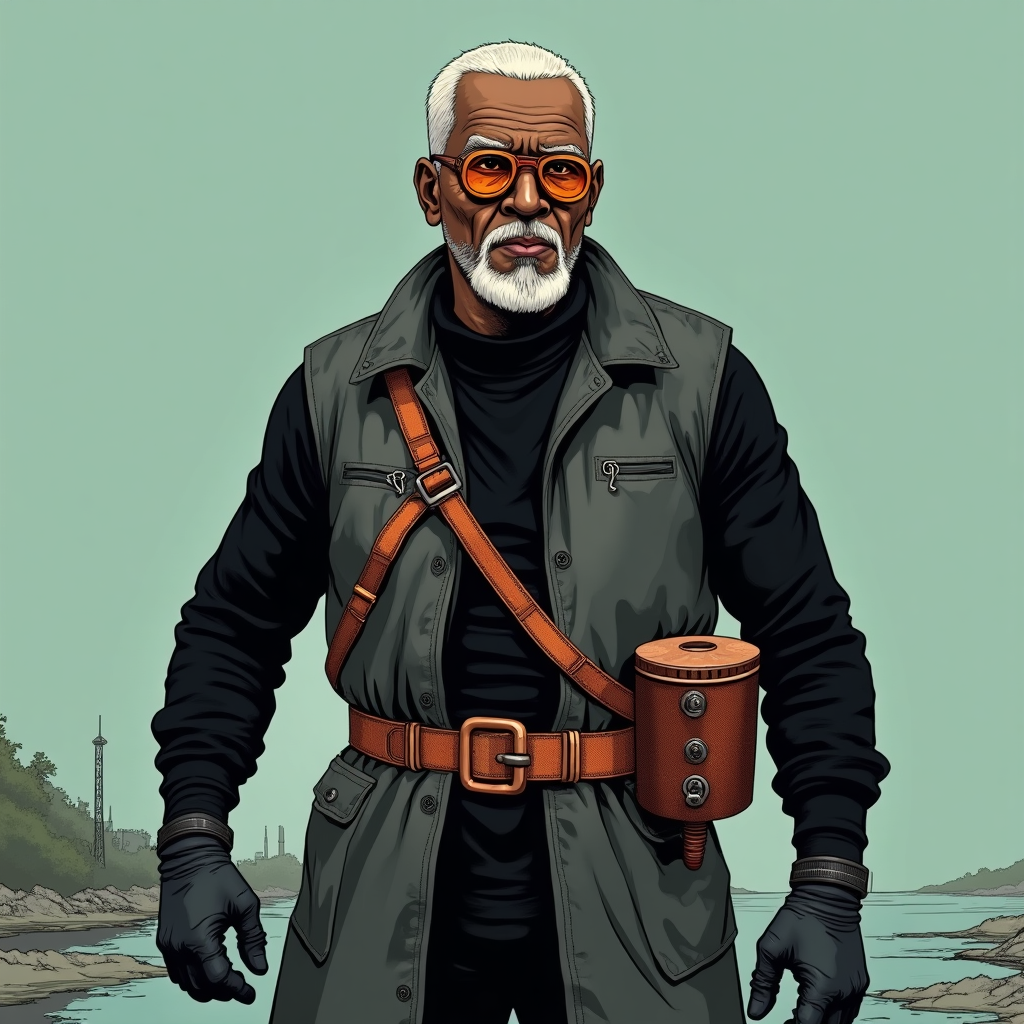
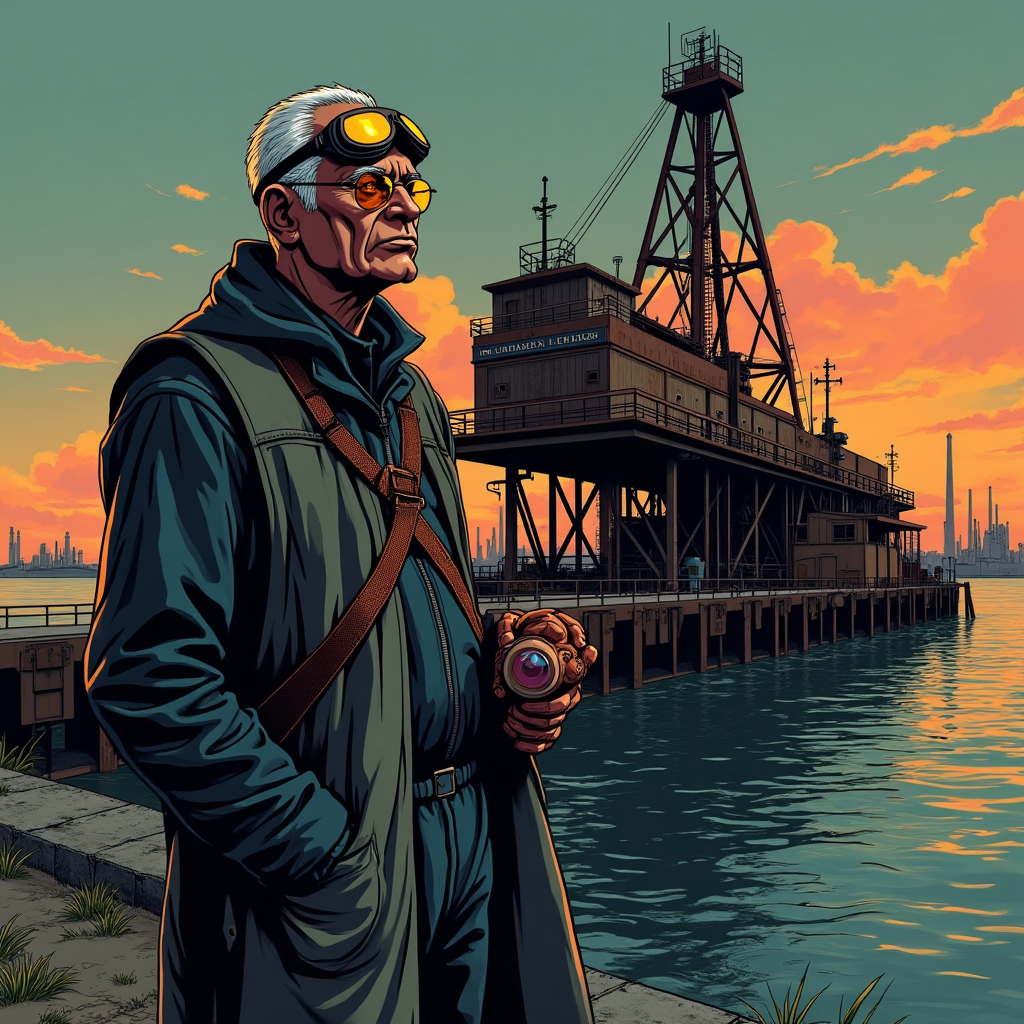
The Nulltide did not wear a costume, exactly. They wore what they always wore — the long charcoal vest, the black clothes, the ink-stained hands — and added only the resonance device, worn in a custom copper-mesh harness against their sternum, and a pair of tinted work goggles that had belonged to a Lenape elder they’d known at the Reeves-Wyndham Institute, who had pressed them into Deverell’s hands once and said: wear these when you look at things you might otherwise flinch from. They had not understood that gift until now.
Close-cropped white hair. Deep brown skin, seventy-one years of it, carrying the specific gravity of someone who has outlived their own illusions. They stood in the mirror in their Rector Street front room and looked at themselves for a long time.
They were not a hero. They knew this. Heroes acted on instinct and called it righteousness. Deverell Okafor was acting on thirty years of evidence and calling it, simply, a correction that was overdue.
Part Five: Low Water
The confrontation at the Ferry Slip at 2 a.m. is not what Deverell had planned. They had planned a daylight action — a public demonstration, witnesses, documentation, the resonance device activated in view of the city council offices across the water. Something undeniable, on the record, for the archive.
But Valentina Reyes had found them first, through channels Deverell underestimated — the bay itself, perhaps, whispering coordinates in the water pressure of the storm drains beneath Smith Street. The young marine technician arrived on the surface of Raritan Bay, walking it like a floor she had always owned, and Deverell felt something that surprised them: not contempt, not triumph, but a complicated and unwanted respect.
They said what they had come to say. They activated the device. They watched Valentina stagger.
And then Valentina did something Deverell had not modeled: she stopped fighting. She opened. She fed the extracted energy back into the bay itself, and the resonance device — chasing that dispersed signal through the tidal field — exhausted its stored terra cotta energy in a spiral of diminishing returns and went silent.
Deverell stood in the dark at the Ferry Slip, the device cold against their sternum, and listened to a twenty-eight-year-old woman from Catalpa Avenue explain what belonging meant.
They did not agree. Not entirely. Power does not become just simply because the person who holds it loves the place it came from. Deverell had watched too many well-meaning individuals absorb what should have been communal and call it stewardship. The bay’s choice was not a mandate. The bay’s choice was an accident with good intentions, which was the oldest story in colonial history.
But they listened. And when Valentina said if you want to talk about the land trust, Deverell heard something in her voice they had not expected: not a concession, not a capitulation, but an invitation from someone who had read the same plaques, walked the same waterfront, and arrived, by a different route, at the same grief.
They left without the device. They left alone.
On Rector Street, in the front room that is also an archive, Deverell Okafor sits in the grey hours before dawn and opens the folder with the 1689 deed. The Gaelic passages look back at them, patient as tides. An tha tobar mara. The tidal well. They trace one ink-stained finger along the edge of the document and think: this is not over. It is never over. The archive does not close just because one night went wrong.
The Nulltide endures. The documents remember. The city still has not settled its debts.
And Deverell Okafor has never, in seventy-one years, stopped collecting evidence.