NULLVEIL: The Architect of Silence
Part One: The Signal Network They Built
The Port Jersey signal network does not announce itself. It hums beneath the surface of the harbor — a nervous system of copper wire, relay towers, navigational transmitters, and maritime communication arrays woven through the industrial skeleton of Bayonne like blood through bone. Most people who cross the Bayonne Bridge or watch the tankers move through the Kill Van Kull have no idea it exists. They assume, the way people always assume, that the lights are simply on, the signals simply work, the ships simply find their way.
Reyes Callahan built most of it.
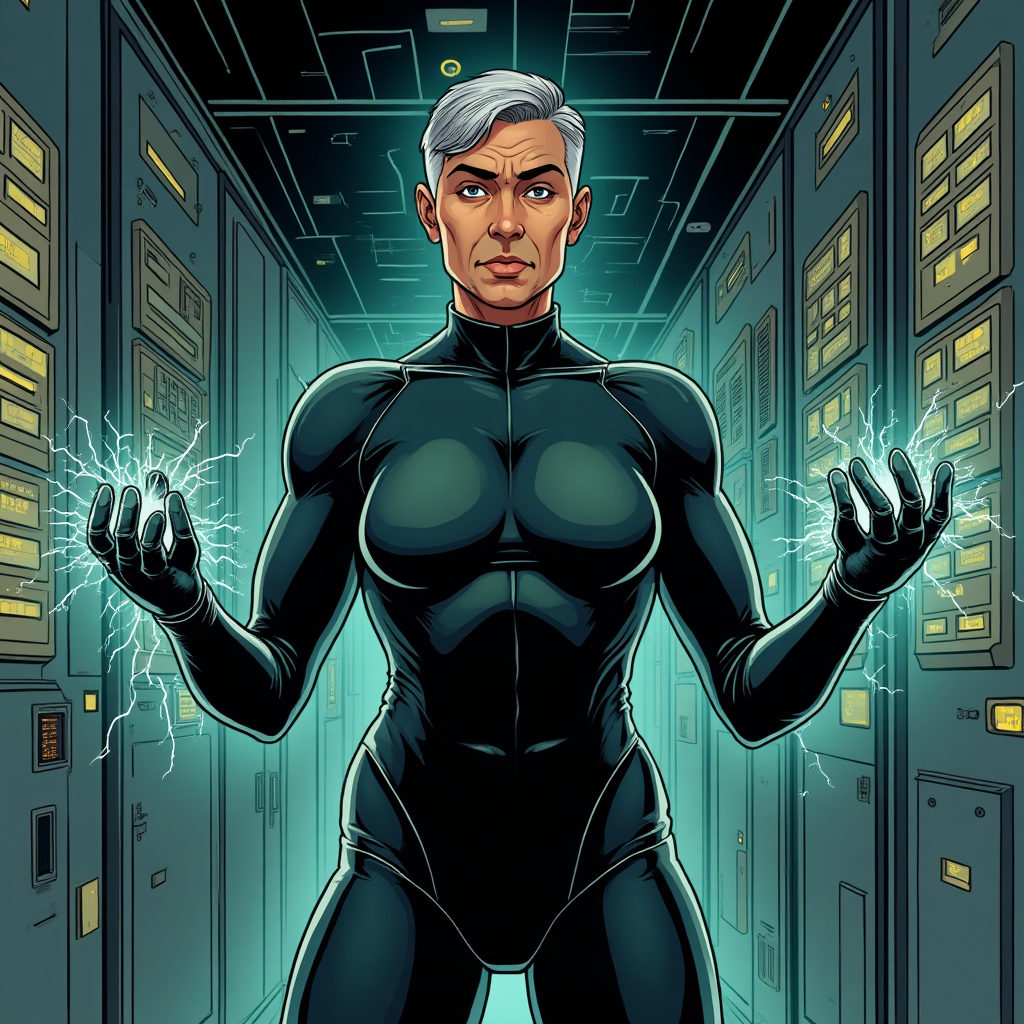
They are sixty-four years old, and they carry that number the way the old refinery sites along Hook Road carry their history — visibly, unapologetically, in every weathered surface. Their heritage is written across the architecture of their face in the way of someone whose roots reach into more than one soil: a Mexican grandmother who crossed the border with a head full of electrical engineering theory and no patience for ceilings, a Puerto Rican grandfather who worked the Constable Hook docks until his knees gave out, a name that folds two worlds into one syllable. Reyes Callahan. The name that nobody can quite place, which has always suited them fine.
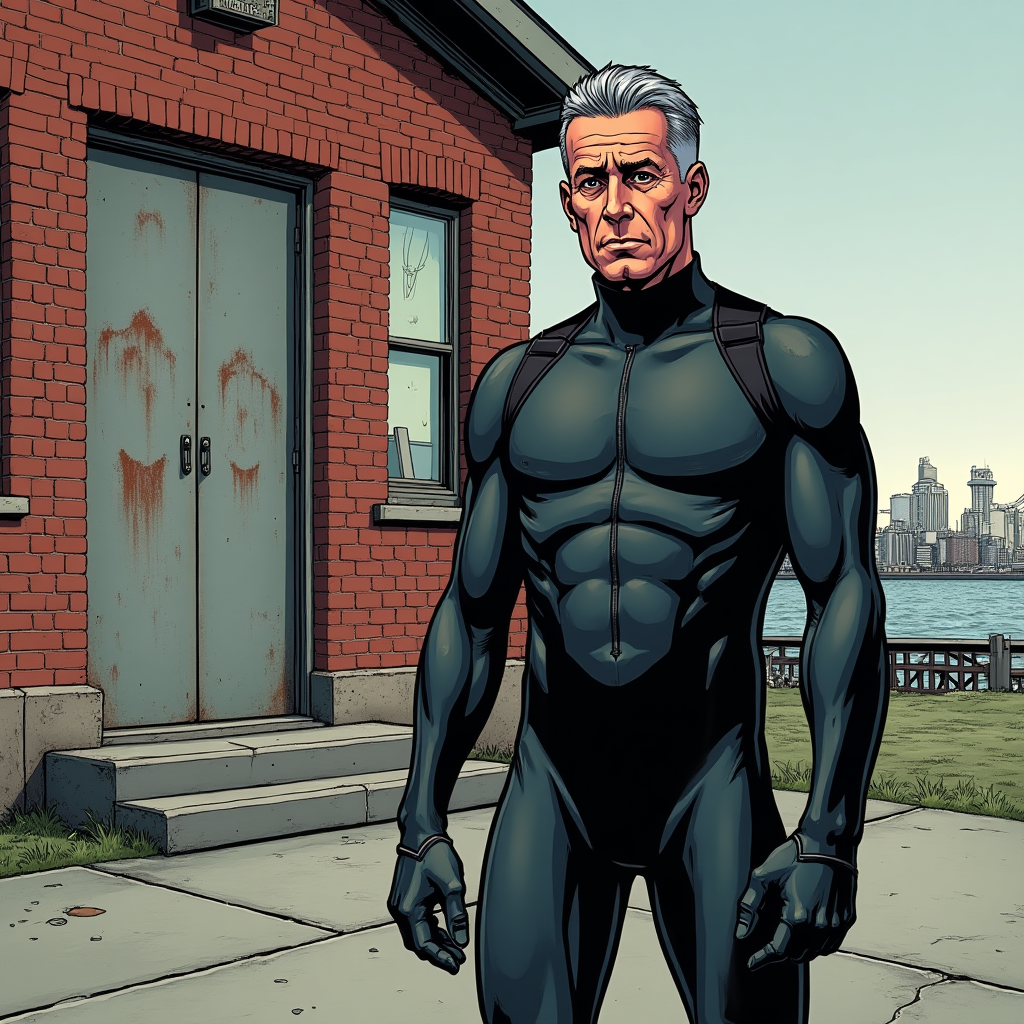
Their grey-streaked hair is cropped close against their skull. Their hands, still calloused from decades of working with live cable and signal conduit, move across equipment with a precision that has never required looking. Their dark clothing is functional — no theater, no vanity. The clothing of someone who expects to be inside a relay housing at 2 a.m.
In 1991, a telecommunications firm called Meridian Signal Group hired Reyes Callahan — then thirty, fresh from a decade of infrastructure work with the Port Authority — to design a navigational communication network for the newly expanded Port Jersey terminal. It was the most ambitious civilian maritime signal project in the region’s history. Reyes spent four years on it. They mapped every approach lane in Newark Bay, every tanker corridor in the Kill Van Kull, every blind spot where fog and geography conspired against a ship’s crew. They ran signal cable through conduits that nobody else would crawl into. They calibrated beacon arrays on the Constable Hook seawall in November, in the rain, because the rain was when the ships needed the signal most.
They built the system to last. They built it to protect.
They were not consulted when Meridian Signal Group sold the maintenance contract to a federal subcontractor in 2003. They were not called when that subcontractor transferred the operational lease on three critical relay stations to a private logistics holding company in 2011. They were not notified when the original technical documentation — their documentation — was reclassified as proprietary assets belonging to an entity incorporated in Delaware that had no employees and no physical address.
They found out the way everyone in Bayonne finds out about things now: too late, from a source that no longer exists.
Part Two: The Newsrooms Go Dark
The Jersey Journal closes on a grey Thursday in February of 2025, and Reyes Callahan reads about it on their phone while sitting in the window of a diner on Broadway, watching the morning traffic back up toward the tunnel. They have been reading the Journal since they were nineteen years old. They remember when it ran investigative pieces on the refinery strikes, on harbor safety violations, on the slow erosion of the public infrastructure they spent their career building.
The Journal ran one of those pieces in 2019 — a four-part series on the privatization of maritime signal infrastructure along the New Jersey waterfront, sourced partly from documents Reyes provided anonymously. It named no individual wrongdoers. It generated seventeen letters to the editor, a statement from a state assemblyman who was not reelected, and nothing else.
The Journal is gone now. The reporter who wrote the series is writing content for a logistics industry newsletter.
Reyes puts down their phone and looks out at the harbor.
They have been watching the degradation for years — not the dramatic, sudden failure of the 1958 Newark Bay disaster, but the slow, bureaucratic rot of deferred maintenance, transferred liability, and accountability so diffused across shell companies and federal subcontracting chains that no single human being can be held responsible for anything. Beacon array C-7 on the Constable Hook seawall has been running three degrees off-bearing since a 2022 storm. Reyes knows this because they still go out there — not officially, not for any employer, but because the array is theirs in the way that a thing you built with your hands is always yours — and they have filed the maintenance report through every channel still available to a private citizen with no institutional affiliation. Six weeks ago. No response.
The government shutdown is now in its fifth week. The harbor safety workers who maintain what remains of the public signal network are working without pay. The partial TSA shutdown gets the headlines. The maritime signal maintainers get nothing — not even a mention in the letters to the editor that flood the surviving newspapers with opinions about NATO and Iran and everything happening somewhere else to someone else.
Nobody is watching the harbor.
Reyes Callahan begins to understand that warnings, filed correctly and through proper channels, accomplish nothing in a world that has systematically dismantled every institution capable of receiving them.
They begin to think about what a warning looks like when it cannot be ignored.
Part Three: The Architecture of Revelation
The decommissioned signal relay station on Hook Road has been sitting vacant since 2017, its brick exterior tagged with rust stains and old graffiti, its windows boarded with plywood that has since gone silver-grey in the salt air. The logistics holding company that technically owns it has never responded to a single inquiry from the city. The city has never pushed. The building simply exists, the way a lot of things in Bayonne simply exist — too expensive to demolish, too forgotten to use.
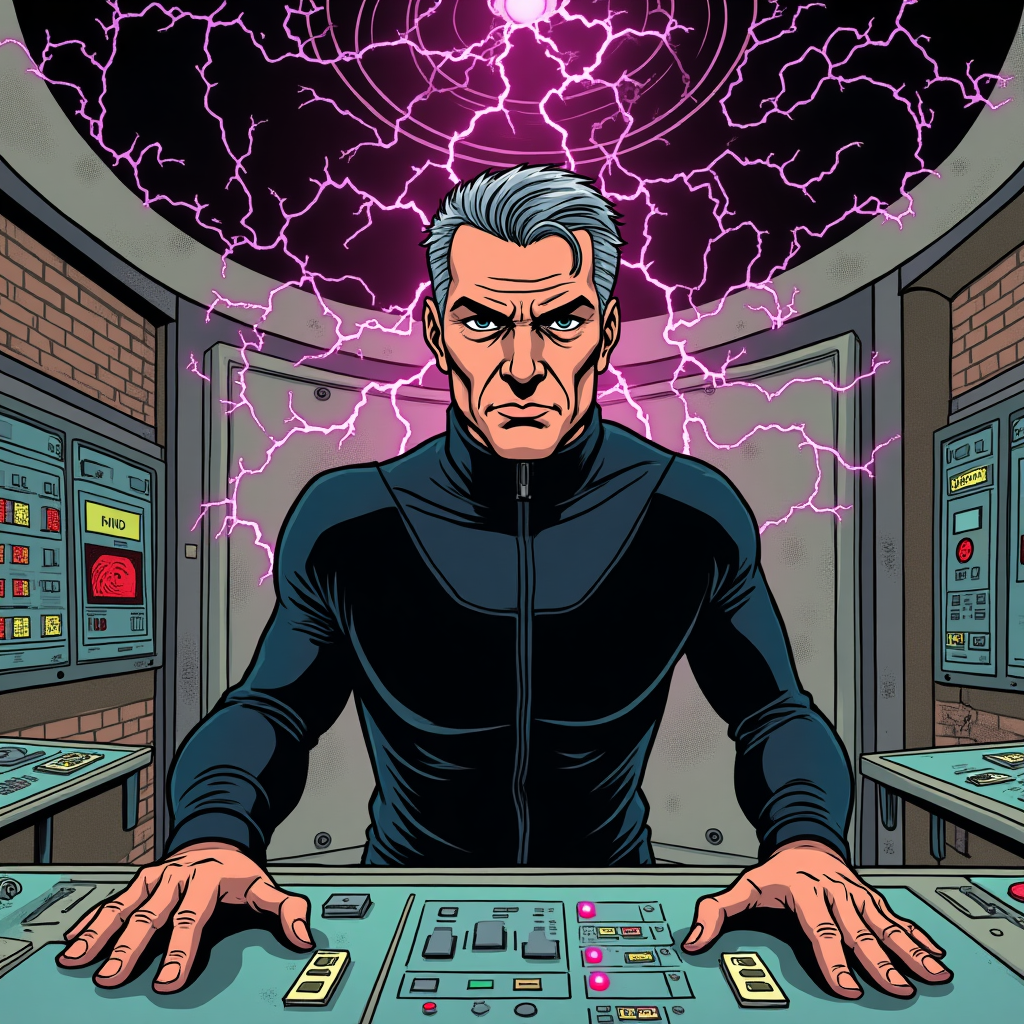
Reyes spends three months moving equipment in through a basement access point that they installed themselves in 1992 and that no subsequent owner has ever found. The work is slow and careful and done entirely alone, mostly at night, mostly in silence. They gut the interior and rebuild it as something between a laboratory and a command center — every surface running with repurposed maritime and industrial hardware, the walls lined with the accumulated technical documentation of thirty years, the air smelling of solder and salt.
The tools they build here are not lightning-given. They are human-made, which Reyes considers a more honest form of power. A suite of electromagnetic warfare instruments, refined from the same principles they used to design the original network, capable of projecting coordinated signal blackouts across the entire regional maritime communication grid. Where a navigator might use a beacon to guide, these tools use the absence of a beacon — silence as a weapon, darkness as a message.
They call the alter ego they are building Nullveil — a name for the space where signal should be and isn’t. The veil of null. The frequency of nothing.
The plan is not destruction. Reyes has no interest in destruction. The plan is revelation — a controlled, cascading failure of the entire Port Jersey navigation and communication infrastructure, designed to last precisely forty-eight hours. Long enough to be impossible to ignore. Targeted to the early hours of a Sunday morning, when maritime traffic in the Kill Van Kull is at its weekly minimum, when the risk of catastrophic collision is lowest. Every news agency still functioning in the region — the ones that remain, the online outlets, the wire services — will receive a complete technical dossier simultaneously: what was shut down, why it could be shut down, who owns what, who is responsible for what, what has been allowed to decay and why.
A demonstration. A warning. The same warning Reyes has been filing for fifteen years, delivered in a frequency that cannot be rerouted to a subcontractor in Delaware.
They know the risk. They are not naive. Forty-eight hours of signal silence in one of the busiest ports on the Eastern Seaboard — even a Sunday morning, even the minimum-traffic window — carries danger. Ships run dark. Crews rely on backup systems that may themselves be degraded. Reyes has modeled every failure scenario with the same obsessive rigor they brought to the original network design. They believe the risk is manageable. They believe the alternative — continued silence, continued degradation, the slow accumulation of unfiled warnings until the next 1958 — is not.
They believe this the way a person believes something they have built their entire life around believing.
They are not entirely certain they are right.
Part Four: The Other Signal Keeper
Reyes first becomes aware of Harborwatch the way a longtime engineer becomes aware of a new variable in a familiar system: as an anomaly that doesn’t fit the existing model.
The spoofing transmitter in the Terminal Road shipping container — that was Nullveil’s probe, a test of the system’s response, a way of measuring how quickly the port’s electronic defenses could locate and neutralize a rogue signal. It should have taken the Port Authority’s automated monitoring system four to six hours. Something neutralized it in forty minutes with a pulse signature Reyes has never seen before: clean, coherent, impossibly broad-spectrum, like a lighthouse that had swallowed a radio telescope.
The Bayonne Energy Center alarm network restoration. The corrected navigational transmissions near Bergen Point. All of it bearing the same electromagnetic fingerprint — not a machine, not a system, but something that thinks while it transmits. Something organic inside the signal.
Reyes tracks the frequency backward through three weeks of harbor data and arrives at a conclusion that they sit with for a long time before accepting: the lightning strike on the Constable Hook seawall. The beacon array C-7 emergency maintenance call. The marine signal technician whose name appears on the unresolved maintenance report that Reyes filed six weeks ago — the report that was never acted on.
Connor Maguire. Early thirties, West 5th Street, Port Authority signal division.
Reyes pulls every public record on him, which takes about an hour. His grandfather’s name stops them. Patrick Maguire. PRR signal maintainer. Forty years of filed reports on the Central Railroad drawbridge mechanism. Forty-eight dead.
Reyes closes the laptop and sits in the Hook Road relay station in the dark for a very long time.
They think about what it means that the harbor has given its voice to the grandson of Patrick Maguire, and what it means that this young man — who has his grandfather’s stone in his chest, who gives the warning even when nobody wants to hear it — is now the primary obstacle between Nullveil and the only plan Reyes has left.
They think about whether that is a sign or a warning.
They decide it doesn’t matter. The cascade is scheduled. The dossiers are prepared. The newsrooms that remain are already in their contacts list. In forty-eight hours, someone will have to answer for what has been done to this harbor.
Even if the only person who shows up to hear the answer is a thirty-one-year-old man who got struck by lightning on a seawall.
Part Five: What Silence Costs
The confrontation begins before Reyes is ready for it.
The cascade sequence initiates from the Hook Road relay station on a Tuesday night in April — the nor’easter is an unexpected gift, maritime traffic already reduced, the risk window narrowing — and Reyes is watching the blackout roll across their monitoring boards like a tide, each beacon going dark in the sequence they designed thirty years ago and still know by heart, when the door of the relay station opens and Connor Maguire is standing in it.
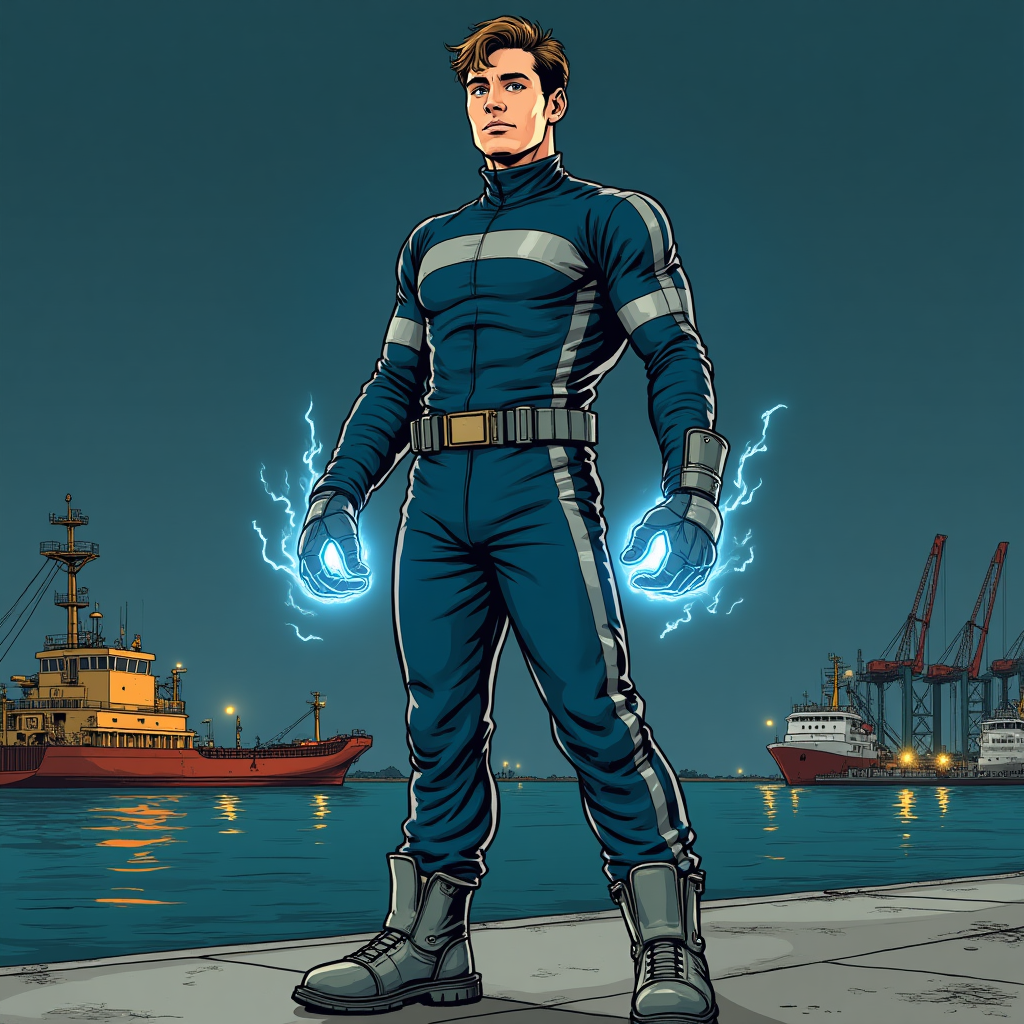
He is soaking wet, his navy suit running with rain, the antenna array on his helmet lit with a pale, steady blue that cuts through the dark of the room like a navigational pulse. His grey eyes move across the equipment, across the walls of documentation, across Reyes’s face, and Reyes can see him recognizing everything — not just the hardware, but the logic behind it, the architecture of a mind that learned this harbor the same way he did, from the inside out, from the parts nobody else bothers to understand.
I know what you’re trying to say, he says. His voice is quiet, the voice of a man who has learned to speak at the volume of a signal buoy in calm water — just loud enough to reach the ships. But you know what silence costs.
Reyes feels the weight of that sentence in the specific way of someone who has spent thirty years calculating exactly what silence costs and concluded that the cost of continued warning is higher.
So does nobody listening, they say.
What follows is not a battle in any sense that would satisfy a casual observer. It is two signal engineers fighting over a frequency — one trying to maintain a blackout, one trying to override it, both working from the same foundational knowledge of the same system, both adapting in real time as the other counters. Reyes deploys the directed EMP bursts, the sonic disruptors, the spoofed positioning cascades. Each one technically flawless. Each one, against an opponent who is the signal rather than merely wielding it, insufficient.
Reyes watches Connor Maguire stand on the Constable Hook seawall through the relay station’s external cameras and become, for the length of the confrontation, the harbor itself — his feet planted on the same concrete where their cable is buried, his arms extended, every beacon in Newark Bay locking onto his transmission and broadcasting it outward with a clarity that the equipment alone could never achieve. He is not stopping the blackout with power. He is replacing it — flooding the null with signal, making silence impossible by making presence undeniable.
The cascade fails at 3:47 a.m. The beacons come back online one by one.
Reyes sits on the seawall beside the ruins of their equipment and does not speak. The rain is still coming in from New York Bay. Their hands are shaking, which they note with the detached curiosity of an engineer observing an unexpected data point. They have not let their hands shake in front of another person in a very long time.
Connor sits beside them. Not across from them. Beside. Reyes registers this.
File the report, he says. I’ll sign it. Both our names.
Reyes looks at him. In the grey pre-dawn light, his face carries something they recognize — not because it is young or because it is certain, but because it carries the same stone their own chest has carried for three decades. Patrick Maguire’s stone, passed down. Their own stone, self-installed. The weight of a warning that the world is very good at not receiving.
They do not tell him it won’t work. He knows it might not work. He is going to broadcast it anyway, the way his grandfather filed the reports anyway, the way Reyes built the system anyway, the way the beacons blink anyway in the dark and the rain and the indifferent silence of the institutions that were supposed to be listening.
On the Kill Van Kull, the navigational lights resume their patient rhythm.
Reyes Callahan looks at the harbor they built and thinks: It is still here. It is still running. Someone will have to answer for it eventually.
They think: I will make sure the report is very, very thorough.
They think: Both our names.
For now, that will have to be enough.