

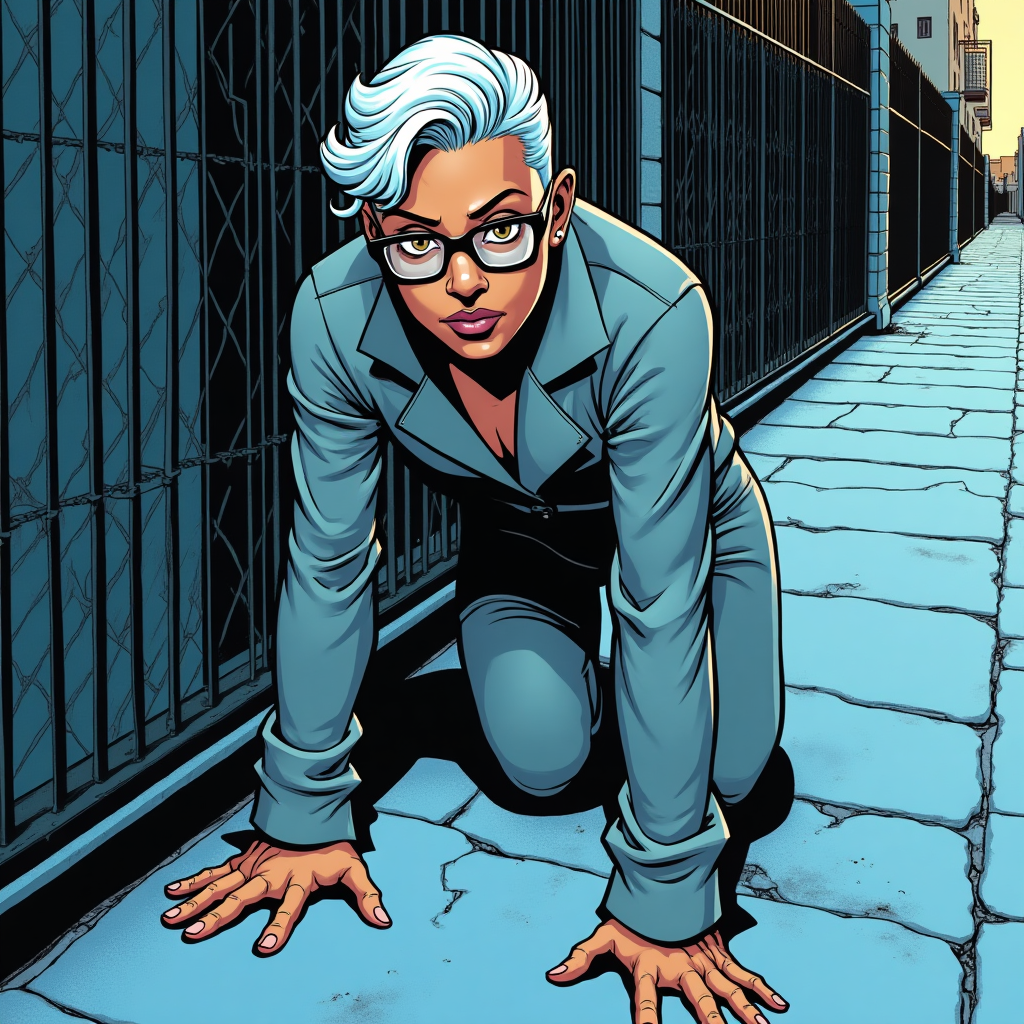

THE CONSULTANT
An East Orange Villain Origin Story
Part One: The Language of Clean Lines
The rezoning application for the AP Smith site runs forty-seven pages, and every sentence is a small act of love.
Devlin Morse knows this because they wrote each one. Not dictated, not delegated — wrote, in the architectural grey of their home office on the fourth floor of a converted loft building on Main Street in East Orange, at a drafting table surrounded by site surveys and demolition timelines and the quiet hum of a city that does not know yet what it is about to become. The coffee goes cold. The streetlights outside shift from amber to blue-white as the hours pass. Devlin does not notice. They are speaking a language that has no room for sentiment: setback requirements, floor-area ratios, traffic impact assessments. Clean language. Precise language. Language that does not bleed.
Devlin Morse is fifty-one years old, multiracial and nonbinary, with close-cropped silver-streaked hair and warm brown skin and eyes the color of old amber behind rectangular wire-rimmed glasses. They dress exclusively in architectural grey — trousers, jacket, sometimes a collarless shirt the shade of poured concrete. Their leather portfolio never fully closes. There is always another document inside it that needs to exist.
They have been in East Orange for four months, contracted by the Hargrove Development Group to shepherd the AP Smith redevelopment proposal through the city council approval process. It is the kind of work Devlin has done in eleven cities across three states: find the old thing, measure it, document its inadequacy, and make the legal and financial case for its replacement with something that functions. Something that does not weep.
They do not think of themselves as a destroyer. They think of themselves as an editor.
What Devlin does not put in the application — what they have never put in any document, because there is no form field for it — is the other thing. The quiet thing they discovered fifteen years ago in a different city, pressing their palms to the iron columns of an elevated rail line the night before the demolition crew arrived. The columns had been standing for eighty years. When Devlin touched them, they could feel it: the accumulated resonance of eight decades of trains, commuters, arguments, proposals, grief, routine. A city’s entire emotional sediment, stored in the molecular memory of worked iron.
It nauseated them.
Not because the feeling was ugly. Because it was so heavy. Because old things in old cities carry so much, and the people who live among them carry it too, and no one ever puts it down. Devlin had pressed their palms flat to the iron that night and felt — for the first and last time — something pass out of them into the metal, and then out of the metal into silence. The columns went still. Not physically — they still stood, would still stand until morning. But the resonance, the memory, the weight: gone. Nullified.
Devlin had stood in the dark for a long time afterward, breathing.
For the first time in forty years, nothing was asking them to carry it.
Part Two: What Was Taken
Here is what no forty-seven-page application will ever say:
Devlin Morse grew up in the Ironbound district of a city thirty minutes south of East Orange, in a neighborhood that smelled like bakeries and diesel and the Passaic River in summer. Their mother was Puerto Rican and their father was Filipino, and the block they grew up on had been there since before either family arrived, and would be there, everyone assumed, long after. The butcher shop with the hand-painted sign. The community center with the iron fence out front. The old transit stop where Devlin’s grandmother waited every morning in her work coat, reliable as a tide.
The developer who bought the block was not fictional. The displacement was not metaphorical. In eighteen months, the butcher shop was a parking structure, the community center was rubble, the iron fence was in a salvage yard in Kearny, and Devlin’s grandmother was in a third-floor walk-up in a town she did not know, waiting for a bus that ran twice a day.
She died the following winter. Devlin was eleven.
They spent the next three decades becoming the most precise, most credentialed, most coldly effective urban planning consultant in the tri-state area, because they had decided — not all at once, but in slow increments across thirty years of site surveys and public hearings — that the only honest thing to say about neighborhoods was this: they end. They always end. The only question is whether they end on someone else’s terms or on terms you have at least reviewed and annotated.
This is not a philosophy Devlin would defend at a dinner table. It is a philosophy they defend in zoning variance hearings, and it has never lost.
The power came later, and it came gradually. A hand on an old fence. A palm on a train platform. The ability to reach into the vibrational memory of worked iron and steel and draw it out — not destroy it, Devlin tells themselves, release it. Silence as mercy. Erasure as kindness. Let the old iron rest. Let the city put down what it has been carrying since before anyone living can remember.
They named themselves Nullveil in a private moment, standing in the fog at the edge of the Passaic, and they have never told anyone.
Part Three: The Application
The East Orange city council session runs two hours and eleven minutes, and Devlin presents for twenty-two of them.
The slides are elegant. The economic projections are, if anything, conservative. The renderings of the proposed Hargrove development show glass and light and green space that the current AP Smith site, shuttered and fence-bound for forty years, demonstrably cannot offer. Devlin speaks without notes. They have given this presentation in variant forms in Camden, in Trenton, in Paterson, in a smaller city in Connecticut whose name they no longer feel the need to remember.
Afterward, a council member with a silver braid and reading glasses on a beaded chain stops them in the corridor.
“You ever actually walk the AP Smith site?” she asks. “Not survey it. Walk it.”
“I’ve conducted three site assessments,” Devlin says.
“That’s not what I asked.”
Devlin thanks her for her time and closes their portfolio.
They do walk it that night — not because of the council member, they tell themselves, but because a good consultant checks their work. The AP Smith fence stands along Frelinghuysen Avenue, wrought iron posts thick as forearms, black over decades of accumulated rust, running the full perimeter of the shuttered plant. It is, by every objective measure, a liability. Structurally marginal, aesthetically dated, historically undocumented.
Devlin puts one hand on the fence.
The resonance hits them like a wall. Forty years of neighborhood children daring each other to touch it. Sixty years before that of workers clocking in through the gate, the iron learning the rhythm of their shifts. A hundred years of weight. It is the loudest old iron Devlin has ever touched.
They begin to draw it out. Slowly, methodically, panel by panel. The hum fades. The silence spreads.
It feels, as it always does, like relief.
Three panels have gone quiet when they feel something they have never felt before: the iron pushes back.
Not from the fence. From deeper — from the buried water mains beneath the street, from the Ampere station platform two blocks north, from somewhere in the networked iron bones of the city itself. A vibrational reply, low and insistent and unmistakably intentional. Something else is in this metal. Something awake, and listening, and not remotely interested in being silenced.
Devlin pulls their hand back.
They stand alone in the dark on Frelinghuysen Avenue for a long time.
Part Four: Ironbloom
They find out about the boy the way they find out about most things: methodically.
The incident report from Demarco’s Corner Mart is not classified information. The cracked linoleum, the two officers, the thirteen-year-old, the inexplicable structural event — it is in the local paper, briefly, as a curiosity tucked below a story about Branch Brook Park cherry blossom attendance records. Devlin reads it twice. Then they pull a site map of East Orange’s iron infrastructure and trace the lines: Demarco’s Corner Mart to the AP Smith fence to the Ampere station platform. A network. A nervous system.
The boy’s name is Marcus Okafor. He attends Cicely Tyson School. He plays percussion.
Devlin sits with this information for four days. They do not enjoy what they feel about it, which is close to something they would call recognition if they allowed themselves that kind of language. A child in Essex County who speaks iron the way Devlin speaks silence. A child who lives inside the weight that Devlin has spent forty years trying to put down.
On the fifth day, they make a decision.
The Hargrove application has to move forward. Not because of the contract — the contract is secondary. Because Devlin has come to believe, with the full force of their considered adult judgment, that the AP Smith site’s resonance is a trap. That as long as that fence stands, as long as the Ampere station platform holds sixty years of commuter memory in its rails, the neighborhood will keep looking backward. Will keep being defined by what it was instead of what it could be. And a thirteen-year-old boy who has just discovered he can speak to old iron is the last person who should be left alone with that kind of gravity.
Devlin is trying to free him. They are certain of this.
They arrange for the demolition crew to arrive before dawn on a Tuesday.
Part Five: First Confrontation at Ampere Station
The April morning is cold and smells like diesel and cherry blossoms — the blossoms drifting south on the wind from Branch Brook, settling on iron that does not deserve them, Devlin thinks, because it will not have them much longer.
They are already at the fence when Marcus arrives.
He is smaller than Devlin expected, which means nothing. Thirteen years old, dark burgundy jacket with deep green at the collar and cuffs, hands loose at his sides, backpack presumably left somewhere, sheet music and practice pads replaced tonight by something steadier and more frightening. He stops on the Ampere Parkway sidewalk and looks at the three-panel section of fence that Devlin has already silenced — grey and still in the predawn light, dead in a way that has nothing to do with rust.
Devlin watches him feel it. Watches the awareness move across his face.
“You feel it, don’t you,” Devlin says. Not a question. “The silence. It’s kinder than you think.”
What they want to say — what they will never say to a child, or to anyone — is: I know what this iron is telling you. I know what it feels like to have a whole city asking you to hold its history in your hands. I know how heavy that is. And I’m trying to put it down for both of us.
Marcus puts both palms flat on the fence.
The remaining panels scream back to life, and Devlin staggers.
The vibration is not like anything in their forty-seven-page application. It travels from the AP Smith fence down through the water mains, north along Frelinghuysen, and connects — with the clean inevitability of something that has always been true — to the Ampere station platform rail. The morning train, still eight minutes out, sends its reply back down the line like a second voice in a conversation that has been waiting a hundred years to happen. The ground beneath the excavator shudders. The machine’s operator kills the engine. The surveyors’ stakes pop from the earth, one by one.
Devlin has nullified old iron in eleven cities. They have never met iron that talked back through a thirteen-year-old boy who plays percussion solos at Cicely Tyson School.
This fence remembers, Marcus says, and his voice is steadier than it should be, steadier than Devlin’s is when they push back — the cold damping wave, the silence reasserting itself, a contest of frequencies that makes Devlin’s palms burn and the boy’s jaw clench.
The fence holds. The silence holds. Neither yields completely.
When the first cherry blossom petal falls on the iron post between them — pink, weightless, absurd — Devlin looks at it for a moment and feels something they have not felt in a long time.
They feel the weight again.
Not of the iron. Of the boy. Of his grandmother watching him with unsurprised eyes. Of a council member asking whether they had ever actually walked this site, and what that question really meant, and why it kept coming back.
Devlin Morse closes their portfolio — the only time anyone has ever seen them do it — and steps back from the fence.
“We’re not finished,” they say.
“I know,” Marcus says.
The demolition crew mills uncertainly behind the idling excavator. The AP Smith fence stands. The Ampere station rails carry the thunder of the morning train, right on schedule, and the whole buried iron network of East Orange sings one long, complicated note into the April ground.
Devlin Morse — Nullveil — walks back to their car alone, the blossoms falling on their silver-streaked hair, carrying exactly as much as they always have.
They are still certain they are right.
That is the most dangerous thing about them.