


The Nullveil Protocol
Part One: The City That Was Taken
Seren Voss is nine years old the day the bulldozers come to Lakeview Commons.
They remember it the way you remember a fever — in fragments of color and sensation. The smell of diesel exhaust mixing with their mother’s cardamom tea. The sound of a forklift backing into the front wall of the Patel family’s grocery, the one that stocked the tamarind candy Seren loved, the one that had been there since before Seren was born. The sight of their father standing on the sidewalk with his arms at his sides, watching the building that housed his tax preparation office — and their apartment above it — get consumed by orange machinery.
The stadium project had been approved in six weeks. The community had objected for two years prior, through every legal channel available to them, through public hearings where officials nodded and took notes and made no decisions, through petitions that were filed and forgotten, through a neighborhood association that showed up and showed up and showed up until one morning there was simply nothing left to show up for. The South Asian immigrant community of Lakeview Commons — Gujarati families, Bengali families, Tamil families who had built a particular world in a particular place over thirty years — was redistributed. Scattered to suburbs they couldn’t afford. To jobs they couldn’t reach without cars. To a diaspora so efficiently dispersed that within three years, no one in city government would have been able to find them if they’d wanted to.
They didn’t want to.
Seren is brilliant from the beginning. Their teachers say so. The scholarship programs say so. The universities say so, one after another, each one pulling them further from the wreckage of Lakeview Commons and deeper into the systems that had demolished it. At MIT they study urban systems theory. At Wharton they study financial architecture. They are the best student in every room they enter, and they are learning one lesson in all of it, refined from the nine-year-old standing on the sidewalk watching the bulldozer eat the tamarind candy store:
Power does not respond to objection. It responds only to power.
They do not become a villain. They become a consultant. They tell themselves, for a long time, that these are different things.
Part Two: The Architecture of Absence
By the time Seren Voss arrives in Newark, they have deployed versions of what they privately call the Nullveil Protocol in six American cities. The premise is elegant, as all effective instruments of control are: transit is the circulatory system of urban life. Price it beyond reach, and the city doesn’t move. A city that doesn’t move doesn’t organize. Doesn’t vote across precinct lines. Doesn’t build coalitions across neighborhoods. The people who can’t afford the ticket stay where they are, economically sorted, what Seren’s internal memos call — in a phrase they chose with full awareness of its coldness — friction-minimized.
The word they use in one memo, when they think no one with conscience is reading, is quieted.
Apex Corridor Solutions is the latest corporate shell in the sequence. Seren has learned to build these structures the way their father once built tax shelters: layered, deniable, technically compliant with every applicable regulation. They arrive in Newark in early spring with a full team, a polished proposal, and a piece of proprietary technology that no one at the Essex County transit board quite understands — a signal-dampening array woven into the new ticketing infrastructure that can interfere with electronic switching systems within a quarter-mile radius. The official documentation calls it a “frequency isolation module for secure fare processing.” What it actually does is give Seren the ability to lock a transit network from the inside.
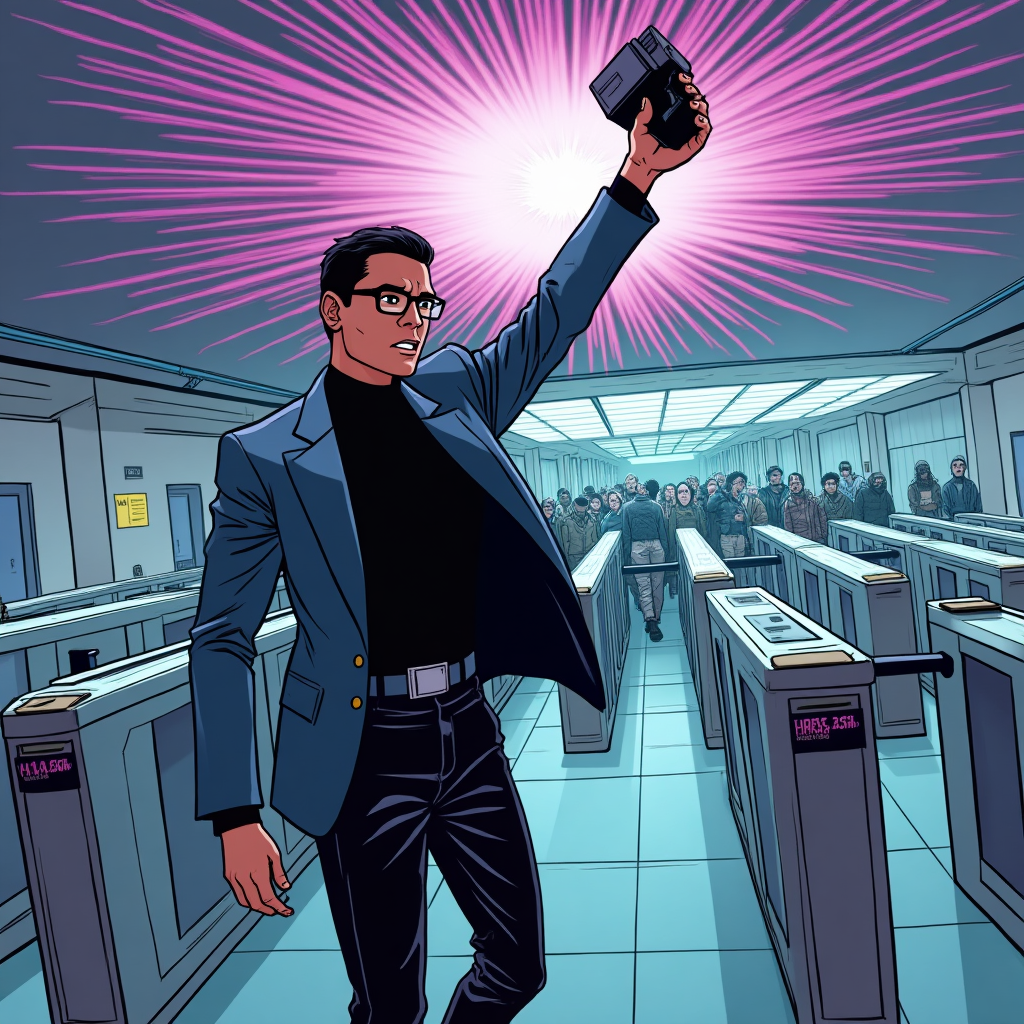
The public hearing at Newark Symphony Hall is a formality. Seren has run these before. They stand behind the Apex lectern in a slate-gray fitted blazer over a high-collared black shirt, wire-rimmed glasses catching the auditorium lights, and they process the room’s objections the way a system processes error messages — absorbed, logged, returned as managed statistics. There is a man in the third row, grey-templed, big-handed, with seven pages of handwritten notes and thirty-one years written into the set of his jaw, who watches Seren with an expression they have not encountered before in these hearings. Not anger. Not despair.
Recognition.
His name, Seren learns afterward, is Darnell Okafor. He works Track 3 at Newark Penn. He filed a formal objection with the transit board that same week. His objection is thorough, factually grounded, and completely within the boundaries of a system that Seren has already structured to absorb exactly this kind of objection.
Seren files it away and returns to the work.
Part Three: What Happens to a Wound That Goes Inward
What Seren will not tell the room at Newark Symphony Hall — what they have not told anyone, in any of the six cities, in any of the years of building the Protocol — is this: they understand Darnell Okafor completely.
They understand what it means to believe in infrastructure as a form of care. To give your life to the maintenance of systems that other people depend on. To show up, and keep showing up, because the alternative is that the city fails the people who live in it. They understand this because their father believed it too — believed that if you paid your taxes, filed the permits, showed up to the hearings, operated within the system, the system would extend to you the same protections it extended to everyone else.
The system did not.
Seren had made a different decision from that lesson than Darnell had. Not a better one. They know this, somewhere beneath the layers of rationalization they have built like load-bearing walls around a wound. But it is the decision that produced a person who can move through boardrooms and transit authorities and private equity structures the way Darnell moves through the iron grid of Newark Penn Station — native, fluent, belonging.
They have named themselves Nullveil in the privacy of their own mind for years before they ever needed the name out loud. A veil that nullifies. A disappearing act. The power to make people invisible by making them immobile.
The signal-dampening technology is real, and powerful, and has been tested. But in the weeks following the Newark Symphony Hall hearing, something stranger begins to happen.
Seren starts dreaming about the port.
Not about the transit infrastructure they’ve been modeling — about something older. The cranes at Port Newark–Elizabeth, standing against the harbor sky like enormous orange birds. The iron in the water. The colonial-era framework of a city that was staked into the Passaic mud in 1666 and has been accumulating weight ever since — industrial weight, human weight, the layered sediment of three and a half centuries of people who needed to move and be moved. In the dreams, the iron speaks to Seren in a frequency they recognize but cannot name. And in the dreams, something is already listening back.
They wake from these dreams with their hands cold and a feeling in their chest like a locked gate.
Part Four: The Signal and the Spike
The frequency interference begins three weeks before the World Cup preliminary rounds.
Seren notices it first in the system diagnostics — a counter-signal in the iron switching grid at Newark Penn, something operating below the threshold their technology was designed to detect, something that moves through the infrastructure the way information moves through a nervous system. It is not electronic. It is not any protocol in their technical library. It is, their instruments tell them with increasing urgency, geological. Mineral. Old.
They pull the Port Newark shipping records. They pull the colonial survey maps from the Newark Public Library’s digital archive — the ones showing the original 1666 settlement stakes at the mouth of the Passaic, the forge-iron infrastructure of the first mills, the buried skeleton of a city that industrialized before the word existed. They run the frequency signature against the iron composition of the riverbed deposits.
The match is exact.
Someone has been changed by this city’s iron. Someone is inside the grid.
Seren does not panic. They have prepared for opposition. They have lawyers, transit board relationships, signal amplifiers, layers of corporate architecture specifically designed to outlast any single objection. What they have not prepared for is an objection that operates at the frequency of three hundred and sixty years of accumulated weight.
They put on the slate-gray blazer. They adjust the wire-rimmed glasses. They initialize the Nullveil Protocol’s full deployment for the opening World Cup weekend and take their position in the station management office on the mezzanine level of Newark Penn Station, watching through glass as the crowd builds below — families, workers, elderly commuters clutching paper tickets now rendered invalid, people who built this city standing on the wrong side of a wall that Seren built for them.
Seren watches this and tells themselves what they have always told themselves: this is how power works.
For the first time, the sentence does not entirely hold.
Part Five: Iron and Open
Darnell Okafor comes up through the maintenance tunnels.
Seren tracks him on the system monitors — or tries to. He moves through the terminal’s iron skeleton like water through a watershed, not forcing, finding, and wherever he moves the monitoring signals go quiet not from Seren’s dampening but from something that simply exceeds it. The master switching panel at the subterranean core flickers. Seren amplifies the Nullveil signal. It holds for forty seconds.
Then the gates open.
Not just one platform. All of them. Every gate in Newark Penn Station exhales at once, and the crowd below — hundreds of people who have been standing on the wrong side of Seren’s architecture — moves. The platforms fill. The trains, held in idle by the Protocol’s first live deployment, begin to run.
Seren finds the staircase.
He is already there. Grey temples, big hands, a face that carries thirty-one years of paying attention. He looks at Seren the way he looked at them across the Newark Symphony Hall — not with hatred, but with the particular sorrow of someone who sees clearly.
“You think opening a gate changes anything?” Seren says. Their voice is controlled. It is always controlled. “The Accord is already in twelve cities. You can’t hold every turnstile in America.”
“No,” Darnell says. “But I can hold this one. Today. For these people.”
Seren raises the signal device. They have prepared for this exact moment — full amplification, targeted suppression of the iron-frequency counter-signal, a technical solution to a technical problem. The device is the best instrument of its kind.
It stops working when Darnell presses his foot to the mezzanine’s iron floor grate and becomes, briefly, continuous with every piece of iron in the city.
The Nullveil Protocol, for one morning, is nullified.
Seren stands on the staircase as the World Cup crowd floods the platforms below, as Newark Penn Station does what it has done for nearly a century — moves people, connects them, refuses the wall — and they feel something they have not felt since they were nine years old watching the bulldozer eat the tamarind candy store. Not power. Not control.
Grief.
For what was done to them. For what they became because of it. For the community they scattered across twelve cities in the name of a lesson that a nine-year-old learned wrong, or learned right, or learned the only way a nine-year-old can learn the worst thing the world has to teach.
They do not surrender. The Protocol is too large, the corporate structures too deep, the twelve cities already mid-deployment. Seren Voss does not become a different person on a mezzanine staircase in Newark Penn Station on a Saturday morning in September.
But they look at the man who held the gate open, and for one unguarded moment — before the slate-gray blazer and the wire-rimmed glasses and the preemptive patience reassemble themselves — Seren Voss is nine years old again, and they are not sure the lesson was right.
They file it. They walk back to the management office. They begin modeling the next city.
Outside, the trains run. Newark, as it always has, refuses to be quieted.
Next issue: Nullveil’s signal-dampening array goes dark at Port Newark–Elizabeth — and someone at Apex Corridor Solutions’ silent partner organization has decided that Seren Voss has become a liability.