


NULLVEIL: Origin of the Unraveler
Part One: The City That Swallowed Her Whole
Margaret Throssell does not remember learning to hate Union City. She remembers learning to need it.
She arrived at twenty-three, the youngest project coordinator at Meridian Properties Group, a Jersey City firm that specialized in what her boss, Ron Daschle, called “opportunity-adjacent acquisitions.” That was the polished term. What it meant: find the places where density had become dysfunction, where a city had been packed so tightly it had begun to strangle itself, and identify the release valve. Margaret was good at this. She was precise, patient, and she could walk into a building and know within minutes whether it was structurally viable or slowly dying — a gift, her mentor told her, that most developers spent a career trying to buy.
What Daschle did not know — what no one at Meridian knew — was that Margaret had grown up the daughter of a structural engineer in Parsippany, and that she had spent her childhood watching her father trace the stress patterns of buildings on graph paper the way other fathers traced maps of places they wanted to visit. She understood load and tension and the mathematics of how things failed before they fell. She understood, in the cold and mechanical part of herself that she had always kept private, that every structure contains the blueprint of its own collapse.
Union City, in those years, seemed to her like the most instructive structure in the world.
She walked Bergenline Avenue in November of 1996, in a wool coat her mother had bought her, taking notes. She passed the bodegas and the embroidery supply shops and the Cuban restaurants exhaling garlic and sofrito into the grey air, and she felt the pressure of the place the way you feel a crowd pressing in from all sides. Sixty-some-thousand people on one square mile of hillside. German ironwork in the older buildings. A Passion Play that had run unbroken for decades. Streets named for the geography they had buried under concrete.
She took a meeting that afternoon with a property owner on New York Avenue who wanted to sell a warehouse adjacent to the old Helmrath Mill. The mill had closed nine years earlier; the warehouse was derelict, its roof partially collapsed. The owner, an elderly man named Costello, served her coffee in a paper cup and told her about the mill workers, how they had made some of the finest embroidery in the world, how the mill floor had hummed with hundreds of machines in simultaneous motion.
“You could feel it through the floor,” Costello said. “Like the whole building was one living thing.”
Margaret wrote the price into her notebook and nodded politely and did not say what she was thinking, which was: living things die. That’s how you know they were alive.
She did not acquire the warehouse that day. Meridian passed on it for reasons of financing. But Margaret did not forget the mill.
She never forgot the mill.
Part Two: The Shuttle
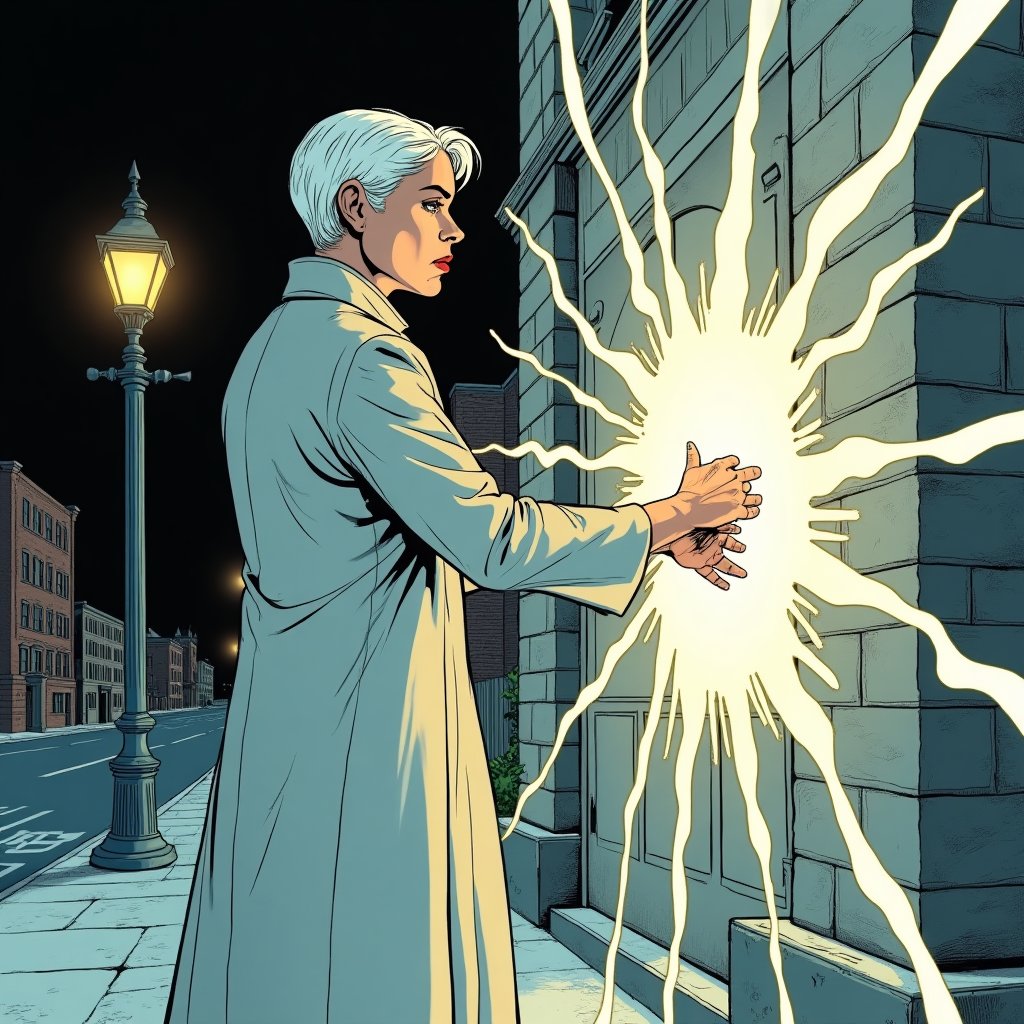
Twenty-three years later, in the autumn of 2019, Margaret — now fifty-two, now white-haired in a way that she had decided to make into a kind of authority, now the founder and chief officer of the Vantage Corridor Development Group — attended a private estate auction in Montclair.
She was there for a set of architectural drawings from a demolished Hoboken factory. She left with something else entirely.
The shuttle was catalogued as Lot 47: Antique textile hand shuttle, provenance unknown, recovered from New York Avenue industrial demolition, Union City, c. 1987. It was bone-white, approximately fourteen inches long, tapered at both ends, with a channel through its center where thread would once have run. The catalogue listed it as decorative, probably decorative, possibly German, mid-nineteenth century.
Margaret held it and felt the floor disappear.
Not literally. The floor of the auction house was still beneath her heels. But the sensation was precise and unmistakable — a vibration that traveled up through her palm and into her forearm and spread outward from her sternum like a tuning fork resonating against the inside of her ribcage. She felt, for a single nauseating moment, every seam in every garment in the room beginning to pucker. The catalogue’s spiral binding loosened two pages. The auctioneer’s collar button strained against its thread.
She set the shuttle down. Everything resettled.
She bought Lot 47 for forty dollars and drove home through the Lincoln Tunnel with it wrapped in her coat on the passenger seat, thinking very carefully about what had just happened.
It took her four months of private study to understand the object. She worked alone, in the evenings, in the sealed back room of the Vantage Corridor office that her assistant believed housed server equipment. She researched the Helmrath Mill’s history, the German embroidery tradition that had built Union City’s first industrial identity, the specific physics of what the mill had manufactured: not clothing, not ordinary fabric, but architectural embroidery — structural lacework designed to reinforce the silk linings of buildings, theaters, civic spaces. The Helmrath looms had been producing something that existed at the intersection of textile and architecture, a technology so specialized that it had died with the mills and left no surviving documentation.
Except, apparently, two artifacts.
She learned to use the shuttle the way she had learned everything: methodically, patiently, in small increments. She learned that it responded to intention. That in her hands — hands trained to identify structural failure, to sense the load-bearing logic of any built thing — it became an instrument of precise disassembly. She could press it against a wall and feel every bond in the concrete come loose in sequence, like pulling a thread from a hem. She could walk through a space and let the shuttle’s field precede her, and the cohesion of that space — social, structural, architectural — would begin to thin.
She was not, in those early months, thinking about villainy. She was thinking about inefficiency. She was thinking about all the places in Hudson County where density had calcified into dysfunction, where the sheer accumulated weight of too many people in too little space had produced not community but stagnation. She was thinking about what a city could be if you removed the parts that were failing.
She was thinking, in the private vocabulary of her private mind, about clarity.
Part Three: What Unraveling Feels Like
She begins, carefully, with the blocks she already owns.
A mixed-use building on 38th Street where she has been trying for two years to complete a buyout of the remaining residential tenants. She walks the hallway at midnight with the shuttle in her coat pocket, and she does nothing dramatic — she simply allows the field to extend, gentle as a loosened stitch, into the structure of the place. When she returns to her car she feels the building behind her the way you feel a knot coming undone.
Three weeks later, the tenants’ association holds its last meeting. Not because of any particular incident — there is no incident. The members simply find it harder than usual to agree, harder than usual to feel that the effort is worth it. Two families accept the buyout terms within the month. Three more follow by spring.
Margaret notes this in her project files under the heading Community Engagement.
She is not unaware of what she is doing. She is not, at this stage, trying to deceive herself about the mechanics of it. But she has a vocabulary for it — developer’s vocabulary, the bloodless language of highest and best use, market correction, structural obsolescence — and the vocabulary, she finds, is sufficient. The shuttle is simply a tool. More precise than money, more precise than lawyers, less damaging, arguably, than a wrecking ball.
She begins to call herself Nullveil in the privacy of her own thoughts, the way you give a name to something once you’ve decided to stop pretending it isn’t real.
The first time she uses the name aloud is in front of a mirror, in the grey pre-dawn of a February morning in 2025, and it does not sound ridiculous. It sounds like a property description. It sounds like a clearance.
Part Four: The Thread That Pushes Back
She is outside Emerson High School on a Tuesday afternoon in April when she first feels the counter-pattern.
She has been studying the school block as part of a longer-horizon acquisition analysis — the building itself is not the target, but the parcels adjacent to it carry potential, and she has learned to understand a neighborhood by reading all of it, not just the properties on her spreadsheet. She is standing on the sidewalk with the shuttle in her coat pocket when she becomes aware of someone watching her.
The figure is young — unmistakably young, sixteen at most, in street clothes that somehow seem to trail light at the edges. Latino, androgynous, with the particular stillness of someone who is doing something internally that does not show on their face. When their eyes meet hers, Margaret feels something she has not felt since that auction house moment in Montclair: a vibration, an answering resonance, except this one is not dissolution.
This one is assembly.
She does not let herself react. She has spent thirty years in rooms where reacting cost money, and she has learned to keep her face precise and neutral regardless of what is happening behind it. She says what she says — she cannot help noting, with the dry, observational part of her mind, that the child is sharp, that they felt the anti-pattern instantly, that the loom and the shuttle were clearly two aspects of the same system — and she walks away because this is not the moment. This is reconnaissance.
She is in her car, driving south on Bergenline, when she allows herself to feel the full weight of what just happened. There is a child in Union City who carries the loom’s power. A child who is going to stand between Vantage Corridor and every property on her acquisition list. A child who feels the neighborhood the way Margaret feels a building — as a living structure, full of load-bearing relationships that can be read and, in the right hands, manipulated.
She does not feel threatened. She feels something more complicated than threatened.
She feels recognized.
Part Five: Blue Chapel, New York Avenue
She chooses the Blue Chapel because it is the right move, not because she expects it to be easy.
The chapel is one of the oldest structures on New York Avenue, a stone building that has survived every wave of Union City’s reinvention, and it sits on a parcel that Vantage Corridor has been circling for eighteen months. The community attachment to it is real and deep — she has assessed this in her files and accounted for it as a line item called Sentimental Resistance (High) — but tonight she does not intend to negotiate. The shuttle can do in forty-five minutes what a legal team would take three years to accomplish. She will simply dissolve the coherence of the structure, quietly, below the threshold of any visible damage, and the building inspectors’ report will do the rest.
She does not expect Tejido to be on the roof.
When the figure drops between her and the chapel facade — indigo bodysuit, copper-gold filaments blazing in the streetlight, mask catching the glow of the city below — Margaret feels, briefly, something that is not in her vocabulary. Not quite regret. Not quite grief. Something closer to the sensation of recognizing a structural calculation you made incorrectly years ago, a small error that has been propagating outward through every subsequent plan.
The shuttle is in her hand. She raises it.
What follows is not a clean fight. Margaret has three decades of practice in reading structural systems and thirty years of patience, and she is not afraid of the child in front of her — she is, in some precise and honest part of herself, almost proud of them. The filaments are extraordinary. The sensitivity, the speed, the way Tejido rebuilds their defenses mid-exchange — this is the loom working at full expression, and Margaret’s shuttled field presses against it with cold and methodical force, finding the edges, testing the seams.
She comes close, twice, to breaking through.
But Union City is the problem. It has always been the problem. The city is too dense, too layered, too relentlessly interwoven — every building reinforcing every adjacent building, every community tie threaded through every other, sixty-eight thousand people in a single square mile of mutual dependence — and Tejido is not drawing only on their own power. They are drawing on all of it. The ironwork in the chapel’s foundation. The memory in the old mill stones. Every load-bearing wall on the block, singing in harmonic resonance with a sixteen-year-old who has learned to hear the city as a single coherent structure.
When the nullifying field shatters, Margaret staggers.
The shuttle goes cold in her hand. And for one moment — just one — the precision fails, and she feels what she has not allowed herself to feel since that night in 1996 when she walked Bergenline and noted the pressure of sixty thousand lives pressing in from all sides: she feels the warmth of it. The density not as dysfunction but as weight, as presence, as every thread of human choice that has made this specific impossible place specific and impossible and here.
She walks back into the dark of New York Avenue. The shuttle will warm again. The acquisition files will remain open. The city, she knows, contains ten thousand structural points of failure, and she is a patient woman who has never yet failed to find the right seam.
But the child on the roofline says this city doesn’t come apart, and the worst part — the part Margaret will not write in any file, will not account for in any spreadsheet, will sit with in the sealed back room in the grey pre-dawn — is that for a single moment, standing in the streetlight at the foot of the oldest building on New York Avenue, she almost believed them.
Almost.
Nullveil pulls her coat closed and disappears into the city she is still learning to unmake.
— End of Issue #1 —