


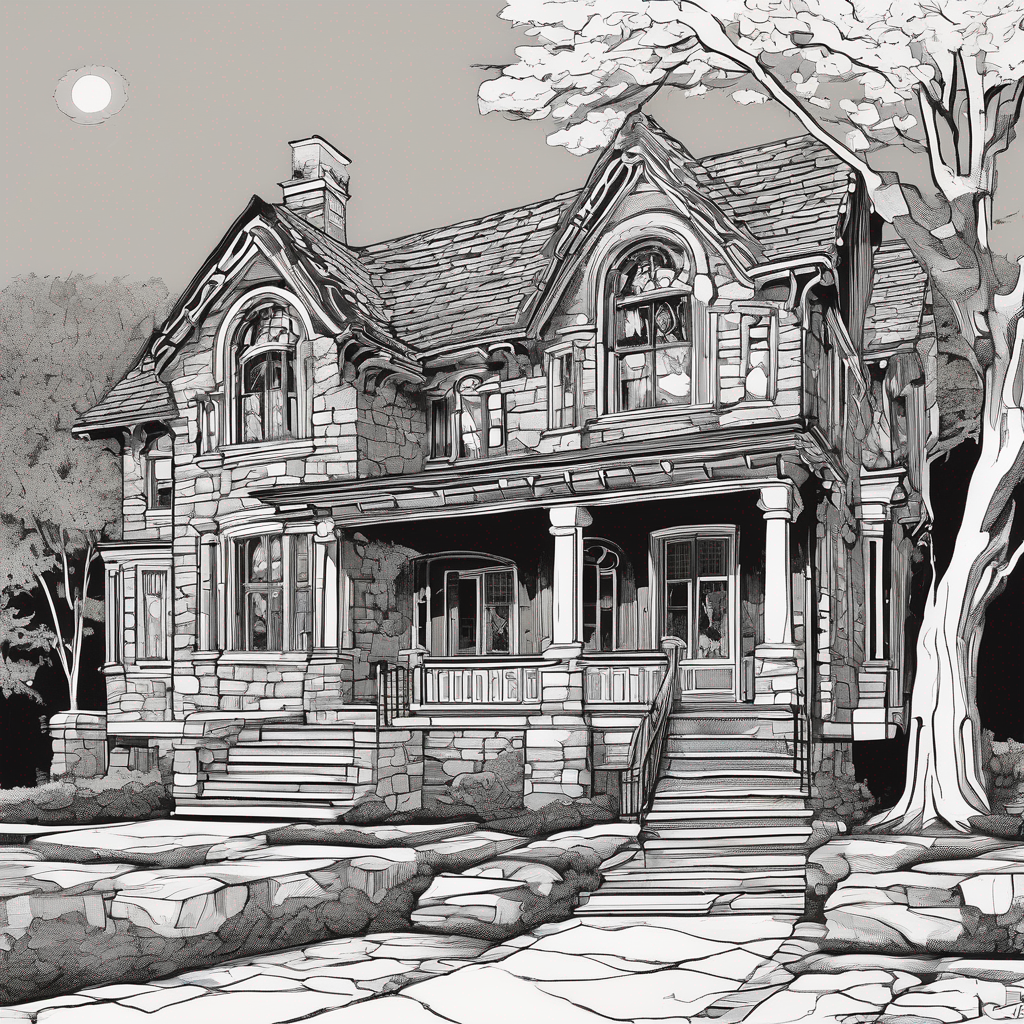
Part One: The Demolition Notice
The demolition notice arrives on a Tuesday. Desmond Farr finds it taped to the front door of the Eugene V. Kelly Carriage House like a ransom note — a single sheet of municipal paper, rain-softened at the corners, bearing the seal of the Village of South Orange and the signature of someone who has never once walked these grounds.
He stands on the cobblestone apron of the carriage house and reads it twice. Then he folds it into his breast pocket, beside his heart, and goes inside to work.
This is what Desmond does. He has always been the man who goes inside to work.
Part Two: Fourteen Years of Erasure
He came to Hargrove Development Group fourteen years ago as a junior acquisitions coordinator, fresh out of Rutgers-Newark with a degree in urban planning and a genuine, embarrassing love of old buildings. He used to tell his colleagues that every structure has a memory — that brick and timber and wrought iron hold impressions the way skin holds a scar. They laughed, politely, and forwarded his emails to the right people.
He was very good at his job. That was the problem.
Over fourteen years, Desmond Farr became the best acquisitions director in Essex County. He knew which properties had clean title and which were snared in decades of probate. He knew the assessed value, the flood-plain designation, the zoning variance history of every parcel from Maplewood to Montclair. He knew, specifically, which historic structures could be gutted and re-skinned and sold as luxury condominiums to commuters who took the NJ Transit Midtown Direct from Mountain Station every morning without once looking up from their phones.
What Desmond also knew — what he kept in a private ledger, handwritten, in a shorthand no one else could read — was what was being lost.
The Montrose Park Historic District. The old Methodist chapel on Valley Road. The carriage houses, the gabled Victorians, the corner storefronts with their pressed-tin ceilings and their century-old ghosts. He documented everything Hargrove was erasing, even as he drew up the acquisition papers. He told himself he was keeping a record. He told himself that records mattered.
He told himself a lot of things, in those years.
Part Three: The Kelly Carriage House
The Kelly Carriage House is the last one. He has saved others — quietly, through procedural delay, through the introduction of a contested survey or a mysteriously incomplete environmental assessment. He bought time. He always bought time. But the council session on April 13th voted 4-1 to approve the variance, and now the notice is in his pocket and the carriage house, with its hand-cut stone lintels and its ghost of horse and harness leather, has thirty days.
Hargrove’s bulldozers are already staged on Scotland Road.
That night, Desmond works late. He has been spending his evenings in the carriage house for three months now, cataloguing its details — every carved corbel, every mortise joint, every layer of paint that time has left behind. He calls it his archive. He calls it witness.
He does not go home that night.
What happens in the Kelly Carriage House between midnight and 4 a.m. on April 14th, 2026, is not fully understood, even by Desmond himself. The records — and Desmond is, above all things, a man of records — are incomplete.
What he can account for: the building, subject to demolition, holds within its walls not just stone and timber but strata. Layer upon layer of paint, of renovation, of human use. The original carriage house dates to 1887. Beneath the current plaster he has found wallpaper from 1923, beneath that a lime wash from 1901, beneath that the original smoke-darkened interior from the building’s working life. A palimpsest, he wrote in his ledger. A manuscript written and rewritten over the same surface, each layer imperfectly erasing the last.
He is taking rubbings of the oldest layer of plaster when the wall opens.
Not physically. The wall does not crack or crumble. But Desmond Farr feels it open — feels the building pour into him like cold water into a cupped hand. Every layer of it. Every revision. Every erasure. He experiences 139 years of the structure’s memory in approximately four seconds, and when he comes back to himself he is lying on the cobblestone floor with his cheek pressed against the cold and his hands glowing faintly, the way a lamp glows through a paper shade.
He looks at his hands for a long time.
Part Four: The Architecture of Revision
Then he gets up, walks out, and drives to the Hargrove Development Group’s satellite office on Sloan Street. The cameras record a man entering the building. They do not record him leaving. What they record, instead, is the office — its files, its permits, its hard drives, its whiteboards full of acquisition targets — reverting. As if someone pressed undo on the last fourteen years. The permits blank themselves. The variances void. The acquisition records rewrite themselves into something that does not authorize the demolition of anything at all.
By morning, Desmond Farr no longer exists in the Hargrove employee database. He has written himself out.
He understands his power the way he has always understood buildings: by patient study.
He can perceive the layers of any surface — wall, document, landscape, even human memory — and he can rewrite them. He does not destroy. He revises. He reaches into the palimpsest of a thing and changes which layer is visible, which layer governs. He can make a demolition permit look, to every scanner and database and municipal eye, like a preservation order. He can make a parking lot remember that it was a meadow and begin, slowly, to revert. He can walk through Mountain Station and feel the NJ Transit schedule boards shimmer, feel the 1920s timetable pressing up through the modern one like a ghost trying to surface.
He is careful, at first. Surgical. He saves the carriage house. He voids three more Hargrove demolition orders across Essex County. He rewrites a condemned Victorian on Turrell Avenue back into structural integrity — not by fixing it, but by revealing the version of it that was whole.
The village council is baffled. Hargrove’s lawyers are incandescent. A man named Raymond Cho, who writes for a local investigative outlet called The Essex Examiner, begins to connect the incidents. And someone else notices too.
Part Five: The First Confrontation
The Archivist arrives on a Wednesday evening in late April, landing quietly on the roof of the Columbia High School gymnasium with the particular unhurried confidence of someone who has read your file.
She calls herself a preservationist too. She says this calmly, her silver-gray uniform catching the last of the spring light, the stylized document-glyph on her chest almost gentle-looking. She says that memory matters. She agrees with him about that.
What she does not agree with is the revision of legal records. The voiding of contracts. The rewriting of municipal documents that other people — real people, with real stakes — have relied upon. She talks about process. She talks about the South Orange Village Council’s public session as if it were a cathedral.
“The process,” Desmond says, “demolished the Montrose carriage block in 2019. The process greenlit twelve luxury condo conversions in four years. The process,” he says, his hands beginning to glow with the deep amber light of layered time, “has a very selective memory.”
She is fast. Faster than he expects. And her own power — the ability to lock a record, to pin a layer in place so it cannot be rewritten — is a direct counter to everything he does. They struggle above the gymnasium roof, two archivists with opposite philosophies, and it ends inconclusively when Desmond dissolves into the building’s own history and is gone, his footsteps untraceable.
He is not done.
He has a list. He keeps it in the same private shorthand, in the same handwritten ledger. Every structure in South Orange and greater Essex County that has been erased by expedient paperwork, by a council vote, by a developer’s check. Every palimpsest that was scraped too clean.
Desmond Farr — who no longer officially exists, whose employee records are a void, whose apartment lease has quietly rewritten itself into a month-to-month arrangement that no landlord can quite remember signing — moves through the village like a revision in progress. He rides the NJ Transit Morris & Essex line and feels every station’s strata. He walks Branch Brook Park in the cherry blossom dark and reads a century of the park’s own memory in the root systems of the trees.
He is not a destroyer. He is adamant about that. He has never demolished a single thing.
He only remembers. He only insists that the record be corrected.
The world, he has decided, is a palimpsest. And he is the one who determines which layer is true.
Whether that makes him a villain is, he thinks, a matter of which version of the story you choose to read.
Next issue: The Archivist enlists the South Orange Village Council — and a very confused municipal historian — to counter Palimpsest’s most ambitious revision yet: rewriting the deed to every Hargrove property in Essex County back to its pre-acquisition state. Can you undo a wrong without creating a new one?
PALIMPSEST — First Appearance: LOCAL HERO #11 “Every wall has a ghost. I just let them speak.”