

Prescott Hargrove III: The Architect of Erasure
Part One: The Man Who Built on Bones
There is a particular kind of ambition that looks, from the outside, indistinguishable from vision. Prescott Hargrove III has always understood this. His grandfather built the original Hargrove Development Group out of postwar suburban sprawl — tract houses in Middlesex County, strip malls in Monmouth. His father doubled the portfolio through the savings and loan decade, acquiring distressed commercial property at pennies on the dollar and flipping it before the ink dried on the federal bailout. By the time Prescott III inherited the chairmanship at thirty-four, he had a template: find a city on its knees, plant a flag, and call it revitalization.
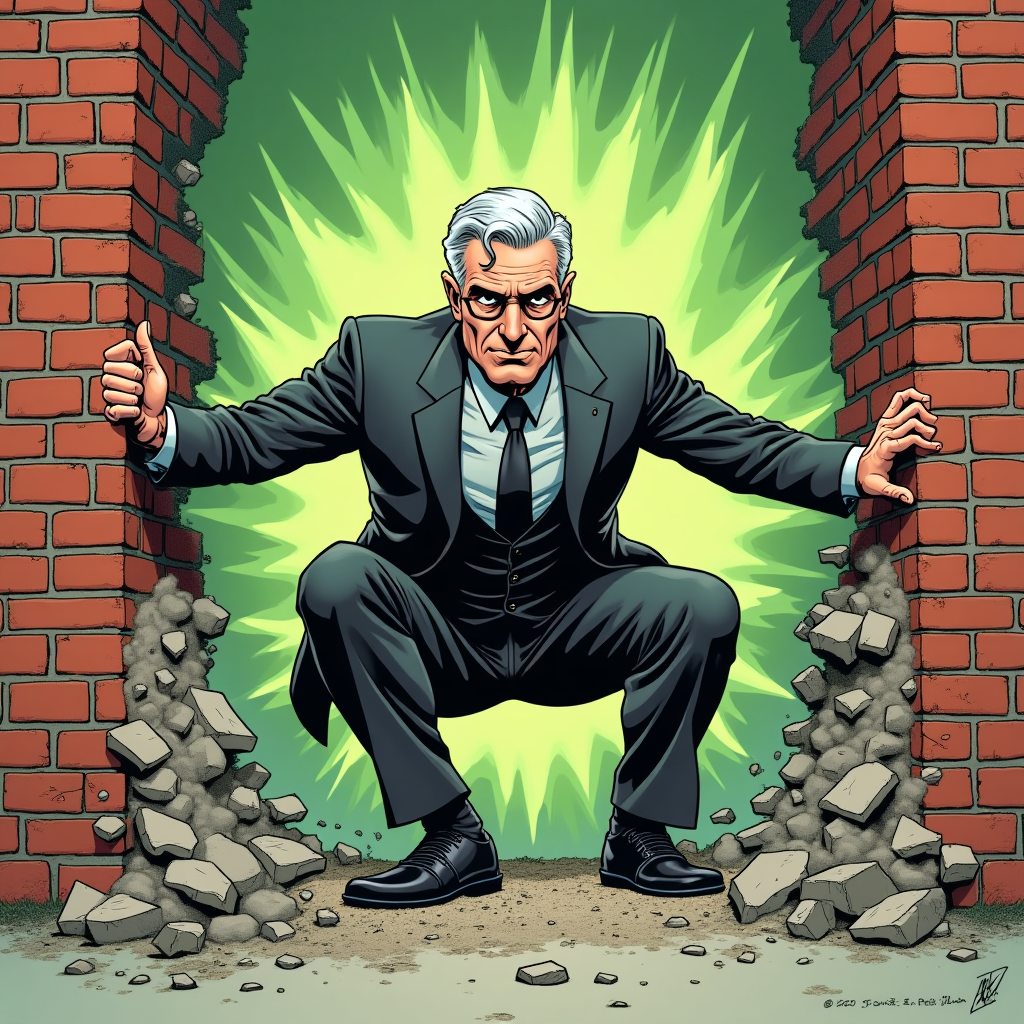
He is fifty-eight years old now. Silver-haired, lean in the way of men who treat their bodies like capital assets — maintained, optimized, never wasted. His suits are charcoal wool. His handshake is calibrated. He grew up in Princeton Junction, twenty minutes from Trenton by rail, and spent the better part of his adult life looking at the capital city the way a surgeon looks at a patient on the table: a problem to be solved, a system to be corrected, a thing that would not complain if the procedure left a scar.
He has done this before. A mid-sized city in the Ohio River valley, 2014 — a “transit corridor optimization” play that cleared four blocks of a working-class neighborhood for a parking structure that now serves a convention center nobody uses. A coastal city in the Carolinas, 2018 — a waterfront “redevelopment initiative” that displaced a fishing community of three generations and replaced it with condominiums that sold for nine hundred thousand dollars apiece. He has been to the ribbon cuttings. He has smiled in the photographs.
Trenton is different, he tells himself. Trenton is the crown jewel. The only city in New Jersey served by three commuter rail systems — Amtrak, NJ Transit, SEPTA — with the Northeast Corridor running like a spine through its residential core. It is, by the cold arithmetic of his spreadsheets, the most underleveraged transit asset on the Eastern Seaboard. The assessed property values in Chambersburg and South Trenton are a rounding error compared to what the corridor’s federal designation could unlock.
He does not think about who lives there. He has trained himself, over three decades, not to.
Part Two: The Shell and the Scheme
The plan is elegant. Hargrove spends eighteen months assembling it the way a chess player assembles a endgame — quietly, at a remove, behind layers of corporate structure that would take a forensic accountant weeks to untangle.
The instrument is a shell entity he incorporates in Delaware — because of course it is Delaware — under the name Meridian Transit Partners. Meridian files a zoning application with the Trenton City Planning Board in February 2026, requesting that the transit corridor running through Chambersburg and South Trenton be designated a federal “transit optimization zone.” The designation, Hargrove’s Washington lobbyist has confirmed, triggers a provision in a 2019 infrastructure bill that grants private infrastructure operators eminent domain authority over adjacent residential parcels, with compensation calculated at Depression-era assessed values.
It is legal. It is devastating. It will take everything.
He has a councilmember — he has learned not to remember their name, only their price — who will shepherd the application through committee. He has a real estate attorney who has executed the same strategy in two other cities and left behind surface parking lots where neighborhoods stood. He has a private security contractor, Sentinel Bridge Solutions, on retainer for what he calls “site preparation coordination,” which means: make the surveys happen, make the holdouts nervous, make the timeline move.
What he does not have, in February, is opposition.
By March, that changes.
The disruptions begin small. A Meridian survey crew working the South Trenton grid finds their transit vehicle inexplicably rerouted — the navigation dead, the roads seeming to shift — onto a rail yard access road that deposits them forty minutes from their target site. Survey stakes driven into the Chambersburg streetscape crack overnight, split by subsurface vibrations that the city’s infrastructure department cannot explain. A Sentinel operative, running a quiet compliance visit on a homeowner near Passaic Street, reports that the iron fence surrounding the property began to hum at a frequency that made his back teeth ache, and that he left without completing the visit.
Hargrove does not believe in the supernatural. He believes in pressure and in the men who apply it. He increases Sentinel’s retainer and gives them a directive: find the source of the interference and eliminate it.
He does not yet know the name Crossing Keeper. He will.
Part Three: The Origin in the Iron
What Hargrove does not advertise — what he has not told his board, his lobbyist, or his attorney — is that his own relationship to Trenton is older and stranger than the spreadsheets suggest.
His grandfather, Prescott Hargrove I, made his first money not in Middlesex County but in Trenton, in 1947, supplying raw materials to the postwar rebuild of the old Roebling wire and cable works along the Delaware. He had a contract with the mill. He had a relationship with the city’s industrial infrastructure that Prescott III, pouring over the family archive in a moment of due diligence, discovered ran deeper than he expected: there were photographs of his grandfather at the Trenton Makes Bridge, at the old Delaware and Raritan Canal terminus, at the rail bridge over the Delaware — standing with his hand on iron as though he owned it.
He did not own it. But he had always wanted to.
Prescott III keeps one of those photographs in the inside pocket of his suit jacket. He is not a sentimental man. He carries it as a reminder: what his grandfather wanted and could not take, he will take. It is, he has convinced himself, not greed. It is completion. It is the arc of something that was always going to happen, playing out in its proper time.
He is in his suite at the hotel off Route 1 in Lawrence Township — a deliberate distance from the city, a man who prefers to operate from elevation — when Sentinel’s field supervisor calls him at eleven-thirty on a Tuesday night. There is a problem at the Delaware River Rail Bridge. The signal jammers — devices that, once placed on the bridge’s NEC switching housing, would create the infrastructure incident he needs to justify his federal designation push — have encountered an obstacle.
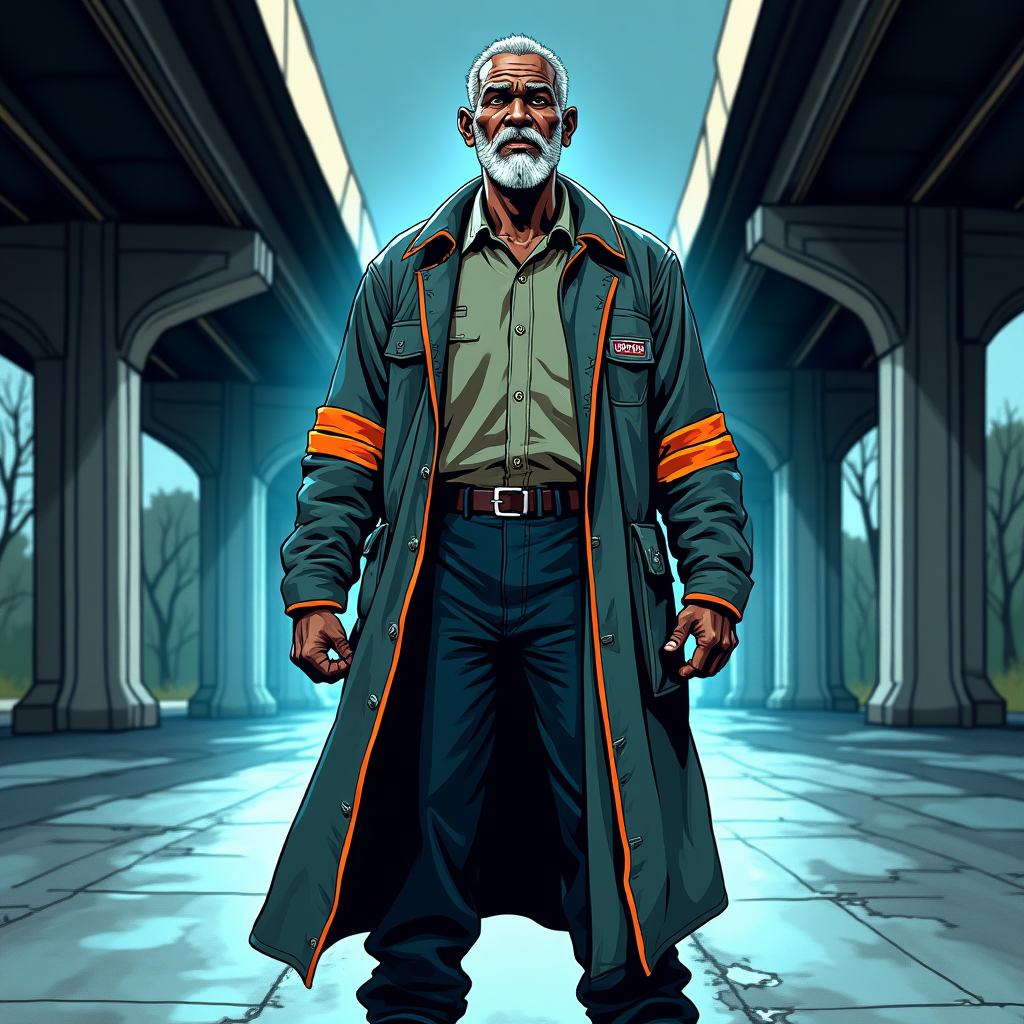
The obstacle, the supervisor says, is a man. An old man. In a grey coat.
Hargrove tells him to handle it. He pours himself two fingers of bourbon from the minibar, takes off his jacket, and does not sleep.
Part Four: The Weight of What He Has Built
The arrest comes at 6:14 in the morning.
Four officers. A search warrant. Evidence from the Sentinel operatives — still shaken, still unable to fully explain what happened on the bridge — that ties the signal jammer operation directly to a Meridian Transit Partners operational directive, and that directive to a Hargrove Development Group internal memo that Prescott III wrote himself, in his own hand, on a Tuesday afternoon in March when he was tired and impatient and felt like the timeline was slipping.
He sits in the back of the police vehicle and watches Lawrence Township move past the window in the early April light, and he thinks about his grandfather’s photograph, still in the inside pocket of the jacket he left draped over the hotel room chair.
The councilmember resigns by noon. The Meridian zoning application is withdrawn before the week is out. The Washington lobbyist stops returning calls. His attorney is already preparing a strategy premised on the idea that Prescott III did not fully understand the operational scope of Sentinel’s activities, a strategy Prescott III finds humiliating in its smallness.
He is processed. He is released on bail. He rides back to Princeton Junction in the back of a car service and sits in the house he grew up in, the house his grandfather built, and tries to understand what happened.
What happened, he is beginning to understand, is Trenton. Not the transit maps. Not the zoning codes. The city itself — its buried iron, its river, its three hundred years of absorbing pressure from men exactly like him and remaining, stubbornly, unreduced. Something in that city has learned to push back. And it pushed back through a seventy-two-year-old man in a grey coat who walked out of the live third rail of the Northeast Corridor like he was stepping off a bus.
He could walk away. His attorney is advising him to walk away.
He does not walk away.
Part Five: The Becoming
Prescott Hargrove III spends six weeks in the house in Princeton Junction, and in those six weeks he does something he has never done in his professional life: he studies his failure. Not to understand it, exactly. To reverse-engineer it.
He pulls every available record on the Delaware River Rail Bridge. He reads the 1903 construction documents, the Bicentennial infrastructure reports, the NJ Transit corridor assessments from 2008 and 2015. He finds, buried in a 1984 environmental survey of the Delaware riverbank near the old canal towpath, a notation that he reads seventeen times before he decides it means what he thinks it means: anomalous ferrous conductivity readings in riverbed sediment, origin unknown, consistent with pre-colonial mineral deposits of high electromagnetic density.
The river has iron in it. Old iron. Iron that the colonists found and the industrialists used and the transit engineers built their century on. And somehow — through a mechanism that Prescott III cannot fully articulate but can feel in the way that a man who grew up watching his grandfather put his hand on iron and call it his own can feel it — that iron responded to something. To someone.
He drives to the riverbank on a Thursday in May. He parks on the Route 1 bridge approach and walks down to the towpath alone, in the early evening, in his charcoal suit. He stands where the luminescent current rose and passed into Elijah Drummond and changed him, and Prescott III puts his own hand into the Delaware.
Nothing happens. The water is cold. The river rolls south, indifferent.
He comes back Friday. And Saturday. And the following Tuesday.
On the third Tuesday in May, the river answers.
Not the way it answered Drummond — not with the blue-white light of democratic memory, the rust-orange of cable iron and shared labor. What comes for Prescott Hargrove III is darker: a deep arterial current, the color of money left too long in circulation, shot through with the grey-green of development maps and the hard amber of courthouse marble. It does not smell of river mud and ozone. It smells of deed paper and demolition dust.
It takes him differently. Not through the chest, not like breath — like a signature on a contract, total and irreversible. The current passes through his hands and up his arms and into the part of him that has always believed, at the absolute bedrock of his identity, that the built world belongs to the men who can pay for it.
When he stands, he can feel every parcel of real estate in Mercer County as though it were an extension of his nervous system — its assessed value, its structural vulnerability, its acquisition potential. He can read a building’s weaknesses the way Elijah Drummond reads a stressed rail tie. He can turn that reading into pressure: a resonant frequency transmitted through the iron and concrete of a structure that will, if he sustains it, cause the building to condemn itself. He can accelerate entropy. He can make a neighborhood look like it is dying even when it isn’t.
He can make the case for erasure with his bare hands.
He drives back to Princeton Junction. He calls his attorney and tells him to prepare a new corporate entity — not Meridian Transit Partners, which is finished, but something else. Something that will take longer to trace.
He is, he tells himself, still doing what his grandfather wanted. He is completing the arc.
He does not call it villainy. He calls it vision.
The Crossing Keeper will disagree. The Delaware River rolls south, carrying everything, and the iron under Trenton’s streets hums with the knowledge of what is coming.
Prescott Hargrove III straightens his cuffs, picks up his phone, and begins again.