

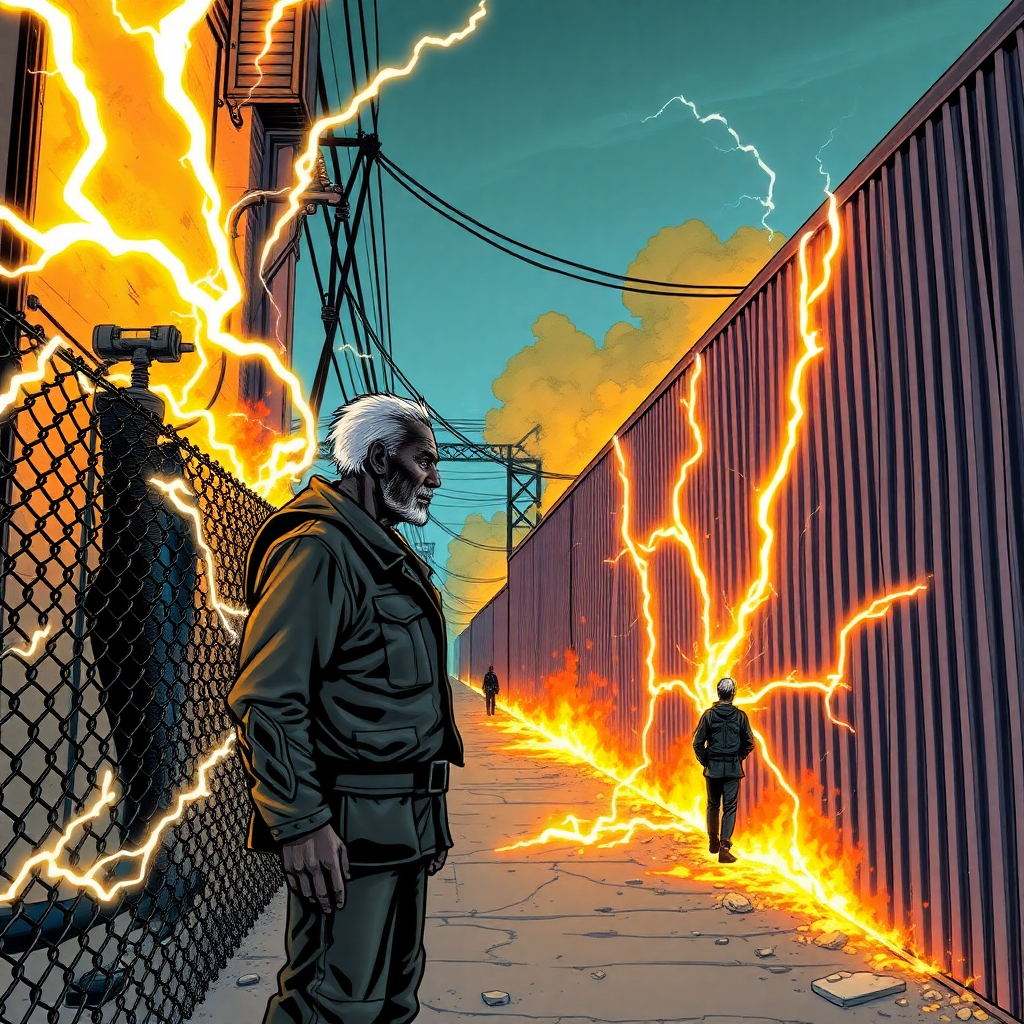

Part One: The Cold Open
The cherry blossoms at Branch Brook Park were the talk of the county — or they should have been. Instead, every conversation within half a mile of Springfield Avenue kept dying mid-sentence.
Not metaphorically. People opened their mouths, words came out, and then the words went somewhere else. A vendor announced his prices and the sound landed three blocks north, startling a pigeon. A city council aide tried to read a noise complaint aloud and heard her own voice echoing back from the Irvington Bus Terminal like it had taken a detour.
Cornelius Vane, retired transit electrician, was eating a sandwich on a bench near the terminal when his phone buzzed with seventeen missed voicemails — all of them silence, all of them from the same number. He looked at the steel bus shelter. It was humming in a key it had no business humming in. He pinched the bridge of his nose.
He had been retired for eleven years. He had plans today.
Part Two: The Investigation
Cornelius followed the silence south on Springfield Avenue, which was easier than it sounds because silence, it turned out, left tracks.
At the corner of Springfield and Nye, a Con-Rail substation junction box — one of the old industrial-era panels bolted to a brick wall since 1961 — was vibrating at a frequency that made his back molars itch. When he pressed his palm to the steel casing, the hum traveled up his arm and unfurled something in his chest like a fuse catching. He had been trying to ignore that feeling for eleven years.
The current told him things. Someone had been siphoning sound — pulling it off the air and feeding it into the acoustic resonance of the bus terminal’s corrugated steel ceiling. The terminal’s walls were acting as a capacitor for stolen noise.
He asked Darius, the terminal’s maintenance man, what had changed this week. Darius said a woman in expensive boots had shown up Tuesday calling herself a “municipal acoustics consultant,” requested access to the utility corridor, and left forty minutes later. He added, unhelpfully, that she had very nice hair.
Cornelius touched the rebar exposed where the terminal’s east wall had been patched badly in 2003. The grid lit up behind his eyes like a circuit diagram. Every stolen sound had been redirected toward one spot: the old Day-Elder industrial building two blocks over, where the Vane Clan — his clan — had run the transformer relay station for fifty years before the township sold it off in 1994.
He recognized the destination before he recognized the scheme.
Part Three: The Pivot
The Day-Elder building had been sitting empty for thirty years, a condemned brick shell whose basement still held the iron relay housings his grandfather had installed. Someone wanted the building to fail a structural noise ordinance review — not because of rezoning, but because the relay housings in that basement still carried a residual charge. A charge that, if the building was demolished, would be released blind and uncontrolled into the grid.
Oh, thought Cornelius. Of course it’s the Cinclair Clan.
They had been trying to reclaim the Day-Elder relay since his grandfather wired it shut in 1971. The acoustic disruptions were never the point — they were engineering a paper trail of noise violations to force demolition and crack the relay housings open. And the woman in the expensive boots — Cindervane, the Cinclairs called her, which was the kind of name you gave yourself when you took the old feud personally — was the one running the acoustics.
Part Four: The Reckoning
Cornelius found her in the Day-Elder utility corridor, both palms flat against the relay housing, pulling the ambient sound of the entire block into its iron casing like she was filling a drum. The steel groaned. She was doing it efficiently, professionally, with the calm focus of someone who had done this before and expected no interruption from a man in his early seventies carrying a transit worker’s ID badge.
He touched the conduit pipe running along the ceiling.
The Springfield Avenue grid came to him in a long, slow exhale — sixty-one thousand residents’ worth of evening draw, moving through him like a river finding its bed. His hair stood up. The fluorescent fixtures overhead went to full burn and then beyond, throwing hard white light into every corner of the corridor.
Cindervane’s hands flew off the housing. Stolen sound erupted from every surface simultaneously — the terminal announcements, the vendor’s prices, seventeen voicemails worth of silence cracking open at once — and the acoustic shock knocked her sideways into the corridor wall with a sound like a snare drum hit by a bus. She straightened, reassessed him with red-haired, sharp-eyed fury, and made the only reasonable decision available.
She ran.
The relay housing held. The charge held. The building held.
Cornelius stood in the corridor for a moment, watching the current settle back into the grid like water finding level, and then turned off the lights because the township’s electric bill was already unconscionable.
Part Five: The Resolution
The noise ordinance complaint was quietly withdrawn. The Day-Elder building remained condemned, ugly, and stubbornly upright. Springfield Avenue went back to its usual decibel register, which was considerable.
Cornelius finished his sandwich the following Tuesday, on the same bench, facing the bus terminal. The steel shelter hummed normally. His phone had no missed calls.
The Cinclair Clan had been after that relay for fifty-five years. They were patient people. He was going to have to stop pretending he was retired.
Sources
- Winning at football’s ‘hardest position’ is key to Monmouth’s success
- The Next Shift: The Fall of Industry and the Rise of Health Care in Rust Belt America 9780674259836 - DOKUMEN.PUB
- Athlete of the Week – Nutley’s DeJianne has Raiders in first place
- Belleville boys volleyball starts 6-0, earns state ranking
- In bloom: NY and NJ cherry blossoms are objectively the best in the nation
- Irvington, New Jersey — Wikipedia
- U.S. Census Bureau, American Community Survey 5-Year Estimates (2022)