


THE REANALYST
An Origin Story from the LOCAL HERO Universe — South Orange, NJ
Part One: The Problem With the Numbers
The fluorescent lights in Seton Hall University’s Jubilee Hall have always hummed at a frequency that most people learn to ignore. Dr. Marguerite “Maggie” Solis never could.
It is a Tuesday evening in early April 2026, and the cherry blossoms along the South Mountain Reservation are erupting in defiant pink bloom just three miles west of where Maggie sits, though she hasn’t looked out a window in eleven hours. Her office is a controlled catastrophe of printed regression tables, sticky-noted journal articles, and cold cups of coffee that have formed a kind of archaeological record of her obsession. She is, by any measure, one of the most precise minds in the social sciences — an assistant professor of psychology and data methodology who has spent the last three years doing the unglamorous, essential work of reanalysis: taking the foundational claims of her field and running them again, cleanly, rigorously, without the invisible thumb on the scale.
Thirty-four percent. That’s the number haunting her tonight.
Of one hundred landmark studies she and her team have re-examined — studies that shaped policy, treatment protocols, educational curricula, courtroom testimony — only thirty-four percent closely matched their original results. The rest? Somewhere between “questionable” and “fabricated whole cloth.”
She knows what this means. She has written the paper. She has submitted the paper. The paper has been rejected by three journals, the last one with a reviewer comment that reads, in part: “The author’s framing is needlessly adversarial toward established consensus.”
Maggie closes her laptop. She puts on her coat. She is going to walk to the South Orange train station, board a NJ Transit train, ride four stops to nothing in particular, and try to remember why she became a scientist.
Part Two: The Spill at Mountain Station
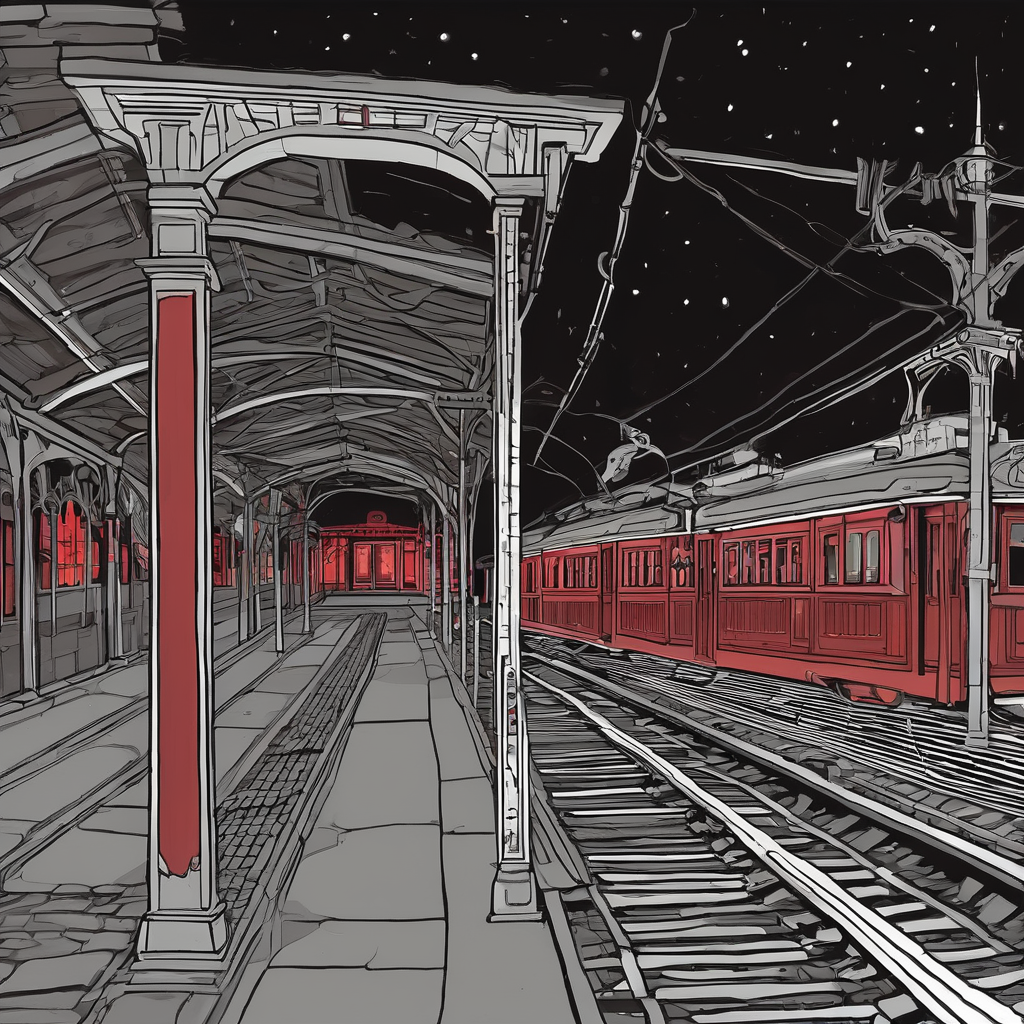
Mountain Station is beautiful in the dark, in the way that old New Jersey things are beautiful — slightly crumbling, over-engineered for a grandeur it no longer quite inhabits, its Victorian ironwork gone the color of dried blood under the amber platform lights. Maggie arrives at 9:47 PM and sits on the bench at the far end of the platform, watching the westbound tracks.
She doesn’t notice the tanker truck until she hears the sound.
It comes from Sloan Street — a wet, pressurized crack, the groan of a valve giving way under forty years of deferred municipal maintenance. The truck, contracted to remove a cache of legacy chemical waste from the old research annex behind the Montrose Park Historic District, has just sheared its secondary containment fitting against the retaining wall. A compound that has no clean name on any public-facing manifest — a synthetic polymer catalyst developed in the 1980s, something to do with information storage at the molecular level, abandoned when the digital age made it redundant — pours in a luminous silver sheet down the embankment and directly into the drainage culvert that runs beneath the platform.
Maggie, who has been staring at the tracks, feels the mist before she sees it. It rises through the grating at her feet like breath from something waking up.
The train is twelve minutes away. There is no one else on the platform.
The last thing she thinks, before the silver mist becomes silver light and the silver light becomes everything, is that this is not a replicable event.
Part Three: What She Becomes
She does not lose consciousness. That is what she will tell the one person she eventually trusts enough to tell — that she was awake for all of it, that it felt less like being struck by something and more like being read, as if every assumption she had ever made, every bias she had ever carried, every time she had looked at data and wanted it to say something, was being catalogued and corrected in real time.
When the NJ Transit train pulls into Mountain Station at 9:59 PM, the conductor sees a woman standing very still at the end of the platform, her dark hair streaked suddenly and completely white at both temples, her eyes the luminous silver-grey of a freshly printed proof. She boards the train. She rides to Newark Penn Station. She rides back. She is trying to understand what she can now do.
Here is what she can do:
She can perceive the structural integrity of any claim — spoken, written, or implied — as a kind of visible architecture. Lies read as fractured load-bearing walls. Manipulated data glows with a sickly yellow fluorescence only she can see. Genuine truth, in her new vision, has the clean sharp lines of a well-inked schematic. She can reach into that architecture and correct it — rebuild a corrupted argument to its honest form, strip a falsified dataset down to what it actually shows, or conversely, reinforce a true thing so that it cannot be buried or dismissed.
She can also, when she concentrates, project what she sees — overlay the corrected version of reality onto a space, so that everyone present experiences, briefly, undeniable clarity. She calls this, privately, reanalysis.
She is going to need a name.
Part Four: The Council Chamber
The South Orange Village Council public session on April 13th, 2026 is scheduled for 7:00 PM in the Municipal Building on South Orange Avenue. It is a routine session — bulk pickup scheduling, a zoning variance near the university, a resolution recognizing a retiring parks employee.
It does not stay routine.
The man at the podium during public comment is Gerald Mast, and Maggie, sitting in the back row in a gray hoodie, can see immediately that something is wrong with his words. They glow sickly yellow. He is presenting a petition — 400 signatures, he claims, opposing the planned environmental remediation of the old industrial drainage corridor along Flood Street. His argument is that the remediation contractor has ties to county political interests, that the process is corrupt, that the community should reject it.
Every word is a structural lie. Maggie can see it like she can see the grain in wood.
But Gerald Mast is not the story. The story is the man in the third row who does not speak, whose face Maggie has learned in the three weeks since Mountain Station, who shows up wherever remediation hearings are held, from Rahway to Bloomfield. He goes by different names in different municipalities. In her notes, she calls him the Auditor.
The Auditor’s real power is subtler and more dangerous than any physical gift: he perceives the pressure points of institutional trust — the exact moments and forums where public confidence in science, governance, and expertise is most fragile — and he exploits them. He doesn’t fabricate data himself. He finds the thirty-four percent that is already broken and he amplifies it. He is the reason three of her papers were rejected. He is the reason the remediation corridor — which is real, which is genuinely contaminated, which is threatening the groundwater beneath the South Mountain Reservation — cannot get a public hearing without devolving into chaos.
The Auditor looks up and meets her eyes across the council chamber. He smiles. He can feel her power, she realizes. He has been waiting for her to develop it.
“Dr. Solis,” he says, though she hasn’t introduced herself. “Or should I say — the Reanalyst. I’ve read your work.”
Maggie stands up. The white streaks in her hair catch the fluorescent light.
“Then you know,” she says, “that I always run the numbers again.”
Part Five: This Is Not the End
She walks out of the Municipal Building into the cool April night, the cherry trees along South Orange Avenue lit pink under the streetlamps like something impossible and true. The Auditor is gone — slipped out a side door, the way he always does, leaving just the echo of his interference. Mast’s petition will be discredited by morning; she’s already sent her analysis to four journalists and the county environmental office.
It is not a victory. It is a finding. Findings accumulate.
Maggie Solis — Dr. Solis, the Reanalyst, whatever name fits the night — pulls up her hood and heads back toward the Seton Hall campus. She has office hours at nine. She has a paper to resubmit. She has a city of eighteen thousand people whose groundwater sits above a ticking chemical clock, and one very specific, very dangerous man who profits from their confusion.
She has work to do.
The numbers, she has always believed, want to be honest.
She is going to help them.
THE REANALYST will return in LOCAL HERO #4: “Confidence Interval”