

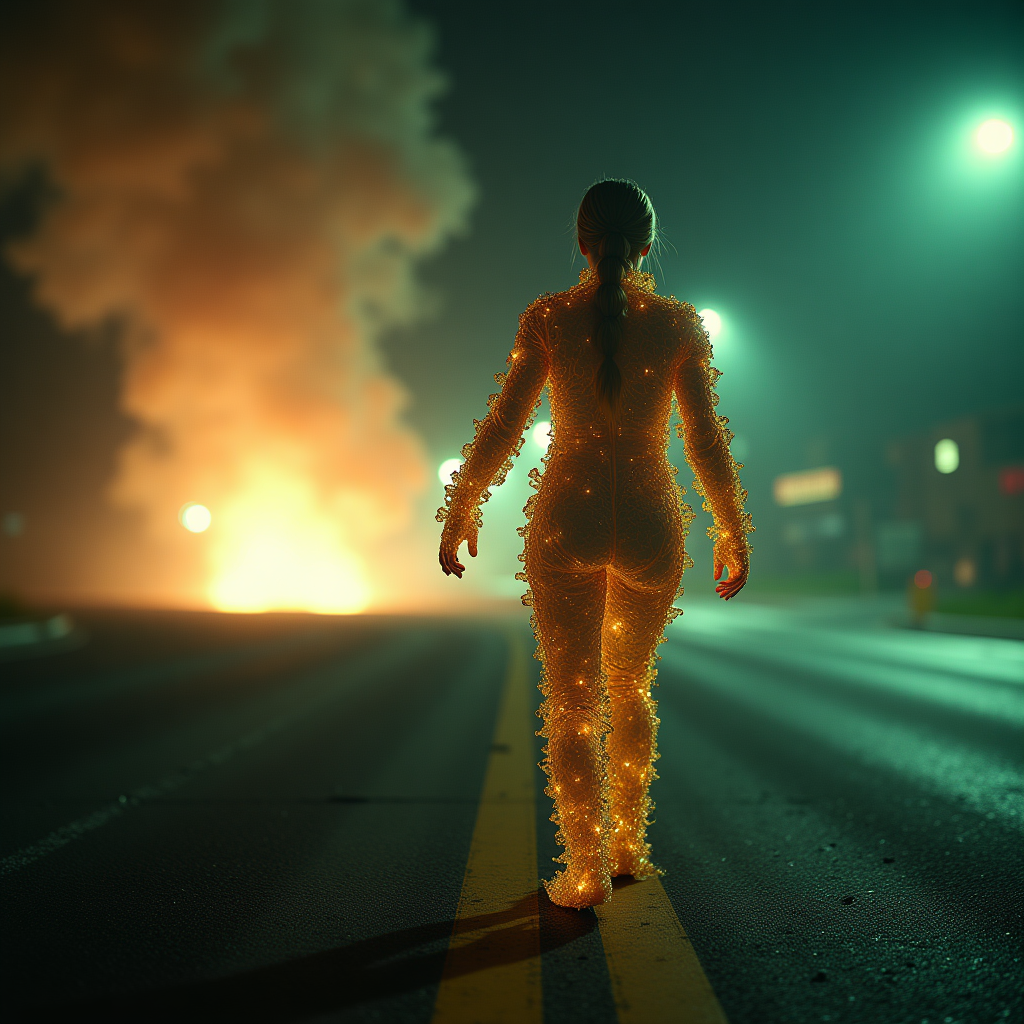

Saltlace of Route 37
Part One: The Corridor Between Worlds
Route 37 is not a place most people stop to love.
It is a place you pass through — a four-lane artery of strip malls, franchise signs, and parking lots that cuts east from the Garden State Parkway toward the Barnegat Bay, bisecting Toms River like a seam stitched through mismatched fabric. On one side: the older colonial neighborhoods, quiet cul-de-sacs, the proud brick face of the Crawford House and the modest town green that still holds the memory of a different era. On the other: the relentless commercial sprawl that defines the modern township — big-box retailers, fast food marquees, auto dealerships with plastic flags whipping in the Atlantic wind, the whole glittering machinery of Shore County commerce.
Margaret “Maggie” Hartwell has driven this corridor every weekday for sixteen years.
She is forty-four years old, a white woman with sun-creased eyes and blonde hair she keeps in a practical braid, a civil structural engineer who works for Ocean County’s public works division. She knows the corridor’s drainage schedules by heart. She has watched the planted medians struggle — scraggly pitch pines, salt-stunted ornamental grasses, clumps of bayberry trying to claw back some semblance of the Pine Barrens biome that once covered this ground before the asphalt came. She has submitted seventeen memos about heat-island remediation along Route 37. Twelve have been filed. None have been acted upon.
Maggie is not bitter about this. She is patient. She is methodical. She is the kind of person who still believes that the right data, delivered in the right format, at the right meeting, can change things.
She is wrong about that, but she is right about everything else.
What Maggie has noticed — what no traffic study or environmental impact report has documented — is the wind. The way Route 37’s canyon of low buildings and wide parking lots creates a specific atmospheric architecture. The Jersey Shore’s salt-laden breezes come in from the east off Barnegat Bay, compressed by the treeline at Cattus Island Park, funneled through the corridor’s commercial structures, and spun into unpredictable vortices at every major intersection. She has measured these. She has mapped them. She has a personal notebook, kept in the glovebox of her county-issued pickup, filled with hand-drawn diagrams of wind behavior at every major block between Fischer Boulevard and Hooper Avenue.
She does this because she is a structural engineer and she cannot stop noticing things.
She does not yet know what the wind is noticing about her.
Part Two: The Night the Grid Cracked
It begins with the storm.
Hurricane-adjacent, the forecasters call it — a nor’easter spiraling up the coast in mid-April of 2026, pulling moisture off a warming Atlantic and dumping it on Ocean County in sustained forty-mile-per-hour gusts with bursts reaching sixty. The power grid, already strained by a week of unseasonable heat, begins to buckle. Community Medical Center on Route 37 — the township’s only major hospital — goes to backup generators. The substation near the Parkway interchange trips twice. And somewhere inside the municipal fiber network, in the snarl of aging conduit and inadequately patched routers that carries Ocean County’s traffic management system, something begins to fail in a systematic and distinctly non-natural way.
Maggie is called out at 11 PM to assess structural stress on the Route 37 drainage overpasses. She is alone, in her truck, parked on the shoulder near the Vaughn Avenue intersection, when the transformer above her blows.
The arc is enormous — a blue-white column of ionized air and electrical discharge that punches through the canopy of the pitch pine planted in the median and blows straight through Maggie’s open window. She is hit simultaneously by the electromagnetic pulse, by a spray of pine-sap and shredded bark from the struck tree, and by the full force of a sixty-mile-per-hour gust that presses the wind into her chest like a hand pushing her back into her seat.
She does not lose consciousness.
She feels every second of it.
The electricity rewires something. The pine sap — alive with the photosynthetic chemistry of a tree that has evolved to survive salt air and poor soil and periodic fire — bonds with the charge, fusing into her skin in microscopic threads of biological circuitry. And the wind, that wind she has spent sixteen years documenting, moves through her like recognition. Like it has been waiting.
She sits in the truck for eleven minutes, staring at her hands.
Then the traffic signal ahead of her goes completely dark, and she can feel it — the network, the grid, the whole digital skeleton of the corridor pulsing against the edges of her awareness like a map she already knows by heart — and she understands, with the calm precision of a structural engineer, that everything has changed.
Part Three: The Architecture of a New Self
The transformation is not instantaneous. It is, like most things in Maggie Hartwell’s life, deliberate and cumulative.
Over the following three weeks, she discovers the boundaries of what she has become.
The wind channeling comes first and most naturally. Along the concrete corridor of Route 37 she learns to read atmospheric pressure differentials with a sensory apparatus she has no name for — some fusion of skin and barometric nerve, rooted in the electromagnetic rewiring of her nervous system. She can compress a gust between two facing strip mall facades and release it as a precision strike with the force of a car-wash blower scaled to a battering ram. She can spin the salt-tinged eddies at the Fischer Boulevard intersection into a sustained vortex that lifts a full-grown man off his feet. She can feel a wind shift three blocks ahead like a change in her own breath.
The photosynthetic bursts are stranger and take longer to understand. In direct sunlight — or even strong indirect light — the pine-sap chemistry threaded through her skin activates. The scraggly, salt-stunted pines and planted medians of Route 37, the grasses fighting the asphalt expansion, the pitch pines at Cattus Island: they are her kin now. She can draw a burst of stored solar energy from her own cells and release it outward — a pulse of warm green-gold light that disrupts electrical systems, stuns biological targets, and in close contact can accelerate plant growth with startling speed. She has cracked the asphalt at the corner of Oak Avenue and Route 37 twice by accident, watching the buried roots of a bayberry surge upward in response to her uncontrolled output.
The digital infiltration is the quietest power and the one that frightens her most. She does not hack. She does not type. She simply reaches — through the ambient electromagnetic field her body now generates — and the network opens. Traffic management. Municipal CCTV. The fiber backbone that connects Ocean County’s public infrastructure. She can read it, rewrite it, redirect it. She finds herself watching the corridor’s camera feeds in her sleep, the grid spread across her dreaming mind like a map she cannot fold away.
She sits in her kitchen in the old colonial on Hooper Avenue, in the yellow light of an April morning, and decides what she is going to do about it.
She is going to be responsible. She is an engineer. She will apply the right data, in the right format, at the right time.
She will call herself Saltlace — for the salt wind and the lacework of the grid, for the route that made her.
Part Four: The Hollowveil Beneath the Township
She finds the anomaly the same way she found the wind: by paying attention to what does not fit.
The traffic data has been wrong for eight months. Not dramatically wrong — the kind of wrong that looks like sensor error, like drift, like the normal noise of an aging municipal network. But Maggie knows this network. She mapped it for a county infrastructure audit in 2023. The errors are not random. They are precise. Someone is feeding falsified congestion data to the Route 37 corridor management system — creating artificial gridlock at specific intersections, routing commercial freight around particular blocks, systematically clearing the area near the Silverton Road interchange every Thursday at 2 AM.
She follows the thread into the network, deeper than any county router should allow access, and finds her.
Renata Cross is fifty-two years old — a multiracial woman of Black and Puerto Rican descent, sharp-boned and silver-streaked, with the particular stillness of someone who has spent decades in rooms where she was underestimated. She was once a legitimate urban planning consultant who worked with the county on the Route 37 commercial corridor revitalization study — the same study that buried twelve of Maggie’s seventeen memos. She was brilliant, thorough, and eventually passed over for a permanent role in favor of a younger, less threatening candidate with better political connections.
What happened to Renata Cross after that is a longer story. The short version is: she found other clients. Clients who wanted the township’s commercial real estate devalued along strategic corridors so they could acquire it cheaply. Clients who wanted municipal permitting data rerouted before public review. Clients who wanted an entire neighborhood’s worth of zoning records quietly amended in the dead of night without a public hearing descending into chaos.
She calls herself Hollowveil — for the hollow at the heart of the township that no one is looking at, for the veil of data that covers it.
Her power, like Maggie’s, came from the network — but it came from within it, from years of inhabiting the county’s digital skeleton as a consultant with clearance she was never asked to relinquish. She does not have Maggie’s atmospheric gifts. She has something more patient: the ability to make a place look empty when it isn’t, to make a building look occupied when it’s not, to hollow out the visible record of a community and fill the space with someone else’s design. She leaves no fingerprints. She leaves no data. She leaves only the absence of information, shaped precisely into profit.
Renata Cross believes she is owed this. She is not entirely wrong about what was taken from her. She is entirely wrong about what she has become.
Part Five: The Intersection
The confrontation happens on a Thursday at 2 AM, at the Silverton Road interchange, in the rain.
Saltlace has been watching the intersection for two weeks. She stands in the shadow of a darkened AutoZone awning, her transformed body — dense radiolarian lattice that has grown over her county-issue coveralls in overlapping silicate panels, geometric diatom structures articulating at every joint, prismatic light fragmenting through her crystalline chest and shoulders — breathing slow in the salt air. She can feel the network overhead like weather. She knows Hollowveil is here before she sees her.
The freight trucks roll through the cleared corridor — three of them, carrying construction equipment to a staging site that does not appear in any public permit database. Renata Cross stands at the edge of the interchange in a dark coat, a phone pressed to her ear, her silver-streaked hair damp against her sharp cheekbones. She looks like a consultant. She looks like a person doing legitimate work in the rain.
Saltlace steps out of the shadow and shuts down the network block — a sweep of her digital infiltration that crashes the veil of falsified data Hollowveil has draped over the interchange and floods the county traffic cameras with clean, unredacted footage.
The freight trucks stop.
Renata turns.
For a moment they look at each other across the wet asphalt of Route 37, in the glow of franchise signs and highway lights, and Saltlace sees the anger in the older woman’s face — not surprise, not fear. Just the particular fury of someone who has been patient for too long and cannot afford to stop now.
Then Hollowveil pulls the veil down across the entire block — every camera, every signal, every piece of county infrastructure in a four-block radius goes dark — and runs.
Saltlace does not chase with her feet. She sends the wind. The salt-tinged channel of the corridor compresses between the storefronts of Fischer Boulevard and catches Renata Cross like a wall — measured, precise, non-lethal. An engineer’s solution. The trucks are photographed. The permits are flagged. The data is already uploading to county servers that Hollowveil can no longer reach.
She does not catch Renata tonight. She knows this. The network is deep and Hollowveil has had years to build her exits. But the corridor is documented. The hollow is exposed. The township’s visible record has been restored, one intersection at a time.
Maggie Hartwell drives home on Route 37 as the sun comes up — the salt wind moving through the pines, the scraggly planted medians blazing gold in the first photosynthetic light of morning — and files her eighteenth memo.
This one, she thinks, they will act on.
She is, for the first time, probably right.