

SEDA DE ACERO / SILK STEEL
An Origin Story from the LOCAL HERO Universe — Paterson, NJ
Part One: The Girl Who Lives Between the Roar and the Silence
The Great Falls of the Passaic River never stop talking.
Most people in Paterson learn to tune them out — the low, constant thunder that threads through the city like a second heartbeat. The sound drifts up from the gorge on Spruce Street, slips through the windows of the bodegas on Market, settles into the old mill buildings along McBride Avenue like it owns the place. Which, in a way, it does. The Falls were here before the city, before Alexander Hamilton pointed at the churning water and said this is where America begins to make things.
Valentina Reyes has never tuned them out.
At thirteen, she is the kind of girl who notices everything — the way silk frays before it snaps, the way a loom’s rhythm changes when a single thread goes wrong, the way her abuela holds her breath every time the rent envelope gets sealed. Valentina lives in a fourth-floor walk-up on Rosa Parks Boulevard, three blocks from the old Ryle Silk Mill, now carved into apartments and studio spaces where artists and immigrants and small manufacturers coexist in improbable harmony. Her mother, Consuelo, runs a tiny alterations shop out of the ground floor. Her grandmother, Esperanza, teaches her to work with thread the way other grandmothers teach recipes — with reverence, with precision, with story.
Valentina attends the John F. Kennedy Educational Complex, where she is known for two things: her near-supernatural patience with difficult tasks and her habit of walking to the Great Falls on her lunch breaks to sit on the overlook and think. Teachers find it vaguely troubling. Valentina finds it necessary.
She is thinking there on the April morning when everything changes.
Part Two: The Machine Underneath the City
The Passaic County Industrial Heritage Foundation — the real one, not the nonprofit that presents plaques and holds ribbon cuttings — exists in the sub-basement of what everyone calls the Old Dolphin Mill. The real organization is called the Lachlan Group, and it has nothing to do with heritage.
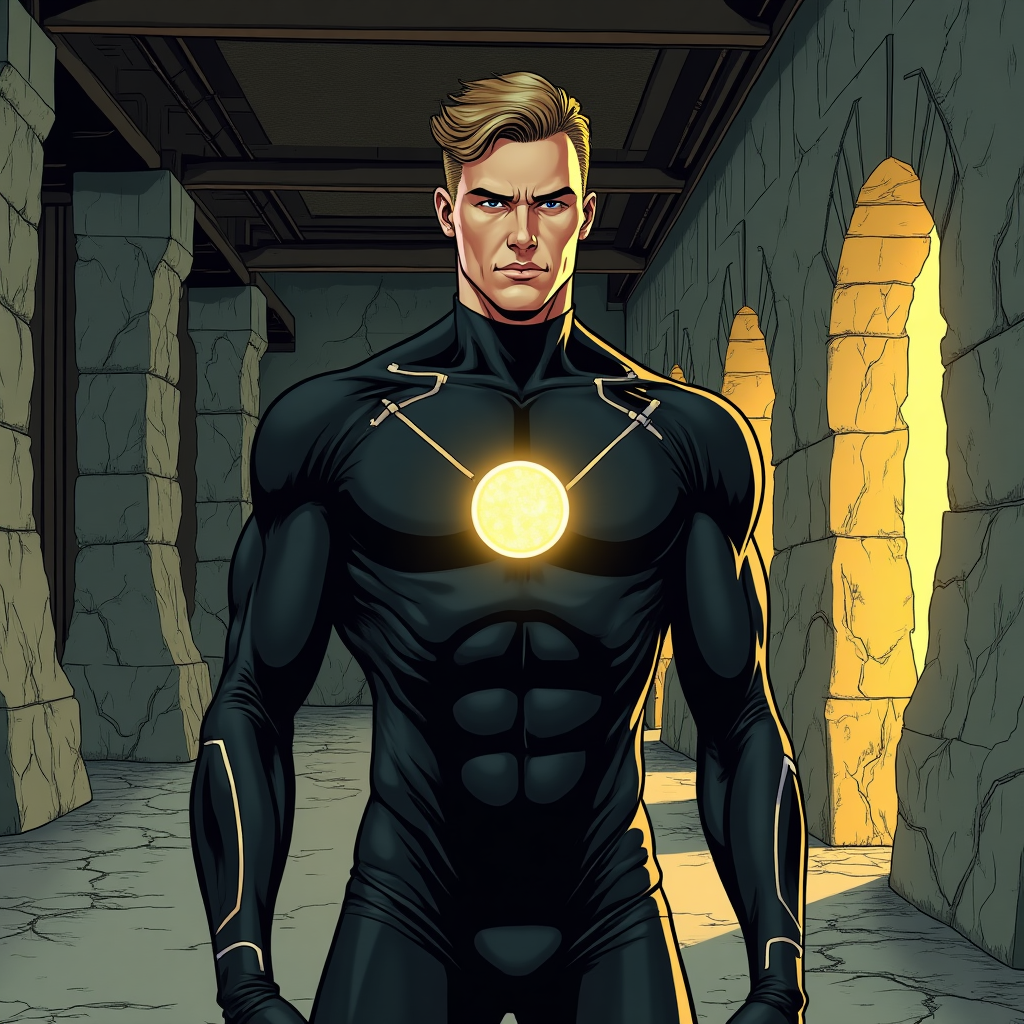
Caden Morrow is twenty-eight years old, with pale, angular features and the practiced smile of someone who learned early that confidence is just performance at volume. He has a degree from a private engineering school in Connecticut, a LinkedIn profile full of words like disruptive and unlocking value, and a leased Porsche that he parks provocatively on streets in neighborhoods he’s trying to buy. He works for the Lachlan Group as what their internal documents call a “site accelerator” — which means he identifies industrial properties in legacy cities, files the paperwork that reclassifies them, and ensures that the people currently living in them have fewer reasons to stay.
His current project: the Paterson Silk Corridor. Seven contiguous blocks of mill buildings along the river gorge, including the Hamilton Street overlook, the raceway channels that once powered the city’s looms, and three residential buildings housing a combined four hundred families — most of them Colombian, Dominican, Guatemalan, Turkish, Bangladeshi. Morrow’s presentations describe this as “repositioning an underperforming urban asset.” His timeline has the first eviction notices going out in sixty days.
But the Lachlan Group also has a science division, and that is what makes Caden Morrow more dangerous than an ordinary predator.
Three weeks ago, Morrow’s team discovered something in the sub-basement of the Dolphin Mill: a crystalline mineral deposit along the old millrace walls, formed over a century and a half of industrial runoff, silk dye chemicals, and Passaic River sediment. The deposit — which the Lachlan Group’s geologist calls Sericum-7, unable to resist the Latin for silk — vibrates at a specific resonant frequency. It stores mechanical energy. It releases it on command. It is, in essence, a natural battery built from the bones of Silk City itself.
Morrow wants it extracted, refined, and sold. He has a buyer in Singapore.
He has not considered what might happen if someone fell into the deposit before extraction was complete.
Part Three: Thread and Thunder
Valentina is not supposed to be in the Dolphin Mill at night.
She is there because she saw the Lachlan Group’s survey trucks blocking the Hamilton Street overlook for the third day running, because she asked the artists on the second floor what was happening and got worried faces and silence, and because at thirteen, Valentina Reyes has not yet learned to let things go when they feel wrong.
She slips in through the loading dock with Tomás, a sixteen-year-old from her building who does courier work for the studio tenants. He is her lookout. He lasts approximately four minutes before a Lachlan security guard spots him and he bolts, leaving Valentina alone in the dark with a flashlight and a fire door that has just clicked shut behind her.
She finds the sub-basement the way the Falls always guided her — by following the sound. Because the Sericum-7 deposit hums. Low and constant and alive, the same frequency as the Great Falls carried up through the gorge and into the city’s stone foundation. She presses her hand to the crystalline wall and feels it vibrating against her palm like a living thing — like the loom in her grandmother’s apartment, like the throat of the city itself.
The Lachlan extraction rig activates automatically at midnight. A remote trigger. Caden Morrow, eating dinner at a restaurant on Getty Square, flips a switch on his phone.
The discharge is not supposed to be that large. The geologist miscalculated.
The explosion of resonant energy fills the sub-basement in a single white second. It tears through the millrace wall and the river water beyond it and the stone that has stored a hundred and fifty years of silk-city industry in its mineral memory. It should kill Valentina Reyes.
Instead, it passes through her.
She wakes up on the raceway bank outside the mill, her clothes scorched, her hands glowing faintly in the dark — not with light exactly, but with vibration, a visible shimmer like heat off summer asphalt. The sound of the Great Falls has changed. She can hear it in her bones. She can hear the entire city in her bones. The looms and the traffic and the trains on the Montclair-Boonton Line and the steel of the old factory walls — all of it hums in her, a full-city chord she can now read and play like an instrument.
Valentina Reyes sits up, touches the iron railing of the raceway fence, and sends a pulse of resonant force down its length that shakes every rivet loose for thirty feet.
She is thirteen years old and the city is alive inside her.
Part Four: What Morrow Builds on Silence
It takes Valentina two weeks to understand what she can do.
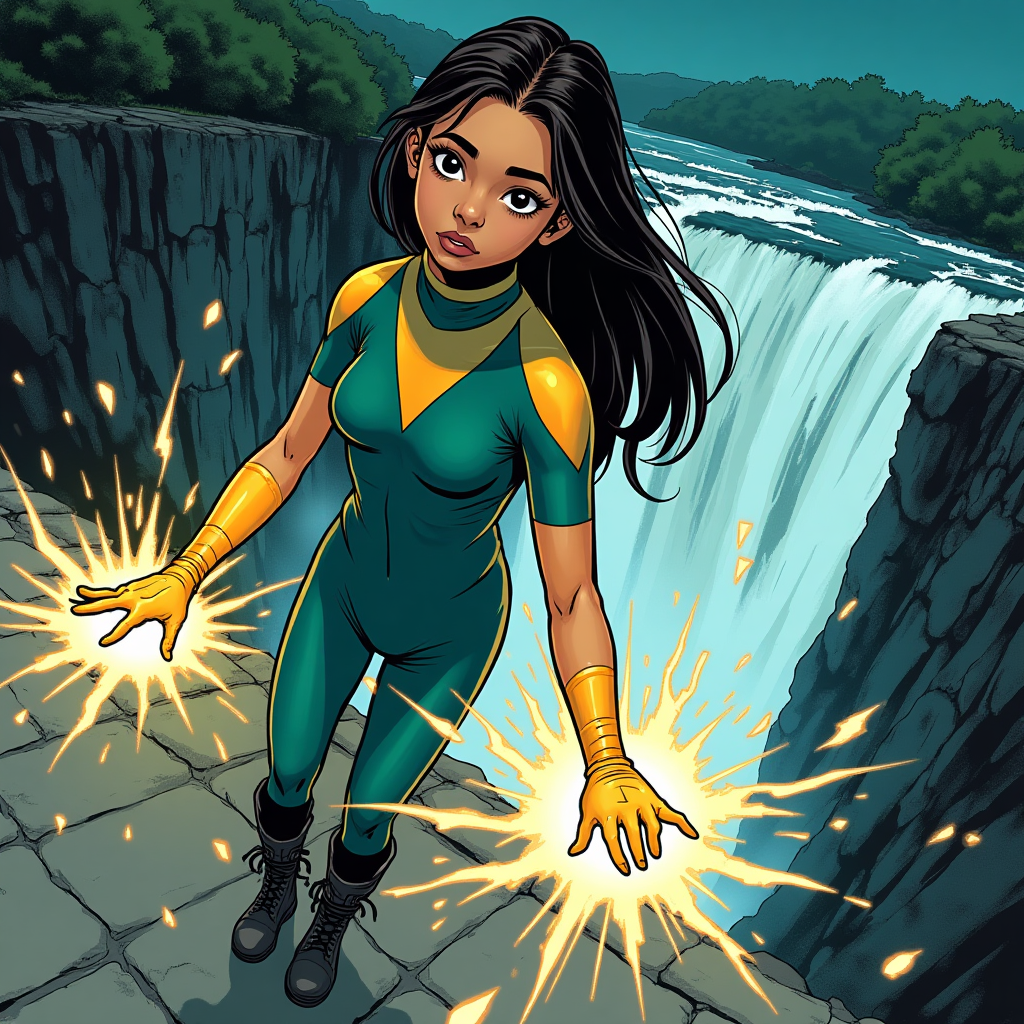
The Sericum-7 energy has fused with her nervous system in a way that mirrors the original function of the deposit: she stores kinetic and vibrational energy, she amplifies it, and she releases it with extraordinary control. She can feel the resonant frequency of any material she touches — silk, steel, concrete, glass — and she can unmake or reinforce its structural integrity with a focused pulse. She can hear structural weakness in a building the way a doctor hears a heart murmur. She can send shockwaves through the ground, redirect the force of moving water, and — most startlingly — produce from her hands a fiber of pure condensed vibrational energy that behaves, under pressure, exactly like high-tensile silk thread. Thin as a whisper. Strong as cable.
She calls herself Sedera — a compression of seda, silk, and dera, her grandmother’s old word for a thread that holds.
She makes her first real move at the Hamilton Street overlook on a Thursday evening, when Morrow’s crews arrive with equipment to begin unauthorized demolition of the raceway infrastructure. Sedera drops from the old pedestrian bridge above Spruce Street on a line of her own spun energy, lands in the middle of the work site, and presses both palms to the hydraulic excavator. The machine shudders to a halt, every hydraulic line vibrating at the precise frequency that triggers automatic safety lockdown. Morrow’s crew scatters. Morrow, watching from his Porsche on McBride Avenue, does not scatter. He watches her with cold, calculating eyes.
He already has a plan.
Because Caden Morrow, unlike most people who see a thirteen-year-old girl stopping his excavator with her bare hands, does not feel wonder or even fear. He feels opportunity. The Sericum-7 is inside her now. She is the deposit. And he has a buyer in Singapore who will pay significantly more for a living battery than for raw mineral.
He reinvents himself overnight. He calls himself Lachlan. He synthesizes a fragment of Sericum-7 retrieved from the blast site, bonds it through a process his geologist calls deeply inadvisable to a neuro-conductive suit, and emerges as something that can absorb Sedera’s vibrations and redirect them. A thief of her own frequency. He cannot create the energy she creates — he can only steal it. He is, in the end, exactly what he always was.
Part Five: The Frequency That Holds
The confrontation comes on the Hamilton Street overlook, above the gorge, the Great Falls roaring below like the city itself is holding its breath.
Morrow — Lachlan — arrives with two of his security contractors and the confidence of someone who has never once been told that what he wants doesn’t belong to him. The neuro-conductive suit is matte black and expensive-looking, seamed with faint silver traces like circuit lines, and when Sedera hits him with her first resonant pulse, he absorbs it and grins.
“You’re a resource,” he says. “The most valuable one in the city.”
Sedera stands on the overlook railing, the falls churning seventy-seven feet below, the sound of all of Paterson humming in her chest — the mills and the mosques and the bodegas and the school hallways and the raceway channels and her abuela’s loom one block up the hill, still running at 9 PM because Esperanza Reyes never sleeps before her granddaughter comes home. She can feel all of it. She can feel the resonance of four hundred families in seven brick buildings, living their lives in the walls that Morrow wants to sell.
She stops trying to throw him off the overlook. That’s not what silk does.
Instead, she spins.
She plants her feet and presses her palms flat against the old stone parapet and reads the entire frequency of the overlook structure — the 1914 limestone, the 1960s rebar retrofit, the iron railing, the roots of the sycamore growing through the northeast corner. She finds the resonant frequency of Morrow’s suit. Not the absorption frequency. The saturation point — the frequency at which the synthetic Sericum-7 fragment stops absorbing and simply vibrates itself apart.
She plays the chord.
The suit fractures at every seam simultaneously. Morrow staggers, the silver traces going dark, and sits down hard on the stone path with the expression of a man who has never in his life hit a floor he couldn’t buy his way off. The security contractors are already gone. Below, the Great Falls roar on, indifferent and eternal.
Valentina drops down from the railing and stands over him.
“This city made you,” she says — meaning the Sericum-7, meaning Silk City, meaning all of it. “It made me too. The difference is I belong to it. You just wanted to own it.”
She leaves him there for the Passaic County Sheriff’s deputies who arrive nine minutes later, summoned by a 911 call made by an anonymous teenager on a burner phone borrowed from a courier she knows.
Tomás, for his part, says nothing to anyone.
On the walk home, Valentina stops at the overlook railing and listens. The Falls are saying what they always say — constant, ancient, loud with everything the city has survived. She listens until she can feel her grandmother’s loom in the frequency, a single high note threading through the bass of the gorge water, patient and precise and unbreakable.
She goes home. She has school in the morning.
SEDERA will return.