


TEJIDO: Origin of the Threadweaver
Part One: The Densest Square Mile
Union City does not breathe — it hums. Every block of Bergenline Avenue pulses with cumbia from open windows, the hiss of steam from bodegas, the rattle of buses grinding uphill. Sixty-eight thousand people pressed into a single square mile of Hudson County hillside, the most densely packed city in the nation, layered like sediment — German immigrants who built the embroidery mills, Cuban exiles who built “Havana on the Hudson,” and now a thousand more arrivals every year, each one weaving themselves into the fabric of the place.
Sixteen-year-old Soleil Vargas-Montoya knows every thread of it.
They live on 21st Street, two blocks from Emerson High School, in a fourth-floor walk-up where their abuela’s sewing machine runs from six in the morning until the light fails. Abuela Celia is one of the last embroiderers — one of the last people who remembers when Union City was the Embroidery Capital of the United States, when the mills along New York Avenue employed thousands of hands stitching silk and tulle into something beautiful. The machines are mostly gone now. The mills have been converted to condos or left to crumble. But Abuela Celia still sews, and Soleil still watches, and somewhere in the watching, they have learned to see the world as a pattern of interlocking threads.
Soleil is nonbinary, quiet in the way that people are quiet when they are always listening. They attend the José Martí STEM Academy, where they are brilliant at materials science and mediocre at everything requiring them to stop thinking long enough to write it down. Their notebook margins are filled with diagrams: stress loads on textile fibers, the geometry of weave patterns, the mathematics of tensile strength. Their teacher, Mr. Fuentes, once said Soleil could change the world if they ever learned to finish a sentence.
They are finishing one on a Tuesday afternoon in April — the cherry blossoms are erupting across the river in Branch Brook Park, visible in a pink smear from the roof of their building — when Abuela Celia calls them downstairs. She has found something in the basement storage unit. Something from the old mill.
Part Two: What the Mill Remembers
The object is a loom.
Not a modern loom — not the computerized industrial kind. This is something else entirely, a hand loom the size of a door, built from iron and dark hardwood, its frame etched with interlocking geometric patterns that Soleil does not recognize as any embroidery tradition they have studied. Abuela Celia says it came from the Helmrath Mill, one of the original German embroidery operations on New York Avenue, closed since 1987. She inherited it from her own mother, who worked the mill floor for twenty years and carried the loom out the day the machines stopped.
“I always thought it was just old,” Abuela Celia says. “But look at the thread.”
The thread is still on it. After nearly forty years in a basement, the thread should be dust. Instead it shimmers — not with light exactly, but with something beneath light, a vibration Soleil can feel in the roof of their mouth when they lean close. The fiber is unlike anything in their materials science textbook. It seems to shift color when Soleil touches the frame: silver, then copper, then the deep indigo of a midnight sky over the Palisades.
Soleil does not mean to sit down at the loom. They do not mean to put their hands on the heddle bar. But the pattern on the frame seems to arrange itself into something readable — a kind of instruction — and Soleil’s hands, trained by ten thousand hours of watching Abuela Celia, know what to do before their brain catches up.
The basement fills with light.
When it clears, Soleil is still seated at the loom, but the thread has unspooled from the frame entirely and wrapped itself around their body — not as a restraint, but as a second skin, a living garment that breathes with them, responds to their pulse, and trails off their fingertips in luminous filaments. The loom is empty. The thread is them now.
Abuela Celia stands in the doorway. She is not afraid. She looks at Soleil the way she has always looked at an especially beautiful stitch: with satisfaction, as though this was always the pattern it was meant to be.
“Mija,” she says — and then corrects herself, softly, the way she has been learning to. “Mijo. Mi sol.”
Part Three: The Threadweaver
It takes Soleil three weeks to understand what they can do.
The filaments that trail from their hands are not simply thread. They are extensions of a structural intelligence — the accumulated memory of every textile ever made in Union City, from the silk embroideries of the Helmrath Mill to Abuela Celia’s tablecloths. Soleil can weave them into any form: rigid as steel cable, flexible as silk, adhesive as industrial resin. They can sense the structural integrity of any woven or built thing by touching it, reading the stress and strain in its fibers the way a doctor reads a pulse. And in the densest city in America, where everything is layered on everything else, that sensitivity becomes something like sonar — a full spatial map of the neighborhood radiating out in all directions, thread by thread.
They test it carefully. They scale the face of an apartment tower on Palisade Avenue using filaments anchored to window frames. They stop a runaway produce truck on Bergenline by weaving a net between two lampposts in under four seconds. They sit at Hudson County Community College and let the vibration of the city flow through them — every voice, every footstep, every bus on the 119 line — and they learn to sort signal from noise.
They call the hero Tejido. Spanish for “fabric.” For “tissue.” For “the thing woven together.”
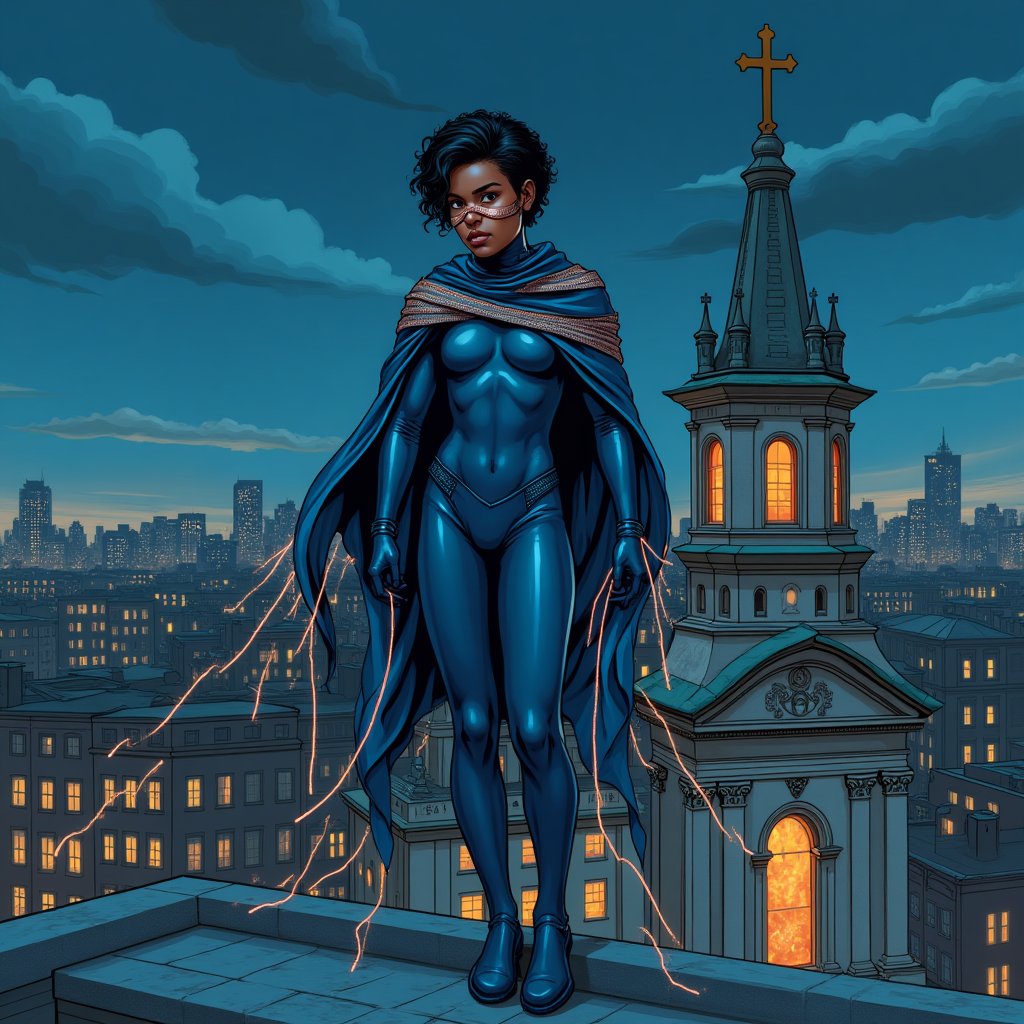
The costume assembles itself from the living thread: deep indigo bodysuit, copper-gold filaments at the wrists and throat, a flowing panel down the back that moves like a cape but functions like a sensory array. Their face is half-covered by a woven mask, and when they are Tejido, their eyes glow with that same shifting silver-to-copper light that pulsed in the mill’s thread.
Union City notices. The 6 o’clock news on the Spanish-language channel runs a shaky cell phone video: a figure in indigo swinging between the towers above 32nd Street, trailing light. The chyron reads: ¿Ángel o superhéroe? The comments section is four hundred replies of people arguing about which block they grew up on.
Part Four: The Woman Unraveling the City
Her name, in the circles that matter, is Nullveil.
Her alter ego is Margaret Throssell, 52, and she runs the Vantage Corridor Development Group from a glass office in Jersey City. She is white-haired before her years, severe in the way of a person who has decided that elegance is a kind of weapon, and she has spent the last decade acquiring distressed properties along the Hudson County waterfront with a patience that her rivals find unsettling.
What no one in those circles knows is that Throssell discovered a sister artifact to Abuela Celia’s loom — a shuttle, recovered from the same mill demolition, sold at auction in 2019 to a private collector and then quietly acquired by Throssell through an intermediary. Where Soleil’s loom bound thread together, the shuttle was designed to do the opposite: to cut, to separate, to unravel. In Throssell’s hands, fed by her cold and acquisitive intelligence, it has become a weapon.
Nullveil can disassemble any structure by touch — concrete, steel, social fabric, community ties — reducing it to its component parts. She can walk through a neighborhood and leave it feeling looser, less coherent, as though the connections between people have thinned. Residents of the blocks she has targeted for development report a strange malaise: neighbors stop speaking, community meetings dissolve into argument, longtime businesses shutter seemingly without reason. The city feels like it is coming apart at the seams.
Soleil first encounters her not as a villain but as a woman in an expensive coat standing outside Emerson High School, studying the building with the calm, appraising look of someone calculating load-bearing walls. When Soleil reaches out with their thread-sense, they feel it immediately: an anti-pattern, a vibration that is the negative image of the city’s hum. Where Union City’s density feels like warmth, Throssell’s field feels like a seam being cut.
“You can feel it,” Throssell says, not looking away from the building. Her voice is even, almost kind. “Interesting. I wasn’t sure the loom would express that way in a child.”
“What are you doing to the neighborhood?” Soleil demands.
Throssell turns. Her eyes are light grey, precise as a pattern gauge. “Clearing the design space,” she says. “This city has been woven too tight for too long. It needs to breathe.”
“People live here.”
“They live here now,” she agrees, and smiles, and walks away.
Part Five: The Longest-Running Story
The confrontation comes on a Friday night in April, at the Blue Chapel on New York Avenue — one of the oldest structures in Union City, a landmark that Vantage Corridor has been quietly maneuvering to acquire for demolition. Nullveil arrives in a long pale coat, the shuttle in her hand now visible for the first time, a bone-white object that pulses with cold anti-light. She has come to unmake the building — not with a wrecking ball, but with her power, quietly and completely.
She does not expect Tejido to be waiting on the roofline.
Soleil drops from above and drives a wall of woven filament between Throssell and the chapel facade. The thread blazes copper-gold in the streetlight. Nullveil raises the shuttle and the air between them becomes a battlefield of competing forces — weaving and unraveling, density and dissolution, the memory of everything the city has made against the cold calculus of everything it could be stripped down to.
The fight is not clean. Nullveil is older and more practiced with her artifact, and twice she nearly cuts through Tejido’s defenses, leaving fraying edges in the indigo suit that Soleil has to rebuild on the fly. But Soleil has something Throssell does not: they can feel every person in every building on this block. Every abuela at a sewing machine. Every student at a kitchen table. Every couple sharing a meal in an apartment the size of a postage stamp, making room, making do, weaving a life out of the densest square mile in America.
Tejido reaches not just for the filaments at their own fingertips but for the structural memory of the entire neighborhood — every load-bearing wall, every fire escape, every length of wire and rebar and old German ironwork — and weaves it into a single resonant pattern. The ground hums. The Blue Chapel’s ancient stones sing.
The nullifying field shatters.
Throssell staggers. The shuttle flickers. For one moment her composure breaks and she looks not like a developer calculating assets but like a woman who has forgotten what it feels like to be part of something larger than herself.
“This city doesn’t come apart,” Soleil says, and their voice is steady and sixteen and certain. “That’s the whole point of it.”
Nullveil retreats into the dark of New York Avenue, the shuttle cold in her hand. She is not finished — Soleil knows this in the way you know a pattern is incomplete, when the thread has been cut but not tied off. She will return with more resources, more patience, more of that terrible quiet precision.
But tonight the Blue Chapel stands. And in the morning, when the 119 bus grinds up Bergenline and Abuela Celia’s machine begins its early hum and the cherry blossoms drift west from Branch Brook on an April wind, Union City hums back — sixty-eight thousand people, one luminous square mile, every thread holding.
Tejido watches from the roofline and feels every single one of them.
— End of Issue #1 —