

Tidecaller
Part One: The Girl Who Counted Rings
Toms River moves at the rhythm of the shore — the pull of the Barnegat Bay, the hum of Route 9, the slow churn of seasons that turn quiet suburbs into something almost mythic when the light hits the water right. Sixteen-year-old Cassidy Marlowe has lived inside that rhythm her whole life.
She is the daughter of a marine biologist who lost her funding and a plumber who lost his back, and she has grown up understanding that water is both gift and threat. She collects core samples from the Toms River itself — cylinders of sediment that tell the story of decades: runoff from old chemical plants, tidal shifts, the slow accumulation of everything the township has tried to forget. She keeps them labeled in her bedroom like library books. Her science teacher at Donovan Catholic calls her obsessive. Her mother calls her gifted. Cassidy calls it paying attention.
She is not popular. She is not trying to be. She spends her weekends at Cattus Island Park, wading in the tidal creeks with a handheld spectrometer she rebuilt from a kit, cataloguing salinity gradients and photographing the way the marsh grass bends differently depending on the depth of the water table. She knows this stretch of coastline the way some kids know song lyrics — automatically, completely, in her bones.
It is April. The cherry blossoms along the community center median are doing their brief, spectacular thing, and the rest of Toms River is busy with wrestling tournaments and Little League tryouts and the low-grade civic drama of a township council meeting that has, apparently, devolved into shouting. Cassidy doesn’t care about any of that. She is standing at the edge of the tidal flat near the northern spit of Cattus Island at 11:47 p.m., finishing a water sample she started at dawn, when the ground beneath her feet begins to vibrate at a frequency she has never felt before.
Part Two: What the River Remembers
The vibration isn’t seismic. She knows what seismic feels like — she felt the 2024 tremor from her kitchen floor, the whole house shuddering like a wet dog. This is different. This is directional. It pulses from the water’s edge inward, in concentric waves, each one carrying a faint bioluminescent shimmer that races along the surface of the creek like a signal being sent.
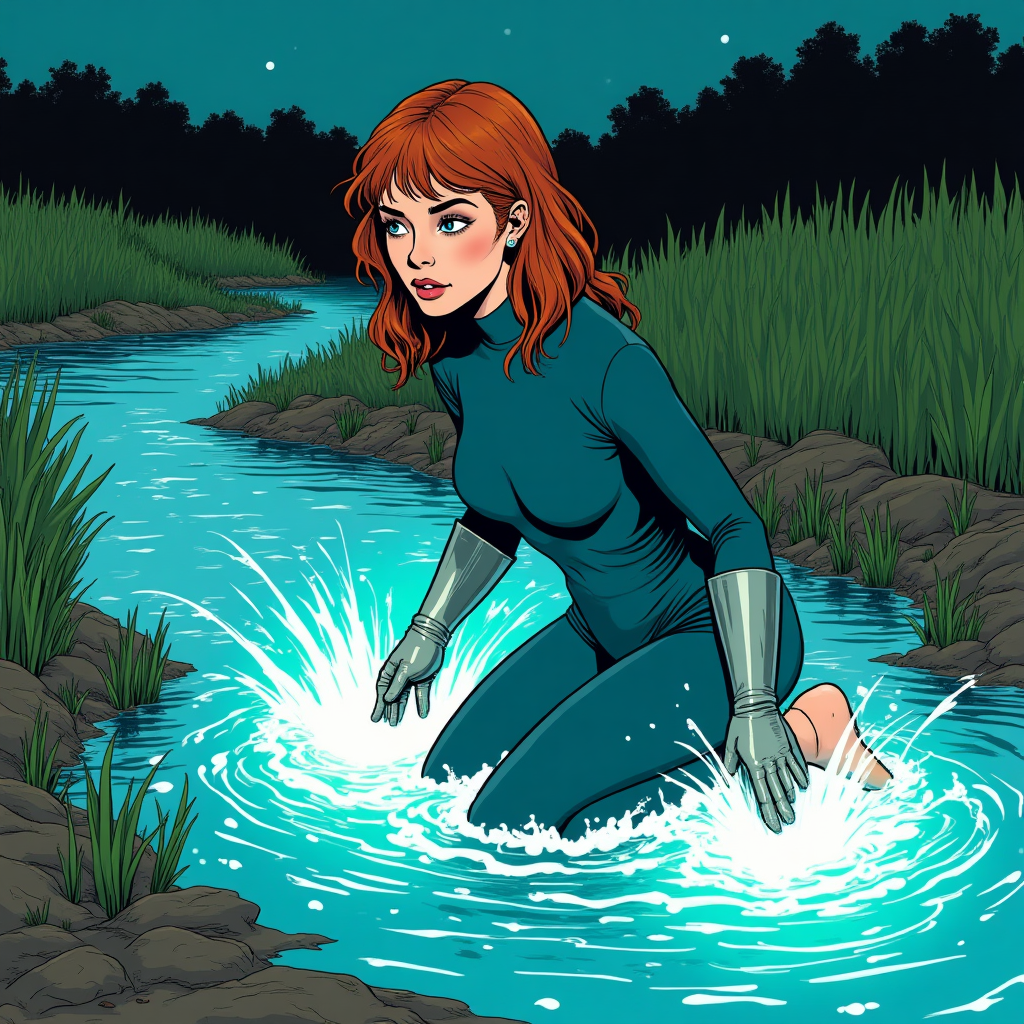
Cassidy, being Cassidy, does not run. She crouches and puts her bare hand into the water.
The creek speaks.
Not in language. Not in sound. In data — an overwhelming, total flood of information pressing into her nervous system like a download: the chemical memory of the river over two hundred years, the pH of every major rain event since 1970, the precise coordinates of every illegal dump site that ever leached into the watershed, the temperature gradient of the bay at every depth, the migratory pattern of every horseshoe crab that has ever crossed this tidal flat. She sees the river’s entire life — its wounds, its recoveries, its long stubborn persistence against everything human industry has done to it.
She is underwater for what feels like an hour. It has been eleven seconds.
When she pulls her hand free, the glow follows her. It threads up through her fingers, settles under her skin like foxfire, and stays. Her core samples, tucked in her field bag, begin to vibrate sympathetically. The water in the creek organizes itself — briefly, impossibly — into a standing wave that holds the exact shape of her handprint before collapsing.
She bikes home along Fischer Boulevard, soaking wet and trembling, and does not sleep.
Part Three: Tidecaller
Over the following three weeks, the scope of what she has become reveals itself in increments that she approaches the way she approaches everything: methodically, with a notebook.
She can feel water. Every body of it within a quarter mile registers as a kind of spatial awareness — a sixth sense that maps aquifers, pipes, puddles, and ponds in her mind like sonar. She can exert will over flowing water, redirecting currents, compressing or releasing pressure in confined channels. She can read the chemical signature of any water source she touches, identifying contaminants, biological markers, even the specific mineral fingerprint that identifies the source aquifer. She can project force through water at range — a concentrated hydraulic pulse that hits like a crash of surf and dissipates harmlessly in open air.
She names herself Tidecaller, because the bay named her first.
Her first real act is not dramatic. She traces a slow-leaking underground petroleum seep near the old industrial corridor east of Route 37, maps it precisely, and anonymously mails the documentation to the Ocean County environmental enforcement office with GPS coordinates. The site gets flagged within a week. She bikes past the orange cones and allows herself one small smile.
Her second act is more complicated.
She notices, during a nighttime patrol of the Toms River waterfront, a series of unexplained current anomalies near the mouth of the river — water behaving as if something is redirecting it from beneath. The patterns are deliberate. Geometrical. Someone else is working in her river.
Part Four: Depths
His name is Ashwater.
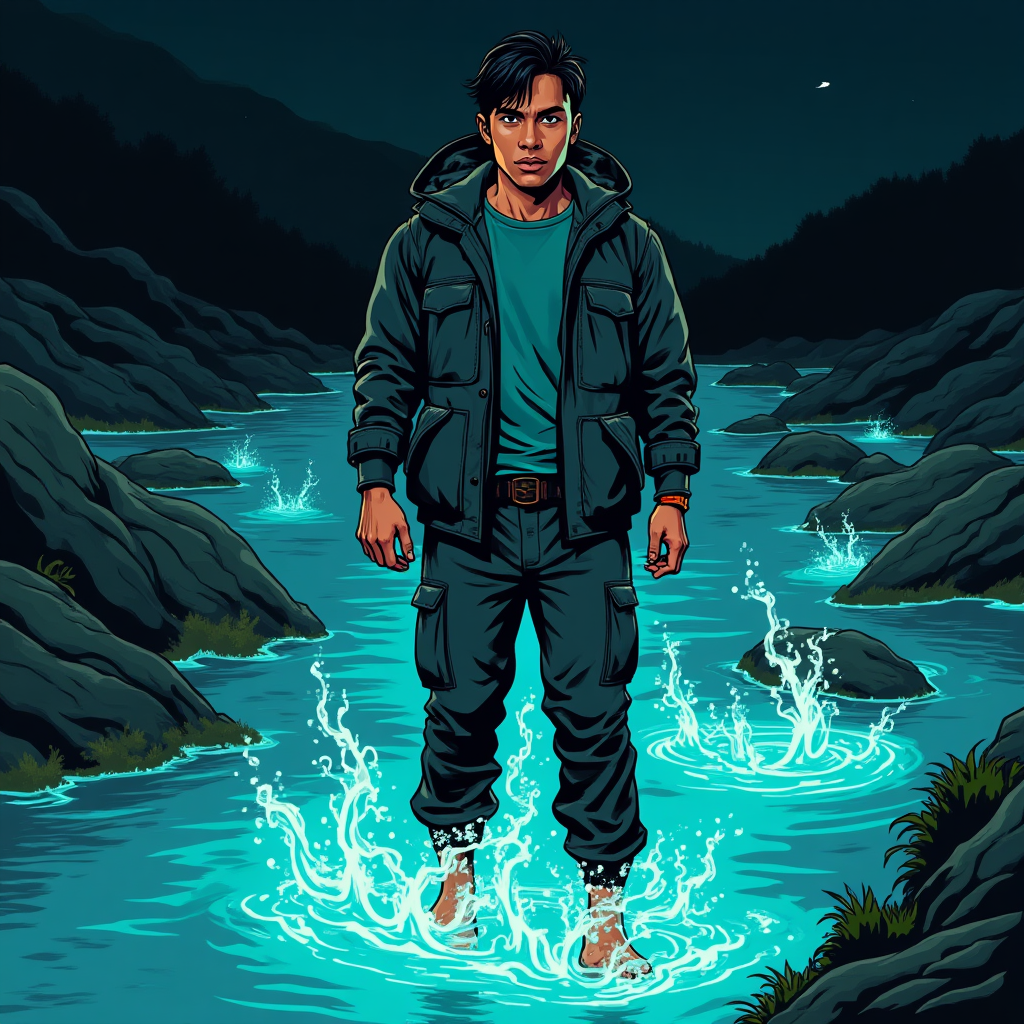
She finds him under the Route 37 bridge, standing in the river shallows at 2 a.m., his bare feet in the current, his eyes closed, his hands moving in slow arcs that trace glowing patterns in the water around him. He is a young Indigenous man, early twenties, lean and sharp-featured, with dark eyes that catch the bioluminescence from the river like mirrors. He wears no mask. He seems to feel no need for one.
She learned his story in pieces, later. His name is Nolan Swiftwater. He is Lenape by descent — his family among the thousands displaced from this exact watershed over the course of three centuries of colonial settlement. He came to Toms River following a different current: a researcher’s thesis on the river’s pre-colonial ecology, a grant from the Matawan Institute for Indigenous Environmental Studies, and a personal mission that began long before the river gave him power.
He was changed the same night she was. Different location — the deep channel beneath the Route 549 bridge, near the bay mouth. Same source.
But where Cassidy sees the river as a system to be protected in the present, Nolan sees it as a historical record of dispossession — a living archive of everything taken from the Lenape people who called this watershed home long before the Dutch arrived, long before the English renamed it, long before Ocean County became a bedroom suburb of New York City. His power is not control but summoning: he can call water from depth, draw it upward in columns, and shape it into forms that carry the memory of the pre-colonial landscape — marshes that have not existed for two centuries, river channels that were filled and paved over, the ghost-geography of a world that was erased.
His plan is not evil. It is something more dangerous than evil: it is righteous, and aimed at the wrong target.
Ashwater intends to reclaim the bay. Not symbolically. Physically. He has identified the keystone infrastructure points of Toms River’s waterfront development — the marinas, the levee reinforcements built after Sandy, the drainage channels that protect the low-lying residential neighborhoods near the shore — and he plans to use his power to systematically restore the estuary to its pre-development hydrology. The science is not wrong. The intent is not malicious. But the execution would flood three residential neighborhoods, overwhelm the stormwater system, and put hundreds of families — families who did not build these levees, who did not displace anyone — underwater.
He knows this. He has made peace with it. That is the difference between them.
Part Five: The Mouth of the River
The confrontation comes at the edge of Cattus Island Park, where the tidal creek meets the open bay and the land thins to a strip of marsh grass and packed mud. It is a Thursday evening. The park is empty. The sky is the color of old iron.
Tidecaller arrives first. She has spent four days modeling Ashwater’s plan in her notebook, running the hydrology on her rebuilt spectrometer software, mapping what his sequence of disruptions will do to the water table, the drainage, the neighborhoods downstream. She has also spent those four days sitting with the weight of his history, the undeniable fact of the harm embedded in this landscape, the way the river itself seems to hold the memory of older geometries.
She does not arrive angry. She arrives prepared.
When Ashwater comes across the water — walking it, technically, the surface tension singing under his feet — she is already standing at the edge of the creek, her hands at her sides, the water around her shimmering faintly with borrowed light.
“You know what I’m going to do,” he says. Not a question.
“I know what you think it will fix,” she answers.
The fight is not long, but it is spectacular. He throws columns of dark bay water sixty feet into the air; she redirects them, splitting the mass into harmless curtains that fall back into the creek. He tries to take the drainage channel — she feels his pull on it through the ground like a hand around her wrist, and she holds the channel closed with everything she has, her knees in the mud, the water trembling between them. The marsh lights up with bioluminescence. The herons don’t move.
In the end she doesn’t defeat him. She anchors him.
She puts her hand into the creek and opens the river’s memory the way he taught her — lets it flow between them, the whole record, everything. The Lenape fish weirs. The Dutch drainage. The industrial dumping. The Hurricane Sandy inundation. The families who rebuilt. The kids in the Little League who won the World Series and came home to houses twelve feet above a reclaimed flood plain. She lets it all run through the water between her hand and his feet until he goes still.
He sits down in the creek. The columns fall.
“This isn’t over,” he says.
“I know,” Cassidy says. “But you know I’m right about who would drown.”
He doesn’t answer. He walks back across the bay, and the bioluminescence fades behind him, and the marsh settles into the quiet sound of moving water.
Cassidy Marlowe sits at the edge of Cattus Island until the tide turns, her bare hand in the creek, listening to everything the river still has left to say.
The bay breathes. The blossoms, somewhere inland, are finally letting go.