


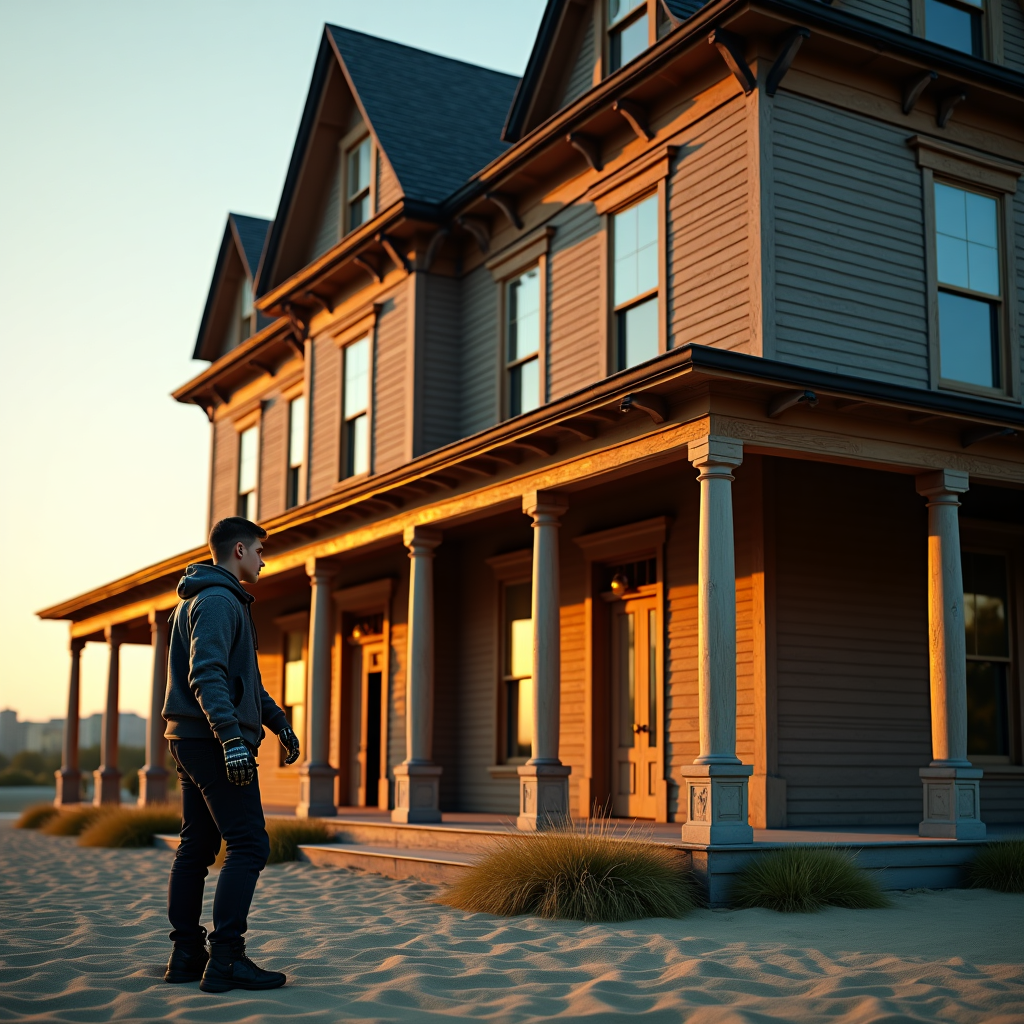
Tideshore
Part One: Something’s Wrong
The shingles on the Chalfonte Hotel were turning to dust.
Not slowly, like weather does it. I mean overnight. I walked past it on Tuesday on my way to school and the cedar facing on the east wall was gone — just pale, crumbling powder blowing off into the street like someone had taken a belt sander to a hundred and fifty years of history.
My name is Declan Marsh. I’m sixteen, I work weekends helping Mr. Fonseca patch and restain Victorian facades on commission, and I know what Atlantic salt damage looks like. This wasn’t that.
I touched the wall where the shingles used to be. Just instinct. Just habit.
And my hand lit up.
Not glowed, exactly — more like the air around my fingers thickened. I felt heat, then cold, then this pulling sensation in my palm, like my skin was reading the wood and the salt and the mineral crud all at once. A second later, something seeped out of my fingertips — amber-colored, dense, almost like resin — and spread across the bare wood in a thin, even coat. The exposed boards stopped crumbling.
I stood there for a full thirty seconds with my mouth open.
Then a seagull landed on my shoulder and I screamed.
Part Two: Following the Thread
I didn’t tell anyone. Obviously. I’m not stupid.
But I started paying attention. Sunset Beach, the Carroll Villa, the old rail terminal on Lafayette — wood and stone and mortar that had survived since the 1870s was failing in patches, fast and wrong. The erosion moved in straight lines, which erosion doesn’t do. It moved toward the waterline each night and pulled back before dawn.
I followed the damage south on Thursday. Past the Cape May Athletic Park, past the lighthouse access road, down to the bay shore where the sand goes gray and the Cape May diamonds wash up in the shingle.
That’s when I saw the water moving wrong. Not waves. Shapes. Something underneath — dark and purposeful — touching the pilings, the rip-rap, the buried foundation stones. And each place it touched, the material just… thinned. Like it was being harvested.
Someone was dissolving Cape May. One historic building at a time.
Part Three: The Reveal
His name was Reeve Blacktide, and he rose out of the bay like he’d been waiting for me to figure it out.
He was tall, maybe late twenties, Black, and the water had become him — or he’d become it. Dark saltwater sheeted off his arms in controlled streams. His hands pulled the mineral content right out of whatever they touched, leaving chalk and rot behind. He told me, very calmly, that he was collecting what the ocean was owed. That Cape May had been built on a coastline that never belonged to anyone who built it. That erosion was just the bay’s memory.
He wasn’t wrong about some of it. That was the annoying part.
“I’m not saying the history’s clean,” I told him. “I’m saying you don’t get to dissolve it.”
He sent a wave of mineral-stripped water at the old rail terminal foundation. I slammed both palms into the base stone.
The compound came fast this time — I felt it pull from the salt in the air, from the shell fragments under my feet, from the driftwood wedged in the rip-rap. It didn’t glow. It just bonded — a dense amber-gray layer spreading through the cracks faster than the water could strip them. The stone held.
Blacktide hit it again. I pushed back, palms flat, compound bleeding out through my hands in sheets. He pulled. I sealed. He pulled harder and I felt it in my teeth.
The terminal didn’t fall. But I went to one knee before he stopped.
He looked at me for a long moment. Then he sank back into the bay like a curtain closing.
“Next time,” he said, “there’ll be less of it left to save.”
Part Four: Aftermath
The shingles on the Chalfonte looked fine the next morning. You could see where my compound had set in the wood — just slightly darker, like a good stain. Mr. Fonseca noticed it and said it was the best preservation work he’d ever seen on those boards.
I didn’t tell him how it got there.
Cape May feels different now. I walk the beach and I feel everything underneath — the foundations, the pilings, the buried history going soft at the edges. The whole town is one long argument between what was built and what the water wants back.
Reeve Blacktide wasn’t wrong. He also wasn’t done.
Neither am I.