Part One: The Cold Open
The warehouse on Irvington Avenue was still a blackened skeleton when Diane Merritt-Calvo arrived at Flood’s Hill Park the following Tuesday, thermos in one hand and a folder of digitized patent scans in the other. The annual Container Day cleanup was technically voluntary. For a Meridian archivist, it was professional obligation.
Then the cinnamon roll cart lit up.
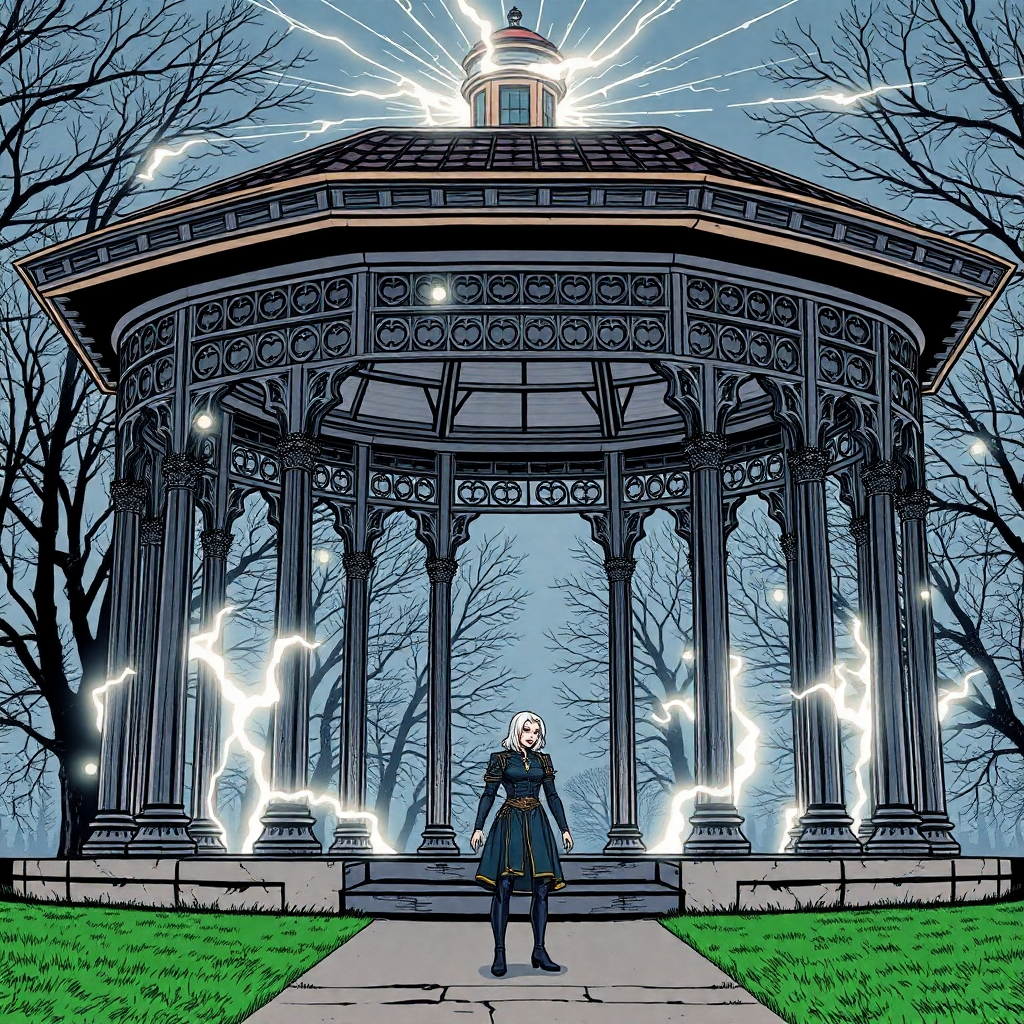
Three feet from the park’s iron pavilion, the vendor’s electric warming drawer fired every element simultaneously — the display reading 9,999°F — and the sweet smell of scorched pastry hit Diane like a wall. Around the pavilion’s central iron pillars, the metal was radiating heat in slow, rolling waves, as if the structure had been baking in a kiln since dawn. Diane pressed a palm to the nearest column. It hummed against her skin. Not electrical. Stored.
She already knew whose fingerprint that was.
Part Two: The Investigation
She found Fernanda Pereira at the pavilion bench before she even had to look — the elderly woman was fanning herself aggressively with a Container Day pamphlet and eyeing the iron pillars with the focused suspicion of someone who had seen too much municipal history.
“He was here at six,” Fernanda said without preamble. “A man with a briefcase. He touched every column.”
Diane walked the pavilion perimeter. Each iron pillar radiated a slightly different thermal signature — staggered charging intervals, maximum capacity, ready to release. Rohan Ashbourne-Vik had spent three weeks since the Carriage House debacle quietly transforming Flood’s Hill Park’s nineteenth-century ironwork into a heat battery.
The park’s pavilion had been cast at the old Ashbourne Ironworks in 1897 — four years after the patent theft. She’d read the foundry plaque a hundred times without understanding why the Ashbourne family had donated it so publicly, so deliberately. Now it was obvious. The iron had always been his family’s claim marker. Today it was his weapon.
The park’s pavilion radiated directly at the Seton Hall campus quadrangle two hundred meters east. At full discharge, the thermal pulse would cook every server rack in the Archives building, boiling the humidity-controlled vaults dry. The digitized records would survive. The original 1893 patent document — still sealed in its alcove — would not.
She called the Archives. No answer. The heat had already knocked the phones.
Part Three: The Pivot
Diane stopped walking.
He wasn’t trying to steal it this time.
Rohan had lost twice trying to take the patent. He’d decided to simply erase it — reduce the original document to ash inside its own vault, leaving only his family’s forged copy as the surviving record. No original, no contest. History rewritten by fire and heat.
“Oh,” Diane said. “Of course it’s him.”
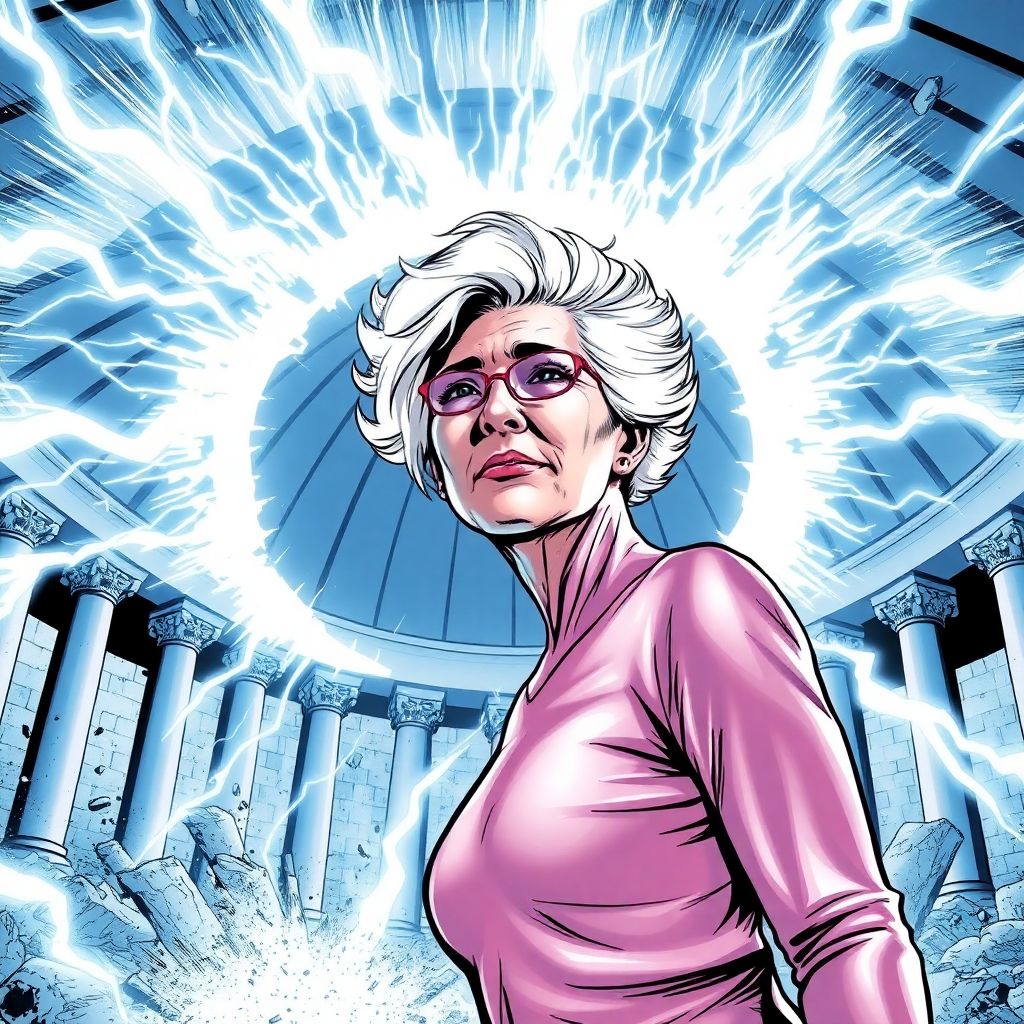
She dropped the thermos, pulled her Meridian field gauntlets from her bag, and felt the familiar electric-white crawl begin at her wrists. The iron columns were already ticking.
Part Four: The Reckoning
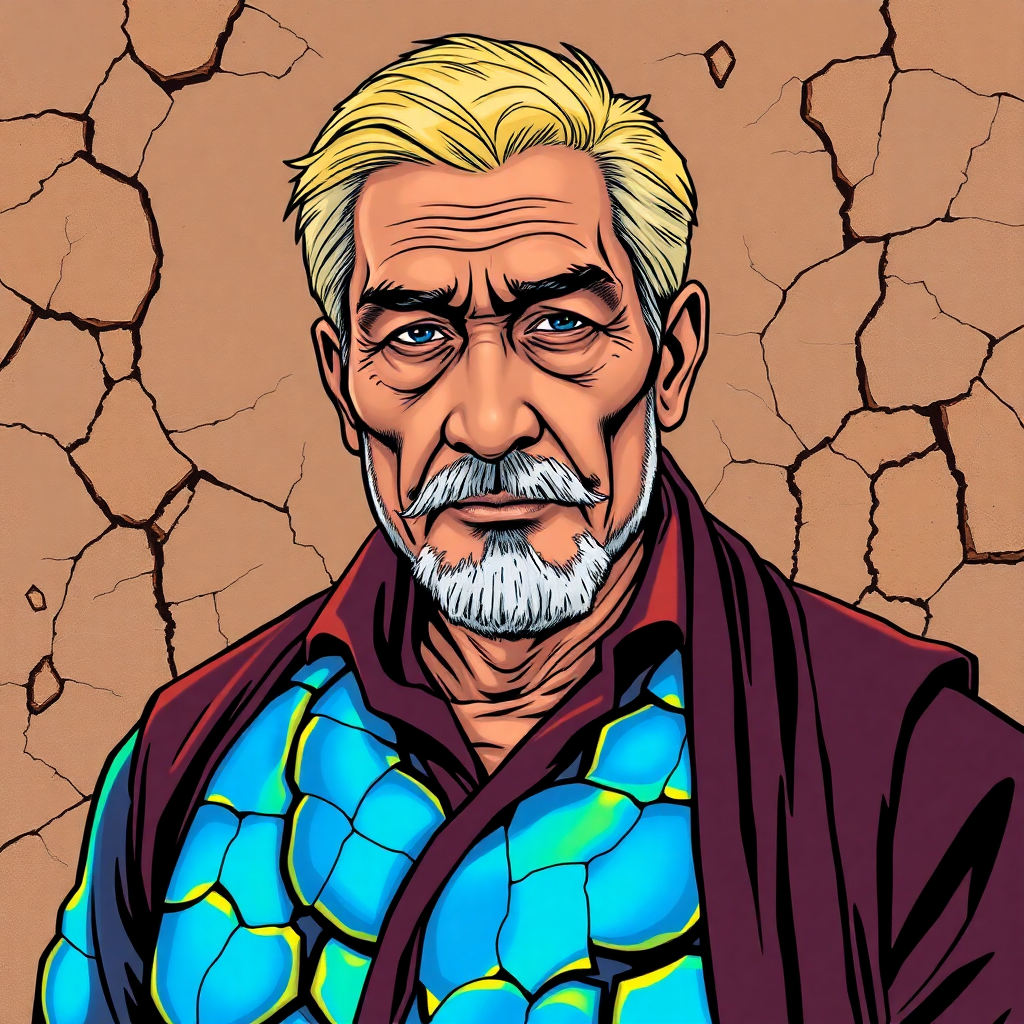
Rohan stood at the pavilion’s center, both palms flat on the load-bearing column, his iridescent chitin suit gleaming like a beetle under the morning sun, kinetic and thermal energy visibly radiating off him in slow bronze waves. He looked, Diane thought, exactly like a man delivering a very expensive invoice.
“Merritt-Calvo,” he said pleasantly. “You’re too late. Discharge begins in ninety seconds.”
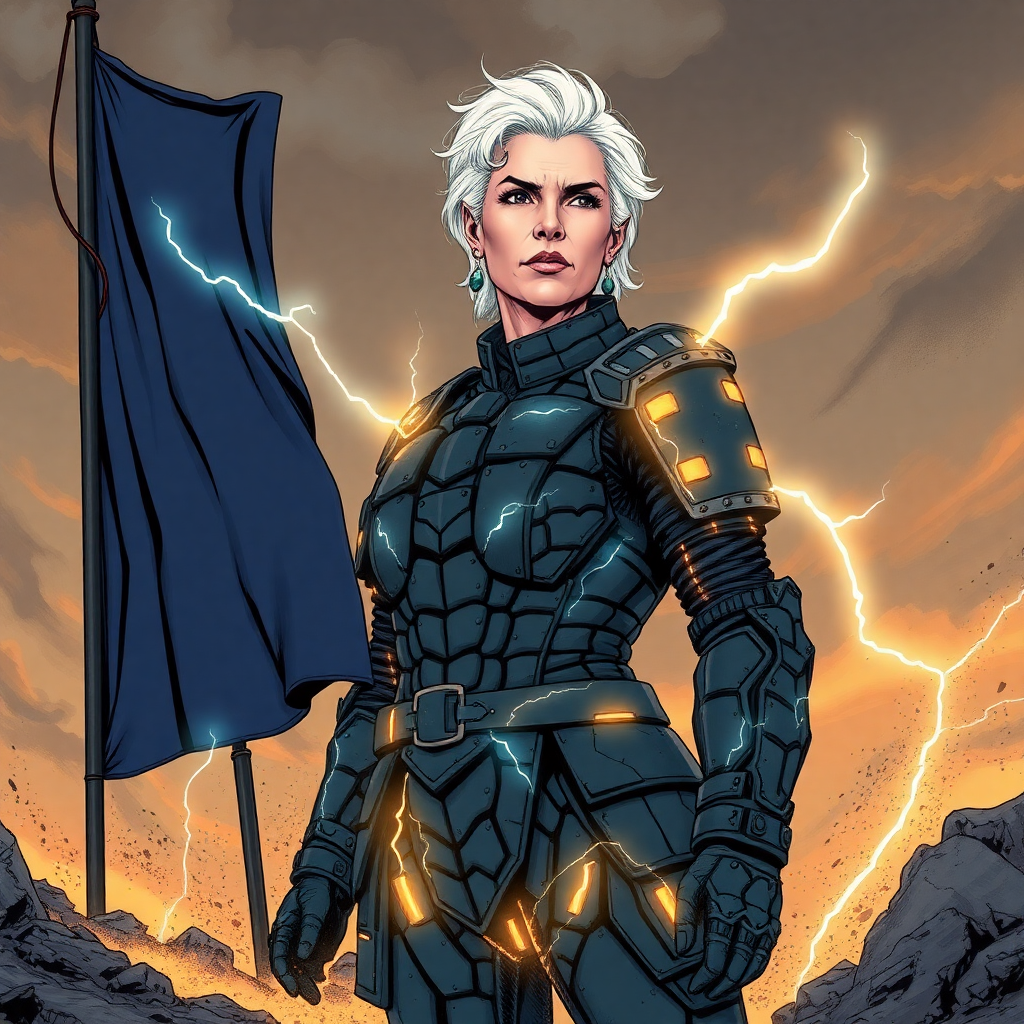
She raised both hands and let the EMP build — not the scattered pulse that had blown his documents into the Rahway, but the full controlled release she’d spent thirty days training herself to hold in sequence. The electric-white arcs climbed her volcanic basalt armor, crackling across every fissure and plate, fusing into a single coherent beam between her palms.
“The iron in these columns,” she said, “carries eighty years of magnetic memory from the Rahway’s banks. My clan put it there.”
She discharged into the pavilion’s iron lattice and the electromagnetic field inverted every stored thermal packet in every column simultaneously — the heat Rohan had spent weeks building went nowhere, locked in standing wave resonance, his kinetic absorption reflexes slamming into a field that simply had no movement to capture. The columns glowed white-blue, cracked their thermal load, and cooled in a cascade that took eleven seconds and blew every leaf off the pavilion’s perimeter oaks.
Rohan stumbled back. The chitin suit’s iridescence guttered, plates losing their oil-slick sheen, the absorbed energy dissipating outward in useless heat haze.
The Meridian field gauntlets discharged a second pulse — targeted, surgical — and the suit’s kinetic absorption matrix shattered across the pavilion’s flagstones in small, clicking pieces.
He sat down heavily on the pavilion bench. Fernanda moved her pamphlet out of his way without comment.
The Archives called back six minutes later. The patent was fine.
Part Five: The Resolution
Under the mutual recognition clause of the 1887 Essex County Clan Compact — a document Diane had personally re-catalogued in 2019 and never expected to actually use — Rohan Ashbourne-Vik was remanded to Clan Arbitration and stripped of active power by the Meridian Clan Elders’ binding resolution, his kinetic inheritance sealed pending tribunal review. He would not be absorbing anything stronger than a firm handshake for the foreseeable future.
The Flood’s Hill pavilion columns still radiated faint warmth on cold mornings, which the parks department attributed to “historic iron thermal mass” and added to the visitor brochure.
Fernanda Pereira submitted a formal complaint about the cinnamon roll cart. It was, she insisted, a zoning issue.
Diane filed it under Closed — Clan Action, made herself a coffee, and considered that one hundred and thirty-three years of vendetta had ended with a very small woman and a very large thermos, on a Tuesday, during Container Day.
Some legacies end in fire. The Meridians had always preferred electricity.
Sources
- Richie Moriarty Arrives on Set With Cinnamon Rolls
- Stewart Copeland Announces New Dates for “Have I Said Too Much” Tour
- Meet the City’s Most In-Demand Mohel
- Here are America’s most and least educated ZIP codes
- Possible cause revealed in ‘12- to 14-alarm’ warehouse fire in leafy NJ town that left police without power: ‘Staring into hell’
- Man arrested in NJ Chick-Fil-A mass shooting was on probation for gun charge
- The Next Shift: The Fall of Industry and the Rise of Health Care in Rust Belt America 9780674259836 - DOKUMEN.PUB
- Athlete of the Week – Nutley’s DeJianne has Raiders in first place
- Belleville boys volleyball starts 6-0, earns state ranking
- South Orange, New Jersey — Wikipedia
- South Orange Official Events Calendar
- U.S. Census Bureau, American Community Survey 5-Year Estimates (2022)