

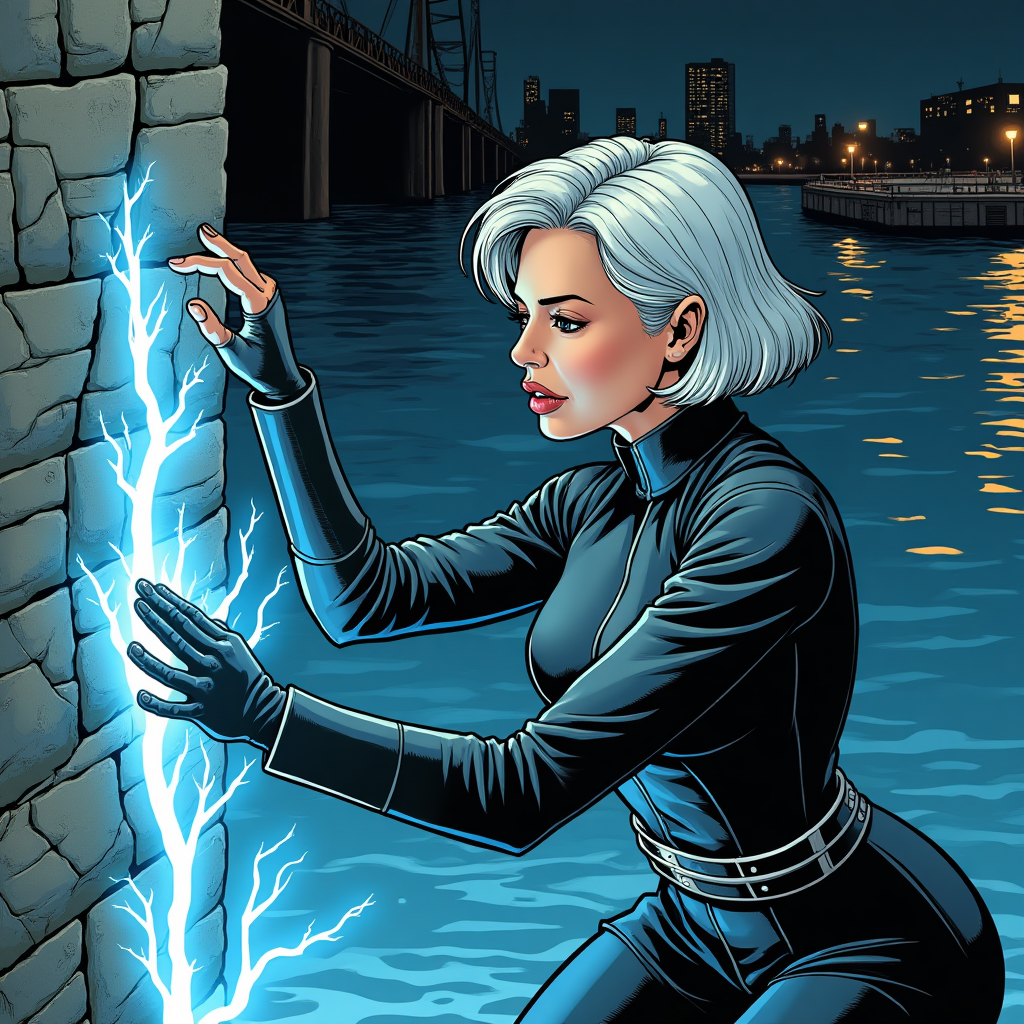

VELDRAN: The Architect of Erasure
Part One: The Woman Who Reads Cities Like Balance Sheets
Dr. Helen Kwon has never once mistaken a river for anything other than hydrology.
She is sixty-six years old, and she has spent forty of those years learning to see cities the way a surgeon sees a body on a table — not with sentiment, not with nostalgia, but with the cold, clarifying precision of someone who knows exactly which parts are failing and what it will cost to save them. She is compact and immaculate, with silver hair cut in a sharp geometric bob and dark eyes that move across a room the way a level moves across a surface: constantly, automatically, measuring. She wears charcoal field coats and Italian walking shoes and carries a tablet the way other people carry convictions. She has never been described as warm. She has been described, many times, as right.
She was born in Flushing, Queens, the only child of Korean immigrants who ran a garment export operation out of a converted warehouse on Kissena Boulevard. Her mother kept the books. Her father negotiated contracts in three languages. Helen watched them both with the focused intensity of a child who understands, before she has the vocabulary to name it, that the world is organized by people who understand systems and exploited by people who don’t. She got a civil engineering degree. She got an MBA. She got a decade of experience at a Northeast infrastructure consultancy that specialized in what the industry called transitional asset repositioning — which is to say, she learned how to turn dying industrial cities into something someone else would want.
She founded Veldran Meridian LLC eleven years ago, naming it for nothing in particular — a word she invented because it sounded like what she intended to become: a line running through the middle of things, orienting everything else by its position. The firm’s record speaks without ambiguity. Seven waterfront redevelopments. Four brownfield conversions. Eleven riverine infrastructure projects in eight states. In each case, she arrived in a city that was struggling, presented a plan that was logistically coherent and financially compelling, absorbed the political resistance with the patience of a long tide, and built. She has never lost a project she committed to.
She does not think of herself as a villain. She thinks of herself as the only adult in rooms full of people arguing about feelings.
When she files the permit application for the Passaic riverfront reclamation corridor in March, she genuinely believes she is offering the city a gift.
Part Two: The Logic of the Valley
The proposal is, by any technical measure, elegant.
The Passaic River’s bend near the old Third Street Bridge has been a municipal liability for decades — flood-prone, underlaid with century-old industrial seepage, ringed by wetlands that, while technically functional as filtration buffers, represent what Dr. Kwon’s environmental engineering team calculates as a recoverable land-use inefficiency of 4.2 acres in a city that has not seen significant private investment in thirty years. The luxury mixed-use development tower she proposes would generate $14 million in annual property tax revenue. It would create, by conservative estimate, four hundred permanent jobs. The rerouted river channel would be engineered to reduce flood-zone liability for three adjacent blocks of residential housing.
She presents this at a city council preliminary briefing on a Tuesday evening in late March, in a conference room on the third floor of Passaic City Hall, and she watches the faces of the seven council members with the practiced attention of a woman who has given this presentation, in variations, to two dozen municipal bodies. She knows the expressions: the skeptics who will eventually be convinced by the numbers, the pragmatists who are already convinced and are only waiting for political cover, and — there is always one — the true believer in the status quo, the person who will fight her not because the plan is flawed but because it represents change, and change in legacy cities is always experienced as loss before it is experienced as anything else.
She files the five-hundred-page environmental impact statement the next morning. She is meticulous. She is correct on every technical point. She is also, and she knows this and does not particularly care, demolishing the last natural filtration buffer for neighborhoods that have no political leverage to replace it.
What she does not account for — what no engineering firm, no geological survey, no environmental impact statement could have predicted — is that the Passaic River is about to start fighting back.
The seismic anomalies begin appearing in her survey data in early April. Small, inexplicable. Vibrations emanating from the retaining wall near the Third Street Bridge that match no construction activity, no transit corridor, no natural fault. She flags them. She hires a second survey firm. The readings persist. She begins to understand, in the clinical way she understands everything, that something is wrong with her model.
She does not yet understand that something is wrong with her.
Part Three: The Accident Below the Embankment
It happens on the night of April 15th, and it is entirely her fault.
Dr. Kwon has developed the habit, in the weeks since the anomalies began, of walking the embankment alone after dark. She tells herself it is a site assessment habit — that she is reading the terrain, cataloguing variables. The truth, which she would not admit to anyone, is that the river unsettles her in a way she cannot engineer away, and she has learned over six decades that the only cure for being unsettled by something is to walk directly toward it.
She is standing at the base of the old colonial-era seawall, tablet in one hand, when her foot slips on the wet stone and she goes down hard — not into the water, but against the wall itself, her bare palms flat against the ancient masonry as she catches herself. And in that instant of contact — both hands pressed to stone that has absorbed four centuries of current and industry and human weight — something passes through her that is not electricity and not heat but is, in some essential way, the opposite of what happened to Ernesto Villanueva on this same embankment the same night.
Where the river spoke to Ernesto in the language of memory and belonging and the long patience of place, it speaks to Helen Kwon in the language she has always used: systems, flows, pressures, the cold mathematics of water moving through stone. She receives the same frequency. She translates it differently. What Ernesto experiences as recognition, Helen experiences as information — a complete, overwhelming data transfer of the river’s infrastructure, its underground channels, its pressure points, its vulnerabilities. Every place where the old seawall is weak. Every subterranean water table intersection. Every fault line that a precisely calibrated force could exploit.
She also receives the full knowledge of what Ernesto Villanueva is becoming. The river, in its old and indifferent way, is not keeping secrets.
She collapses. She wakes cold and alone. The stars are out.
She sits on the embankment for a long time, processing. Then she opens her tablet and begins taking notes. Because Helen Kwon, when she receives new information, does not panic. She updates her model.
Part Four: The Arsenal of Angles
The power comes to her in the weeks that follow, and she receives it as she receives everything: systematically.
She can feel underground water flow through any surface she touches — not the warm, living connection that Ernesto has cultivated, but a precise hydraulic readout, exact as a gauge. She can apply targeted pressure to subterranean water tables, directing flow, increasing or relieving pressure at specific points. She can locate structural weak points in any foundation with a touch and, with sustained concentration, amplify the natural water seepage along those lines until the foundation begins to fail — slowly, deniably, in ways that look entirely like deferred maintenance and aging infrastructure. She can redirect underground channels to create controlled sinkholes. She can, in short, make buildings fall down in ways that no one would ever prove were anything other than the inevitable consequence of municipal neglect.
She does not use these abilities immediately. She is not impulsive. She is strategic.
What has shifted in Dr. Kwon is not her values — she is too old and too precise for a transformation of values — but her patience. She had been willing, before the embankment, to win through process: permits, variances, council votes, legal maneuvers. She is still willing to win that way. She simply now has a contingency for when process fails. And when she confirms, through her private geological survey data and the subsequent confrontation at the riverbank on the evening of April 16th, that the man standing between her and the Passaic riverfront reclamation corridor can generate seismic pulses through direct contact with stone and earth — she also understands, with the clarity of someone who has mapped his power’s source, exactly where he is vulnerable.
Pahsayèk draws his strength from connection to the river, from the living watershed, from the deep roots of place. Remove the roots — drain the wetlands, reroute the channel, sever the ancient continuity of the water table — and the source of his power goes with them.
Her plan is not to defeat him. Her plan is to make the ground beneath him disappear.
Part Five: Contingencies
She stands at the riverbank on a Thursday evening in mid-April and watches him work.
She has arrived early — two days before the legal close of the comment period, yes, technically a violation, but her attorneys have already drafted the procedural argument that will make the forty-eight-hour gap disappear in the relevant filings. The excavator is already biting into the seawall when the man in the dark river-green jacket appears at the top of the embankment, and she observes him with the focused attention she usually reserves for structural load calculations.
He is compact, broad-shouldered, silver-streaked, deliberate. He speaks with the cadence of a man who believes words are permanent. He presses his hands to the stone, and she watches the pulse move outward through the embankment the way she now watches all seismic events: not with fear, but with measurement. The excavator stalls. The ground opens beneath it. The construction zone floods from below, cold and fast and precisely targeted.
She grips her tablet. She watches the water rise.
“Seismic anomaly,” she says, and the words taste like a formula being confirmed. “I knew the readings were off.”
He tells her the land remembers. She does not argue the point. She files it, correctly, as a data point.
By morning, the injunction is in place. The project is paused. The affiliate cameras have filmed the flooded construction zone extensively and with great sympathy for the river and its guardian. The council members who were waiting for political cover have found it, and it is pointing the wrong direction. She is, by any conventional measure, losing.
She is already in the car, already on the phone with her attorneys, already constructing the second approach. Not the permit — that avenue is closed for now. The second approach is quieter and takes longer and begins not with machinery but with a series of small, deniable touches applied to three specific points along the underground water table beneath the Passaic Academy for Science and Engineering on Paulison Avenue, where a maintenance supervisor named Ernesto Villanueva spends his days keeping aging infrastructure in reverent working order.
The Academy’s boilers are old. Its basement walls are already cracked. Its foundation is built on colonial-era fill over a buried tributary of the original Acquackanonk watershed — a tributary that, with the right hydraulic pressure applied at the right junctions, will begin to migrate. Slowly. Imperceptibly. In ways that will look, to any inspector, like the inevitable consequence of a building that has not been properly funded for thirty years.
She is not going to fight the guardian on the riverbank. She is going to make the riverbank uninhabitable.
She presses two fingers lightly to the leather of the car seat as they pull away from the embankment, feeling the distant pulse of the water table three blocks away, confirming the pressure points she has already mapped. The river is old and patient. So is she.
Veldran is just getting started.