


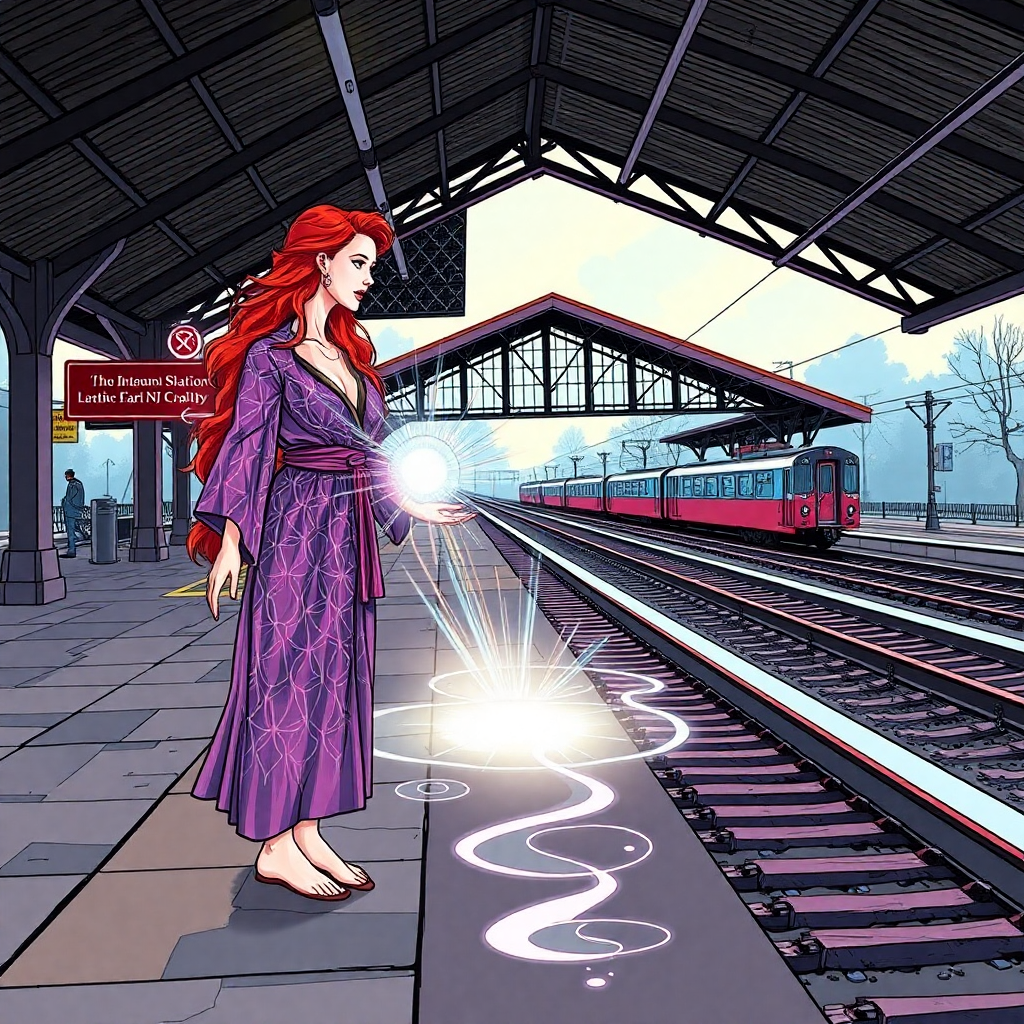
Part One: The Cold Open
The warehouse fire on Valley Street had been out for three days, but the runoff was still wrong.
Fiona Mercer noticed it the way she noticed everything lately — through her palms. She’d been cutting through Meadowland Park after her shift at the South Orange Free Clinic when her hands started buzzing: not the warm hum of a healthy nervous system, but something cold, grid-like, and deliberate. The storm drains along Scotland Road were flowing uphill. Not dramatically. Just enough that a person paying attention would think they were losing their mind. Fiona was not losing her mind. She was just very tired of being right.
Part Two: The Investigation
She followed the buzz to Mountain Station, where the NJ Transit platform was ankle-deep in water that had no business being there — the sky was clear, the Rahway River tributary was low, and the stationmaster was explaining it to three commuters with the haunted look of a man who had stopped asking questions.
Fiona pressed her palm to the platform railing. The bioelectric signature in the water was organized. Channeled. This wasn’t weather.
At the Baird Community Library, she found old Drum Corps Associates records that mentioned the Ashbourne name: a founding family of the old South Orange Stormwater Consortium, chartered in 1887 to manage runoff from the estates along Ridgewood Road. The Ashbournes had controlled every drainage easement in town for forty years. Then the Mercer Wellspring Clan — her clan, which she had learned about four months ago at the worst possible time, mid-flu shot — had rerouted a key channel through Meadowland, breaking their monopoly.
The Ashbourne records were meticulous. And someone had checked them out six weeks ago. She touched the library card sleeve. The bioelectric residue was fresh, expensive-cologne cold, and furious.
She knocked over an entire display of AAPI Heritage Month bookmarks on the way out. She did not stop.
Part Three: The Pivot
The warehouse fire. The power outage. The flooded station. It wasn’t chaos — it was preparation.
Darren Ashbourne was rerouting South Orange’s entire stormwater network beneath the surface, using the fire’s disrupted drainage infrastructure as cover. If he could overwhelm the Meadowland channel — the one her clan had diverted in 1887 — with enough controlled runoff, the original Ashbourne easements would legally and physically reassert themselves. Old deeds, old water. The grudge was exactly that old.
“Of course it’s the drainage rights,” Fiona said to no one. “It’s always the drainage rights.”
Part Four: The Reckoning
She found Darren Ashbourne in a tailored charcoal overcoat standing in the culvert beneath Sloan Street, directing sheets of channeled water with the practiced calm of a man closing a very complicated real estate deal. He was holding a leather ledger. He looked like he’d been expecting a lawyer, not her.
Ashbourne turned and the runoff surged — a wall of cold, directed water slamming toward her through the culvert. He didn’t raise his voice. He simply said, “The Mercer easement expires by morning,” and redirected a second channel to cut off her retreat.
Fiona flattened both palms against the culvert wall.
The bioelectric field in the water was enormous — but it had a nervous system, because he was in it, and nervous systems she could read. She felt the exact node where his concentration was anchored, a sharp cortisol spike behind his left shoulder, the tell of a man holding too many variables at once.
She pushed back — not with water, but with the counter-frequency of his own bioelectric signature, reflected and amplified through the standing water between them. The channels stuttered. Ashbourne’s ledger got very wet. He managed one deeply offended look before the culvert backfilled against his own redirected pressure and deposited him, sitting, in four inches of Rahway tributary at the base of the Sloan Street storm drain.
The water went flat. The drains resumed their proper direction.
Part Five: The Resolution
By morning the Mountain Station platform was dry, the Valley Street runoff had cleared, and three commuters told the stationmaster they’d had a very strange dream about hydrology.
The Ashbourne easement paperwork was, technically, still pending — Darren had managed to file it before the culvert incident, because of course he had.
Fiona filed a counter-claim on behalf of the Mercer Wellspring Clan, which mostly meant she found the right form on the Essex County website and her hands only buzzed a little.
The drainage rights of South Orange had been contested since 1887. They would, she suspected, still be contested in 1887 more years. She bought a coffee on South Orange Avenue and walked home through Meadowland, palms warm, drains running exactly where they should.
For now.
Sources
- Richie Moriarty Arrives on Set With Cinnamon Rolls
- Stewart Copeland Announces New Dates for “Have I Said Too Much” Tour
- Meet the City’s Most In-Demand Mohel
- Possible cause revealed in ‘12- to 14-alarm’ warehouse fire in leafy NJ town that left police without power: ‘Staring into hell’
- Man arrested in NJ Chick-Fil-A mass shooting was on probation for gun charge
- The Next Shift: The Fall of Industry and the Rise of Health Care in Rust Belt America 9780674259836 - DOKUMEN.PUB
- Athlete of the Week – Nutley’s DeJianne has Raiders in first place
- Belleville boys volleyball starts 6-0, earns state ranking
- South Orange, New Jersey — Wikipedia
- South Orange Official Events Calendar
- U.S. Census Bureau, American Community Survey 5-Year Estimates (2022)