


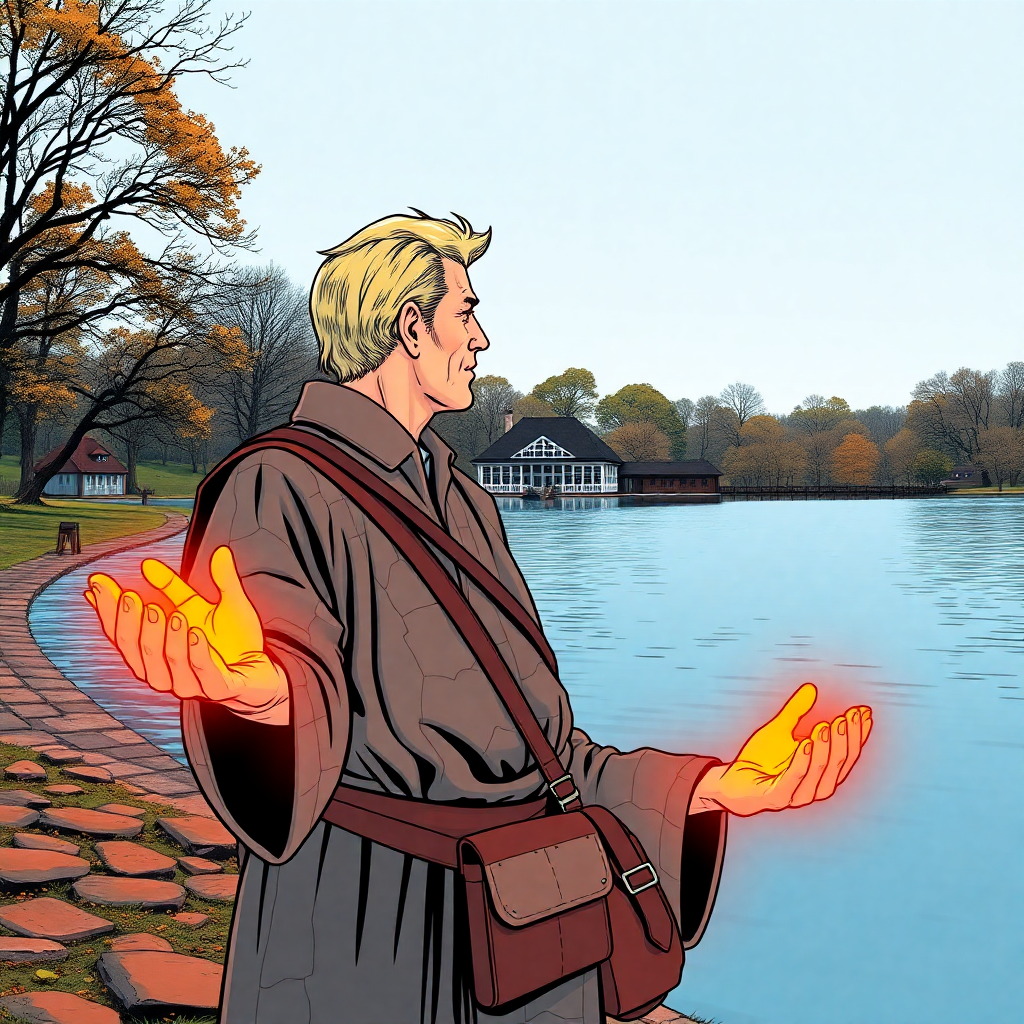
Part One: The Cold Open
The Black Skimmer survey tables had been set up on the banks of Carnegie Lake since dawn, and Dr. Edmund Forgewright was already regretting volunteering. He had seventy-two years of experience with bad decisions, and this one ranked somewhere between “agreed to referee the faculty squash tournament” and “opened that email from the Dean.” His clipboard was damp. His coffee was cold. And the citizen scientists around him were, one by one, quietly excusing themselves — wandering off the path, sitting on the grass, pressing their palms to their foreheads with the glazed expressions of people suddenly remembering every vitamin they had forgotten to take. The survey was collapsing. Someone had even abandoned their field binoculars mid-count, which Edmund found genuinely alarming. Citizen science was supposed to be the fun part of academia.
Part Two: The Investigation
Edmund followed the retreat. The afflicted volunteers were converging, inexplicably, on the far end of Lake Carnegie near the old rowing sheds — each one claiming a different ailment, all of them exhibiting nothing physically wrong. He recognized the pattern from an obscure addendum in the Ashvane Codex, a water-damaged notebook his grandmother had pressed into his hands with the words “you’ll know when.” The Codex described a practitioner who read bodies the way others read balance sheets: every inflammation, every cortisol spike, every suppressed creak in a knee — data, leverage, inventory.
He tracked the trail to the boathouse, passing a Princeton University grounds crew whose supervisor was inexplicably sitting on a wheelbarrow, convinced she had a heart murmur she’d never had before. The power was being used at volume, and sloppily — like someone running a diagnostic sweep rather than targeting. Edmund’s own palms began to glow faintly, volcanic orange seeping through the lines of his hands. Wrong moment, as usual. He shoved them into his jacket pockets before anyone looked up.
The Codex fell open in his satchel, unbidden, to a folded page dated 1893.
Part Three: The Pivot
The page described a patent dispute: the Forgewright Clan’s revolutionary kiln-compression process, stolen by a trading house called the Ashvane Concern and quietly sold to a Philadelphia manufacturer. The Ashvane family had since built a quiet empire on reading need — diagnosing what people wanted, what they feared, what they ached for, and selling that information back at a premium. Today the target wasn’t bodies. It was Carnegie Lake’s survey data: nesting coordinates for a Black Skimmer colony that sat, coincidentally, atop the last undeveloped lakeshore parcel in Princeton. If the birds could be shown to have “abandoned” the site — their surveyors all conveniently too ill to count — a development bid filed that afternoon would face no environmental objection.
Edmund looked at his glowing hands. Oh. Of course it’s the Ashvanes.
Part Four: The Reckoning
He found her at the boathouse dock — Deva Ashvane, late twenties, red hair pinned back, a leather-bound ledger open across her forearm, scanning the survey volunteers with the calm professional attention of a doctor who billed by the vulnerability. She looked up, unsurprised. “Dr. Forgewright. You’re presenting moderate hypertension and considerable irritation.”
“I am,” he said, and pressed both palms flat against the dock’s wooden planking.
The heat came up through the boards in a long amber wave — not explosive, but insistent, the way a kiln breathes when it has been patient long enough. The dock warped. The ledger’s leather spine began to smoke. Deva stepped back, reading his vitals even as she retreated, calling out numbers — elevated epinephrine, bilateral heat in the metacarpals, classic stress response — as if narrating his defeat would help her win. It did not. The heat spread to the survey dock’s instrument table, fusing the locking mechanism she’d attached to the data recorder. The morning’s corrupted counts were unrecoverable. But so were the manipulated ones.
She dropped the ledger into the lake and ran. The ledger sank. The survey volunteers, released from the empathic feedback loop, blinked and reached for their binoculars.
Part Five: The Resolution
By noon, seven Black Skimmers had been logged and the survey coordinator had rescheduled the count. The development bid, lacking environmental clearance, sat in a county office in Trenton going nowhere useful. Carnegie Lake glittered. A grounds crew supervisor told anyone who would listen that she had never felt healthier, which her doctor later confirmed was statistically improbable.
Edmund Forgewright updated his entry in the Ashvane Codex — new page, neat handwriting, current date — and noted that the Ashvane Concern had been running the same scheme for a hundred and thirty-three years, which at least showed brand consistency. The clan feud was, of course, nowhere near over. It never was. But the Black Skimmers were nesting, and that, for today, would have to be enough.
Sources
- 10 Comedy Shows That Will Keep You Hooked From Start to Finish
- ‘PILOT’ tax breaks have long spurred NJ development. Should they help schools, too?
- Vile NJ vanity plate appearing to target Trump yanked over a year after being approved: ‘This isn’t funny’
- A citizen scientist’s survey provides insights into the movements of Atlantic and Gulf states’ populations of Black Skimmers (Rynchops niger)
- House Dem frontrunner’s connections to ‘Blind Sheikh’ terrorist trial resurface and draw GOP fire
- The Battle at the Beach (N.J.) 2026 releases revised schedule
- Noom Names “Power of Habit” Author Charles Duhigg as Advisor, Releases New Research Linking GLP-1 Success to Habit Formation
- June 6: Cryptids and Paranormal Festival
- 10 Heaviest TV Episodes of the Last 10 Years, Ranked
- NJ-12 Progressive Candidate Forum
- Princeton, New Jersey — Wikipedia
- U.S. Census Bureau, American Community Survey 5-Year Estimates (2022)