


Part One: The Cold Open
The New Jersey Motor Vehicle Commission’s regional records annex on Witherspoon Street had been behaving strangely all morning. Three clerks had called in sick with vague complaints — joint aches, sudden migraines, a supervisor who kept insisting her hands had gone numb despite perfectly normal circulation. The backlog was enormous. The computers were fine. The people were not.
Edmund Forgewright arrived to renew a trailer registration for the kiln equipment he no longer owned, which was exactly the kind of errand his grandmother’s estate kept generating from beyond the grave. He noticed the pale faces behind the counters and felt the familiar low heat rise in his knuckles. This was not the flu.
Part Two: The Investigation
He crossed to Nassau Street and stood outside the wrought-iron gates of Princeton University’s main campus, letting the hum of the grid settle into his palms — transformers along Route 27 feeding the whole eastern corridor, the campus electrical infrastructure a vast slow pulse he could read like a heartbeat. Nothing wrong with the current. The wrongness was biological, not electrical. Which meant Ashvane.
Edmund spent forty minutes working his way through the university’s administration building on the far side of FitzRandolph Gate, following a thread of overheard conversations. A grants administrator had missed a filing window. A research compliance officer had been out three days with “exhaustion.” An archivist named Petra Vasquez — sharp, skeptical, the kind of woman who wrote everything down — flagged it for him: every absent staff member had recently handled files related to a new easement application for the land parcel east of Lake Carnegie.
“Same parcel,” Edmund said.
“Same parcel,” Petra confirmed, and handed him a folder of rejection notices, each stamped Insufficient Documentation — Survey Data Incomplete. “Someone is resubmitting. Third attempt.”
He touched a nearby lamp post, pulled a brief crackling charge through his fingertips, and said a word his grandmother would have disapproved of.
Part Three: The Pivot
The survey data Edmund had destroyed at Carnegie Lake in March had hurt Deva Ashvane’s timeline — but it hadn’t ended the bid. She’d simply moved the choke point upstream. The development filing needed a clean environmental certification and a clear administrative record, and if the county clerks and university compliance staff were too debilitated to process the counterfiling before Ashvane’s resubmission window closed at close of business Friday, the parcel would be approved on a technicality.
She wasn’t blocking the data anymore. She was blocking the people who could contest it. Of course. The Ashvane Concern had always been less interested in brute force than in making sure no one was healthy enough to stop them.
Edmund looked at the Friday deadline and then at his watch. It was Wednesday afternoon.
Part Four: The Reckoning
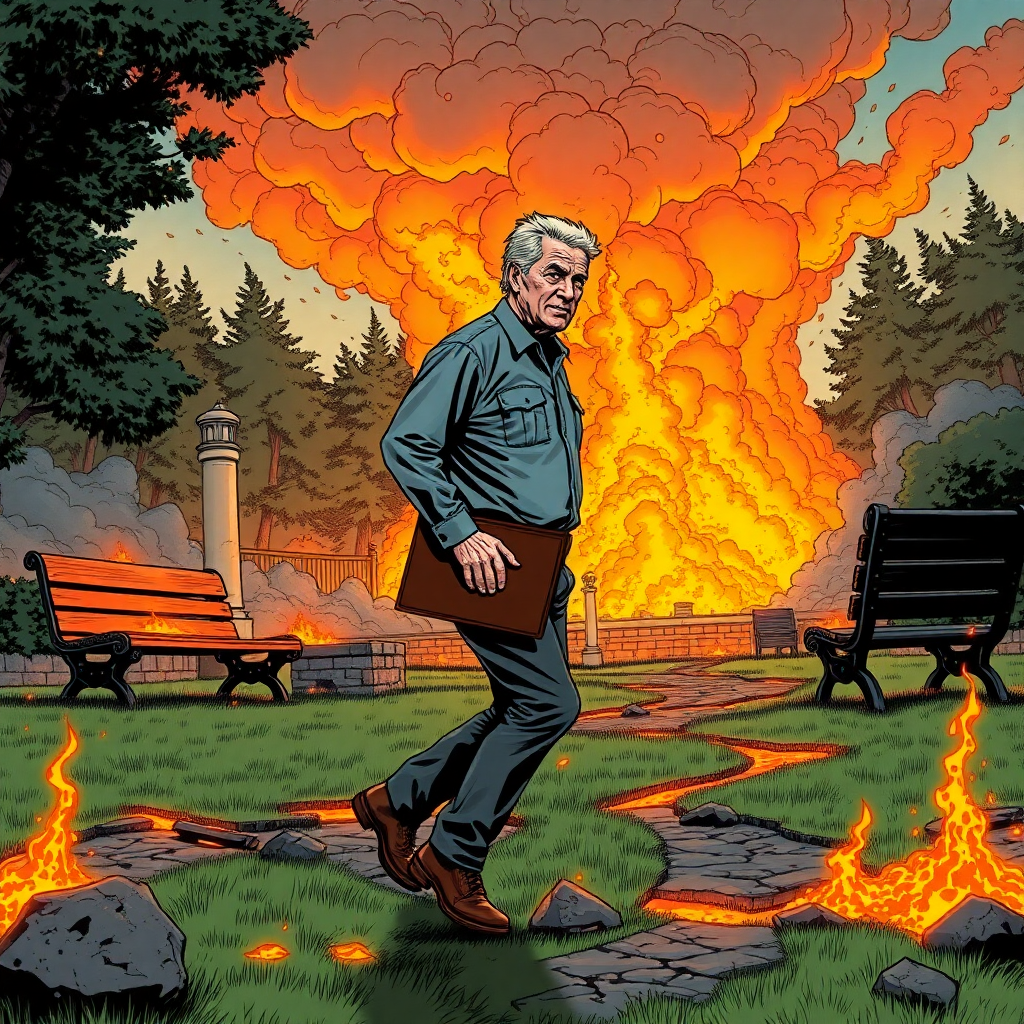
He found her at Marquand Park, which was not where he expected — but the old estate grounds made a certain grim sense. The canopy of ancient trees insulated the space from the grid’s ambient hum, and Deva Ashvane stood in the center of the open lawn with a leather portfolio under one arm and an expression of total professional calm.
Around her, three county attorneys she’d arranged to meet for an “informal review” sat on the park benches looking increasingly unwell. One had already stopped writing. Deva’s power worked at range now — Edmund could see the shimmer of it, a subtle iridescent distortion in the air around her that he’d learned to clock since March. She was reading their bodies and dialing specific systems down, precise as a thermostat.
Edmund pulled current from the park’s lamp circuit — old iron posts, still on the municipal grid — and sent a controlled arc across the lawn. The grass scorched in a line. The attorneys startled. Deva turned, and for a moment something passed across her face that might have been annoyance.
“Edmund.” She tilted her head. “You look tired.”
He felt it immediately: a sudden, drilling pressure behind his left eye, his grip on the lamp post circuit loosening as his nervous system stuttered under her attention. She’d been studying him since March. She knew exactly which frequencies made his concentration collapse.
He managed one broad pulse — forge heat blooming outward from his chest, scorching the grass in a wide radius, forcing her three steps back. Her portfolio flew open. Half the documents scattered.
But she didn’t run. She let the iridescent shimmer intensify, and Edmund’s vision swam. His left hand lost the circuit entirely. He went down on one knee on the scorched grass, teeth clenched, as Deva Ashvane collected her documents with unhurried precision.
“You destroyed eight months of work at the lake,” she said pleasantly. “This took eleven. I planned for you.”
She left him there, kneeling on the lawn, the lamp post cooling behind him, the county attorneys slowly recovering without any understanding of what had just happened.
Part Five: The Resolution
By Thursday morning the administrative resubmission had cleared. The easement was approved at close of business Friday. The lakeshore parcel east of Carnegie Lake was now subject to a pending development agreement, and the Black Skimmer colony — whose spring survey remained technically incomplete — had no formal protected status on the site.
Petra Vasquez left a voicemail for Edmund that he listened to three times. She’d found a procedural error in the easement language. Small. Possibly correctable at appeal.
Edmund sat in his truck on Witherspoon Street with the grid humming through the chassis and thought about his grandmother, who had also lost the first round.
She had not lost the second.
Sources
- 10 Comedy Shows That Will Keep You Hooked From Start to Finish
- ‘PILOT’ tax breaks have long spurred NJ development. Should they help schools, too?
- Vile NJ vanity plate appearing to target Trump yanked over a year after being approved: ‘This isn’t funny’
- A citizen scientist’s survey provides insights into the movements of Atlantic and Gulf states’ populations of Black Skimmers (Rynchops niger)
- House Dem frontrunner’s connections to ‘Blind Sheikh’ terrorist trial resurface and draw GOP fire
- The Battle at the Beach (N.J.) 2026 releases revised schedule
- Noom Names “Power of Habit” Author Charles Duhigg as Advisor, Releases New Research Linking GLP-1 Success to Habit Formation
- June 6: Cryptids and Paranormal Festival
- 10 Heaviest TV Episodes of the Last 10 Years, Ranked
- NJ-12 Progressive Candidate Forum
- Princeton, New Jersey — Wikipedia
- U.S. Census Bureau, American Community Survey 5-Year Estimates (2022)