


Part One: The Cold Open
The Bradford pears were behaving again.
Not blooming early this time — they’d been banned, finally, after decades of municipal suffering. The last of them were being cut down on Washington Street when a city work crew’s chainsaw seized mid-cut, the metal housing warping like taffy in the May morning air. The saw operator dropped it. The housing had reached 900 degrees Fahrenheit in eleven seconds. Nobody touched it for a long time.
Gus Lockshore was two blocks away at Dolores Vega’s newsstand when he felt it — a hot pressure gradient rolling off Washington Street like a furnace door left open. Dolores handed him his coffee without looking up. “She’s back,” she said.
Part Two: The Investigation
Gus followed the heat signature west on Third Street, the fissures in his robes burning blue-white in the shadow between buildings, the glacial glow of his pressure sense prickling against the thermal anomaly. It wasn’t dispersed the way it had been at the Terminal — focused, controlled, surgical.
The trail led to Stevens Park.
The park overlooked the Hudson River at the foot of Castle Point, the basalt bluff where Colonel John Stevens had planted his estate in 1784. Beneath it ran the oldest load-bearing stonework in Hoboken — retaining walls that dated to the Stevens family’s original land grading, which the Lockshores had maintained under pressure-engineering contracts for three generations. The walls held the bluff together. The bluff held the western edge of the city together.
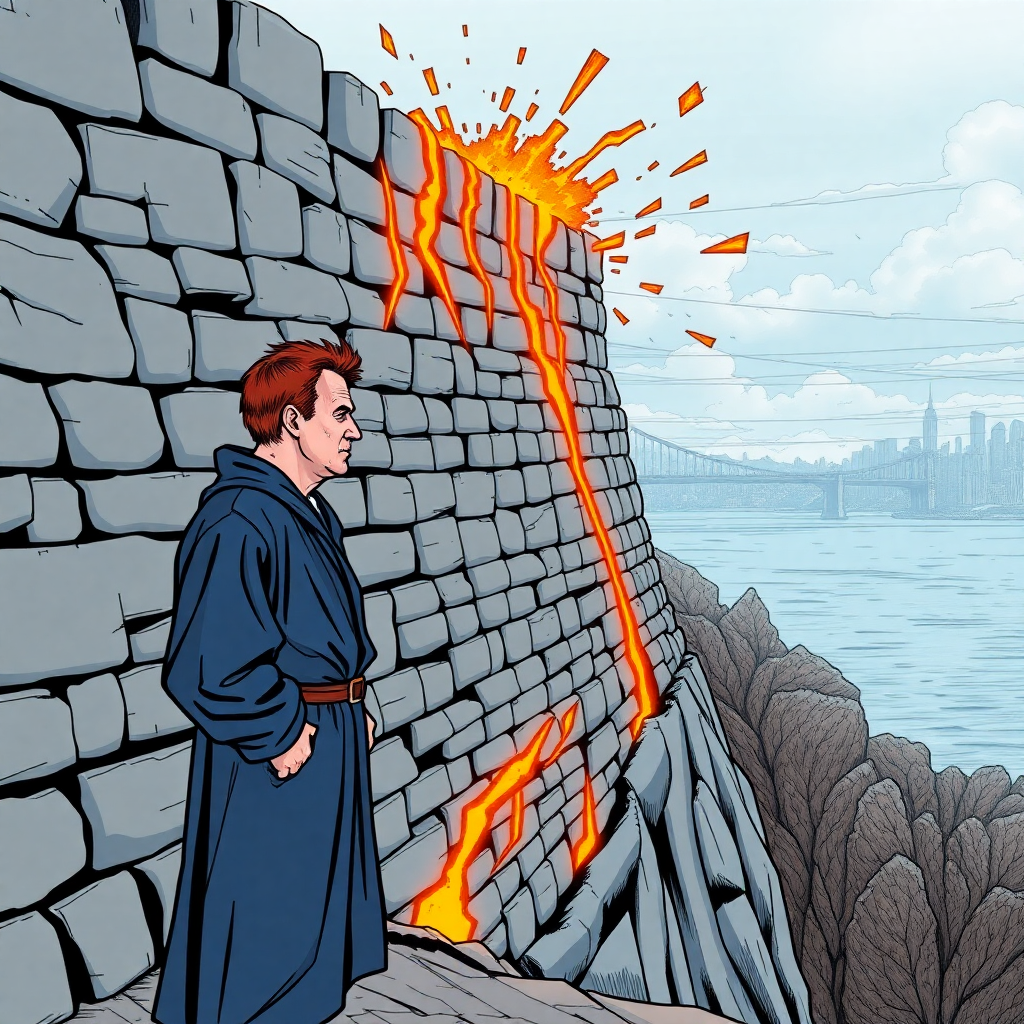
Mara Ashvane was standing at the base of the primary retaining wall with both palms flat against the stone, and the stone was glowing.
Part Three: The Pivot
The retaining wall. Of course.
The pressure-anchor at the Terminal was the Lockshores’ most famous patent, but it wasn’t the original work. The original contract — signed in 1891, two years before the patent dispute — had been the Castle Point Stabilization Agreement: Lockshore atmospheric compression applied to the Stevens-era stonework to counteract tidal erosion from below. The Ashvane Furnace Clan had submitted a competing thermal-expansion proposal for the same contract and lost it. That loss had come before the patent. That had been the first wound.
Mara wasn’t after the anchor this time. She was going to thermally fracture the retaining wall and let Castle Point begin to slide.
Part Four: The Reckoning
Gus hit her with a pressure front from forty yards, the kind of atmospheric compression that should have knocked a charging linebacker sideways. It hit Mara’s heat field and simply… stopped. She had been expecting him this time. The air around her was superheated to the point where his pressure wave dissipated on contact, the cold front vaporizing before it reached her hands.
She turned and smiled — she looked, Gus thought, like someone who had done their homework.
The wall cracked. A single seam, vertical, running from the base stones to the capstone. Gus pushed again, harder, pouring every millibar he had into a focused compression spike. Mara absorbed it, redirected it as convective heat back into the stone, and the crack widened. Chunks of 19th-century basalt facing fell into the grass. The Hudson glinted through the gap.
Gus got a partial freeze on the crack — just enough pressure to slow the thermal expansion — but his hands were shaking. He was 72 years old and she was 24 and she had come prepared. The next pulse she threw was the size of a blast furnace. It lifted him three feet off the ground and deposited him in the park’s ornamental shrubbery.
By the time he got up, Mara was gone. The crack in the retaining wall was eight inches wide and still warm to the touch.
Part Five: The Resolution
The city’s structural engineering team was on-site by noon. They classified the damage as a “seismic micro-event,” which was technically not a lie. The wall would need emergency underpinning — three weeks, minimum, with scaffolding blocking the park’s river view entirely.
Gus sat on a bench with Dolores, who had walked over with a second coffee she hadn’t asked him if he wanted. He took it without comment.
“She came prepared,” Dolores said.
“She studied,” Gus said. “The 1891 contract. I didn’t think anyone still had those records.”
Dolores said nothing for a moment. Then: “Someone gave them to her.”
Gus looked at the cracked wall, the glacial blue guttering low in the fissures of his robes. The clan feud was 135 years old and Mara Ashvane was winning on points.
Sources
- How boxing’s ‘Hammer Hands’ carries North Jersey grit into Vegas fight
- ‘PILOT’ tax breaks have long spurred NJ development. Should they help schools, too?
- Chris Troyano sets North Arlington hits record, tops 100 hit mark
- Quality of antenatal and delivery care and postnatal care use: A multi-country observational study of 400,000 births
- After holding its nose for decades, NJ finally bans stinky Bradford pear tree
- Athlete of the Week – Kearny’s Butler throws perfect game, gets three hits
- Owner of closed Jersey City hospital floats a return, but NJ officials are skeptical
- First Look: Jennifer Lopez and Brett Goldstein’s Netflix Rom-Com Sets a Summer Premiere Date
- Here are America’s most and least educated ZIP codes
- Possible cause revealed in ‘12- to 14-alarm’ warehouse fire in leafy NJ town that left police without power: ‘Staring into hell’
- Hoboken, New Jersey — Wikipedia
- U.S. Census Bureau, American Community Survey 5-Year Estimates (2022)